
Xiaomi announces a new HK$20 billion share buyback program—will the stock price get a boost?

Xiaomi has broken below HK$30 and remains weak; the risk-reward ratio for a rebound remains low until it reclaims HK$30.805.
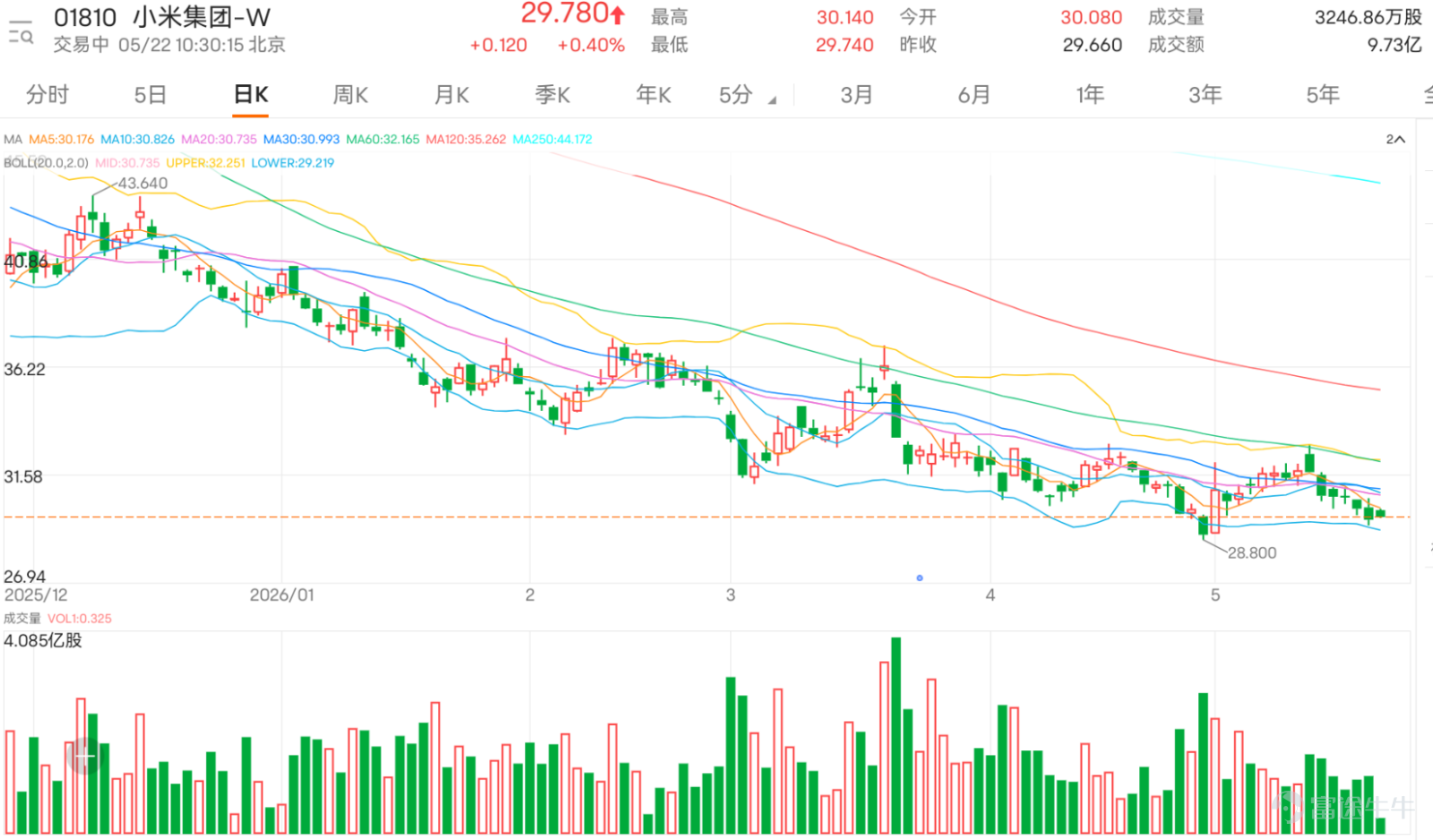
$XIAOMI-W (01810.HK)$ Currently trading at HK$29.760, up 0.34%. Today’s high reached HK$30.140 and the low hit HK$29.740. The most important signal today is that the stock failed to stabilize back above HK$30 and is now approaching the lower Bollinger Band, indicating that although there hasn’t been widespread panic selling on high volume, buying support remains insufficient. For short-term retail investors, the key question now isn’t simply whether the stock has fallen enough, but whether it can hold HK$29.420 and HK$29.344, followed by whether it can reclaim HK$30.200 and HK$30.805.
Technically, Xiaomi’s current price is below the 10-day moving average (MA) at HK$31.016, the 20-day MA at HK$30.805, and the 30-day MA at HK$31.046—all key short-term moving averages are above the current price. This indicates the stock remains under downward pressure from these MAs, with clear resistance to any rebound. Around HK$30.805 lies the 20-day MA and a short-term pivot point, while near HK$31 sits a cluster of resistance from the 10-day and 30-day MAs, forming a distinct overhead resistance zone. In other words, even if Xiaomi rebounds in the short term, the first target is merely to regain HK$30.200, followed by challenging the resistance zone between HK$30.805 and HK$31.046. Until this zone is reclaimed, the trend remains one of weak consolidation near lows rather than a genuine recovery.
Regarding Bollinger Bands, the middle band is at HK$30.805, the upper band at HK$32.266, and the lower band at HK$29.344. Xiaomi’s current price is already near the lower Bollinger Band, suggesting it is technically oversold and theoretically poised for a bounce. However, proximity to the lower band does not guarantee a bottom, as the price remains below key short-term moving averages and the Relative Strength Index (RSI) is still weak, with no clear signs of strength yet. If the levels of HK$29.420 and HK$29.344 hold, the stock may consolidate sideways before attempting a rebound; however, a break below HK$29.344 could extend the downtrend, with the next support level to watch at HK$28.800.
The Relative Strength Index (RSI) stands at approximately 23.706, reflecting weak short-term momentum. At this level, market sentiment often splits into two opposing views: some investors believe the stock has fallen sufficiently and, being near the lower Bollinger Band, presents a bounce opportunity; others, seeing the breach below HK$30, expect further declines toward HK$28, HK$25, or even lower. From a technical standpoint, a rebound is indeed possible at these lows—but for such a move to materialize, the stock must first hold above HK$29.344 and then break back above HK$30.200. If even HK$29.344 fails to hold, short-term weakness will likely deepen further.
In terms of trading volume, yesterday’s turnover was approximately 1.170684 billion shares, down from recent high-volume days, indicating a decline on shrinking volume. The fact that the price fell without a significant surge in volume suggests selling pressure hasn’t escalated into full-blown panic—this is somewhat better than a sharp drop on heavy volume. However, buying interest also remains inadequate, as the stock closed near its daily low and failed to push back above HK$30. To confirm a bottom, it would be ideal to see the stock hold above HK$29.344, then break above HK$30.200, and gradually challenge HK$30.805.
From key comments, market sentiment is clearly bearish, focusing on three price levels: HK$30, HK$29.5, and HK$28. Some investors doubt the stock will break below HK$29.5, while others are directly asking if it will reach HK$28—even lower targets like HK$28.8, HK$28, HK$25, HK$24, and HK$20 have been mentioned. This shows that after breaking below HK$30, retail investors’ psychological support levels have shifted significantly lower. HK$30 has now turned from support into the first resistance level on any rebound. If HK$30.200 isn’t reclaimed soon, market focus will likely shift further down to HK$29.344 and HK$28.800.
Bullish comments mainly reflect two sentiments. One is waiting for a more favorable entry price—some investors said they would place significant bets if the stock pulls back to an attractive level, while others noted that Xiaomi has declined less than other tech stocks and still shows some resilience. The other sentiment is that after multiple days of consecutive losses, the stock is nearing the lower Bollinger Band and could see a short-term rebound; some even anticipate a sharp rally soon. This view isn't entirely baseless: Xiaomi’s current price is close to the lower Bollinger Band, and its RSI is relatively low, indicating technical conditions for a bounce. However, having bounce conditions doesn’t confirm that a rebound has begun—it would at least require holding above HK$29.420 and HK$29.344, followed by a move back above HK$30.200, to signal initial recovery.
Bearish comments focus more on downside risks following the break below HK$30. Several investors mentioned targets at HK$28, HK$25, HK$24, or even lower levels; others believe the stock could continue falling after earnings results or product launches. While these comments shouldn’t all be treated as precise technical targets, they do reflect weak near-term market sentiment. Technically, the strongest bearish argument currently is that the stock has broken below key short-term moving averages, closed near its session low, and failed to hold above HK$30. If HK$29.344 is breached, bearish momentum will strengthen further, making HK$28.800 the next focal support level.
Comments expressing uncertainty or posing questions reveal anxiety among current holders. Some asked why the stock is plummeting so sharply; others said they haven’t taken profits and are now sitting on losses. Many referenced entry prices of HK$57, peak prices around HK$60, and the prolonged multi-day decline, while some questioned whether they should cut losses. These remarks indicate that Xiaomi’s pressure stems not just from today’s drop but from the earlier retreat from highs, which has clearly shaken the confidence of those who bought near peaks. Especially after breaking below HK$30, market sentiment can easily shift from 'waiting for a rebound' to 'worrying about the next support level.' For existing holders, the priority now isn’t fantasizing about an immediate return to highs but first watching whether HK$29.344 holds—if it does, the next focus becomes whether HK$30.805 can be reclaimed.
Common questions can be grouped into three categories. First, is Xiaomi cheap enough to buy now? Technically, the stock is near the lower Bollinger Band and does show bounce potential; however, the current price remains below key short-term moving averages and hasn’t yet stabilized above HK$30.805, leaving the risk-reward ratio only modestly favorable at best. Second, will it fall to HK$28? If HK$29.344 breaks, HK$28.800 becomes the next immediate support level, likely intensifying market discussion around the HK$28 area. Third, can it reclaim above HK$30? If HK$29.420 and HK$29.344 hold, the stock may first test HK$30.200; however, meaningful recovery hinges on overcoming the resistance zone between HK$30.805 and HK$31.046.
In terms of short-term strategy, it’s premature to rush into calling a bottom for Xiaomi. For long positions seeking a bounce, the first condition is that HK$29.420 and HK$29.344 hold firm; the second is a sustained move back above HK$30.200. Only if the stock reclaims HK$30.200 can we consider preliminary recovery underway; a clearer improvement in trend would require a breakout above the HK$30.805–HK$31.046 resistance zone. Conversely, if the price breaks below HK$29.344, weakness may persist, with attention shifting to HK$28.800 as the next key support. Should HK$28.800 also fail, market speculation about even lower levels will likely intensify.
Overall, after Xiaomi broke below HK$30, all key short-term moving averages now sit above the current price. Although the area near the lower Bollinger Band offers technical support, buying interest remains insufficiently strong. On the comment front, bullish traders are waiting to accumulate at lower levels or play a technical rebound, bearish traders are focused on downside targets at HK$28, HK$25, and even lower, while neutral observers are most concerned about whether to cut losses, when the bottom will form, and whether the stock will fall further after upcoming product launches or earnings reports. Technically, HK$29.420–HK$29.344 serves as the near-term defense zone, HK$30.200 is the initial recovery level, and HK$30.805–HK$31.046 constitutes the main resistance zone. Until Xiaomi regains HK$30.805, it remains in a weak, consolidating state; if it breaks below HK$29.344, the next support level to watch is HK$28.800.
Key trading levels: HK$29.420–HK$29.344 is the short-term support zone—holding above this range allows for a tactical play on a technical rebound. A move above HK$30.200 would establish preliminary recovery conditions, with the next target at HK$30.805–HK$31.046. If the price breaks below HK$29.344, weakness may persist, with initial support then seen at HK$28.800.

Strategy 1 | Play a short-term rebound after holding above HK$29.344
$UBXIAMI@EC2709A.C (28811.HK)$ | Strike price HK$32.88 | Effective leverage 3.1x | Strike price is closer to the upper recovery zone, suitable for playing a modest rebound toward HK$30.200 with lower leverage after the stock holds the lower Bollinger Band.
$CIXIAMI@EC2710A.C (28818.HK)$ | Strike price HK$33.88 | Effective leverage 3.1x | Suited for a more conservative rebound play—the key is to wait for the stock to stabilize above HK$29.344 before capturing upside movement toward the HK$30+ recovery zone.
$UBXIAMI@EC2712A.C (25395.HK)$ | Strike price HK$35.90 | Effective leverage 3.0x | Longer time to expiry, ideal for those seeking rebound exposure without being overly sensitive to short-term volatility; if the stock merely trades sideways at low levels, holding pressure is relatively low.
Strategy 2 | Chase recovery after breaking above HK$30.200
$UBXIAMI@EC2609E.C (28195.HK)$ | Strike price HK$37.01 | Effective leverage 8.1x | Higher leverage, suitable for aggressively chasing a short-term recovery once the price clearly breaks above HK$30.200, targeting upward momentum toward the HK$30.805–HK$31.046 resistance zone.
$HSXIAMI@EC2609E.C (28627.HK)$ | Strike price HK$37.01 | Effective leverage 8.0x | Suitable for follow-through entries after a breakout; the product offers strong elasticity, but positions should not be held too long if the price fails to stabilize above HK$30.805.
$UBXIAMI@EC2612A.C (13135.HK)$ | Strike price HK$37.15 | Effective leverage 5.7x | Moderate leverage, suitable for bullish positioning after the stock breaks above HK$30.200 to capture a rebound—not ideal for bottom-fishing at current lows.
Strategy 3 | Turn bearish if price falls below HK$29.344
$UBXIAMI@EP2608A.P (26121.HK)$ | Strike price HK$28.16 | Effective leverage 6.5x | Strike price near key support zone below; suitable for capturing downside momentum toward ~HK$28.800 after a break below HK$29.344.
$MSXIAMI@EP2608A.P (26086.HK)$ | Strike price HK$28.16 | Effective leverage 6.7x | Slightly higher leverage, suitable for short-term bearish trades after a breakdown; avoid premature positioning if price holds above support.
$BPXIAMI@EP2609A.P (26247.HK)$ | Strike price HK$28.20 | Effective leverage 6.3x | Suitable for bearish continuation after breaking below HK$29.344, offering strong downside elasticity—primarily used to capture sustained weakness, not for sideways markets.
Reply to investor inquiries
@EVE-: Avoid unfounded speculation on the sharp drop. From a purely technical perspective, Xiaomi has broken below key short-term moving averages and is approaching the lower Bollinger Band.
@日日月月年年高升: The steep decline is understandable as the stock closed near its session low. Technically, it remains weak until it reclaims HK$30.805.
@買港股等破產: It’s impossible to predict whether new lows will occur post-launch event. Technically, if HK$29.344 is breached, weakness is likely to persist.
@26278593: HK$24 is not currently supported by near-term technical levels. Watch HK$28.800 as the immediate short-term support.
@@同錢有關係: If planning to keep averaging in, pay close attention to your position-sizing rhythm. Risk remains elevated for ‘buying the dip’ strategies until the stock reclaims HK$30.805.
Feel free to share your insights in the comment section. For more market analysis, please continue following ‘Hong Kong Stock Warrants Jenny’ for daily updates!
Reminder: This article does not constitute any investment advice.
This article is for reference only and does not constitute any investment advice. Market data, opinions, and analysis contained herein may change at any time without prior notice. We are not responsible for any loss or damage caused by reliance on the information in this article. Technical analysis only shows whether certain technical conditions are met; asset performance should be comprehensively evaluated using other sources of information, and trading decisions should not be made solely based on this article. Please note that past performance is not indicative of future results.
#HKStocks #RealTimeAnalysis #WarrantPicks #WarrantStrategies #DerivativesHedging #HKWarrantsJenny #Xiaomi #09988 #BlueChips #TechnicalAnalysis $Hang Seng Index (800000.HK)$$Hang Seng TECH Index (800700.HK)$
Risk Disclaimer: The above content only represents the author's view. It does not represent any position or investment advice of Futu. Futu makes no representation or warranty.Read more

Comments (2)
to post a comment
5