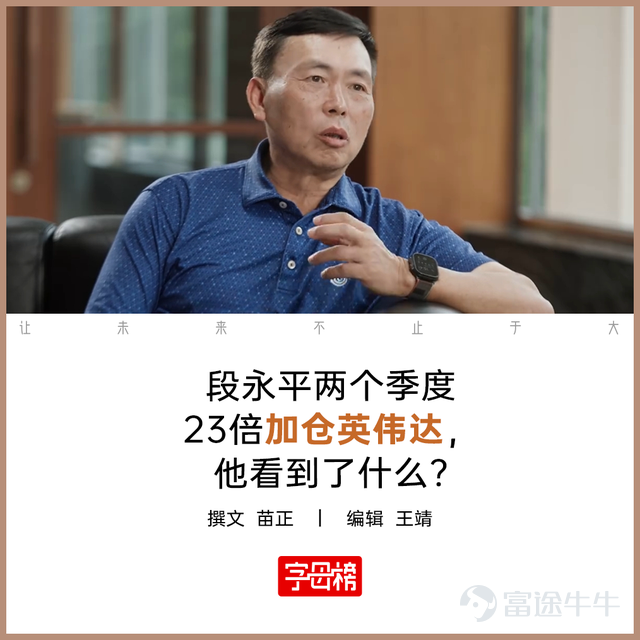

Duan Yongping Reassesses NVIDIA

Duan Yongping has long been known for his principle of 'never invest in what you don’t understand.'
His firm, H&H International Investment, held 964,800 shares of NVIDIA as of Q2 2025, which decreased to 597,800 shares in Q3—a reduction of approximately 38%.
However, H&H then rapidly increased its NVIDIA position: by Q4 2025, its stake had grown to 7,237,100 shares, a 1,110.62% increase quarter-over-quarter. According to its latest 13F filing for Q1 2026, NVIDIA holdings further rose to 13,843,800 shares, up another 91.29% from the prior quarter.
In just two quarters, the holding surged from 597,800 shares to 13,843,800 shares—roughly a 23-fold increase.
As of the end of Q1 2026, NVIDIA’s market value in the portfolio stood at approximately $2.414 billion, accounting for about 12.07% of H&H’s 13F-reported U.S. equity portfolio, making it the third-largest holding.
And that’s not all—the 13F filing also revealed that in Q4 2025, H&H initiated new positions in three AI supply chain companies: CoreWeave (an AI computing cloud provider, 299,900 shares), Credo Technology (optical interconnect chips, 141,300 shares), and Tempus AI (healthcare AI, 110,000 shares), covering compute infrastructure, connectivity, and applications.
By Q1 2026, CoreWeave had been fully sold out, Credo Technology was increased to 751,200 shares, and Tempus AI was reduced to 20,000 shares.
This indicates one thing: after gaining a deeper understanding of NVIDIA, Duan Yongping developed a new perspective on the entire AI infrastructure ecosystem.
Nonetheless, in H&H’s Q1 2026 13F filing, Apple remained the top holding at approximately 36.72%, followed by Berkshire Hathaway Class B shares at around 21.91%. NVIDIA jumped to become the third-largest holding, with a market value of approximately $2.414 billion, representing about 12.07% of the portfolio.
As recently as last year, NVIDIA was merely viewed by Duan Yongping as a 'chip stock.'
What is a semiconductor stock? It’s the quintessential highly cyclical industry, characterized by strong cyclical volatility combined with long-term spiral growth, completing one full cycle roughly every three to four years.
In the past, NVIDIA—whose core business was gaming GPUs—was indeed a semiconductor stock. But today, capital markets view NVIDIA as an infrastructure stock.
No AI company can operate without NVIDIA, because the race is no longer about algorithms—it’s all about computing power.
“How many H200s does your company have? How else could you afford to write such a bold model technical report?”
Duan Yongping, often called 'China’s Buffett,' has undergone a shift in his perception of NVIDIA similar to how Buffett later re-evaluated Apple. Initially, Buffett viewed Apple as a tech stock—and since he never invested in tech stocks, he missed out on Apple during its early rise.
Later, Buffett began treating Apple as a consumer stock, leading to what became the most successful single equity investment in the history of investing.
The total cumulative return exceeded $150 billion, with an annualized compound return of 28.3%—far surpassing the S&P 500’s同期 return of 13.9%. Of this, approximately $125 billion represents realized gains, around $46 billion is unrealized paper profit, and dividends received total about $9.3 billion.
So what prompted Duan Yongping to reassess NVIDIA?
A
Companies Duan Yongping has historically favored typically share several common traits: enduring demand, strong branding or ecosystem, excellent management, and pricing power.
These companies generally weather economic cycles and consistently generate cash flow.
In Duan Yongping's view, 'buying a stock is buying a business.'
Therefore, you must clearly understand the company's business model to grasp its future cash flows and the underlying industry dynamics.
In a Xueqiu interview in November 2025, Duan Yongping explicitly stated that the changes brought by AI are beyond imagination. He said AI has climbed ten thousand steps—it’s hard to imagine what the world will look like in ten years, but the transformation could be even greater than that of the past 10, 20, or even 40 years.
This judgment is crucial. It means Duan Yongping no longer sees AI as just another ordinary technological upgrade, but rather as a paradigm shift on the scale of an industrial revolution. In such a shift, whoever controls the infrastructure holds the power of influence.
Duan Yongping believes NVIDIA's moat is far harder to replicate than the market imagines.
AMD, custom ASICs, and cloud providers’ in-house chips are all competing in the AI chip space, but NVIDIA’s advantage lies not only in superior performance but also in its entire CUDA ecosystem.
Around CUDA, developers, model frameworks, enterprise deployments, supply chains, network interconnects, and software compatibility have already formed a complete closed loop.
On October 16, 2025, during an exclusive interview with Fang Sanwen, founder of Xueqiu, Duan Yongping explained NVIDIA’s ecosystem barrier in this way.
‘I used to think it was highly volatile, but later realized it’s truly impressive—their ecosystem is genuinely strong. Look at NVIDIA’s collaboration with OpenAI versus AMD’s collaboration with OpenAI. From these two deals, you can see just how dominant NVIDIA really is.’
‘NVIDIA invests $100 billion—but gives you its chips and takes equity in return. AMD says, “I’ll give you chips and equity—please, just use me.” Now do you see the difference?’
One has customers clamoring for its products, willing to trade equity for chips; the other is practically paying people to use them.
He further noted that NVIDIA's CUDA platform has established a monopoly akin to that of an operating system.
AI companies can’t even write code without CUDA, and alternative technologies from tech giants—such as TPUs—pose limited short-term threats. Despite its lofty valuation, the current supply shortage and strong ecosystem lock-in have firmly cemented NVIDIA’s role as the ‘pick-and-shovel seller’ of the AI boom.
As previously mentioned, Apple remains Duan Yongping’s largest holding, so his gradual accumulation of NVIDIA shares appears as if he has identified a new engine with very high odds of success over the next decade.
Duan Yongping remarked, 'Apple is indeed still impressive, but its growth may not be as rapid as it once was.'

Duan Yongping also believes that 'AI will likely bring about even greater changes than the internet did, and probably even more than the Industrial Revolution.'
Apple is already a mature consumer goods company whose growth curve has entered a plateau phase. In contrast, NVIDIA stands at the very beginning of the AI wave, with enormous growth potential ahead.
Beyond corporate and industry fundamentals, Jensen Huang’s personal charisma is another reason Duan Yongping has heavily invested in NVIDIA.
In an interview, Duan Yongping said, 'I’ve watched many videos of Jensen Huang, and I deeply admire him. What he talked about over a decade ago aligns closely with what he says today—he saw it coming long ago and has been steadily working toward that vision. So now, when he speaks, you can’t help but believe he’s still articulating a credible view of the future.'
His investment in Apple stemmed largely from his admiration for Steve Jobs’ and Tim Cook’s relentless pursuit of product excellence. His investment in Kweichow Moutai reflects his appreciation for the company’s corporate culture and long-term philosophy. Now, his significant position in NVIDIA clearly shows he sees many admirable qualities in Jensen Huang as well.
In March 2026, Duan Yongping also said, 'Jensen Huang clearly understands AI better than I do. If you don’t trust him, there’s no need to go around asking people who understand it even less than he does!'
B
Looking back, Duan Yongping’s attitude toward AI and NVIDIA has undergone a clear transformation.
Prior to 2025, Duan Yongping was very cautious about investing in semiconductors.
Even when NVIDIA was at the peak of its success, Duan Yongping repeatedly stated that he 'didn’t understand' the industry NVIDIA operated in, viewing semiconductors as a 'highly volatile' sector that fell outside his circle of competence.
At the time, he remarked, 'I still don’t fully grasp AI,' and believed that one should 'at least get involved a bit, so as not to miss out.'
So he took a small, exploratory position—using a modest stake to test the waters, a common approach he employs to learn about new industries. However, he reduced his holdings just one quarter later.
Later, through firsthand experience with AI tools, Duan Yongping’s perspective on AI began to shift.
In a September 2025 post on Xueqiu, he wrote, 'AI is an unavoidable topic! Put simply, AI isn’t really “anything special”—it’s essentially what we’ve always referred to as computer applications. But AI is the product of dramatically increased computing power; philosophically speaking, it’s a classic case of “quantitative change leading to qualitative change!”'
He gave himself as an example, saying that in the past, researching a new company would take him several days of poring over financial statements, news articles, and various reports. Now? He just asks an AI—and within minutes, gets a clear and comprehensive overview.
He also remarked that nowadays, even when watching an animated show, it’s hard to tell whether it’s performed by real actors or generated by AI.
"The more I use this thing, the more fascinating it becomes—it feels like the world is changing a bit," said Duan Yongping about AI.

This kind of cognitive shock from firsthand experience is far more convincing than any research report.
Perhaps precisely because he used those magical AI tools, Duan Yongping joined us in becoming followers of Jensen Huang.
On the broader outlook for AI, Duan Yongping believes it is undoubtedly an industrial revolution, though bubbles inevitably accompany such transformations.
Despite this, he remains skeptical about the commercial prospects of most large model companies.
In April 2026, Duan Yongping stated, "Aside from Gemini, which other large models have gone public? Aside from Gemini, which large model will survive to see the next decade? I don’t understand the business model of large models."
"There are many large models on the market right now, but the probability that more than 10% will survive the next decade is low—so this is a game where nine out of ten will fail (this is my guess)."
In other words, Duan Yongping is bullish on AI as a broad trend and on NVIDIA—the 'shovel seller'—but not on most large model companies.
His reasoning is that large model companies lack a clear path to profitability, the competitive landscape remains unstable, and most will ultimately run out of cash.
At the beginning of 2026, Duan Yongping said, "In the new year, I need to seriously study how to use AI. I hope that one day I’ll understand it well enough to make bold bets. The more I use AI, the more interesting it becomes—it feels like the world is changing. It’s hard to imagine what the world will look like in 10 years, but the changes could be greater than those of the past 10, 20, or even 40 years."
From 'not understanding it' to 'testing with a small position,' and then to 'going all-in,' Duan Yongping took less than a year to fully grasp NVIDIA.
C
Known as 'China's Buffett,' Duan Yongping’s investment pivot in the AI era mirrors Buffett’s rationale for investing in Apple.
Before 2016, Buffett adhered to a principle of 'not investing in tech stocks,' believing the tech sector changed too rapidly and lacked stable moats.
This caused him to miss out on tech giants like Google and Amazon.
In 2016, prompted by Berkshire’s investment managers, Buffett began building a position in Apple and continued adding to it over the following years, eventually making Apple the single largest holding in Berkshire’s history—accounting for nearly 40% of its portfolio.
Buffett’s core rationale for investing in Apple was redefining it as a 'consumer products company.'
He repeatedly emphasized that, in his view, Apple is a 'consumer products company' with a powerful economic moat. The iPhone is an 'electronic addictive product,' with user stickiness comparable to 'chewing gum.' The closed nature of the iOS ecosystem, brand loyalty (with user retention exceeding 90%), and consistent cash flow together form its 'economic moat.'
When Buffett first entered the position, Apple’s valuation wasn’t high; the market worried iPhone growth had peaked. However, the company still possessed strong free cash flow, a massive user base, and consistent share repurchase capacity—all aligning with Buffett’s principle of 'buying wonderful businesses at fair prices.'
Moreover, Buffett greatly admired Steve Jobs’ and Tim Cook’s unique understanding of product experience.
This is why this investment has been hailed as 'the most successful single stock investment in the history of investing.'

Duan Yongping’s investment logic in NVIDIA is similar to Buffett’s investment in Apple.
Both initially misjudged the situation but corrected course promptly. They also both place strong emphasis on the company's ecosystem moat and express confidence in top management.
Another key point is that both only made significant investments after they truly 'understood' the business.
Buffett admitted he 'doesn’t even know how to use an iPhone,' but he grasped Apple’s value by studying its business model and financial data. Similarly, Duan Yongping went through a journey from 'not understanding' to personally using AI tools and analyzing NVIDIA’s ecosystem barriers before making a major investment increase in Q4 2025.
At age 95, Buffett still insists in 2026 on 'not investing in AI algorithm companies,' saying he 'can’t learn new industries.' Berkshire has explicitly stated it 'won’t adopt AI just for the sake of AI' and avoids pure concept stocks.
By contrast, 65-year-old Duan Yongping is willing to personally use AI tools, watch Jensen Huang’s presentations, and study NVIDIA’s collaboration model with OpenAI.
Actually, there’s another interesting detail in the 13F filing: Duan Yongping has bought Tesla.
In Q1 2026, H&H established a new position in Tesla with 3.4089 million shares, valued at approximately $1.267 billion at quarter-end.
In fact, Duan Yongping previously wasn’t particularly fond of the brand. When discussing Tesla in the past, he noted that investing essentially means becoming friends with a company’s management—and he didn’t particularly like Elon Musk’s character, saying, 'I wouldn’t want to be friends with him, even if he paid me.'
He also believes the EV business is extremely challenging, with differentiation hard to achieve, and ultimately most EV companies will fail.
But later, after Duan Yongping bought a Model Y, he said that FSD really works well and that driving the Model Y isn't uncomfortable at all—now driving a Tesla has become his top choice.
Regarding Elon Musk himself, he said his views haven’t changed much—he still dislikes the things he never liked. However, he also acknowledged that many of the things Musk has built initially sounded like they were just hype, yet actually came to fruition a decade or so later.
Taking a large position in NVIDIA might just be the beginning; one thing is undeniable: traditional value investing is being reshaped by AI. $NVIDIA (NVDA.US)$$GraniteShares 2x Long NVDA Daily ETF (NVDL.US)$$GraniteShares 2x Short NVDA Daily ETF (NVD.US)$$NVIDIA Portfolio (LIST20882.US)$$Virtual Reality (LIST2139.US)$$Apple (AAPL.US)$$Duan Yongping chicang gainian (LIST2116.US)$$Tesla (TSLA.US)$$Tesla (LIST0426.SH)$
Risk Disclaimer: The above content only represents the author's view. It does not represent any position or investment advice of Futu. Futu makes no representation or warranty.Read more
Comments
to post a comment
1