English
Back
Open Account
AI Boom vs. Tight Liquidity: Will the US Stock Rally Continue?
Futubull Options Sir
joined discussion · May 19 18:31 ·

Options Sir Breaks Down the Hot Topic | Earnings Beat Expectations + Valuation Rebounds from Lows: Is It Time for a 'Davis Double Play' in AI Application Software?

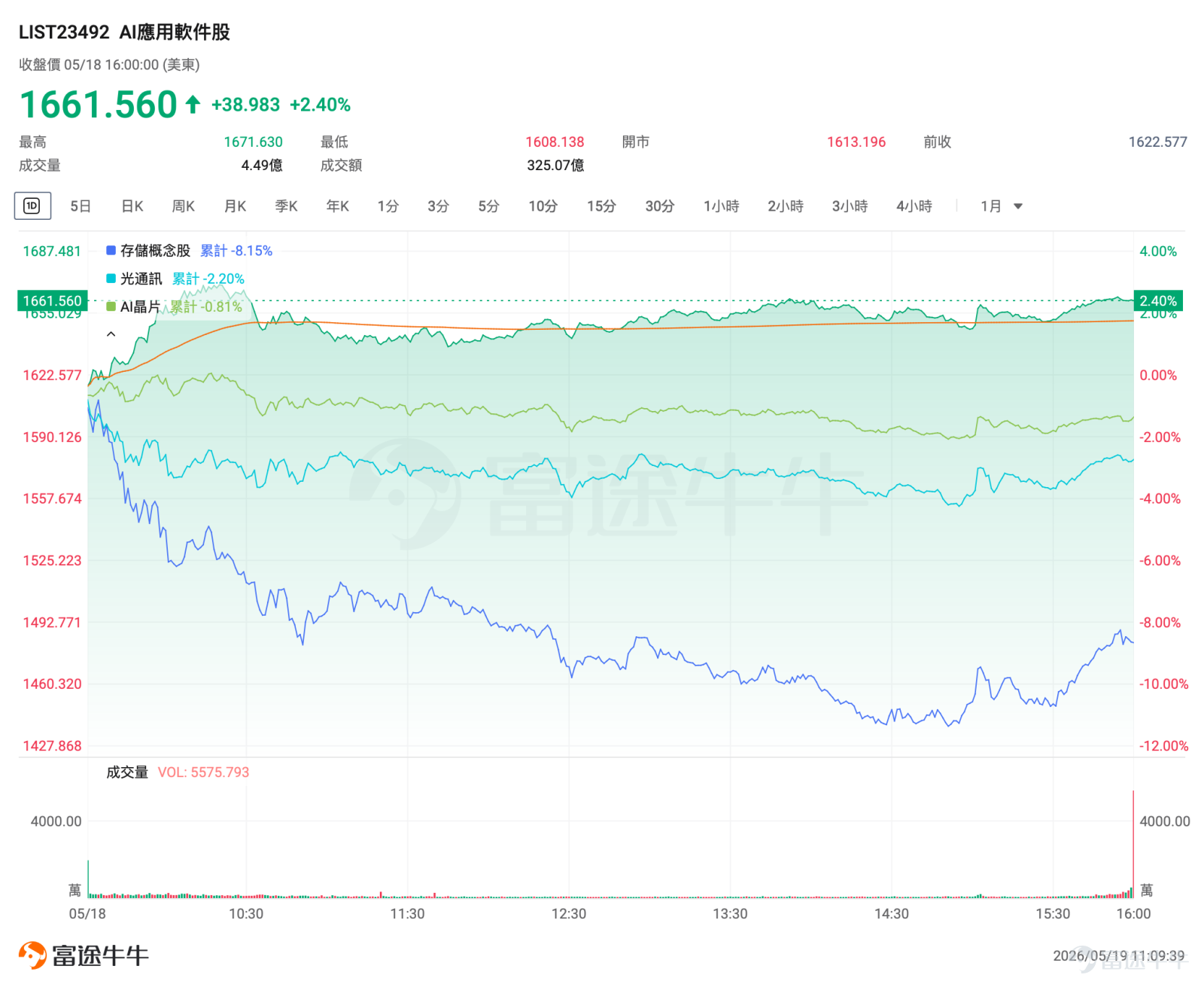
In the previous trading session, US equities showed notable divergence: AI hardware sectors (including semiconductors, optical communications, and memory) collectively pulled back, while AI application software stocks strengthened against the trend.
U.S. equities showed significant divergence in the previous trading session: AI hardware sectors (chips, optical communications, memory, etc.) collectively pulled back, while AI application software stocks strengthened against the trend. Among AI application software stocks, $Zeta Global (ZETA.US)$ surged nearly 12%, accumulating a gain of almost 20% over the past three trading days, $ServiceNow (NOW.US)$ rose nearly 9%, with a cumulative increase of nearly 19% over the past three trading days, $Figma Inc (FIG.US)$ gained more than 6%, surging 29% cumulatively over the past three trading days. $iShares Expanded Tech-Software Sector ETF (IGV.US)$ also climbed nearly 1%. On one side, 'shovel sellers' are seeing cooling sentiment and valuation pressure; on the other, 'gold miners' are delivering results and attracting capital inflows.With the retreat in hardware stocks coinciding with earnings validation, has the AI application software sector reached the 'Davis Double Play' moment of simultaneous earnings growth and valuation expansion? Hardware stocks pull back: The recent broad weakness in the AI hardware sector is the result of a confluence of factors, including market news, macroeconomic pressures, and sentiment shifts. On the news front, $Seagate Technology (STX.US)$ CEO Dave Mosley stated at a JPMorgan conference that building new factories or adding capacity would take 'too long' and might fail to keep pace with AI demand growth, while also expressing concerns that it could slow down the pace of technological iteration. This comment quickly triggered market...
Among AI application software stocks, $Zeta Global (ZETA.US)$ rose nearly 12%, accumulating a gain of almost 20% over the past three trading days, $ServiceNow (NOW.US)$ climbed nearly 9%, for a cumulative increase of nearly 19% over the past three trading days, $Figma Inc (FIG.US)$ gained more than 6%, surging 29% cumulatively over the past three trading days. $iShares Expanded Tech-Software Sector ETF (IGV.US)$ also rose by nearly 1%.
U.S. equities showed significant divergence in the previous trading session: AI hardware sectors (chips, optical communications, memory, etc.) collectively pulled back, while AI application software stocks strengthened against the trend. Among AI application software stocks, $Zeta Global (ZETA.US)$ surged nearly 12%, accumulating a gain of almost 20% over the past three trading days, $ServiceNow (NOW.US)$ rose nearly 9%, with a cumulative increase of nearly 19% over the past three trading days, $Figma Inc (FIG.US)$ gained more than 6%, surging 29% cumulatively over the past three trading days. $iShares Expanded Tech-Software Sector ETF (IGV.US)$ also climbed nearly 1%. On one side, 'shovel sellers' are seeing cooling sentiment and valuation pressure; on the other, 'gold miners' are delivering results and attracting capital inflows.With the retreat in hardware stocks coinciding with earnings validation, has the AI application software sector reached the 'Davis Double Play' moment of simultaneous earnings growth and valuation expansion? Hardware stocks pull back: The recent broad weakness in the AI hardware sector is the result of a confluence of factors, including market news, macroeconomic pressures, and sentiment shifts. On the news front, $Seagate Technology (STX.US)$ CEO Dave Mosley stated at a JPMorgan conference that building new factories or adding capacity would take 'too long' and might fail to keep pace with AI demand growth, while also expressing concerns that it could slow down the pace of technological iteration. This comment quickly triggered market...
On one hand, 'shovel sellers' are seeing cooling sentiment and valuation pressure; on the other, 'gold diggers' are delivering strong earnings and attracting capital inflows.With hardware stocks retreating amid earnings validation, has the AI application software sector reached a 'Davis double play'—a simultaneous boost in both earnings and valuation?
Hardware stocks pull back:
The recent broad weakness in AI hardware stocks stems from a confluence of market news, macroeconomic pressures, and shifting investor sentiment.
On the news front, $Seagate Technology (STX.US)$ CEO Dave Mosley stated at a JPMorgan conference that building new factories or expanding capacity would take 'too long' to keep pace with AI demand growth and could slow down the pace of technological iteration. This comment quickly sparked market concerns about supply bottlenecks and the sustainability of growth in memory chips, triggering a sharp drop in Seagate Technology’s share price and dragging down $Micron Technology (MU.US)$$Western Digital (WDC.US)$ other memory-related stocks collectively lower.
U.S. equities showed significant divergence in the previous trading session: AI hardware sectors (chips, optical communications, memory, etc.) collectively pulled back, while AI application software stocks strengthened against the trend. Among AI application software stocks, $Zeta Global (ZETA.US)$ surged nearly 12%, accumulating a gain of almost 20% over the past three trading days, $ServiceNow (NOW.US)$ rose nearly 9%, with a cumulative increase of nearly 19% over the past three trading days, $Figma Inc (FIG.US)$ gained more than 6%, surging 29% cumulatively over the past three trading days. $iShares Expanded Tech-Software Sector ETF (IGV.US)$ also climbed nearly 1%. On one side, 'shovel sellers' are seeing cooling sentiment and valuation pressure; on the other, 'gold miners' are delivering results and attracting capital inflows.With the retreat in hardware stocks coinciding with earnings validation, has the AI application software sector reached the 'Davis Double Play' moment of simultaneous earnings growth and valuation expansion? Hardware stocks pull back: The recent broad weakness in the AI hardware sector is the result of a confluence of factors, including market news, macroeconomic pressures, and sentiment shifts. On the news front, $Seagate Technology (STX.US)$ CEO Dave Mosley stated at a JPMorgan conference that building new factories or adding capacity would take 'too long' and might fail to keep pace with AI demand growth, while also expressing concerns that it could slow down the pace of technological iteration. This comment quickly triggered market...
On the macro front, persistently rising U.S. Treasury yields are further pressuring high-valuation tech stocks. $U.S. 30-Year Treasury Bonds Yield (US30Y.BD)$ Yields have climbed to approximately 5.13%–5.14%, nearing recent highs, exerting systemic pressure on momentum stocks sensitive to interest rates.
U.S. equities showed significant divergence in the previous trading session: AI hardware sectors (chips, optical communications, memory, etc.) collectively pulled back, while AI application software stocks strengthened against the trend. Among AI application software stocks, $Zeta Global (ZETA.US)$ surged nearly 12%, accumulating a gain of almost 20% over the past three trading days, $ServiceNow (NOW.US)$ rose nearly 9%, with a cumulative increase of nearly 19% over the past three trading days, $Figma Inc (FIG.US)$ gained more than 6%, surging 29% cumulatively over the past three trading days. $iShares Expanded Tech-Software Sector ETF (IGV.US)$ also climbed nearly 1%. On one side, 'shovel sellers' are seeing cooling sentiment and valuation pressure; on the other, 'gold miners' are delivering results and attracting capital inflows.With the retreat in hardware stocks coinciding with earnings validation, has the AI application software sector reached the 'Davis Double Play' moment of simultaneous earnings growth and valuation expansion? Hardware stocks pull back: The recent broad weakness in the AI hardware sector is the result of a confluence of factors, including market news, macroeconomic pressures, and sentiment shifts. On the news front, $Seagate Technology (STX.US)$ CEO Dave Mosley stated at a JPMorgan conference that building new factories or adding capacity would take 'too long' and might fail to keep pace with AI demand growth, while also expressing concerns that it could slow down the pace of technological iteration. This comment quickly triggered market...
Additionally, AI hardware stocks had previously accumulated substantial gains and entered technically overbought territory, increasing short-term profit-taking pressure. Meanwhile, uncertainty surrounding U.S.-Iran negotiations has pushed oil prices higher, fueling inflation expectations and indirectly affecting risk asset valuations. Together, these factors have placed near-term downward pressure on hardware stocks.
However, it should be noted that this is more of a phase-specific adjustment rather than a trend reversal.Long-term demand for AI computing power remains intact; the market is simply digesting earlier over-optimistic expectations and awaiting further earnings validation.
AI application software stocks break out against the trend: Earnings validate growth
Just a few months ago, the market was steeped in extreme pessimism under the narrative that 'AI will devour software.' The prevailing view at the time was: if AI agents can write code themselves, what need is there for SaaS?Investors feared that AI would completely upend traditional software’s pricing power and room to operate.
Some AI application software companies reported better-than-expected results, directly validating their ability to commercialize AI.
1、 $Datadog (DDOG.US)$ (Cloud monitoring and analytics platform): Q1 revenue reached $1.07 billion, exceeding analyst expectations, and raised its FY2026 revenue guidance to $4.30–$4.34 billion. The stock surged 31.33% in a single day after the earnings release, leading gains across the AI application sector.
2、 $Baidu (BIDU.US)$ (AI cloud and native applications): Q1 revenue totaled RMB 32.075 billion, beating expectations; AI-related revenue reached RMB 13.6 billion, up 49% year-over-year; AI revenue accounted for 52% of core business revenue, surpassing the 50% mark for the first time.
3、 $Figma Inc (FIG.US)$ (AI design): Q1 revenue grew 46% year-over-year to $333 million, significantly above the market expectation of $313 million, with growth accelerating from 40% in the prior quarter—demonstrating sustained momentum. The company's AI product suite continues to drive expansion in paid users and enhance customer stickiness. Net Dollar Retention Rate rose to 139% in Q1, the highest level in over two years, indicating strong retention and continued upselling among existing customers. Figma Make, its AI design tool, has been particularly impressive, with large enterprise penetration among weekly active users already reaching approximately 60%, signaling a shift from early trials to enterprise-scale deployment.
4、 $Zeta Global (ZETA.US)$ (Marketing technology platform): Q1 revenue increased 50% year-over-year to $396 million, marking the 19th consecutive quarter of beating expectations and raising guidance. Following the launch of its AI product Athena, agent interactions surged sevenfold within one week. Average revenue per large customer reached $1.7 million (up 21% year-over-year), and the sales pipeline grew by approximately 40% year-over-year.
5、 $ServiceNow (NOW.US)$ (Enterprise workflow automation platform): Q1 revenue was USD 3.77 billion, up 22% year-over-year, exceeding expectations by USD 24 million. Subscription revenue reached USD 3.671 billion, and the company raised its full-year subscription revenue guidance to USD 15.74–15.78 billion.
Liquidity signals are equally positive.Whale Rock Capital’s latest 13F filing reveals new positions in application software, further reinforcing market confidence through institutional activity.
Why has capital recently shifted from hardware to software? The core reason lies in valuation.After the earlier sharp rally in hardware stocks, investors are taking profits; meanwhile, software stocks had previously lagged but now show solid earnings validation, making their valuations more attractive. Investors are beginning to reward companies that can effectively translate AI capabilities into tangible products, services, and revenue streams.
This is precisely the early stage of a classic 'Davis double play': upside surprises in earnings driving upward revisions in profit forecasts, combined with valuation recovery from depressed levels.
Historical Precedents and Industry Chain Logic
Looking back at internet history, similar sector rotation patterns are clear. Around the year 2000, infrastructure (fiber optics, servers) heated up first, but after the bubble burst, it was the application layer—e-commerce, search, and social media—that truly drove sustained growth. AI may follow a similar trajectory: hardware provides the essential foundation, but it is the application layer that captures end users and generates cash flows, ultimately determining long-term valuation ceilings.
Currently, hyperscale cloud providers’ AI investments continue to grow; the recent hardware pullback does not signal diminished demand. Over the long term, chips, storage, and optical communications remain core components of AI infrastructure.
Therefore,The path toward a 'Davis double play' for AI application software is not without obstacles—two key risks warrant close attention.First, capital rotation driven by a potential rebound in hardware stocks after their recent pullback; second, intensifying industry competition has led to AI monetization falling short of expectations, with some companies failing to capitalize on the AI-driven transformation, making sustained earnings growth difficult.
Investors should focus on industry leaders that demonstrate genuine AI return on investment (ROI), strong application-scenario moats, and clear monetization pathways, while avoiding stocks driven purely by speculative hype.First, prioritize earnings validation—companies that beat expectations are not merely adding a Chatbot interface but are genuinely reducing costs or boosting revenues through AI. Second, focus on 'picks-and-shovels' players with strong scenario-based moats—these firms not only implement AI themselves but also provide indispensable tools for AI deployment, such as AI-focused cybersecurity companies.
Options Strategy
Take $iShares Expanded Tech-Software Sector ETF (IGV.US)$ For example, the candlestick chart exhibits a classic W-bottom pattern. The current price has broken above the neckline of this W-bottom, with the 5-day, 10-day, and 20-day moving averages forming a bullish alignment and trading above the longer-term 60-day moving average, confirming a medium-term price reversal trend from a technical perspective.
From an options volume perspective, the put/call volume ratio exceeded 1 on the previous trading day, and the put/call open interest ratio stood at 1.32, indicating lingering market concerns about potential declines in AI application software stocks. Implied volatility (IV) is at the 79th percentile, placing it in the moderately high range historically; however, both IV and historical volatility (HV) remain at low absolute levels, making both long and short option strategies worth considering.
U.S. equities showed significant divergence in the previous trading session: AI hardware sectors (chips, optical communications, memory, etc.) collectively pulled back, while AI application software stocks strengthened against the trend. Among AI application software stocks, $Zeta Global (ZETA.US)$ surged nearly 12%, accumulating a gain of almost 20% over the past three trading days, $ServiceNow (NOW.US)$ rose nearly 9%, with a cumulative increase of nearly 19% over the past three trading days, $Figma Inc (FIG.US)$ gained more than 6%, surging 29% cumulatively over the past three trading days. $iShares Expanded Tech-Software Sector ETF (IGV.US)$ also climbed nearly 1%. On one side, 'shovel sellers' are seeing cooling sentiment and valuation pressure; on the other, 'gold miners' are delivering results and attracting capital inflows.With the retreat in hardware stocks coinciding with earnings validation, has the AI application software sector reached the 'Davis Double Play' moment of simultaneous earnings growth and valuation expansion? Hardware stocks pull back: The recent broad weakness in the AI hardware sector is the result of a confluence of factors, including market news, macroeconomic pressures, and sentiment shifts. On the news front, $Seagate Technology (STX.US)$ CEO Dave Mosley stated at a JPMorgan conference that building new factories or adding capacity would take 'too long' and might fail to keep pace with AI demand growth, while also expressing concerns that it could slow down the pace of technological iteration. This comment quickly triggered market...
1. Investors bullish on the application software sector may consider a Long Call strategy:Directly purchasing call options to profit from upward price movement. This strategy offers unlimited upside potential with limited downside risk, but its one-sided bullish stance leaves little room for error—as a reversal in price can quickly erode the option premium.
U.S. equities showed significant divergence in the previous trading session: AI hardware sectors (chips, optical communications, memory, etc.) collectively pulled back, while AI application software stocks strengthened against the trend. Among AI application software stocks, $Zeta Global (ZETA.US)$ surged nearly 12%, accumulating a gain of almost 20% over the past three trading days, $ServiceNow (NOW.US)$ rose nearly 9%, with a cumulative increase of nearly 19% over the past three trading days, $Figma Inc (FIG.US)$ gained more than 6%, surging 29% cumulatively over the past three trading days. $iShares Expanded Tech-Software Sector ETF (IGV.US)$ also climbed nearly 1%. On one side, 'shovel sellers' are seeing cooling sentiment and valuation pressure; on the other, 'gold miners' are delivering results and attracting capital inflows.With the retreat in hardware stocks coinciding with earnings validation, has the AI application software sector reached the 'Davis Double Play' moment of simultaneous earnings growth and valuation expansion? Hardware stocks pull back: The recent broad weakness in the AI hardware sector is the result of a confluence of factors, including market news, macroeconomic pressures, and sentiment shifts. On the news front, $Seagate Technology (STX.US)$ CEO Dave Mosley stated at a JPMorgan conference that building new factories or adding capacity would take 'too long' and might fail to keep pace with AI demand growth, while also expressing concerns that it could slow down the pace of technological iteration. This comment quickly triggered market...
(The design images shown on screen are for illustrative purposes only and do not constitute any investment advice or guarantee; market conditions change frequently, and the prices depicted do not reflect real-time data.)
2. For investors who are moderately bullish on AI applications over the medium to long term, expect温和 upward movement, wish to avoid high costs and excessive volatility, and seek steady swing returns, a Bull Call Spread may be appropriate:Buy a call option with a lower strike price while simultaneously selling a call option with a higher strike price to reduce net cost. Compared to a pure Long Call, this strategy offers lower upfront cost and better risk-adjusted efficiency, though it caps the maximum upside potential.
U.S. equities showed significant divergence in the previous trading session: AI hardware sectors (chips, optical communications, memory, etc.) collectively pulled back, while AI application software stocks strengthened against the trend. Among AI application software stocks, $Zeta Global (ZETA.US)$ surged nearly 12%, accumulating a gain of almost 20% over the past three trading days, $ServiceNow (NOW.US)$ rose nearly 9%, with a cumulative increase of nearly 19% over the past three trading days, $Figma Inc (FIG.US)$ gained more than 6%, surging 29% cumulatively over the past three trading days. $iShares Expanded Tech-Software Sector ETF (IGV.US)$ also climbed nearly 1%. On one side, 'shovel sellers' are seeing cooling sentiment and valuation pressure; on the other, 'gold miners' are delivering results and attracting capital inflows.With the retreat in hardware stocks coinciding with earnings validation, has the AI application software sector reached the 'Davis Double Play' moment of simultaneous earnings growth and valuation expansion? Hardware stocks pull back: The recent broad weakness in the AI hardware sector is the result of a confluence of factors, including market news, macroeconomic pressures, and sentiment shifts. On the news front, $Seagate Technology (STX.US)$ CEO Dave Mosley stated at a JPMorgan conference that building new factories or adding capacity would take 'too long' and might fail to keep pace with AI demand growth, while also expressing concerns that it could slow down the pace of technological iteration. This comment quickly triggered market...
(The design images displayed on screen are for illustrative purposes only and do not constitute any investment advice or guarantee; market conditions change frequently, and the prices shown do not reflect actual market values.)
3. Long-term value investors who recognize the long-term investment potential of AI application software stocks, plan to gradually build positions at lower levels, are unconcerned about missing short-term rallies, and prefer conservative strategies with accumulation at depressed prices may consider selling cash-secured puts:Sell cash-secured puts on high-quality underlying assets to collect premiums below the current market price; if the price does not decline, you profit from time decay.
U.S. equities showed significant divergence in the previous trading session: AI hardware sectors (chips, optical communications, memory, etc.) collectively pulled back, while AI application software stocks strengthened against the trend. Among AI application software stocks, $Zeta Global (ZETA.US)$ surged nearly 12%, accumulating a gain of almost 20% over the past three trading days, $ServiceNow (NOW.US)$ rose nearly 9%, with a cumulative increase of nearly 19% over the past three trading days, $Figma Inc (FIG.US)$ gained more than 6%, surging 29% cumulatively over the past three trading days. $iShares Expanded Tech-Software Sector ETF (IGV.US)$ also climbed nearly 1%. On one side, 'shovel sellers' are seeing cooling sentiment and valuation pressure; on the other, 'gold miners' are delivering results and attracting capital inflows.With the retreat in hardware stocks coinciding with earnings validation, has the AI application software sector reached the 'Davis Double Play' moment of simultaneous earnings growth and valuation expansion? Hardware stocks pull back: The recent broad weakness in the AI hardware sector is the result of a confluence of factors, including market news, macroeconomic pressures, and sentiment shifts. On the news front, $Seagate Technology (STX.US)$ CEO Dave Mosley stated at a JPMorgan conference that building new factories or adding capacity would take 'too long' and might fail to keep pace with AI demand growth, while also expressing concerns that it could slow down the pace of technological iteration. This comment quickly triggered market...
(The design images displayed on screen are for illustrative purposes only and do not constitute any investment advice or guarantee; market conditions change frequently, and the prices shown do not reflect actual market values.)
4. Investors who already hold positions in AI application software stocks but are concerned about a short-term pullback, or those who believe these stocks will continue to face downward pressure over the long term, may consider buying puts.
U.S. equities showed significant divergence in the previous trading session: AI hardware sectors (chips, optical communications, memory, etc.) collectively pulled back, while AI application software stocks strengthened against the trend. Among AI application software stocks, $Zeta Global (ZETA.US)$ surged nearly 12%, accumulating a gain of almost 20% over the past three trading days, $ServiceNow (NOW.US)$ rose nearly 9%, with a cumulative increase of nearly 19% over the past three trading days, $Figma Inc (FIG.US)$ gained more than 6%, surging 29% cumulatively over the past three trading days. $iShares Expanded Tech-Software Sector ETF (IGV.US)$ also climbed nearly 1%. On one side, 'shovel sellers' are seeing cooling sentiment and valuation pressure; on the other, 'gold miners' are delivering results and attracting capital inflows.With the retreat in hardware stocks coinciding with earnings validation, has the AI application software sector reached the 'Davis Double Play' moment of simultaneous earnings growth and valuation expansion? Hardware stocks pull back: The recent broad weakness in the AI hardware sector is the result of a confluence of factors, including market news, macroeconomic pressures, and sentiment shifts. On the news front, $Seagate Technology (STX.US)$ CEO Dave Mosley stated at a JPMorgan conference that building new factories or adding capacity would take 'too long' and might fail to keep pace with AI demand growth, while also expressing concerns that it could slow down the pace of technological iteration. This comment quickly triggered market...
(The design images displayed on screen are for illustrative purposes only and do not constitute any investment advice or guarantee; market conditions change frequently, and the prices shown do not reflect actual market values.)
Fellow investors, do you think AI application software stocks will see a rally this time?
Finally, Option Sir brings a small perk for fellow investors, welcome to claim it.Options Beginner Pack
*This event is exclusive to invited HK users. Click to learn more.Detailed event rules>>
Market conditions are complex and volatile,Options StrategyOverwhelmed by choices? Futubull helps you build a portfolio in three steps.Options Strategymaking investing simple and efficient!
U.S. equities showed significant divergence in the previous trading session: AI hardware sectors (chips, optical communications, memory, etc.) collectively pulled back, while AI application software stocks strengthened against the trend. Among AI application software stocks, $Zeta Global (ZETA.US)$ surged nearly 12%, accumulating a gain of almost 20% over the past three trading days, $ServiceNow (NOW.US)$ rose nearly 9%, with a cumulative increase of nearly 19% over the past three trading days, $Figma Inc (FIG.US)$ gained more than 6%, surging 29% cumulatively over the past three trading days. $iShares Expanded Tech-Software Sector ETF (IGV.US)$ also climbed nearly 1%. On one side, 'shovel sellers' are seeing cooling sentiment and valuation pressure; on the other, 'gold miners' are delivering results and attracting capital inflows.With the retreat in hardware stocks coinciding with earnings validation, has the AI application software sector reached the 'Davis Double Play' moment of simultaneous earnings growth and valuation expansion? Hardware stocks pull back: The recent broad weakness in the AI hardware sector is the result of a confluence of factors, including market news, macroeconomic pressures, and sentiment shifts. On the news front, $Seagate Technology (STX.US)$ CEO Dave Mosley stated at a JPMorgan conference that building new factories or adding capacity would take 'too long' and might fail to keep pace with AI demand growth, while also expressing concerns that it could slow down the pace of technological iteration. This comment quickly triggered market...
Option Risk Warning:An option is a contract that grants the holder the right, but not the obligation, to buy or sell an asset at a fixed price on a specific date or at any time before that date. The price of an option is influenced by various factors, including the current price of the underlying asset, the strike price, time to expiration, and implied volatility. Implied volatility reflects the market’s expectations for the level of volatility in the option over a future period. It is a data point derived inversely from the Black-Scholes option pricing model and is generally regarded as an indicator of market sentiment. When investors anticipate greater volatility, they may be more willing to pay a higher price for options to hedge risks, resulting in higher implied volatility. Traders and investors use implied volatility to assess the attractiveness of option prices, identify potential mispricings, and manage risk exposure.
Disclaimer:This content does not constitute any offer, solicitation, recommendation, opinion, or guarantee of any securities, financial products, or tools. The risk of loss in trading options can be substantial. In some cases, losses may exceed the initial margin deposited. Even if you set contingent orders such as 'stop-loss' or 'limit' orders, these may not prevent losses. Market conditions may make such orders unexecutable. You may be required to deposit additional margin within a short period. If you fail to provide the required amount within the specified time, your open positions may be liquidated. However, you will still be responsible for any shortfall in your account. Therefore, before trading, you should study and understand options and carefully consider whether such trading is suitable for you based on your financial situation and investment objectives. If you trade options, you should be familiar with the procedures for exercising options and the rights and obligations upon exercise and expiration. Options trading carries extremely high risks and is not suitable for all investors. Investors should carefully readCharacteristics and Risks of Standardized Options
Editor/Doris
Risk Disclaimer: The above content only represents the author's view. It does not represent any position or investment advice of Futu. Futu makes no representation or warranty.Read more
Heart
2
Thumbs Up
14
Thumbs Up
1
Sob
1
Commando
1
496K Views
Report
Comments
Write a Comment...
19
45