
Optical interconnects take off again! Jensen Huang anoints Marvell as the trillion-dollar champion

Up over 110% year-to-date! Nokia's transformation from mobile phone kingpin to telecom giant
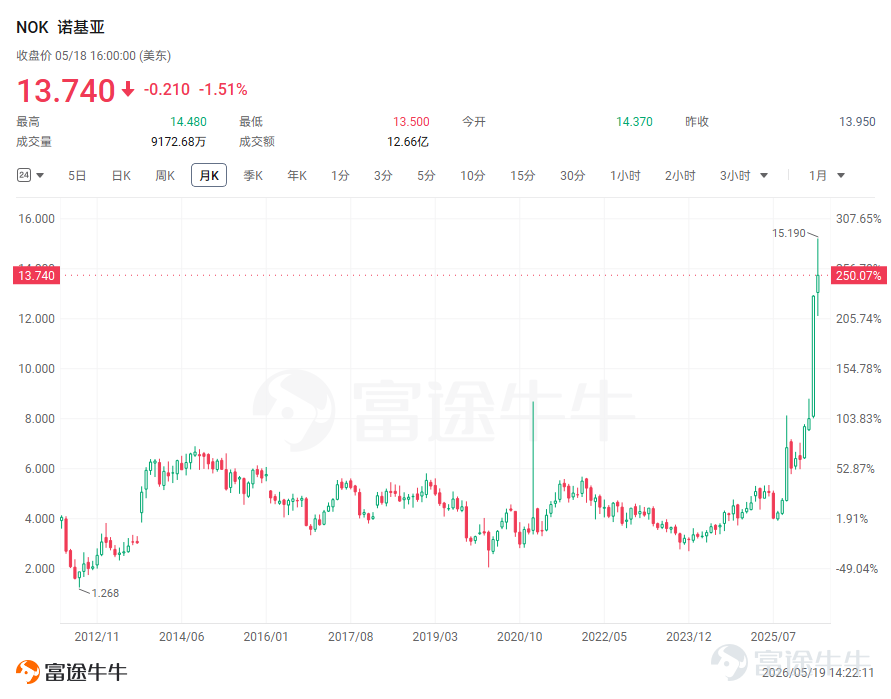
When most people assumed that $Nokia Oyj (NOK.US)$ had faded away along with the feature phone era, this former mobile giant quietly executed an epic transformation and now stands at the forefront of AI infrastructure.As of the May 18 close, Nokia’s share price settled at $13.74, up over 110% year-to-date, with a market cap surpassing $70 billion—reaching a 16-year high! $Defiance Daily Target 2X Long NOK ETF (LNOK.US)$
This recent surge is no accident. Since announcing the sale of its mobile phone business in 2013, Nokia has transformed from a consumer electronics company into a core global supplier of communications infrastructure through a series of strategic acquisitions and business restructurings.In an era of explosive AI computing demand, Nokia is shedding its label as 'left behind by the times' and emerging as the critical 'artery' connecting AI computing 'brains.'

From Mobile Kingpin to Communications Giant: A Transformation Journey
Nokia transformed from a mobile phone powerhouse into a communications giant through a critical strategic overhaul.In 2013, the company announced the sale of its mobile phone business to Microsoft for €5.44 billion (officially completed in April 2014), while simultaneously acquiring Nokia Siemens Networks shares, marking its first step toward transforming into a communications infrastructure provider.In 2016, Nokia completed the acquisition of Alcatel-Lucent for €15.6 billion, gaining Bell Labs and core patents in optical communications and IP networking, becoming the world's second-largest optical networking equipment vendor. In 2024, the company acquired Infinera for $2.3 billion, strengthening its capabilities in high-speed data center interconnect technologies and indium phosphide photonic chips.
In October 2025, NVIDIA invested $1 billion in Nokia to jointly advance AI-RAN innovation and 6G evolution. In January 2026, Nokia reorganized into two business groups—Network Infrastructure and Mobile Networks—focusing on fiber connectivity required for AI computing. It subsequently divested its FWA CPE business and appointed a new president for Mobile Networks, further sharpening its core focus.
The transformation has yielded significant results. In Q1 2026, Nokia reported a 4% year-over-year increase in comparable net sales to €4.5 billion, with adjusted operating profit reaching €281 million. Network Infrastructure sales grew 12% year-over-year, driven by a 56% surge in optical networking. Revenue from AI and cloud customers rose 49%, accounting for 8% of total sales, with €1 billion in new orders secured in the quarter.Nokia has evolved from a consumer electronics company into a leader in connectivity for the AI era.

Deep Dive: Three Growth Engines Building a Moat in the AI Era
1. Optical Communications: The 'Blood Vessels' of AI Compute, with CPO Technology Leading the Next-Gen Data Center Revolution
In an era of explosive AI compute growth, data transmission has become a critical bottleneck limiting computational efficiency.Leveraging its technological expertise and market position in optical communications, Nokia is emerging as one of the primary beneficiaries of this trend.
Facing the dual constraints of bandwidth and power consumption inherent in traditional copper cabling, optical interconnects have become the only viable solution.Nokia has established significant market and technological advantages, holding a 21% share of the global optical networking equipment market (ranking second) and a 35% global market share in the XGS-PON segment.Its strategic core lies in betting on next-generation CPO (Co-Packaged Optics) technology. By integrating optical engines with computing chips at the package level, this technology dramatically reduces power consumption and increases transmission density. To this end, Nokia has launched a $40 billion investment plan in the U.S. Through its acquisition of Infinera, Nokia has further acquired critical vertical integration capabilities in indium phosphide and silicon photonics, becoming the only Western vendor with end-to-end in-house capabilities spanning DSPs, photonic integrated circuits, and packaging.
1. AI-RAN: The Convergence Revolution of Communications and Computing—The Essential Path Toward 6G
AI-RAN (Artificial Intelligence Radio Access Network) is a core area of collaboration between Nokia and NVIDIA and represents a key strategic initiative for Nokia’s 6G era. This technology introduces GPUs into radio access network nodes, enabling a single hardware platform to simultaneously support both communications and AI workloads. In simple terms, it allows base stations to run AI. Nokia’s network architecture happens to integrate quite naturally with $NVIDIA (NVDA.US)$ NVIDIA’s GPUs. To some extent, Nokia is the only compatible building block NVIDIA can rely on within the 'Western AI infrastructure stack.'
At MWC (Mobile World Congress) 2026, Nokia announced that it had completed AI-RAN functional trials with $T-Mobile US (TMUS.US)$ Indosat (Indonesia Telecom), SoftBank (Japan), and several other operators. Nokia’s Chief Technology and AI Officer, Pallavi Mahajan, stated: 'We will launch our first commercial pilot in 2026 and roll out our first commercial version in 2027.'
1. 6G Strategy: Seizing the High Ground of Next-Generation Communications and Competing for Control Over AI-Native Network Standards
As 5G commercialization matures, 6G R&D has become a critical battleground for global telecom giants. Through deep collaboration with NVIDIA, Nokia has already secured a first-mover advantage in AI-native 6G architecture.
Regarding 3GPP standards, NVIDIA led the development of the 'AI-native air interface' specification in Release 19 and jointly proposed the 'AI-RAN Performance Evaluation Metrics Framework' with Nokia and Ericsson. The AI-RAN Alliance has now grown to over 130 members and completed 33 joint demonstrations at MWC 2026.
Investment Opportunity Analysis: Valuation Reassessment and Market Opportunity Estimation
On April 26, 2026, JPMorgan significantly raised Nokia's price target from €6.90 to €12.00—an increase of nearly 74%—while maintaining an 'Overweight' rating. Following Nokia’s Q1 earnings release, Argus upgraded its rating from 'Hold' to 'Buy' with a $15 price target. The firm’s core rationale is:Nokia is no longer the mobile phone manufacturer of old but a telecommunications giant seizing the AI infrastructure opportunity and undergoing significant valuation reassessment.
If evaluated independently, the implied value of Nokia’s optical networking business alone is already close to the company’s current total market capitalization. In Q1 2026, Nokia’s optical networking segment generated approximately $900 million in revenue, accounting for 18% of total revenue, with a gross margin of 43.4%. The company expects full-year 2026 optical networking revenue to grow by 18–20%, reaching approximately $3.86 billion.
By comparison, global optical networking leader $Ciena (CIEN.US)$ had a market capitalization of approximately $76 billion as of May 4, 2026, reported Q1 2026 revenue of $1.26–1.29 billion, achieved a 43.4% gross margin, and provided full-year guidance for 24% growth. Applying Ciena’s valuation multiples as a benchmark, the implied value of Nokia’s optical networking business exceeds $50 billion. This implies the market may effectively be 'giving away for free' Nokia’s other core businesses (mobile networks, cloud services, patents)—representing the largest current valuation gap.
According to Futubull data,Eight analysts have rated Nokia over the past three months, with an average price target of $13.13, a high of $15.00, and a low of $9.32. Nokia currently trades at a P/E ratio of 78.21x, well above the industry median of 32.5x.This indicates the market has already assigned Nokia a significant valuation premium, reflecting optimistic expectations regarding its AI transformation prospects.
Investors should closelymonitor Nokia's order wins in AI and cloud customer segments, market share shifts in its optical networks business, and progress in AI-RAN commercial pilots. The second-quarter earnings report will be a critical checkpoint to validate its growth narrative.

Nokia’s transformation is a classic turnaround story. When the company sold its mobile phone business in 2013, its market capitalization stood at just €5 billion; today, 13 years later, it has surpassed $83 billion, with a year-to-date gain of over 110%. Behind this remarkable recovery lies the company’s precise grasp of infrastructure demand in the AI computing era and its successful conversion of legacy telecommunications technology strengths into competitive moats for the new age.
When waves of transformative change hit, some are drowned while others learn to surf. Nokia’s story may offer a valuable lesson to all traditional companies facing transformation:True competitive advantage lies not in past glories, but in the courage to embrace the future.
P.S.: Want to know target prices for your favorite stocks? Top analysts have you covered!

Path: Any stock in the U.S. or Hong Kong market > Quote page > Company > Analyst Ratings
Risk Disclaimer: The above content only represents the author's view. It does not represent any position or investment advice of Futu. Futu makes no representation or warranty.Read more


Comments
to post a comment
56
88