
AI Boom vs. Tight Liquidity: Will the US Stock Rally Continue?

The US bond storm is here with a vengeance! Is the rally over? The answer lies in two historical 'false alarms'
The sharp AI-driven uptrend suddenly faced a turning point last week, as global financial markets are experiencing turbulence triggered by a surge in US Treasury yields.
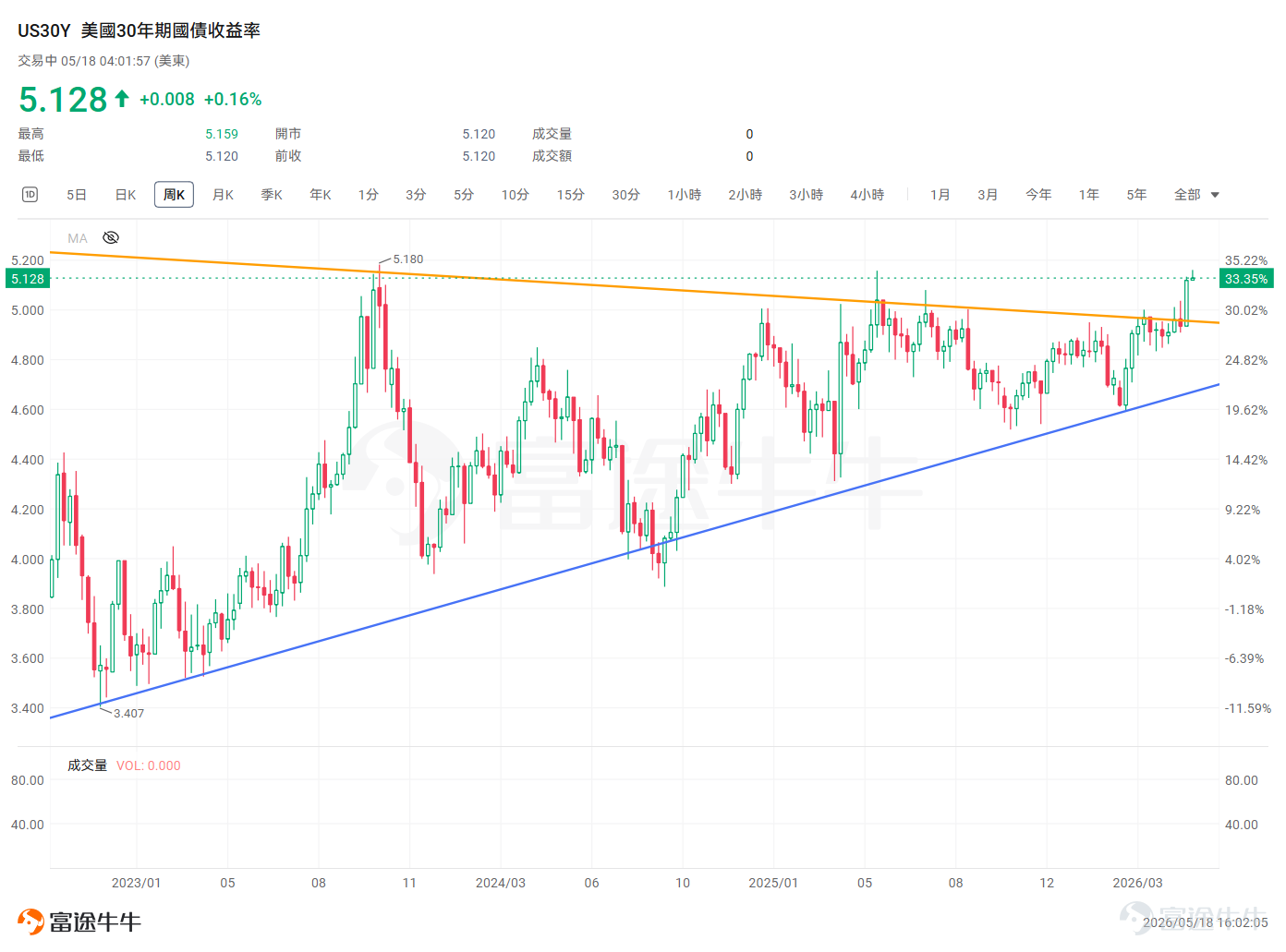
Last Friday, the 10-year US Treasury yield broke through the key psychological level of 4.5%, while the 30-year Treasury yield remained firmly above 5%, hitting its highest closing level since July 2007. This storm also weighed on the broader market: $Nasdaq Composite Index (.IXIC.US)$ Ending a streak of consecutive gains, the index fell 1.54% in a single day and slightly declined by 0.08% for the week. $S&P 500 Index (.SPX.US)$ Although it still managed to achieve a seventh consecutive weekly gain, it also dropped more than 1% on the same day.
The source of the storm: Three drivers behind the surge in US Treasury yields
Why did US Treasury yields break out at this moment?
(1) Triple data shock, with the specter of inflation making a comeback
Last week, three important indicators of the US inflation line were released - CPI, PPI, and retail data - all exceeding expectations.
The US Consumer Price Index (CPI) for April rose 3.8% year-over-year, marking the largest increase since May 2023 and far exceeding market expectations of 3.7%. The core CPI, excluding food and energy, increased by 2.8% year-over-year, also higher than the previous reading.More concerning is that the Producer Price Index (PPI) for April recorded its worst performance since 2022.Meanwhile, retail sales grew 4.9% year-over-year, showing the strongest performance in nearly eight months.
Energy prices have been the main driver of inflation - with energy prices up 17.9% year-over-year in April, and gasoline prices rising by 28.4% over the same period.
(2) US-Iran talks remain deadlocked
The ongoing blockade of the Strait of Hormuz has been the immediate trigger for rising oil prices, which in turn fueled inflation. The US-Iran negotiations are at an impasse, with Trump stating last week, 'If Iran doesn't act quickly, they will end up with nothing.' US sources revealed that the Pentagon is preparing to resume military action against Iran, with tensions continuing to escalate amidst repeated setbacks.
Since the conflict erupted at the end of February, the Strait of Hormuz has been effectively blockaded. As the closure extends day by day,there is a growing consensus in the market that even if the Strait of Hormuz were to fully reopen today, it would take at least several months to rebuild production infrastructure and restore oil flows to full capacity. This suggests that oil prices will remain high for the foreseeable future.
(3) Long-term concerns about fiscal sustainability
US federal debt has approached $39 trillion, accounting for about 135% of GDP. Annualized interest payments for the 2026 fiscal year have reached $1.23 trillion. On May 13, the US Treasury completed a $25 billion auction of 30-year bonds, with the final winning interest rate set at a high of 5.046%—investors once again locked in ultra-long bond coupons at the 5% level in the primary market.
Due to rising interest rates caused by inflation concerns, US borrowing costs have increased accordingly, prompting the government to issue more bonds to repay its debt. The increase in bond supply will, in turn, lead to higher yields.This cycle of 'issuing debt—paying interest—widening deficits—reissuing debt' directly increases the pressure on long-term bond supply, forcing yields upward.
Moreover, this storm is not solely about US Treasuries but shows significant global resonance. Japan's 30-year government bond yield broke through 4% for the first time in history, UK bond yields surged amid political turmoil, and government bond markets in Germany, Spain, Australia, and others also rose simultaneously.
From a technical analysis perspective, both the 10-year and 30-year US Treasury yields broke through the converging triangle pattern that had been forming since 2023 on a weekly chart basis.Such breakouts typically indicate a continuation of trends, suggesting that US Treasury yields may still have room to rise further.

Is it the end for US stocks? The answer from two 'false breaks'
The storm triggered by US Treasuries has deep and complex causes, with widespread and severe impacts. The most direct impact of soaring yields is the 'recalibration' of valuation models. Higher discount rates will first put pressure on high-valuation, long-duration growth stocks.
The storm has already arrived, but does it mean the complete end of the market rally? History might provide some different perspectives.Interestingly, just within the past three years, the market has experienced two 'US Treasury storms' that were highly similar to the current situation.
(1) May 2025, US Treasury auction cools down
On May 21, 2025, due to a lackluster US Treasury auction and fiscal health concerns triggered by tariffs, US Treasury yields surged significantly. However, this interest rate-induced pullback did not evolve into a reversal of the overall trend.

Source: Bloomberg. Data as of May 21, 2025.
At that time, the market had just emerged from the deep panic of 'Tariff Day,' and on that day, the S&P 500 Index fell more than 1.6%. After a brief period of panic, capital quickly reassessed and anchored itself in the solid fundamentals of the AI industry.

(2) October 2023, Turmoil triggered by a 'big player's' reversal
Hedge fund titan Bill Ackman made a high-profile announcement of shorting 30-year US Treasuries.Under his continued bearish stance, by October 2023, the yield on 10-year US Treasuries broke through 5%, and the yield on 30-year US Treasuries reached 5.18%, causing market panic to spread temporarily.

Source: X/BillAckman, 2023
However, 2023 also featured another investment theme worth remembering—the early boom of the AI industry.At that time, AI was still in the 'germination stage' of industrial development. ChatGPT had just been released for less than a year, and the commercial application of large-scale models was still being explored.
For most investors, AI was still a direction that was 'hard to understand, too risky to invest in.' But this 'vaguely correct' moment became the starting point for wealth creation.The US bond storm of 2023 overshadowed the brilliance of the AI theme. However, investors who dared to bet amidst panic and stuck to their 'technological faith' in uncertainty eventually reaped the dividends of the times.
Reviewing these two 'false dips,' we can draw a clear conclusion:Market pullbacks triggered by spikes in US Treasury yields do not necessarily equate to the end of a bull market.They more often played the role of a 'stress test' and 'separating truth from falsehood.'
A true industrial revolution (such as the AI wave) can withstand or even surpass valuation compression caused by rising interest rates through sustained capital expenditures, technological breakthroughs, and earnings delivery. Rapid pullbacks can effectively squeeze out speculative funds based on liquidity and sentiment, making the market structure healthier and allowing long-term bullish funds on industry trends to gain better positioning.
In an adjustment where everything declines together, sectors that can recover first and reach new highs are often the core mainline of the next phase of the market.History has proven twice (and recent events such as the US-Iran conflict with a March drop and April rebound also confirm), the protagonist has always been AI and its related industrial chain.
The market's primary concern at present is: high interest rates are suppressing the valuation logic of high-valuation growth stocks. Higher risk-free rates mean lower discounted values of future cash flows, which impacts the valuation system of tech stocks.
However, from the PEG perspective, the AI sector remains the 'cheapest' segment in the market.The formula is PEG = Price-to-Earnings Ratio (PE) / Earnings Growth Rate (G). Typically, a PEG equal to 1 is considered fairly valued, while less than 1 may indicate that growth is underappreciated or even undervalued.
Although the PE multiples of leading AI stocks appear high, their impressive earnings growth rates keep the PEG ratio within a reasonable range. $NVIDIA (NVDA.US)$ Its revenue growth and profit margins far exceed those of tech giants at any other time in history, while $Advanced Micro Devices (AMD.US)$ 、 $Broadcom (AVGO.US)$ core AI suppliers such as NVIDIA also demonstrate strong earnings growth.

Source: Jeffries.
The current positioning in the AI sector is indeed quite crowded, but crowding alone does not equate to a bubble.True bubbles often occur when fundamentals weaken and valuations are excessively high, whereas the AI industry is still in the critical phase of converting capital expenditures into revenue.
Short- to medium-term response strategies
In the short term, market focus is highly concentrated on several key events this week:
The Fed's meeting minutes will be released at 5:00 AM Beijing time on May 21, and the market will closely watch the voting members' statements on inflation and the interest rate path. The current interest rate futures market has fully priced in no further rate cuts by the Fed this year, with even a probability of a rate hike.
In addition, the world's most valuable company,NVIDIA, the 'universal leader,' will also release its latest earnings report after the US stock market closes that day, with the market expecting its revenue and profits to continue growing at a high rate. This is not only a barometer of confidence in the AI industry but will also largely determine the direction of this week’s US stock market movement.
Moreover, whether the blockade of the Strait of Hormuz can be lifted will directly affect oil price movements and inflation expectations. After the market plunge, the Trump administration may have more incentive to push for negotiations, which is an important factor limiting further declines in US Treasury bonds.
From a medium-term perspective, the expectation of 'higher rates maintained for longer' and the systematic rise in the risk-free interest rate anchor indeed imply that the global asset pricing system is entering a new round of reassessment. Every adjustment brought about by interest rate shocks is likely to be a good opportunity for quality companies to 'trade time for space.'
Companies with real profitability and cash flow will have growth sufficient to offset the valuation pressures caused by rising interest rates. In contrast, AI stocks driven purely by concepts may gradually be cleared out by the market—this is an inevitable process as both the market and the industry move toward maturity.
However, it is far from certain when the 'storm will pass'—whether inflation can fall, geopolitical risks can ease, or fiscal deficits can be controlled, all these key variables are fraught with uncertainty.It is worth noting that historically, after a rate shock, the market returning to focus on the AI theme does not mean this scenario will simply repeat itself this time.For investors, instead of panicking in the storm, it is better to keep a clear head and rationally assess their portfolio structure and risk tolerance.
Risk Disclaimer: The above content only represents the author's view. It does not represent any position or investment advice of Futu. Futu makes no representation or warranty.Read more


Comments (17)
to post a comment
68
172