
NVIDIA casts its 'golden touch' again! IREN soars after receiving strong subscription

NVIDIA completes the trio of Neocloud giants with a $2.1 billion investment in IREN. What's the logic behind it?
NVIDIA takes another step forward in its capital layout within the Neocloud sector.
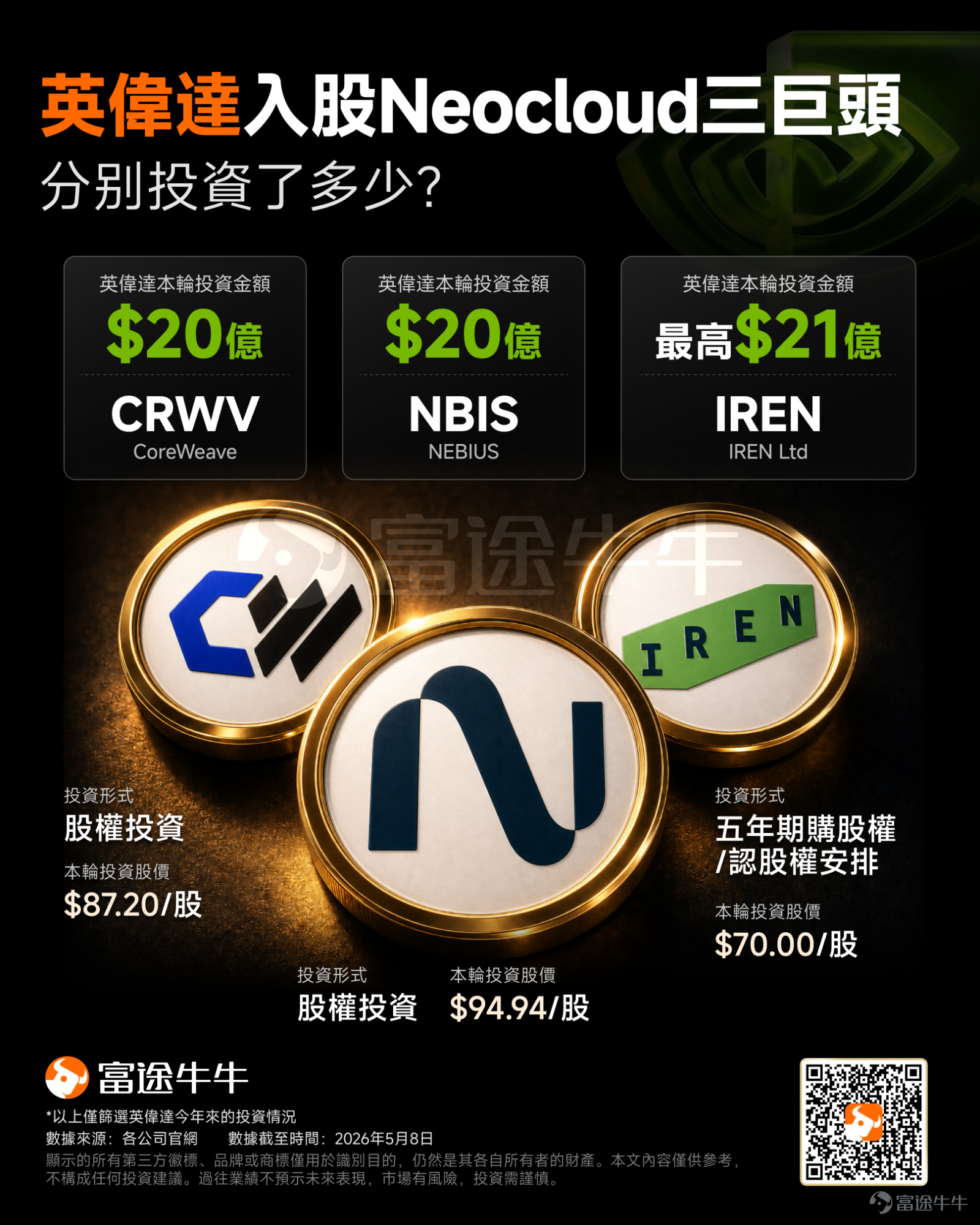
On May 7, $NVIDIA (NVDA.US)$Announce regarding$IREN Ltd (IREN.US)$announced an investment of up to $2.1 billion, while both parties signed a multi-billion-dollar computing power deployment cooperation agreement, further deepening NVIDIA's capital layout in the AI ecosystem.
According to the agreement,NVIDIA will be granted a five-year stock option allowing it to purchase up to 30 million shares of IREN at an exercise price of $70 per share.the commercialization loop for FSD is continuously being perfected, opening up new profit potential.IREN announced a $3.4 billion AI cloud computing contract with NVIDIA for the procurement and deployment of NVIDIA’s Blackwell series processors.
The two parties plan to jointly develop large-scale data centers, with NVIDIA providing hardware equipment and IREN responsible for land acquisition, power supply, and other infrastructure construction aspects.
It is worth noting that this is not NVIDIA's first move this year.
In January, NVIDIA invested $2 billion in $CoreWeave (CRWV.US)$ , deepening collaboration on infrastructure, software, and platforms to support CoreWeave's goal of building over 5GW of AI Factory capacity by 2030.
In March, NVIDIA announced another $2 billion investment in $NEBIUS (NBIS.US)$ . Their partnership covers the entire AI technology stack, from AI Factory architecture to production software, helping Nebius accelerate the construction of a full-stack AI Cloud platform and supporting its deployment of over 5GW capacity by 2030.
In fact, from CoreWeave to NEBIUS, and now IREN, NVIDIA has already poured over $6 billion into the Neocloud space this year. This is far more than just financial investment; it’s a carefully orchestrated campaign for 'cloud infrastructure reconstruction.'

At this point, many investors might want to understand why NVIDIA is making such significant bets on the Neocloud sector. What is the logic behind these three deals? And what do they mean for NVIDIA, IREN, and the broader ecosystem?
Why is NVIDIA making such significant bets on the Neocloud sector?
Historically, the market understood NVIDIA through four words: GPU dominance.
However, as the AI industry has developed to this point, the real competition is no longer just about whose chip is faster, but rather who can turn GPUs into sustainable, scalable, and directly accessible computing power services for enterprises and model companies.
This is the backdrop against which Neocloud has emerged.
Simply put, Neocloud refers to a new breed of cloud service providers specifically built for AI workloads. Unlike AWS, Azure, or Google Cloud, which evolved from general-purpose cloud computing, Neocloud was designed from the ground up around large model training, inference, GPU clusters, low-latency networks, and high-density data centers.
For NVIDIA, Neocloud holds three strategic values.
First, they act as amplifiers of GPU demand.
To expand, Neocloud needs to purchase large quantities of NVIDIA GPUs, networking equipment, and full AI infrastructure solutions. By investing in them, NVIDIA is essentially supporting its own downstream computing channels.
Second, they serve as carriers for implementing AI Factory standards.
What NVIDIA sells today is no longer just individual GPUs, but an entire AI Factory: GPUs, CPUs, DPUs, networking, CUDA, inference software, cluster scheduling, and data center reference architectures. The more Neocloud relies on NVIDIA’s architecture, the stronger NVIDIA's position as an industry standard becomes.
Third, they act as a counterbalance to traditional cloud giants.
While AWS, Azure, and Google Cloud remain among NVIDIA's most important customer groups, these giants are also advancing their own custom chips and proprietary AI infrastructure. By supporting Neocloud, NVIDIA is creating a set of more NVIDIA-native computing platforms outside the traditional Hyperscalers (large-scale cloud service providers).
Therefore, NVIDIA’s investment in Neocloud is not just a simple financial investment; it is about reshaping the distribution channels of AI computing power.
What is the logic behind these three deals?
First, through our detailed analysis of CoreWeave, Nebius, and IREN, we can see their differentiation.
1. CoreWeave: The model room for GPU cloud
Among the three giants of Neocloud, $CoreWeave (CRWV.US)$ it is the most typical representative of a GPU-native cloud.
Its core value is not just 'having a lot of GPUs,' but proving a new cloud computing model: instead of starting with general-purpose clouds and gradually adapting to AI, it builds infrastructure around AI training and inference from day one.
In January, NVIDIA invested $2 billion in CoreWeave, clearly stating that both parties would accelerate CoreWeave's plan to build over 5GW of AI factories by 2030. The cooperation includes adopting NVIDIA CPUs and storage platforms, deploying multiple generations of NVIDIA infrastructure, as well as testing and validating CoreWeave’s AI-native software and reference architecture.
This shows that CoreWeave’s significance to NVIDIA is no longer just as a customer, but as a model.
It is a case NVIDIA presents to the market: as long as an AI cloud is built around NVIDIA’s technology stack, it can meet the computing power needs of global enterprises, large model companies, and AI application developers.
Therefore, CoreWeave's role can be summarized as the commercial showcase for NVIDIA’s AI Factory.
If CoreWeave succeeds, it means the GPU-native cloud model works; if this model is viable, NVIDIA's revenue will no longer rely solely on one-time hardware sales but will be tied to the long-term expansion of AI infrastructure.
2. NEBIUS: A bet on a full-stack AI cloud platform
While CoreWeave represents the operational capability of a GPU cloud,That$NEBIUS (NBIS.US)$NEBIUS represents full-stack engineering capabilities.
The focus of NVIDIA’s collaboration with NEBIUS is on the synergy across the entire technology stack from AI factory architecture to production software. NVIDIA officially stated that this $2 billion investment reflects its confidence in NEBIUS’s business and its comprehensive AI technology stack engineering capabilities.
The keyword here is 'full-stack'.
An AI cloud isn’t just about putting GPUs into data centers. A true AI cloud that serves large models and enterprise customers needs to solve a series of engineering problems: cluster scheduling, network interconnection, storage throughput, model deployment, inference efficiency, fault recovery, billing management, and software compatibility.
NEBIUS’s value lies in its role as a cloud-based hosting platform for NVIDIA’s full-stack solutions.
For NVIDIA, NEBIUS can help transform its hardware capabilities into platform capabilities, turning chip advantages into cloud service advantages.
Therefore, the role of NEBIUS can be summarized as: the engineering platform for NVIDIA's full-stack AI cloud solution.
This step is crucial because the future competition in AI infrastructure will not just be about GPU performance but a systematic competition involving 'hardware + network + software + scheduling + developer ecosystem.'
To maintain its monopolistic position, NVIDIA cannot remain solely at the chip level; it must incorporate the entire AI cloud technology stack into its own ecosystem control.
3. IREN: What NVIDIA is really buying is the power entry point.
CoreWeave leans more towards GPU cloud operations, while NEBIUS focuses more on full-stack AI cloud engineering.The core resources of IREN are land, electricity, and data center construction capabilities.
IREN stated that its platform is built on large-scale grid-connected land and power portfolios across North America, Europe, and the Asia-Pacific region. The company also mentioned that the world is facing structural computing power shortages, with the bottleneck being deliverable data centers and GPU capacity.
This statement actually highlights the next core contradiction in AI infrastructure competition:GPUs are scarce, but electricity is even scarcer.
An AI data center cannot be built just by having money to buy GPUs. You also need land, grid connection, substations, cooling systems, data center construction, power contracts, regulatory approvals, and a construction timeline.
IREN's advantage lies precisely in these 'heavy and slow' aspects.
The transformation logic of IREN from Bitcoin mining farms to AI cloud is actually quite clear: In the past, it turned electricity into Bitcoin computing power; now, it aims to turn electricity into AI computing power.
NVIDIA’s five-year options and 5GW strategic cooperation agreement with IREN indicate that what NVIDIA values is not only the $3.4 billion contract itself, but also the power supply and data center pipelines behind IREN.
IREN’s role can be summarized as the energy and physical infrastructure gateway for NVIDIA’s AI Factory.
This is also why IREN’s deal has had a significant market impact. It signifies that the pricing logic of AI computing power is extending further from 'GPU supply' to 'electricity supply.'
At this point, we realize that while CoreWeave, NEBIUS, and IREN each have different business models when viewed individually, when considered together, NVIDIA’s strategic puzzle becomes very clear.

In other words, these three companies correspond to the three core issues of AI infrastructure:
Who will operate the GPU cloud?CoreWeave
Who will carry the full-stack AI cloud platform?Nebius
Who will solve the issues of power and data center capacity?IREN
What does this deal mean for NVIDIA, IREN, and even the entire ecosystem?
First, for NVIDIA, this is an upgrade from 'selling shovels' to 'building mining farms'.
The market often described NVIDIA as 'selling shovels' in the AI gold rush: no matter who wins, NVIDIA sells GPUs. But now, NVIDIA is no longer satisfied with just selling shovels. It has started investing in mining farms, supporting miners, controlling power access, and even participating in setting standards for computational power highways.
This indicates that NVIDIA’s business model is undergoing three changes:
First, transitioning from a chip supplier to an infrastructure organizer.
NVIDIA doesn’t just hand over GPUs to customers; it helps clients build data centers, secure power, deploy software, and form cloud service capabilities.
Second, shifting from point-based revenue to an ecosystem loop.
NVIDIA invests in Neocloud, Neocloud purchases NVIDIA systems, and then provides computing power to AI companies and enterprise clients. This ties NVIDIA’s revenue to the entire AI computing consumption cycle.
Third, the transformation from hardware standards into industry standards.
As more AI cloud platforms are built around NVIDIA's architecture, the CUDA ecosystem, NVIDIA's network interconnect solutions, AI software stack, and AI factory reference architecture will gradually become the industry’s default standards.
This is NVIDIA’s true moat. GPUs can face competition, but once the entire ecosystem takes shape, migration costs will only increase.
Secondly, for IREN, this represents a revaluation from a mining company to an AI cloud infrastructure company.
This partnership is equally significant for IREN itself.
It is no longer viewed merely as a Bitcoin mining company undergoing transformation,but has been validated by NVIDIA as part of the AI infrastructure ecosystem.
According to IREN’s announcement, the company plans to expand to 480MW by 2026, with 1,210MW of AI Cloud capacity under construction by 2027, and further expansion planned around a 5GW secured power portfolio after 2028; the company also mentioned acquiring Nostrum to add 490MW of resources in Spain and acquiring Mirantis to enhance software orchestration and support capabilities.
This indicates that IREN’s transformation is not just about “converting mining farms into data centers,” but rather an attempt to build comprehensive AI Cloud capabilities: power, data centers, GPUs, software operations, and customer delivery.
However, this brings higher execution requirements. AI data centers are far more complex than Bitcoin mining farms. Bitcoin mining focuses more on electricity prices and miner efficiency, while AI clouds require highly reliable networks, GPU cluster stability, customer SLAs, software scheduling capabilities, and continuous capital expenditures.
Therefore, the logic for revaluing IREN holds, but the premise is that it must truly complete its transformation from an energy asset provider to an AI cloud service provider.
Finally, the impact on the entire AI ecosystem: the competition for computing power has entered a 'heavy-asset arms race.'
NVIDIA's bet on Neocloud will have the biggest impact on the entire AI ecosystem by pushing the competition for computing power into a heavy-asset phase.
In the past, AI competition focused more on models, algorithms, and applications. Now, the competition is shifting to infrastructure: whoever has GPUs, electricity, data centers, and the ability to fund capital expenditures will gain control of the next phase of influence.
This will lead to three outcomes.
First, the strategic value of AI cloud platforms is rising.
Companies like CoreWeave, NEBIUS, and IREN are no longer just 'cloud service providers,' but new infrastructure nodes in the AI supply chain.
Second, power assets are being repriced.
The case of IREN illustrates that grid-connected electricity, land, and data center pipelines are becoming core scarce resources in the AI era.
Third, NVIDIA's ecosystem influence is further spilling over.
It not only controls the supply of GPUs but also manages the expansion pace of downstream computing power platforms through capital and partnerships.
In other words, the next phase of AI is not just about who has the stronger model but who can support larger-scale, lower-cost, and more stable computing power supply.
Is it an 'ecosystem flywheel' or a 'capital cycle'?
Of course, NVIDIA's approach is not without controversy.
The market's biggest concern is the issue of 'circular financing': NVIDIA invests in downstream customers, who then use the funds to purchase NVIDIA GPUs. Could this inflate revenue and demand in the short term?
This skepticism is not without merit.If Neocloud’s end-user demand is real and sustainable, then NVIDIA's investment in downstream is ecosystem expansion. However, if end-user demand is insufficient or overly reliant on financing, this model could lead to controversies regarding revenue quality and capital returns.
Moreover, AI data centers are extremely capital-intensive industries. Grid connection for electricity, GPU procurement, liquid cooling upgrades, data center construction, and debt financing all require massive capital investment.IREN itself disclosed in its latest quarterly report that total revenue fell to $144.8 million, with a net loss of $247.8 million, reflecting ongoing cost pressures as it transitions from Bitcoin mining to AI Cloud.
Therefore, this strategy is not without risks.
What investors really need to track is not who NVIDIA has invested in again, but three more fundamental questions:
First, whether Neocloud can secure enough real end-customer orders.
Second, whether data centers and power capacity can be delivered as planned.
Third, whether AI training and inference demands can continuously absorb the newly added computing power.
Only if these three points hold true can NVIDIA's Neocloud investment become an ecosystem flywheel rather than a capital cycle.
Summary
From CoreWeave to NEBIUS, and then to IREN, NVIDIA’s capital layout is becoming increasingly clear.
CoreWeave addresses GPU cloud operations; NEBIUS provides a full-stack AI cloud platform; IREN tackles power and physical infrastructure—combined, they form the complete prototype of an AI Factory.
This is also NVIDIA's true strategic ambition: it doesn’t just want to be an AI chip supplier, but aims to become the standard-setter for AI infrastructure, a capital organizer, and an ecosystem controller.
Therefore, NVIDIA’s heavy bet on Neocloud,appears to be an investment on the surface, but is essentially a strategic positioning move.It's not betting on the stock price of a single company, but rather on the three scarcest elements in the AI era: computing power, electricity, and the right to distribute computing power.
In other words,NVIDIA’s investment in the CoreWeave trio isn’t just about buying stocks; it’s about building its own AI computing power highway.
Finally, fellow investors interested in Jensen Huang’s investment portfolio can click to view.‘Follow Jensen Huang's Strategy! NVIDIA Heavily Bets on Corning, the Strongest Dark Horse in the AI Investment Landscape Soars 350%’!

Risk Disclaimer: The above content only represents the author's view. It does not represent any position or investment advice of Futu. Futu makes no representation or warranty.Read more


Comments (6)
to post a comment
106
369