
Samsung strike alert lifted! Where are memory stocks headed?

Daily Options Seller Strategy | The storage supercycle continues! SanDisk and Micron hit new highs in the previous trading session. How to position with options after missing the entry opportunity?
I. Market Barometer: Outstanding performance of the semiconductor sector, storage supercycle bursts into prominence
The Nasdaq and S&P 500 indices hit new highs in the previous trading session.Storage chip sectorDriven by three factors—AI computing power demand, surging DRAM/NAND prices, and sold-out HBM capacity—it has become a key market trend. AI-driven training and inference are pushing storage demand to grow exponentially. Combined with leading manufacturers allocating over 70% of their new capacity to HBM, the industry is shifting from 'inventory reduction' to 'inventory scramble.'
Short-term risks lie in the sector's significant accumulated gains, which may lead to volatile consolidation needs. However,the AI-driven storage supercycle shows strong certainty. In the current environment of soaring short-term implied volatility (IV) in the storage sector, investors may consider an options selling strategy.
II. Focus on Hot Targets
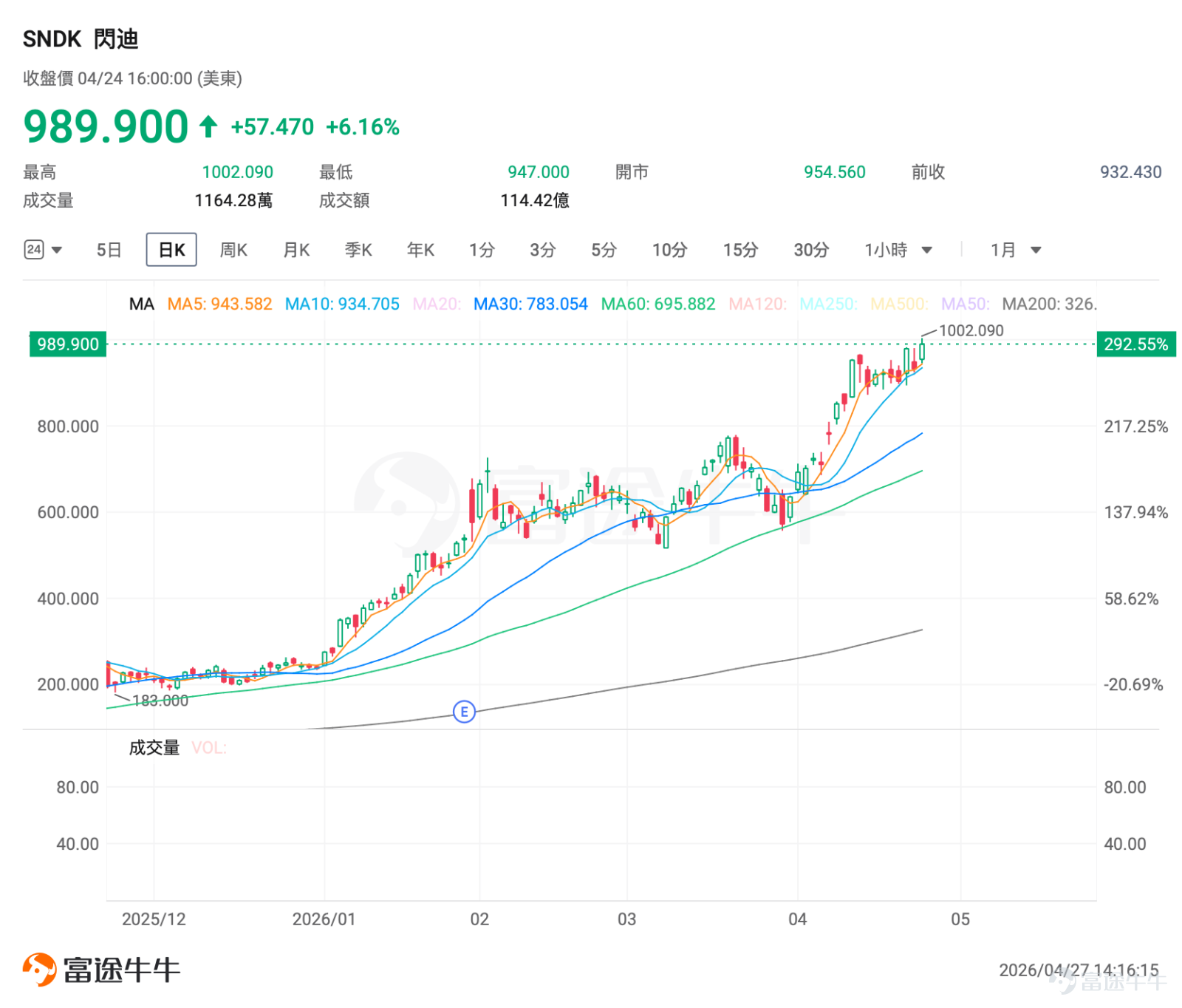
$SanDisk (SNDK.US)$ The stock closed at $989.90 in the previous trading session, surging 6.16%, reaching an intraday high of $1002.09—a new all-time high. Year-to-date, it has risen over 317%.

NAND flash memory prices have risen continuously for 15 months, with expectations of another 70%-75% increase in Q2. 90% of the company's revenue comes from long-term contracts with cloud vendors, ensuring stable cash flow. Since April, Wells Fargo & Co, Citi, and others have raised their target prices; Citi increased its target from $900 to $1080. On April 20, the company was added to the Nasdaq 100 Index, gaining passive investment inflows. Risks include the rapid recent rise, technical overbought conditions, and significant profit-taking; the company remains in a loss-making state with a negative TTM P/E ratio.
2、 $Micron Technology (MU.US)$: Earnings and valuation double boost, significantly improved order visibility pushes market cap to new highs
$Micron Technology (MU.US)$ The stock closed at $496.72 in the previous trading session, up 3.11%. It has gained over 47% since April, with a total market value surpassing $560 billion.

HBM capacity is sold out until 2027, and DDR5 capacity remains tight, significantly improving the company’s order visibility. The company's Q2 results for the fiscal year 2026 exceeded expectations, with gross margin surging to 74.4%; UBS Group raised its target price to $535, while the analysts' average target price stands at $549, indicating further upside potential compared to the current stock price.
III. Seller Options Strategy
1. Sell 1 contract$SanDisk (SNDK.US)$May 1, 2026, 800P, estimated required margin (for reference only): $80,000 ($800 x 100)

2. Sell 1 contract$Micron Technology (MU.US)$May 15, 2026, 420P, estimated required margin (for reference only): $42,000 ($420 x 100)

Strategy rationale:
$Micron Technology (MU.US)$ 、 $SanDisk (SNDK.US)$ As a core investment target in the storage sector, it will benefit from the super storage cycle over the long term and is suitable for long-term holding. However, the recent sharp rise poses some downside risks, making it highly risky for investors who missed earlier opportunities to chase the stock at higher levels.
By selling call options with strike prices below the current stock price, if the share price continues to rise or consolidates at high levels, premium income can be collected, enhancing idle cash returns; if the stock price pulls back to the strike price, shares can be purchased at lower costs to gain exposure to this core storage asset, achieving dual objectives of 'earning premiums when the market rises, and building positions at lower prices when it falls.'
IV. Risk Control Reminder
Although the seller strategy has a high probability of success, investors must still manage risks effectively:
– Position management is key:The biggest risk for sellers lies in black swan events. It is recommended thatthe margin requirement for any single underlying should not exceed 20% of total capital. Never sell options beyond your capacity to handle them just for the sake of greedy premium collection.
– Covered call options should be rolled over in a timely manner.(Rolling): When a covered call option becomes deeply in-the-money (stock price far exceeds the strike price),if you remain bullish on the underlying stock, you should decisively 'roll' the position— that is, buy to close the current option while simultaneously selling an option with a further expiration date and a higher strike price, avoiding the forced liquidation of the underlying stock at a low price.
– Cash-secured put options should beware of 'left-tail risk':For cash-secured puts,if the stock price collapses due to deteriorating fundamentals (rather than normal pullbacks), don’t hold on stubbornly.At this point, it's advisable to cut losses or 'roll down' to gain time, waiting for volatility to normalize.
Make the most of the options seller zone to understand income strategies for selling options,Earn option premiums!

Options Risk Warning
An option is a contract that grants the holder the right, but not the obligation, to buy or sell an asset at a fixed price on a specific date or at any time before that date. The price of an option is influenced by various factors, including the current price of the underlying asset, the strike price, time to expiration, and implied volatility. Implied volatility reflects the market’s expectations for the level of volatility in the option over a future period. It is a data point derived inversely from the Black-Scholes option pricing model and is generally regarded as an indicator of market sentiment. When investors anticipate greater volatility, they may be more willing to pay a higher price for options to hedge risks, resulting in higher implied volatility. Traders and investors use implied volatility to assess the attractiveness of option prices, identify potential mispricings, and manage risk exposure.
Disclaimer
This content does not constitute any offer, solicitation, recommendation, opinion, or guarantee of any securities, financial products, or tools. The risk of loss in trading options can be substantial. In some cases, losses may exceed the initial margin deposited. Even if you set contingent orders such as 'stop-loss' or 'limit' orders, these may not prevent losses. Market conditions may make such orders unexecutable. You may be required to deposit additional margin within a short period. If you fail to provide the required amount within the specified time, your open positions may be liquidated. However, you will still be responsible for any shortfall in your account. Therefore, before trading, you should study and understand options and carefully consider whether such trading is suitable for you based on your financial situation and investment objectives. If you trade options, you should be familiar with the procedures for exercising options and the rights and obligations upon exercise and expiration. Options trading carries extremely high risks and is not suitable for all investors. Investors should carefully readCharacteristics and Risks of Standardized Options。
Editor/Doris
Risk Disclaimer: The above content only represents the author's view. It does not represent any position or investment advice of Futu. Futu makes no representation or warranty.Read more

Comment (1)
to post a comment
5
11