
The S&P 500 has risen for seven consecutive weeks—should you chase the rally or take profits?
Options Sir on Macro | Nasdaq's 13-day winning streak ends! Fed's Chris Waller debut and Middle East turmoil deadline loom, US stocks at a crossroads
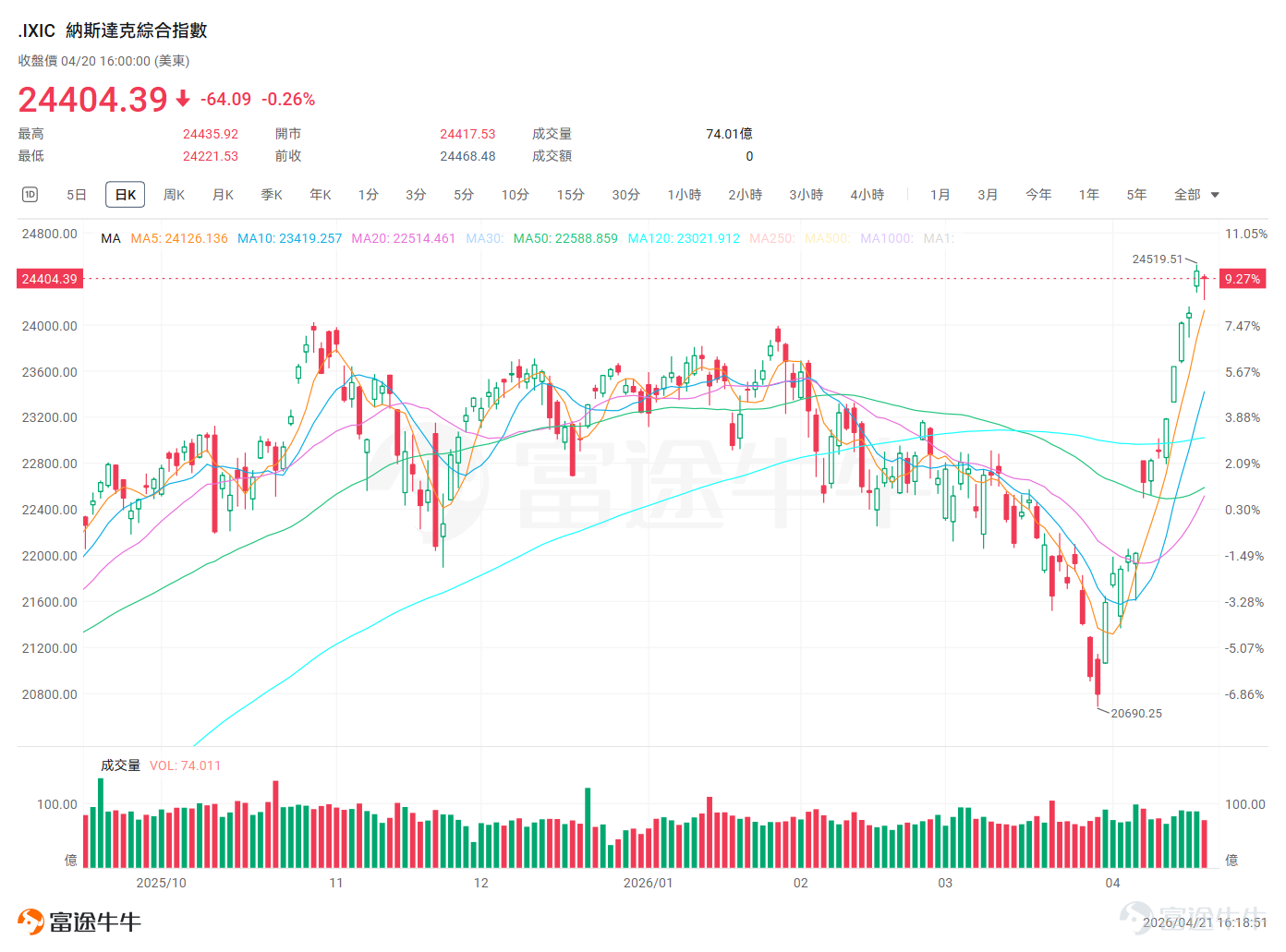
If fellow investors have grown accustomed to the 'effortless winning' mode of US stocks essentially rising every day over the past two weeks, they may need to be more vigilant going forward. A landmark record came to an abrupt end last night—the Nasdaq's 13-day winning streak has officially ended.

The market’s breather is not without cause, as investors are now focusing on two major upcoming events:
First, tonight (April 21, Eastern Time), Kevin Warsh, the nominee for Federal Reserve Chair, will attend his confirmation hearing before the Senate Banking Committee; second, the temporary US-Iran ceasefire agreement, set to expire tomorrow (April 22), with the prospects for the second round of negotiations remaining uncertain. The intersection of these two events will profoundly influence market risk appetite and asset price direction in the near future.
On one side, there is the interview for the head of the Fed, who determines the 'price of money' (interest rates); on the other, geopolitical tensions affecting 'oil prices' and global nerves. When technical overbought conditions in the market meet significant fundamental uncertainties, how should we view the road ahead? What practical strategies can investors who want to find opportunities in volatility refer to?
Hidden Worries Amid the Feast: Narrowing Breadth of the Rally, Momentum Faces Challenges
The Nasdaq index achieved its longest consecutive rally in nearly 13 years, while the S&P 500 also broke through the 7,000-point mark, continuously setting new all-time highs.The forces driving this rally are very clear: first, signs of easing tensions between the US and Iran have caused a sharp rebound in market risk appetite; second, the start of earnings season has seen results generally surpassing expectations, dispelling fears of an economic recession.
However, this rally itself has accumulated substantial technical overbought pressure and profit-taking positions. The internal 'health' of the market has also shown some hidden concerns: the rally increasingly relies on the technology sector, with market breadth (the proportion of advancing stocks) narrowing. This is akin to a team where the forwards are charging ahead aggressively, but the midfield and defense lines are starting to lag behind.
Therefore, the end of the consecutive rally mostly signifies “a temporary conclusion to the one-sided sprint phase.” The market needs to pause, wait for more fundamentals (additional earnings reports), observe new events (hearings, geopolitics), and then decide whether to continue the charge or take a breather.
The key question is: Is this a healthy pause, or the beginning of trend exhaustion? The answer may lie in the development of the next two events.
Dual Eye of the Storm: The Ultimate Game Between the Wash Hearings and US-Iran Negotiations
Tonight’s hearing holds significance far beyond a procedural review. Market focus has shifted from whether Wash will 'take office' to 'how he will set the policy path'.A leaked draft of his speech indicates that Wash will pledge strict independence on interest rate issues, believing that comments from the President or other elected officials on interest rates will not threaten the central bank's independence. This statement aims to ease market concerns about the Federal Reserve’s independence.
However, the live questioning session is the real key.Wash will face a triple balancing act: shrinking the Federal Reserve's balance sheet without disrupting markets, bringing inflation back to 2%, and avoiding Trump's intervention which could weaken the Fed's independence in the process. His past views suggest that reducing the balance sheet by $1 trillion would have an economic impact equivalent to a 50-basis-point interest rate hike, and he advocates for simultaneous 'balance sheet reduction and rate cuts'.
The market's most favorable scenario is “no big news”:
If Wash successfully demonstrates his balancing act, the market will be boosted.The key lies in his ability to solidify policy credibility with a hawkish stance (maintaining the anti-inflation target and defending Fed independence) while cleverly paving the way for easing (such as linking rate cuts to a new narrative of 'AI suppressing inflation').This 'outwardly hawkish but inwardly dovish' expectation management can simultaneously alleviate inflation concerns and strengthen hopes for rate cuts, potentially driving stock market gains (especially in tech stocks), lowering U.S. Treasury yields, and weakening the dollar.
Being overly hawkish or overly dovish could both have counterproductive effects:
If Vosh's statement is unbalanced, it may trigger a market sell-off.Any deviation from the expectation of 'prudent balance' could lead to significant volatility.
There are two bearish paths: Hawkish impact – an unexpectedly tough stance on inflation, suggesting rates will be 'higher for longer,' directly hitting high-valuation growth stocks and causing a stock market decline. Dovish risk – overemphasizing rate cuts, interpreted as succumbing to political pressure, damaging the Fed’s credibility and instead triggering inflation concerns and a spike in U.S. Treasury yields, tightening financial conditions and causing a drop in risk assets.

Additionally, the U.S. and Iran reached a two-week ceasefire agreement on April 8, set to expire on Wednesday night Washington time (around April 23 Beijing time). As the final moment approaches, the situation has reached its peak with repeated fluctuations:
President Trump stated that he would not lift the maritime blockade on Iran before reaching an agreement and that extending the ceasefire was 'highly unlikely.' In response, Iran firmly rejected negotiations under threat, accusing Trump of wanting to turn the negotiation table into a 'surrender table.'
The U.S. military seized an Iranian cargo ship in the Gulf of Oman, while Iran sent armed speedboats to block merchant ships in the Strait of Hormuz. The passage through the Strait of Hormuz alternated between 'open' and 'closed,' directly causing sharp fluctuations in international oil prices, with Brent crude surging nearly 6% on Monday.
Iranian officials once denied any negotiation plans, but U.S. media reported that Iranian representatives were planning a trip to Islamabad. As of press time,
This ongoing pattern of 'fighting while talking' has led to signs of 'desensitization' in the market. Markets seem to have already priced in another extension of the ceasefire, with Trump likely to continue following the 'TACO' script.However, until the agreement is finalized or completely collapses, any sudden news (such as the strait being closed again or military friction) will continue to disrupt the market in the short term.
Traffic data shows that the flow through the Strait of Hormuz saw a small peak last week, the highest since the conflict began, but has started to decline again in the past two days.
Options Strategy: How to 'Surf' in Volatility?
For investors looking to capitalize on volatility for profit, options are a powerful tool.This week, two major macro events overlap, along with significant earnings reports from individual stocks, $Tesla (TSLA.US)$which could lead to highly volatile market conditions.
Unlike traditional monthly or weekly expiring options, $SPDR S&P 500 ETF (SPY.US)$ and $Invesco QQQ Trust (QQQ.US)$ major ETFs such as Nasdaq offer options that expire every trading day (0DTE), allowing deployment on the same day as key events (such as tonight’s hearing or tomorrow’s ceasefire expiration) to achieve precision targeting.
Based on different risk appetites, several strategic approaches can be considered:
(1) Directional speculation
At critical moments during the hearing Q&A or breaking Middle East news, quickly buy out-of-the-money call or put options expiring the same day, betting on the immediate directional impact of the news on the market.
For example, if Wash makes an extremely hawkish statement, immediately buy puts; if breaking news indicates an extension of the ceasefire agreement, immediately buy calls. It's important to note that positions must be 'quick in, quick out,' treating the options like 'event lottery tickets.' Regardless of profit or loss, avoid holding overnight as the option value may drop to zero.

(The design images displayed on screen are for illustrative purposes only and do not constitute any investment advice or guarantees; market conditions fluctuate frequently, and the option prices shown do not represent real-world values.)
(2) Moderately bearish
If you believe the market's momentum for consecutive sharp rises is limited, but a crash-like decline is also unlikely, you can consider a Bear Put Spread. This involves buying one Put option with a higher strike price while simultaneously selling another Put option with a lower strike price, both with the same expiration date.
This strategy provides an opportunity to profit from a moderate drop in stock prices by paying a defined and limited upfront cost, while strictly capping the maximum loss at that cost, resulting in a more moderate and controllable risk-reward structure overall.

(The design images displayed on screen are for illustrative purposes only and do not constitute any investment advice or guarantees; market conditions fluctuate frequently, and the option prices shown do not represent real-world values.)
Finally, here's a small perk for fellow Futubull investors, welcome to claim it.Options Beginner Pack
*This event is exclusive to invited HK users. Click to learn more.Detailed event rules>>
Futu's simulated trading challenge is now open for registration! Zero cost, zero risk, and you could win stock cash vouchers!For more details, click here
Disclaimer
This content does not constitute any offer, solicitation, recommendation, opinion, or guarantee for any securities, financial products, or instruments. The risk of loss in trading options can be substantial. In some cases, your losses may exceed the initial margin amount deposited. Even if you have set contingent orders, such as 'stop-loss' or 'limit' orders, they may not necessarily prevent losses. Market conditions may render these orders unexecutable. You may be required to deposit additional margin within a short period. If you fail to provide the required amount within the specified time, your open positions may be liquidated. However, you will still be responsible for any deficit balance in your account. Therefore, before trading, you should study and understand options and carefully consider whether such trading is suitable for you based on your financial situation and investment objectives. If you trade options, you should be familiar with the procedures upon exercising options and at expiration, as well as your rights and obligations when exercising options and at expiration.
Risk Disclaimer: The above content only represents the author's view. It does not represent any position or investment advice of Futu. Futu makes no representation or warranty.Read more


Comment (1)
to post a comment
20
43