
CPU returns to the core of AI! Who are the big winners?

Options Sir Breaks Down the Hot Topic | AMD's 12-day Winning Streak! From 'Supporting Role' to Core, Can CPUs Follow the Same Path as Memory?
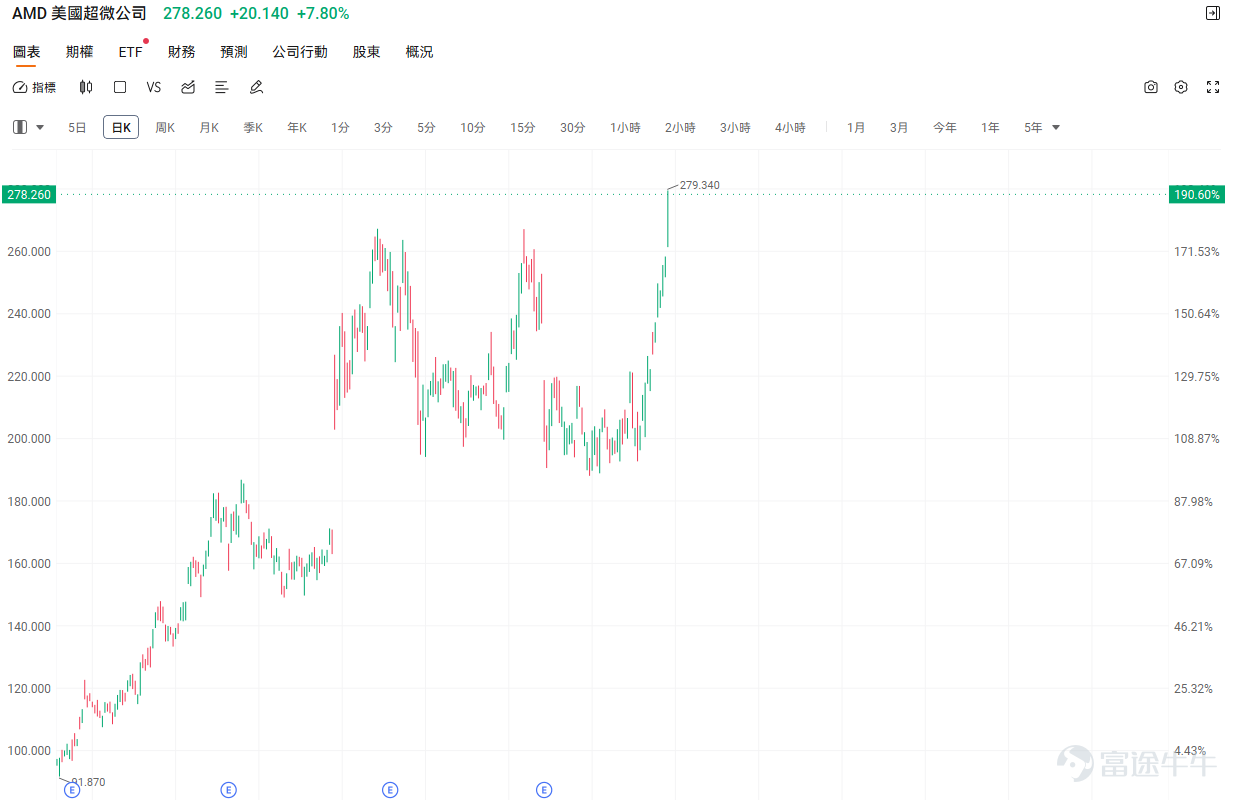
On April 16, $Advanced Micro Devices (AMD.US)$ Closing up 7.8%, marking a 12-day winning streak and breaking new highs at $278.29. The positive factors this time include not only an increase in GPU orders, but more importantly, $Taiwan Semiconductor (TSM.US)$ 、 $ASML Holding (ASML.US)$ The earnings report confirmed another acceleration in AI demand while also indicating that AI agents are driving the demand for CPUs.The core logic behind this round of market momentum is investors reassessing AMD’s server CPU business – with the rise of the AI agent wave, the strategic importance of CPUs in data centers is undergoing structural reevaluation.
Not coincidentally, this CPU-driven trend has affected not just AMD alone, $Intel (INTC.US)$ Yesterday, NVIDIA's stock price rose by 5.49%. $Arm Holdings (ARM.US)$ It went up 1.88%. Both NVIDIA and Arm announced their entry into the server CPU market in March 2026. Market research firm TrendForce expects the ratio of AI data center CPUs to GPUs to narrow significantly from the current 1:4 to 1:8 to 1:1 to 1:2. The competitive landscape of the CPU sector is accelerating its reshaping.

Why has the CPU become so important?
In the past, AI was primarily focused on training and simple text generation.with the GPU handling core computations and the CPU playing a supporting role in scheduling.Currently, with OpenAI o1, code agents, multi-agent collaboration, RAG as representatives of the new generation of applications, AI is required to be autonomous:
1) Task decomposition, multi-step reasoning, logical judgment
2) Frequent tool invocation (search, database, code interpretation, web crawling)
3) Multi-threaded scheduling, state maintenance, cross-agent communication
4) Long-duration continuous operation (several hours)
All of these are CPU-intensive tasks, which GPUs are not good at.
1) In the agent scenario,CPU processing latency accounts for 90.6% of total latency
2) The CPU load of a single AI agent is 10 to 100 times that of an ordinary user
3) The server CPU:GPU ratio is rapidly narrowing to 1:1~1:2
4) The number of CPU cores in a single AI server has increased from 32 cores to 128 cores
5) A traditional AI data center requires 30 million CPU cores per gigawatt, which will increase during the agent era 120 million(×4)
Therefore, market research firm TrendForce predicts thatthe ratio of CPUs to GPUs in AI data centers will narrow significantly from the current 1:4 to 1:8 to 1:1 to 1:2. CThe competitive landscape of the CPU sector is accelerating its transformation.

Why is AMD's rise more aggressive?
AMD's rise has been stronger as it is now at the intersection of both sides of the trade. On one hand, AI Agent reinforces the CPU narrative Lisa Su mentioned earlier this year when she stated that CPU demand had exceeded expectations due to increasing inference needs. On the other hand, AMD still has another leg tied to its rack-scale GPU roadmap. AMD has officially announced that the Helios rack equipped with MI450 will be launched in the second half of 2026, and new market rumors on April 16According to SemiAnalysis’s social media summary, suggest that Anthropic might start adopting AMD's GPUs from the MI450. This report remains speculative and does not confirm a contract, but it gives investors a reason to imagine AMD achieving more victories beyond the current CPU boost.
Intel's moves are easier to explain. Reuters reported on April 9$Google-C (GOOG.US)$ will continue to deploy Intel Xeon processors, including Xeon 6, while both companies deepen their collaboration on custom infrastructure processors. Intel CEO Lip-Bu Tan stated that scaling AI requires balanced systems, and CPUs and IPUs are crucial for delivering performance, efficiency, and flexibility. Reuters also explicitly linked stronger CPU demand to the rise of intelligent agent-based AI systems. Therefore, even though Intel is not the leader in the AI accelerator market, it still benefits from the same trend of increased CPU relevance.
How the Market Sees It: Analysis of Options Signals
From the options signals perspective,AMD's Put/Call ratio reached 0.49, and INTC hit 0.55, reflecting a highly bullish short-term sentiment in the market. Currently, AMD's implied volatility (IV) percentile is at 85%, and INTC is at 94%.Both figures are at historically high levels, indicating market expectations of further stock volatility.


However, risk factors cannot be ignored: While TSM and AMSL's earnings guidance points to strong growth expectations and robust demand for CPUs,supply-side constraints remain, and evidence is still needed to support AMD and INTC’s performance optimization and capacity increases.AMD needs to translate its MI450 and Helios roadmaps into visible sales and lasting customer wins. Intel, on the other hand, needs to demonstrate that the renewed importance of CPUs can lead to sustained financial improvements rather than just an emotional rebound.
In terms of open interest,AMD's Put/Call open interest ratio is as high as 1.08, with INTC at 0.97, showing a relatively high proportion of put options held, reflecting market concerns about a potential pullback after an emotionally driven rally.


How to invest in options: optimistic in the long term, cautious in the short term
From a long-term perspective, the market's demand for CPUs will further increase. If you are optimistic about the value and potential of the CPU market in the long term, you canbuy LEAPS Call options expiring in one year. Compared with buying the underlying stock directly, purchasing LEAPS Call options requires less capital but still allows you to track the returns of the underlying stock to a certain extent, making it an efficient use of funds.

From a short-term perspective, the current implied volatility (IV) percentile of the stock has reached 80%, which may be unfavorable for single-leg option buyers if the stock peaks in the short term. At this point, using a multi-legged option position to hedge against the impact of time decay might be more appropriate. If you hold the underlying stock and want to hedge against downside risk, you can buy a Put option above and sell a Put option below to createa bear put spread, where the purchased Put option hedges the downside risk of the underlying stock, while the sold Put option partially offsets the time decay of the bought option.

Conversely, if you're optimistic about the stock price continuing to rise in the short term, you can open a positionBull Call Spread, betting on a moderate rise in the stock.

Finally, here's a small perk for fellow Futubull investors, welcome to claim it.Options Beginner Pack
This event is exclusively for invited HK users, click to learn moreDetailed event rules >>
Disclaimer
This content does not constitute any offer, solicitation, recommendation, opinion, or guarantee for any securities, financial products, or instruments. The risk of loss in trading options can be substantial. In some cases, your losses may exceed the initial margin amount deposited. Even if you have set contingent orders, such as 'stop-loss' or 'limit' orders, they may not necessarily prevent losses. Market conditions may render these orders unexecutable. You may be required to deposit additional margin within a short period. If you fail to provide the required amount within the specified time, your open positions may be liquidated. However, you will still be responsible for any deficit balance in your account. Therefore, before trading, you should study and understand options and carefully consider whether such trading is suitable for you based on your financial situation and investment objectives. If you trade options, you should be familiar with the procedures upon exercising options and at expiration, as well as your rights and obligations when exercising options and at expiration.
Risk Disclaimer: The above content only represents the author's view. It does not represent any position or investment advice of Futu. Futu makes no representation or warranty.Read more

Comments
to post a comment
28
10