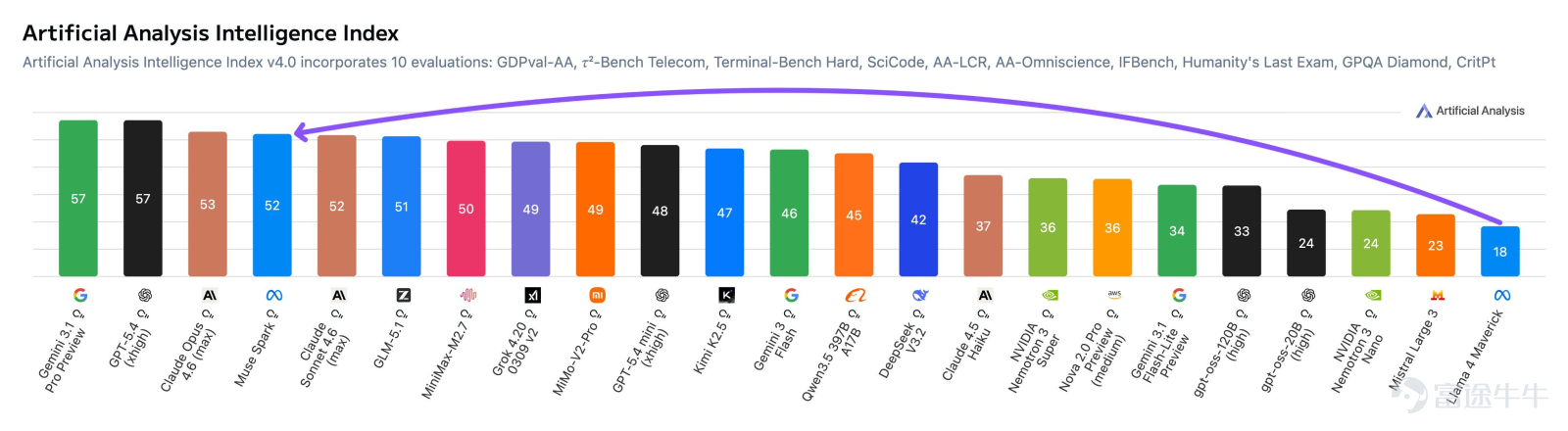

Muse Spark makes its debut! Meta officially enters the top-tier AI competition

OptionSir Breaks Down the Hottest Trends | Back to the AI Large Model Scene! Meta Soars, After New Model Ignites Frenzy, How to Invest?
Meta has once again highlighted its presence in AI. Meta's stock surged 6.52% in a single day, with the direct catalyst being the launch of its new model, Muse Spark, the first major release from its newly formed Superintelligence team in over a year. However, it should be noted that this round of gains does not mean Meta has completely escaped controversy, as there were significant market concerns about the return on its AI investments.
What exactly did Meta release this time, and why is the market reaction so significant?
What the market truly revalued this time is Muse Spark, introduced by Meta Superintelligence Labs. Meta officially stated that Muse Spark is the company’s 'most powerful model to date,' already integrated into the Meta AI app and meta.ai.It will also be rolled out to WhatsApp, Instagram, Facebook, Messenger, and AI glasses in the coming weeks.This marks Meta's first major AI model launch in about a year, and also represents a key move by the company to regain a competitive edge in cutting-edge model development after Llama 4 failed to impress the market.
The core reason behind the market’s strong positive reaction isn’t just 'the release of a new model,' but rather that Meta has finally advanced from 'heavy AI investment' to a stage where 'AI products are being rolled out, ecosystems distributed, and future commercialization paths are becoming clearer.'
Official materials indicate that Muse Spark is not an isolated lab product but is designed around Meta’s existing super traffic entry points. It supports complex reasoning and multi-modal tasks while directly integrating into social content, recommendations, search, shopping, and device scenarios, making it easier for investors to link it to subsequent user engagement, ad conversion, business tools, and API revenue.

However, it should be noted that Meta’s surge on Wednesday was not solely due to the new model itself but also benefited from the broader recovery of the U.S. tech sector that day. Meta was the best-performing stock among the Magnificent Seven, benefiting both from the release of Muse Spark and the market's improved risk appetite.
Meta has retraced over 25% from its peak; how long will this rebound last?
Meta isn't continuing to stretch its valuation from a strong high point but is rebounding from a significant pullback. As of this recent surge, Meta’s year-to-date decline is still approximately 7%. Meanwhile,Meta’s drop in the first quarter of this year was about 13%, marking one of its worst quarterly performances since 2022.Its lowest point saw a pullback of about 25% from last year’s stock price peak.
There are three main layers of pressure behind this. The first is excessive AI capital expenditure. Meta’s guidance for capital expenditure in 2026 is as high as 135 billion USD, raising concerns that it may repeat the previous 'huge metaverse investment with overly long return cycles,' leading to a valuation discount. The second is legal and regulatory disruptions. A late-March ruling on platform safety for teenagers prompted investors to reassess potential constraints on its algorithm and advertising businesses. The third is the macro advertising environment, including geopolitical and trade factors fueling concerns about fluctuations in advertiser budgets.

Precisely because of the earlier heavy losses, the significance brought by Muse Spark goes far beyond a single day's rally. Fundamentally, it is correcting a pessimistic narrative about Meta in the market: Meta isn’t just burning money on AI infrastructure—it still has the opportunity to quickly embed model capabilities back into its already powerful social traffic and advertising monetization system. As long as the market begins to believe this again, Meta’s valuation recovery won’t be confined to a one-day rebound.
Meta's Strongest Trump Cards: Cash Flow and a Closed Business Loop
If the focus is solely on "who is building the largest models," Meta may not be the most compelling player; but when the question shifts to "who is best positioned to turn large models into profit-generating tools," Meta remains one of only a handful of companies worldwide with the strongest prospects. In the fourth quarter of 2025, Meta reported revenue of $59.893 billion, up 24% year over year, with full-year revenue totaling $200.966 billion. Within this, advertising revenue reached $58.137 billion in the quarter and $196.175 billion for the full year, while the Family of Apps generated $198.759 billion in annual revenue—underscoring that this segment continues to be the company's overwhelming profit engine.
More importantly, it's about cash flow.In 2025, Meta's full-year operating cash flow totaled US$115.80 billion, with free cash flow of US$43.59 billion; as of the end of 2025, its combined holdings of cash, cash equivalents, and marketable securities amounted to US$81.59 billion. This indicates that, despite extremely high capital expenditures, MetaStill a company that "can sustain the AI arms race through self-generated revenue."rather than relying on external financing to bet on a long-term narrative. This is critically important in the era of large models.
From the perspective of deep business integration, Meta's advantages are highly concrete rather than abstract "AI empowerment." According to official disclosures, its Family daily active users reached 3.58 billion in December 2025; in the fourth quarter, ad impressions grew 18% year over year, and the average price per ad rose 6% year over year. The company also revealed that its AI-powered recommendation and advertising systems continue to deliver improved performance: Facebook ad clicks increased by 3.5% in the fourth quarter of 2025, while Instagram conversions rose by more than 1%; revenue from video-generation ad tools has annualized at $10 billion, and the launch of a new model for incremental attribution tools has driven a 24% increase in incremental conversions.

In other words, Meta's AI is not some abstract "cutting-edge model race" floating in a vacuum; rather, it is deeply embedded within the end-to-end loop of recommendation and distribution, user engagement, ad clicks, merchant conversion, and content–shopping integration. The biggest highlight of Muse Spark lies precisely in its potential to extend this integrated approach—from advertising and recommendations all the way to search, shopping, messaging, creator-content distribution, and wearable devices. For capital markets, AI that is "close to revenue" typically commands higher valuations than mere benchmark performance.
How to invest in the underlying stock: It's more suitable for buying on pullbacks, pending confirmation from earnings reports.
From the perspective of the underlying stock, the most appropriate approach for Meta right now is not to chase short-term sentiment-driven rallies, but rather to view it as a…Core business with high cash flow + AI narrative recovery + Earnings reports still have a validation window Leading technology stocks. Although the current share price surged in a single day, from a year-to-date perspective, it has not fully recovered previous losses, indicating that the market hasn't returned to a highly optimistic position on the AI story.
A more reasonable stock investment strategy is to view Meta in two phases. In the short term, focus on the public response and product feedback following the release of Muse Spark, and whether the market continues to include it in the 'AI application layer reassessment' theme.In the medium term, the focus is mainly on the next earnings report and management guidanceParticularly on two issues: first, whether the advertising business can continue to use AI to improve efficiency; second, whether the market begins to accept that high capital expenditure corresponds to faster productization and commercialization, rather than another long-term money-burning story. Meta's revenue guidance for Q1 2026 provided in January was between $53.5 billion and $56.5 billion, so the upcoming earnings validation remains key to sustaining the stock price.
In terms of specific investments, the stock is more suitable for two types of investors. The first type are those willing to hold for the medium term, who can treat Meta as the 'leading platform in the AI application layer' for phased investment. The second type are those looking to trade based on events, who would be better off waiting for a pullback after a big rise, rather than emotionally chasing highs after a large volume single-day surge. The bullish logic for Meta is now clear, but it also faces triple pressures from high capital expenditure, regulatory scrutiny, and macro advertising conditions, making it unlikely for the stock price to follow a straight upward trajectory.
How to invest in options: The core is choosing the right odds structure
If participating via options, Meta’s main feature is that it has both a strong long-term narrative and clear near-term catalysts, so a one-size-fits-all approach is unsuitable. A more practical method is to differentiate based on what you are trading.
1) Medium-term recovery focus: Prioritize 'stock + small position in call options'
This approach suits those who believe Meta’s AI reassessment won’t last just a day or two but don’t want to chase highs with too much cash. The underlying logic is: holding the stock captures the medium-term trend, while a small call option position amplifies potential gains if the AI narrative continues to develop and earnings exceed expectations again. Here, the key is controlling position size, not fantasizing about short-term windfalls.
2) Focus only on earnings report events: prioritize 'directional strategies with limited losses.'
The next major volatility window for Meta is most likely still the earnings report. If you believe that Muse Spark will be further framed as a commercialization pathway during the earnings call, and management can ease market concerns about Capex, consider buying call options or a bull call spread. The latter is typically more stable than outright buying of calls because it reduces cost and time decay, making it suitable for situations where the overall trend is correct but the upside may not be unlimited. The market has consistently priced Meta’s earnings volatility high, with the options market once pricing weekly volatility near 6% ahead of the January earnings. This also indicates that simply buying options outright may not be favorable if the price increase isn’t substantial.

3) For steady income generation: selling puts after pullbacks is more appropriate than aggressively selling volatility on news days.
If you are willing to take delivery of Meta shares, consider selling cash-secured puts when the stock pulls back and implied volatility rises, turning “wanting to buy Meta” into “collecting premiums while waiting for a lower-cost entry.” However, avoid blindly selling volatility outright just after a single-day surge when market sentiment might be overheated, as subsequent news flow, earnings expectations, and broader market conditions could continue to amplify volatility.
Overall, this rally in Meta is not solely due to the release of a new model, but because the market has started to believe again:It has the opportunity to truly integrate cutting-edge model capabilities into the world's largest social traffic and advertising monetization system. This is also the biggest difference between Meta and many pure-play model companies.
From a trading perspective, the underlying stock is better suited for medium-term phased accumulation, while options are more suitable for structured participation around earnings reports and pullbacks. What investors should really be wary of is not that Meta lacks a compelling story, but whether the market will once again question its 'high investment and slow returns.' If subsequent product feedback and earnings reports continue to confirm that Muse Spark is not a one-off event, this round of AI revaluation and rebound for Meta may have further room to run.
Risk Disclaimer: The above content only represents the author's view. It does not represent any position or investment advice of Futu. Futu makes no representation or warranty.Read more


Comments (2)
to post a comment
19
18