English
Back
Open Account
Focus on GTC 2026! What signals did Jensen Huang's speech send?

牛牛Insights
joined discussion · ·

CPO is set to shine at NVIDIA's GTC conference; what kind of reshuffle will the optical communication sector see?

What exactly is CPO, which NVIDIA is betting on?
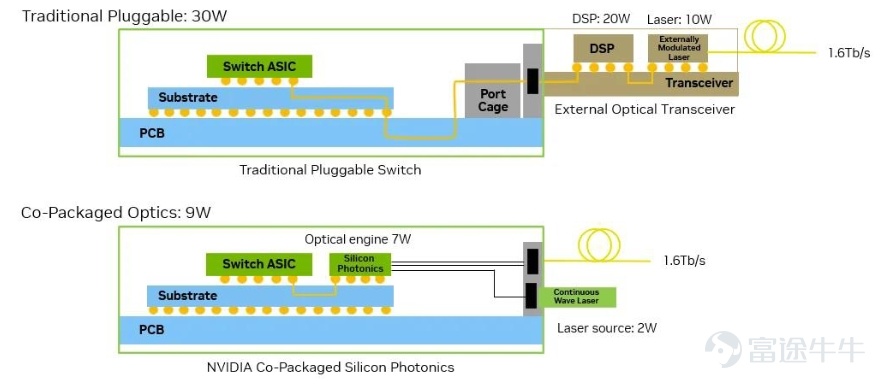
CPO (Co-Packaged Optics) refers to the co-packaging of optical engines, originally housed in pluggable transceivers, with host chips. This shortens the electrical signal transmission distance from tens of centimeters to tens of millimeters (since the optical engine is adjacent to the XPU or switch ASIC), significantly reducing power consumption, increasing bandwidth density, and decreasing latency by minimizing electrical interconnect distances and alleviating signal integrity issues.
How does CPO change the traditional demand structure for optical communications?
What exactly is CPO, which NVIDIA is betting on? CPO (Co-Packaged Optics) refers to the co-packaging of optical engines, originally housed in pluggable transceivers, with host chips. This shortens the electrical signal transmission distance from tens of centimeters to tens of millimeters (since the optical engine is adjacent to the XPU or switch ASIC), significantly reducing power consumption, increasing bandwidth density, and decreasing latency by minimizing electrical interconnect distances and alleviating signal integrity issues. How does CPO change the traditional demand structure for optical communications? Compared to traditional pluggable optical modules, CPO (Co-Packaged Optics)Parts that are completely or largely eliminatedare: the optical module housing, MPO/LC interfaces. Parts that are retained but modified/expandedYes 1) Lasers: They remain core components. The EML lasers commonly used in optical modules have been replaced by CW lasers in CPO. However, whether it’s EML lasers or CW lasers, the main manufacturers remain the same. $Lumentum (LITE.US)$ are notable. 2) The DSP chip is still retained but its form has changed, with the signal processing function being integrated into the switch ASIC/optical engine EIC. 3) Silicon photonics integrated circuits, in which the InP (Indium Phosphide) substrate has been replaced by a silicon-on-insulator (SOI) wafer (major manufacturers include $GlobalFoundries (GFS.US)$ and $Intel (INTC.US)$ ), however, within the laser...
Compared to traditional pluggable optical modules, CPO (Co-Packaged Optics)Parts that are completely or largely eliminatedare: the optical module housing, MPO/LC interfaces.
Parts that are retained but modified/expandedYes
1) Lasers: They remain core components. The EML lasers commonly used in optical modules have been replaced by CW lasers in CPO. However, whether it’s EML lasers or CW lasers, the main manufacturers remain the same. $Lumentum (LITE.US)$ are notable.
2) The DSP chip is still retained but its form has changed, with the signal processing function being integrated into the switch ASIC/optical engine EIC.
3) Silicon photonics integrated circuits, in which the InP (Indium Phosphide) substrate has been replaced by a silicon-on-insulator (SOI) wafer (major manufacturers include $GlobalFoundries (GFS.US)$ and $Intel (INTC.US)$ , although InP is still used in lasers; additionally, detectors, modulators, and others remain largely unchanged.
Key players in silicon photonics modules:
What exactly is CPO, which NVIDIA is betting on? CPO (Co-Packaged Optics) refers to the co-packaging of optical engines, originally housed in pluggable transceivers, with host chips. This shortens the electrical signal transmission distance from tens of centimeters to tens of millimeters (since the optical engine is adjacent to the XPU or switch ASIC), significantly reducing power consumption, increasing bandwidth density, and decreasing latency by minimizing electrical interconnect distances and alleviating signal integrity issues. How does CPO change the traditional demand structure for optical communications? Compared to traditional pluggable optical modules, CPO (Co-Packaged Optics)Parts that are completely or largely eliminatedare: the optical module housing, MPO/LC interfaces. Parts that are retained but modified/expandedYes 1) Lasers: They remain core components. The EML lasers commonly used in optical modules have been replaced by CW lasers in CPO. However, whether it’s EML lasers or CW lasers, the main manufacturers remain the same. $Lumentum (LITE.US)$ are notable. 2) The DSP chip is still retained but its form has changed, with the signal processing function being integrated into the switch ASIC/optical engine EIC. 3) Silicon photonics integrated circuits, in which the InP (Indium Phosphide) substrate has been replaced by a silicon-on-insulator (SOI) wafer (major manufacturers include $GlobalFoundries (GFS.US)$ and $Intel (INTC.US)$ ), however, within the laser...
NVIDIA's phased deployment in the CPO field:
Vera Rubin series products: $NVIDIA (NVDA.US)$ Used in Quantum-X and Spectrum-X (Ethernet), which belong to CPO technology in the Scale-out (connecting various servers) domain. Quantum-X and Spectrum-X were introduced by NVIDIA at the 2025 GTC conference, and new versions may be launched this year.
Vera Rubin Ultra and subsequent Feynman architecture: NVIDIA will directly use CPO within server racks, employing CPO in Scale-Up scenarios. At this year’s GTC conference, NVIDIA is expected to provide detailed disclosures on its Scale-Up optical interconnect solutions, as well as supply chain and ecosystem integration.
What exactly is CPO, which NVIDIA is betting on? CPO (Co-Packaged Optics) refers to the co-packaging of optical engines, originally housed in pluggable transceivers, with host chips. This shortens the electrical signal transmission distance from tens of centimeters to tens of millimeters (since the optical engine is adjacent to the XPU or switch ASIC), significantly reducing power consumption, increasing bandwidth density, and decreasing latency by minimizing electrical interconnect distances and alleviating signal integrity issues. How does CPO change the traditional demand structure for optical communications? Compared to traditional pluggable optical modules, CPO (Co-Packaged Optics)Parts that are completely or largely eliminatedare: the optical module housing, MPO/LC interfaces. Parts that are retained but modified/expandedYes 1) Lasers: They remain core components. The EML lasers commonly used in optical modules have been replaced by CW lasers in CPO. However, whether it’s EML lasers or CW lasers, the main manufacturers remain the same. $Lumentum (LITE.US)$ are notable. 2) The DSP chip is still retained but its form has changed, with the signal processing function being integrated into the switch ASIC/optical engine EIC. 3) Silicon photonics integrated circuits, in which the InP (Indium Phosphide) substrate has been replaced by a silicon-on-insulator (SOI) wafer (major manufacturers include $GlobalFoundries (GFS.US)$ and $Intel (INTC.US)$ ), however, within the laser...
Impact: NVIDIA's deployment in the CPO field will further increase the value proposition of lasers and optical engines, drive demand for silicon photonics, and restructure the previously fragmented supplier system. The increased level of integration of optical communication components will inevitably lead to higher supplier concentration, and leading optical communication suppliers are still expected to benefit from the development of co-packaged optics. Particularly noteworthy is NVIDIA's impact on $Lumentum (LITE.US)$$Coherent (COHR.US)$ Investment is equivalent to declaring the choice of main suppliers in the future.
Overview of CPO concept stocks
What exactly is CPO, which NVIDIA is betting on? CPO (Co-Packaged Optics) refers to the co-packaging of optical engines, originally housed in pluggable transceivers, with host chips. This shortens the electrical signal transmission distance from tens of centimeters to tens of millimeters (since the optical engine is adjacent to the XPU or switch ASIC), significantly reducing power consumption, increasing bandwidth density, and decreasing latency by minimizing electrical interconnect distances and alleviating signal integrity issues. How does CPO change the traditional demand structure for optical communications? Compared to traditional pluggable optical modules, CPO (Co-Packaged Optics)Parts that are completely or largely eliminatedare: the optical module housing, MPO/LC interfaces. Parts that are retained but modified/expandedYes 1) Lasers: They remain core components. The EML lasers commonly used in optical modules have been replaced by CW lasers in CPO. However, whether it’s EML lasers or CW lasers, the main manufacturers remain the same. $Lumentum (LITE.US)$ are notable. 2) The DSP chip is still retained but its form has changed, with the signal processing function being integrated into the switch ASIC/optical engine EIC. 3) Silicon photonics integrated circuits, in which the InP (Indium Phosphide) substrate has been replaced by a silicon-on-insulator (SOI) wafer (major manufacturers include $GlobalFoundries (GFS.US)$ and $Intel (INTC.US)$ ), however, within the laser...
Apart from mainstream optical module companies like Lumentum and Coherent, it's worth mentioning that there are players in the silicon photonics foundry field $GlobalFoundries (GFS.US)$ and $Tower Semiconductor (TSEM.US)$ that hold significant positions. Although these two semiconductor foundries do not manufacture advanced process chips below 7nm, both companies have made substantial technological preparations in the CPO field, forming a differentiated division of labor with $Taiwan Semiconductor (TSM.US)$ the silicon photonics integration segment. Among them, Tower Semiconductor plans to expand its production capacity to more than five times that of Q4 2025 by 2027. GlobalFoundries has entered the industry's first tier through last year’s acquisition of Singapore-based silicon photonics subsidiary AMF.
In addition, some large technology companies are also major participants and promoters of CPO technology. For example, $Broadcom (AVGO.US)$ Broadcom possesses full-stack self-developed capabilities including DSP, silicon photonic modulators, and drivers, eliminating the need to externally purchase core chips like traditional module manufacturers, thus optimizing power consumption and cost to the extreme. Through deep collaboration with Taiwan Semiconductor, Broadcom solved the yield issues of photonic engine and electrical chip integration using its COUPE (Compact Universal Photonic Engine) packaging technology.
And$Marvell Technology (MRVL.US)$ primarily entered the optical interconnect field through its 2021 acquisition of Inphi, and its CPO solution closely aligns with its Teralynx series of switch chips.
Changes in data center architecture are expected to drive exponential growth in demand for optical communications.
To maximize data center utilization and operational efficiency, network architectures are rapidly evolving from traditional three-tier structures to Spine-Leaf architectures.
The leaf-spine architecture enables data center networks to have larger scale and flatter characteristics, thereby requiring the deployment of more switches with faster transmission rates and higher fiber optic coverage to support efficient internal traffic interoperability. This trend directly drives optical communication components to upgrade towards higher density and faster transmission rates.
The demand for high-speed optical modules and fiber cabling products in the leaf-spine architecture has significantly increased, with related usage reaching more than 10 times that of the traditional three-tier architecture.
What exactly is CPO, which NVIDIA is betting on? CPO (Co-Packaged Optics) refers to the co-packaging of optical engines, originally housed in pluggable transceivers, with host chips. This shortens the electrical signal transmission distance from tens of centimeters to tens of millimeters (since the optical engine is adjacent to the XPU or switch ASIC), significantly reducing power consumption, increasing bandwidth density, and decreasing latency by minimizing electrical interconnect distances and alleviating signal integrity issues. How does CPO change the traditional demand structure for optical communications? Compared to traditional pluggable optical modules, CPO (Co-Packaged Optics)Parts that are completely or largely eliminatedare: the optical module housing, MPO/LC interfaces. Parts that are retained but modified/expandedYes 1) Lasers: They remain core components. The EML lasers commonly used in optical modules have been replaced by CW lasers in CPO. However, whether it’s EML lasers or CW lasers, the main manufacturers remain the same. $Lumentum (LITE.US)$ are notable. 2) The DSP chip is still retained but its form has changed, with the signal processing function being integrated into the switch ASIC/optical engine EIC. 3) Silicon photonics integrated circuits, in which the InP (Indium Phosphide) substrate has been replaced by a silicon-on-insulator (SOI) wafer (major manufacturers include $GlobalFoundries (GFS.US)$ and $Intel (INTC.US)$ ), however, within the laser...
Risk Disclaimer: The above content only represents the author's view. It does not represent any position or investment advice of Futu. Futu makes no representation or warranty.Read more
Heart
1
Thumbs Up
13
295K Views
Report
Comments
Write a Comment...
14
33