
Outlook falls short of expectations! Is Intel still worth holding onto?

CPU Rekindles the Memory Narrative! Intel's Earnings Report Looms, AMD Aims for New Highs, Will Volatile Market Moves Repeat?
Since the beginning of 2026, the two major sectors of storage and CPU have become the absolute focus of the market, with the intensity of the rally leaving people in awe.They not only overshadowed the seven major US tech giants such as $NVIDIA (NVDA.US)$ 、 $Alphabet-C (GOOG.US)$ , but even under geopolitical tensions in Greenland, they continued to rise strongly despite market pressure.
The representative of the storage industry, $SanDisk (SNDK.US)$ , surged nearly 600% in 2025, and has already doubled again before the end of January this year; companies in the CPU sector $Intel (INTC.US)$ and $Advanced Micro Devices (AMD.US)$ have also shown strong performance recently. Even when the broader market fell more than 2% on Tuesday, these stocks rose against the trend, and continued their upward momentum after the easing of geopolitical factors.
A review makes it clear that as the AI wave continues to develop, the narrative shift in the CPU industry mirrors that of the storage industry in a strikingly similar way.Tonight, with Intel's release of key earnings reports and AMD's stock price hitting new highs, the industrial game surrounding the 'revaluation of CPU value' has entered a fever pitch. We will delve into the changes in industry logic, compare Intel and AMD's strategies, and based on current market expectations, explore potential options trading strategies.

This moment is just like that moment!
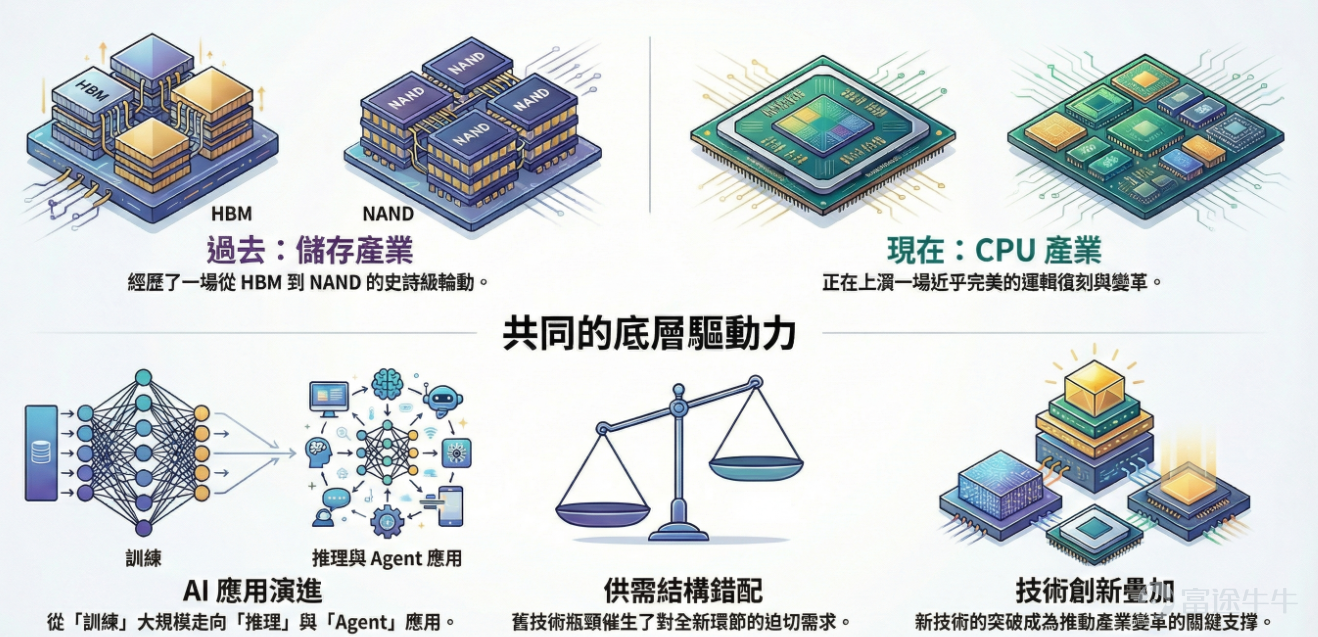
The pricing of capital markets for industry trends often follows a similar narrative logic. The epic rotation in the memory industry from HBM to NAND is now experiencing a near-perfect logical replication in the CPU sector,supported by multiple factors including the evolution of AI application stages, supply-side compression, and technological innovation.
(1) The shift in the memory industry
Large AI ModelsTrainingrequires massive data to be exchanged at high speed between GPUs and memory. However, the data transmission speed lags significantly behind the computing speed, forming a 'memory wall' that constrains computing power, becoming a bottleneck in the development of AI. The high bandwidth feature of HBM makes it an essential requirement for training large AI models.
EnterInference and large-scale deploymentthe characteristics of workloads undergo fundamental changes. Real-time, parallel user request processing, along with support for long context and multimodal data (image, video generation), make memory capacity as important as computing bandwidth, or even more critical. Although HBM has extremely high bandwidth, its limited capacity and high cost have shifted market focus systematically to NAND, which balances cost and performance.
To meet explosive demand, major memory manufacturers allocated most of their new capital expenditures and advanced production capacity to HBM.However, due to its own characteristics, NAND did not catch the fast train of development in the early stages of the AI wave. As AI-driven demand systematically reaches new levels, the supply side cannot respond quickly due to resources being occupied by HBM and manufacturers exercising discipline, leading the NAND market to transition from cyclical fluctuations into a new phase of structural shortages.
NAND contract prices were adjusted upwards in one go in November 2025.50%The market narrative has successfully shifted from 'who can secure scarce HBM' to 'who can use NAND to solve AI's capacity wall.' The new protagonist of the story has also changed from $Micron Technology (MU.US)$ to $SanDisk (SNDK.US)$ (Micron's layout is more comprehensive as it also includes NAND business, but SanDisk is more focused).
Moreover, architectural innovations relying on NAND, such as high-bandwidth flash memory (HBF), could challenge HBM's dominance in large model training if successfully implemented. In the future, while providing bandwidth comparable to HBM, these solutions could achieve 8 to 16 times the storage capacity of HBM at a similar cost.

Source: SanDisk
(2) Evolution of computing architecture
Currently, the exact same logic is repeating itself in the AI computing architecture space. Over the past few years, the GPU card-stacking race assumed that AI compute bottlenecks only existed within GPUs—this mirrors the early belief that storage bottlenecks were solely tied to HBM. Now, industry consensus is rapidly shifting.
AI training relies on massive parallel computation, and GPUs (and their ecosystem) are the only solution. Their value has long been fully recognized by the market, with 'the universe's top leader' NVIDIA being the clearest investment theme in AI over the past few years.
When AI starts handling massive, real-time inference requests, system bottlenecks shift from the GPU to task scheduling efficiency, latency, and coordination.The CPU manages the entire system, prepares data, and schedules tasks; its performance directly impacts GPU utilization and overall response speed.
The CPU, as the core of system scheduling, is being reassessed for its importance. Deepseek's newly released Engram architecture assigns the CPU to control the task of transferring data across different levels of storage. In Agent-related tasks, CPU processing delays account for the majority of end-to-end latency, becoming a key factor affecting user experience.
In parallel with memory, in order to prioritize the high-margin demand for AI GPUs, foundries have allocated most of their advanced capacity to NVIDIA, significantly squeezing the available capacity for CPUs.
By early 2026, $Intel (INTC.US)$ and $Advanced Micro Devices (AMD.US)$ to address supply-demand imbalances and ensure stable future supply, server CPU prices are planned to increase.10%-15%Moreover, nearly all of their production capacity for 2026 has already been pre-sold.
At this very moment, it mirrors that time before, uncannily similar!The two most critical narrative shifts in today’s tech investment landscape share nearly identical underlying logic: both are driven by AI’s large-scale deployment from training to inference and Agent applications, where mismatches in old bottlenecks have created urgent demand for new components, accompanied by supply-side crowding effects.
However, it should be noted that the narrative around CPUs is not yet as strong as that of memory was just a few months ago. The difference in price hikes (50% vs. 10%-15%) is indicative of this, and fellow investors can closely monitor the evolution of the supply chain going forward.
Intel vs AMD, how do the industry's two giants stack up?
$Intel (INTC.US)$ As traditional giants in the CPU space, recent changes have been more attributable to strategic partnerships, external support, and market expectations rather than a fundamental reversal in performance.
In August 2025, the US federal government completed its strategic investment in Intel, acquiring 9.9% of Intel's shares for approximately $89 billion, becoming its largest shareholder. In the following September, NVIDIA made a strategic investment in Intel, holding 4% of Intel's shares for $50 billion.
Its highly anticipated 18A process has finally achieved mass production, with the first product, Panther Lake, set to ship soon. The yield rate is reportedly over 60%, easing the deepest concerns about its manufacturing capabilities.

Despite an improvement in sentiment, Intel continues to lose market share in the CPU market.The market share of server CPUs, primarily used in AI, has declined from nearly 100% a few years ago to around 60%. The next generation of server CPUs will not arrive until the second half of 2026 or even 2027, and the current products do not have a significant advantage compared to competitors.
And$Advanced Micro Devices (AMD.US)$ AMD’s share of revenue in the server CPU market has exceeded 20% and is still growing. Its Turin platform based on Taiwan Semiconductor's 3nm process is widely considered to have a competitive edge. With leaps in performance, energy efficiency, and multi-core capability, AMD has eroded Intel’s market share across several segments.
In the GPU business, AMD has also made significant progress, announcing a deeply binding strategic partnership with OpenAI in October 2025. OpenAI has committed to deploying a total of 6GW of AMD GPU computing power, with the first 1GW planned to launch in the second half of 2026. AMD, in return, issued OpenAI warrants for up to 160 million shares of common stock. Although NVIDIA’s dominance in the GPU space remains difficult to shake,AMD's image as an 'aggressor' in ecosystem breakthroughs has been solidified.
In addition, $Arm Holdings (ARM.US)$ With its unique architecture, it has also emerged strongly in the CPU market, securing a share and becoming an important alternative when mainstream x86 architectures (used by Intel and AMD) are in short supply.
Options strategy deployment
$Intel (INTC.US)$Will release Q4 and full-year 2025 earnings after the market close on January 22.After yesterday's sharp rise, the stock price hit another new high. Signals from the options market show that investors expect a fluctuation of ±11% after the earnings report is released. Based on historical data, except for Q2 2024, Intel’s post-earnings fluctuations have mostly been smaller than what the options market predicted.

Currently, Intel’s IV rank is 61, with a percentile of 94%, reflecting the characteristic of increased volatility before earnings reports, theoretically benefiting option sellers.

Investors who already hold Intel can consider implementinga Covered Call,selling out-of-the-money call options while holding the underlying stock.
For example, if you hold 100 shares of Intel, you could consider selling one call option expiring this week with a strike price of $60. If Intel rises above that level by expiration, you would sell those 100 shares at $60 each; if the stock price doesn’t reach that level, you can still pocket the premium earned during the period of heightened volatility.

For investors not holding Intel, they can also take advantage of the pre-earnings volatility expansion and the post-earnings 'IV Crush' phenomenon by deploying strategies that short volatility. The historical data mentioned earlier provides statistical support for such a strategy. However, if there is an unprecedented one-sided surge or crash in the stock price beyond historical norms, the seller's strategy may face significant losses—risk management is crucial.

$Advanced Micro Devices (AMD.US)$Following yesterday's strong rally, the stock is now just a step away from its all-time high, with the company’s earnings report set to be released after the market closes on February 3.The current IV is lower than Intel’s but remains relatively high historically (81st percentile).
If optimistic about AMD’s related developments, one can consider implementing a Bull Call Spread. This involves buying a call option and simultaneously selling another call option with a higher strike price, reducing the cost of the purchase. Selling an out-of-the-money call limits the maximum profit potential but lowers the breakeven point, making it suitable for a wave-like upward movement.

Finally, here's a small perk for fellow investors—welcome to claim it!Beginner's Options Package
This event is exclusively for invited HK users, click to learn moreDetailed event rules >>
Major upgrade to the US options mechanism! New Monday and Wednesday options added for nine major symbols including Tesla and NVIDIA. A step-by-step guide to profiting from end-of-term options using the NiuNiu tool >>

Disclaimer
This content does not constitute any offer, solicitation, recommendation, opinion, or any guarantee regarding securities, financial products, or instruments. The risk of loss in trading options can be substantial. In some cases, losses may exceed the initial margin deposited. Even if contingency orders such as 'stop-loss' or 'limit' orders are placed, they may not necessarily prevent losses. Market conditions may render these orders unexecutable. You may be required to deposit additional margin within a short period. If you fail to provide the required amount by the specified time, your open positions may be liquidated. However, you will still be responsible for any shortfall in your account resulting from this. Therefore, before engaging in trading, you should study and understand options and carefully consider whether such trading is suitable for you based on your financial situation and investment objectives. If you trade options, you should be familiar with the procedures upon exercising the options and at their expiration, as well as your rights and obligations when exercising the options and at their expiration.
Risk Disclaimer: The above content only represents the author's view. It does not represent any position or investment advice of Futu. Futu makes no representation or warranty.Read more


Comments (226)
to post a comment
281
207