
In 2025, Blue Moon still hasn't stopped the bleeding
Author | Zhao Zhi
Editor | Qujie Business Information Team
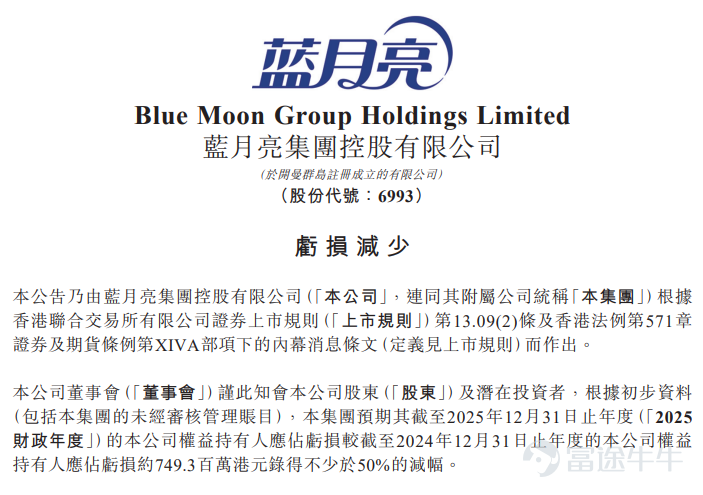
Recently, Blue Moon announced that for the fiscal year ended December 31, 2025, the loss attributable to equity holders of the company is expected to decrease by no less than 50% compared to the loss of approximately HKD 749 million recorded for the fiscal year ended December 31, 2024.

Image source: announcement screenshot
In 2024, Blue Moon's loss amounted to approximately HKD 749 million; accordingly, its loss in 2025 will drop below HKD 375 million.
However, Blue Moon still reported a loss of HKD 435 million in the first half of 2025. Calculations show that Blue Moon achieved at least HKD 60 million in profit in the second half of 2025.
In the announcement, Blue Moon stated that the main reasons for the reduction in losses were the improvement in overall operational efficiency and the results of channel strategy investments.
“Fun Business Insights” noted that in the first half of 2025, Blue Moon had already been cutting operating costs. Specifically, sales and distribution expenses decreased by 13.2% year-on-year to HKD 1.91 billion; general and administrative expenses fell by 20.4% year-on-year to HKD 450 million.

Source: Screenshot from the semi-annual report
Nevertheless, despite these reductions, sales and distribution expenses still accounted for a significant portion of Blue Moon’s revenue during the same period. In the first half of 2025, Blue Moon generated revenue of HKD 3.037 billion, representing a year-on-year decline of 3.01%. Based on this calculation, its sales and distribution expenses accounted for over 60%, indicating there is still room for optimization in Blue Moon's operational strategy adjustments.
For the full year, although Blue Moon expects the loss attributable to equity holders in 2025 to narrow by at least 50%, it has not yet emerged from losses.
Blue Moon went public on the Hong Kong Stock Exchange in 2020, and its performance has continued to decline post-IPO, eventually leading to losses. In 2024, Blue Moon suffered its first annual loss since going public.
The main reason for the losses in 2024 was the heavy investment in 'new channels,' specifically marketing expenses for live-streaming e-commerce. Particularly in the first half of 2024, Blue Moon launched several high-profile influencer-exclusive live streams. One of these, a record-breaking session with a Guangdong-based couple, gave away a cumulative total of 5,000 Apple iPhones, incurring significant marketing costs.
The homogenization in the household cleaning industry is severe. Brands wanting to quickly gain an edge in new channels must inevitably increase their marketing investment, but the cost-effectiveness of their 'high-input' approach to livestreaming appears to be low. After Blue Moon released its loss-making annual report, some investors criticized it for 'losing money to make a splash.'
Starting from the second half of 2024, Blue Moon began adjusting its online marketing strategy, increasing its focus on brand self-broadcasting and shelf space layout. However, judging from the interim report of 2025, the effect has not been particularly noticeable. Although a year-on-year decrease in sales and distribution expenses improved profit levels, product sales revenue declined.
By product category, revenue from fabric care products, which account for over 80% of total revenue, fell by 4.6% in the first half of 2025. While revenue from personal care and home cleaning products achieved year-on-year growth, their share of total revenue was not high enough to become a new growth driver.

Source: Screenshot from the semi-annual report
Laundry detergent is a price-sensitive product, but in recent years, Blue Moon has been promoting its more expensive concentrated laundry detergents. The 2025 interim report shows that in 2015, Blue Moon launched the 'Supreme' brand and Supreme 'Concentrated+' laundry detergent; in 2018, it introduced Supreme Bio-Tech laundry detergent; in 2021, Supreme Bio-Tech laundry detergent (Antibacterial & Odor Removal); in 2022, Supreme Bio-Tech laundry detergent (Sports Special Effects); and in 2024, Supreme Bio-Tech laundry detergent (All-Purpose Cleaning).
One e-commerce platform showed that a 660g bottle of Supreme Bio-Tech laundry detergent 'Elegant Orchid Scent' trial pack was priced at 89.95 yuan after a coupon, making the per gram price higher than the post-coupon price of 10.8 yuan/bottle for the same brand's 500g detergent.
As the company’s main revenue-generating product, Blue Moon’s laundry detergent has frequently been embroiled in quality disputes in recent years.
In September 2024, according to a report by '1818 Golden Eye,' a consumer in Hangzhou found that a newly purchased skirt faded after being washed once with Blue Moon detergent. The broadcast triggered numerous complaints about Blue Moon causing clothes to 'fade' or even 'burn.'
On Xiaohongshu, a netizen mentioned that washing a linen shirt with Blue Moon resulted in streaky 'color stains,' ruining the original color of the fabric.

Source: Screenshot from Xiaohongshu
The 'Black Cat Complaints' platform shows that as of January 22, there were 1,026 complaints containing the search term 'Blue Moon,' with many consumers reporting issues such as clothing damage caused by Blue Moon detergent, questioning product efficacy, and alleging false claims.

Image source: Screenshot from Hei Mao Complaint
Additionally, some consumers expressed dissatisfaction with the inclusion of optical brighteners in certain Blue Moon detergents. On social media platforms, some users stated that applying Blue Moon directly to clothing caused fading, and they had already damaged several garments using it. Others noted that Blue Moon’s 'Brightening & Whitening' formula contains significant amounts of optical brighteners, turning white clothes blue after washing.
Although the China Cleaning Products Industry Association issued a clarification on the harmlessness of optical brighteners long ago, this has not entirely dispelled consumers' perception and fear of optical brighteners being 'carcinogenic'.
Moreover, as a national brand of laundry detergent, Blue Moon is often counterfeited, leading some consumers to be misled by low-quality knockoffs, which further affected Blue Moon's brand reputation.
"Fun Business Insights" noticed that there are山寨 (counterfeit) "Blue Moon brand stores" on certain e-commerce platforms that closely resemble the official flagship store. The laundry detergent prices are cheaper than the genuine products, and the appearance is almost indistinguishable from the real thing. Many consumers only realized they were deceived when they found the packaging to be rough and the liquid too thin upon receiving the product.
Chi Wenxi, Chief Economist for the China Region of the China Enterprise Capital Alliance, believes that reliance on a single category increases the company’s operational risk. In the future, Blue Moon needs to intensify its R&D and market promotion efforts in personal care and home cleaning products, enrich its product portfolio, and diversify operational risks.
However, Blue Moon appears to be relatively conservative in developing new categories. For example, regarding laundry pods, which have gained significant popularity over the past two years, other leading home cleaning brands like Liby are heavily investing. According to an Artwood report, the market share of laundry pods in 2024 was 11.1%, making it the second-largest clothing care category after laundry detergent. However, Blue Moon has yet to launch any laundry pod products.
Blue Moon's R&D expenditure in 2024 amounted to approximately HKD 44 million, with this figure not exceeding HKD 100 million between 2021 and 2023. In recent years, Blue Moon's promotional focus has remained on laundry detergents, particularly the "Supreme Series" labeled as "concentrated+". However, due to its higher price, the sales volume of the Supreme Series has consistently lagged significantly behind the Classic Series.
In contrast, veteran players such as Liby and Nice Group continue to expand their market share by launching new brands and products. Meanwhile, global giants like Unilever and Procter & Gamble also solidify their positions in the market through their strong brand influence and R&D capabilities. Additionally, some emerging brands have entered the laundry detergent market in recent years. For instance, Hema and Yonghui have introduced their private-label cleaning products, promoting them via their self-operated channels. "Su Guoyuan" also entered the laundry detergent market, leveraging e-commerce platforms to quickly accumulate sales. These established players and new entrants have impacted Blue Moon's market share to a certain extent.
Notably, following Blue Moon’s first annual loss, in April 2025, Blue Moon's Chairman of the Board, Poon Tung, announced that the company had acquired the land use rights to a plot in the Huangpu District of Guangzhou through its wholly-owned subsidiary. This plot will be used to develop a multi-purpose complex building; the project investment is expected to be no less than RMB 890 million, with funding sources including the group's own operating cash flow and proceeds from the initial public offering. Additionally, in March of the same year, Blue Moon announced plans to allocate over HKD 2.6 billion by the end of 2028 to further expand channels and strengthen brand building.
Facing internal and external pressures, Blue Moon's increased investment in "hardware" signals its pursuit of a new phase of development. Moving forward, this national veteran brand still needs to continuously provide new answers to consumer concerns about quality and category innovation.
Risk Disclaimer: The above content only represents the author's view. It does not represent any position or investment advice of Futu. Futu makes no representation or warranty.Read more
Comments
to post a comment
2