
Baidu Surges 9%! Is the Autonomous Driving Sector Gaining Momentum Again?

富途研究 | 百度自动驾驶进展驱动股价上扬:萝卜快跑订单激增彰显市场潜力
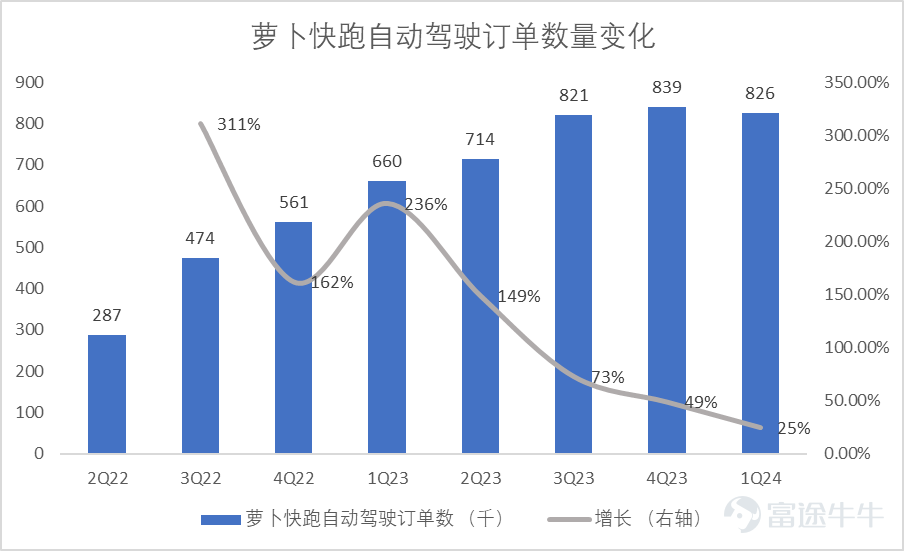
近来,百度(股票代码:$BIDU-SW (09888.HK)$ csi commodity equity index $Baidu (BIDU.US)$)的股价呈现显著上升趋势,这一变化与公司在自动驾驶领域取得的重大突破密切相关。特别值得关注的是,百度旗下的萝卜快跑(ApolloGo)服务在武汉市的全无人自动驾驶订单量出现爆发性增长,显示出市场对自动驾驶技术的积极反响。
6月底,北京市经济和信息化局发布《北京市自动驾驶汽车条例(征求意见稿)》,公开邀请社会各界提出意见,这一举措进一步增强了市场对自动驾驶相关企业投资的信心。据百度在ApolloDay2024大会上披露的数据,截至2024年4月19日,萝卜快跑已累计处理超过6 million单,业务范围覆盖北京、上海、广州、深圳等11个主要城市,在北京、武汉、重庆、深圳、上海等多个城市开展全无人自动驾驶出行服务与测试。
本文将聚焦于百度萝卜快跑(ApolloGo)业务的单位经济模型(UE),通过详尽的情景分析,我们旨在探索萝卜快跑未来商业化的广阔空间。鉴于其在自动驾驶领域的持续创新和稳健增长,萝卜快跑的商业模式及其潜在的经济效益将成为本次研究的重点。

1. 单车营收测算
As a pioneer in self-driving technology, Robo Taxi is disrupting the traditional travel market with a highly competitive price. Many users are attracted by its affordable prices, especially for trips of 10 kilometers, where Robo Taxi's fare ranges from 4 yuan to 16 yuan, much lower than the 18 yuan to 30 yuan for regular online car-hailing services (all amounts mentioned in this article are in RMB).
Price Comparison:
Robo Taxi: Starting price is approximately 15-16 yuan, with a cost of 2.4-3.5 yuan per kilometer.
Regular Didi Express: Starting price is 10-12 yuan, with a cost of 1.59-2.3 yuan per kilometer.
Taxi: Starting price is 10-14 yuan, with a cost of 2.5-3.5 yuan per kilometer.
Although Robo Taxi's unit price seems slightly higher than online car-hailing and taxis, its low-price advantage is mainly due to the platform's subsidy policy. It is worth noting that, with the end of the promotional period, maintaining such low prices may become a challenge. However, due to the elimination of driver labor costs by self-driving, Robo Taxi still has the potential to maintain its price competitive advantage and continue to fiercely compete with the human-driven online car-hailing industry.
Table: Price Comparison of Various Ride-Hailing Platforms in Wuhan Area
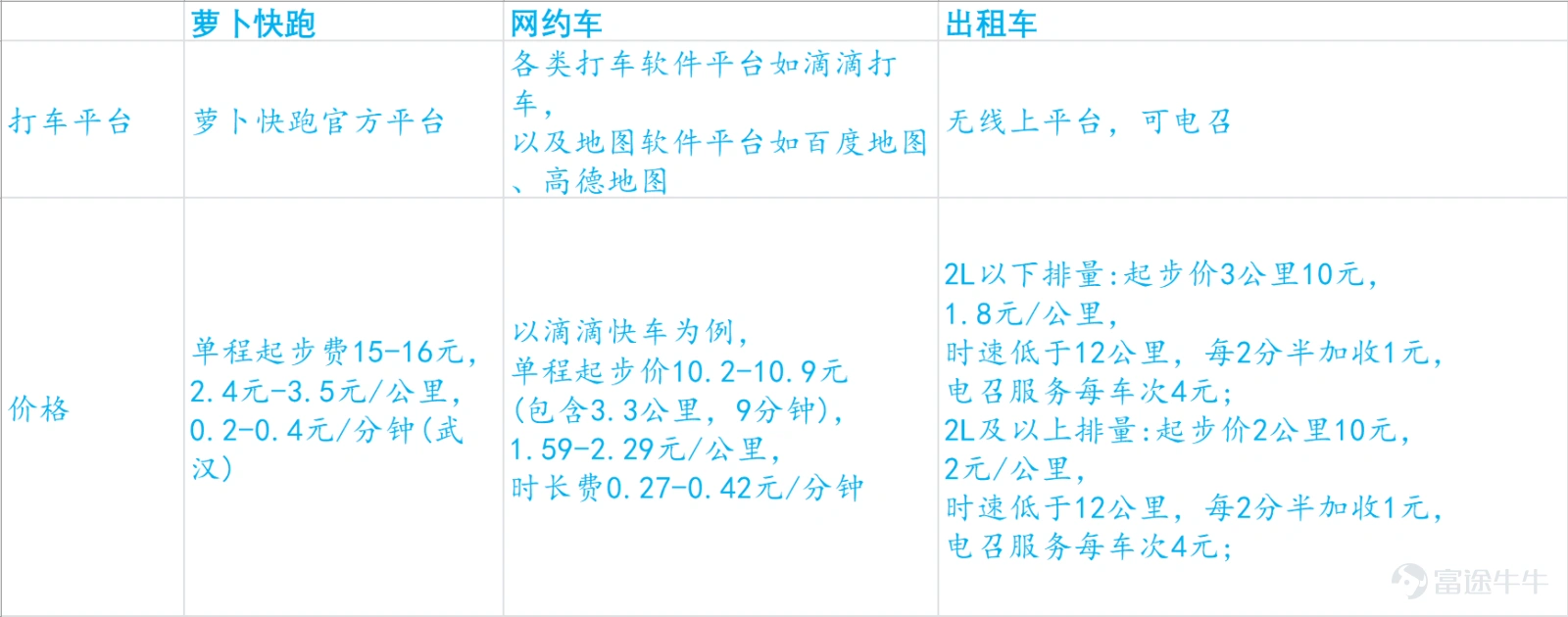
Note: Different regions have different charging prices.
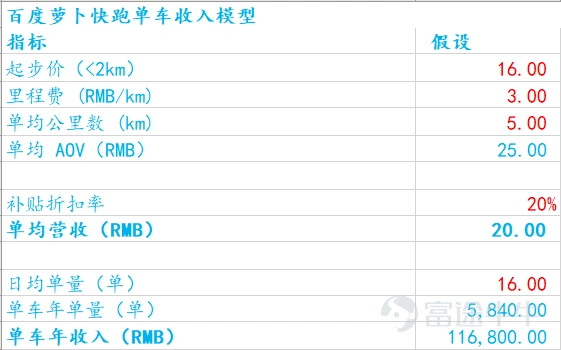
According to the company's disclosure, Wuhan's 'Radish Run' recently experienced an explosion in orders, with a peak of over 20 orders per day per bike, while online car-hailing and taxi daily average orders are around 16. Assuming an average distance of 5km per order and a daily average order volume of 16, the annual income per bike is around 0.11 million yuan, calculated based on a 20% subsidy from the platform.
2. Calculation of single bike cost
In terms of single bike costs, the main costs of 'Radish Run' are vehicle costs, labor costs, with other costs including electricity costs, maintenance, insurance, and other expenses.
(1) Vehicle costs: significantly reduced, opening a new chapter in self-driving cars
Vehicle costs are a crucial part of Baidu's Robotaxi project, mainly reflected in hardware-related depreciation costs. Notably, the cost of the sixth generation of Baidu's Robotaxi model has been significantly reduced to 0.2046 million RMB, compared to the previous generation's RT5, which had a cost of 0.48 million RMB, achieving a significant decrease. Since the first half of this year, the Wuhan region has gradually deployed the sixth generation models, indicating that it will soon become the main force of the Robotaxi fleet, thereby significantly reducing the depreciation costs per vehicle. Looking ahead, there is the possibility of further cost reduction paving the way for widespread application of self-driving technology.
In the cost analysis, we calculated the purchase cost for the sixth generation Robotaxi as 0.2046 million RMB, assuming a scrappage period of six years, resulting in an annual depreciation cost of approximately 0.034 million RMB per vehicle.
(2) Labor costs: intelligent management, efficient operation guarantee
The operation mode of Carrot Run can be divided into two categories. The first category is vehicles equipped with safety officers. The safety officers only intervene in emergencies, and the vehicles are in autonomous driving mode the rest of the time. The second category is fully autonomous vehicles. Although there is no need for safety officers on-site, each vehicle will be remotely monitored by the cloud driving platform to ensure safety and efficiency. It is worth mentioning that each cloud driver can remotely control 2 to 3 autonomous vehicles at the same time, effectively improving operational efficiency and safety.
Please see the detailed assumptions in the table below:
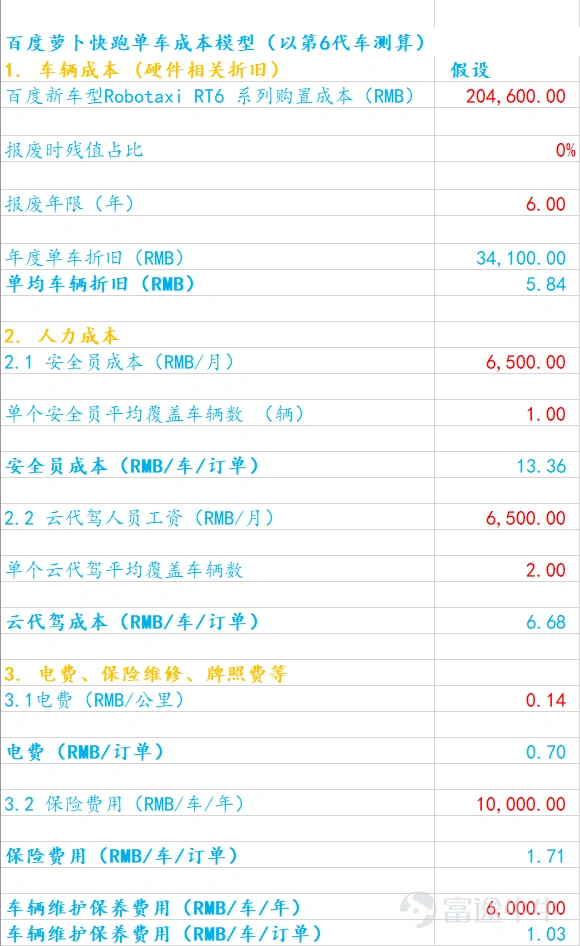
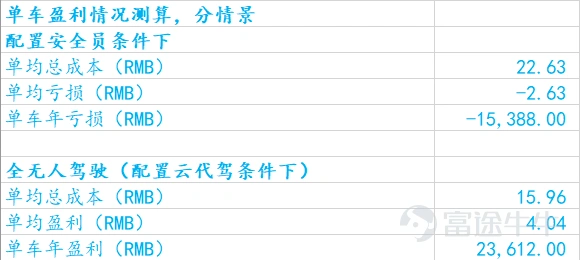
Based on the above assumptions, we have calculated the following scenarios based on the configuration of safety officers and cloud drivers:
(1) Scenario 1: With one safety officer assigned to each vehicle, the annual loss per vehicle is 0.015 million yuan.
(2) Scenario 2: In the scenario of fully autonomous driving and each cloud driver covering 2 vehicles, the annual profit per vehicle is 0.023 million yuan.
3. Taking Wuhan as an example, the profitability of mature areas is calculated.
As of the first quarter of 2024, the size of the RoboRun unmanned vehicle fleet in Wuhan has remained stable at 400 to 500 vehicles, correcting the inaccurate information circulating on the internet of 1,000 vehicles. During Baidu's 2024 ApolloDay event, company management revealed that the proportion of completed orders for fully unmanned vehicles has reached 55%, a significant growth compared to the fourth quarter of 2023's 45%. This proportion has exceeded 70% in April 2024 and is expected to continue to climb in the coming quarters, with the goal of achieving a 100% completion rate for fully unmanned orders.
Its goal is to achieve a balance between income and expenses in Wuhan by the end of 2024 and achieve overall profitability in 2025. According to our scenario analysis, a steady increase in the proportion of fully unmanned orders may help achieve a profit and loss balance in the Wuhan region. Assuming a 70% proportion of unmanned vehicles and an average annual operation of 500 vehicles, the annual profit is estimated to be around 6 million yuan. If this is increased to 1,000 vehicles and achieves a 100% proportion of unmanned vehicles, the annual contribution to profit could reach around 24 million yuan.

4. Future Outlook
Key drivers for UE improvement:
1. Advancement of autonomous driving: The gradual relaxation of national regulatory policies will be a key driver for improving UE (Unit Economics). As more vehicles obtain full autonomous driving permits, the profitability per vehicle will significantly increase.
2. Decline in hardware costs: In the long run, further reduction in per vehicle hardware costs will be another major driving force. The significant decrease in the cost of Baidu Robotaxi's sixth-generation vehicle to 0.2046 million yuan demonstrates the potential for cost control.
3. All-weather operation capability: The all-weather operation feature of self-driving cars allows for a much higher daily order volume than traditional taxis, creating conditions for improving UE.
4. Efficiency improvement of cloud driving: Technological advancements will allow for remote control of more vehicles in cloud driving, increasing overall operational efficiency.
5. Subsidy policy adjustment: After the promotion period, the reduction of subsidies is expected to have a positive impact on bike revenue, improving UE.
6. Technological iteration and consumer appeal: Continuous advancements in autonomous driving technology will improve vehicle operation efficiency, attract more consumers, and promote UE growth.
Potential risk factors:
1. Consumer reaction after subsidy reduction: Adjustments in subsidy policies may lead to a decrease in consumer enthusiasm and impact order volume.
2. Uncertainty in policy implementation: Inconsistent enforcement of commercial autonomous driving policies in different cities may restrict the improvement of UE.
3. Reputation risk due to safety issues: Traffic accidents may damage the brand image and affect consumer confidence.
The short- and medium-term impact and investment recommendations of CarrotRacing:
Although CarrotRacing has limited contribution to Baidu's profits in the short- and medium-term, the recent rise in stock price is mainly driven by events, reflecting the market's recognition of the profit potential of CarrotRacing's business model and optimistic expectations for future urban expansion.
The progress of autonomous driving technology and the support of related policies are expected to further boost the company's valuation.
Currently, the forecasted P/E ratio for the company's stock price in 2024 is 11 times. Due to Baidu's long-term lack of shareholder returns and the difficulty of CarrotRacing in releasing significant cash flow in the short term, it is expected that if Baidu fails to boost shareholder returns in the later stage, this breakthrough of CarrotRacing will become a short-term 'event-driven' factor in Baidu's stock price. Therefore, investors can actively engage in trend trading, while long-term investment still needs to be based on Baidu's shareholder returns and cash flow.
Risk Disclaimer: The above content only represents the author's view. It does not represent any position or investment advice of Futu. Futu makes no representation or warranty.Read more


Comments (17)
to post a comment
53
81