
English
Back
Open Account
牛牛課堂
wrote a column · ·

【Investment Hot Topic】Berkshire Flash Crash 99.97%? 2 tips to help you earn more and lose less!

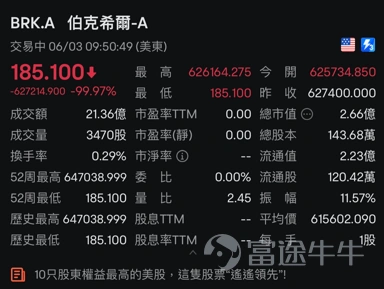
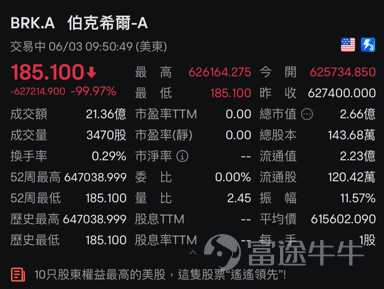
An extremely abnormal market event occurred last night (June 3)! Even Buffett was affected! Although there have been four technical halts in the U.S. stock market, his own stock plummeted by 99.97%, this is the first time old Buffett has seen such a phenomenon!$Berkshire Hathaway-A (BRK.A.US)$also affected! Although he has experienced 4 technical halts in the U.S. stock market, his own stock flash crashed by 99.97%, this phenomenon is also the first time old Buffett has seen!
An extremely abnormal market event occurred last night (June 3)! Buffett's$Berkshire Hathaway-A (BRK.A.US)$also affected! Although he has experienced technical halts in the US stock market four times, his own stocks plummeted by 99.97%, this phenomenon is also the first time for old Buffett to see! What is the logic behind this incident, what impact does it have? How to cleverly use order types to avoid losses in such events? How to do risk control well and better protect your wallet?Mr. mooer will explain one by one below. What is the logic and impact behind this? What exactly is the situation?The reason is that the NYSE (New York Stock Exchange) was responsible for handling the software upgrade for quotes, which led to technical issues causing significant volatility and trading halts for stocks such as Berkshire Hathaway, Bank of Montreal, Barrick Gold, and others. Normal operations have now resumed. As an investor, what kind of impact will this have on you?In theory, this is a BUG, and when prices are abnormal, you cannot buy in, which will not have a long-term impact on the market. However, in the short term, it is indeed possible for some investors to incur losses as a result. For example, some investors submitted Market Orders during abnormal market conditions at the time, and did not have the opportunity to cancel the order later, or were unable to cancel the order due to brokerage restrictions. When the price returned to normal, they bought at market price. Once the price returned to normal, due to a large number of buy orders stacking up, the price quickly surged, rising by as much as 15% at one point. After the buy orders were absorbed, the price quickly fell back...
What is the logic behind this matter, what are the impacts? How can you use order types skillfully to avoid losses in such events? How to do good risk control and better protect your wallet?Moo Sir will explain one by one below.
1. What is the logic and impact behind this?
What is the situation exactly?The reason is that NYSE (New York Stock Exchange) was responsible for handling the quote software upgrade, which encountered technical issues, leading to significant fluctuations and trading halts in stocks such as Berkshire Hathaway, Bank of Montreal, Barrick Gold, etc. It has now returned to normal.
As an investor, will there be any impact?In theory, this is a BUG, you cannot buy in when the price is abnormal, and it will not have a long-term impact on the market. However, in the short term, there may indeed be investors incurring losses.
For example, some investors placed market orders during the abnormal market conditions, then did not have time to cancel the orders, or were unable to cancel due to brokerage restrictions. Eventually, after the price returned to normal, they ended up buying at market price.
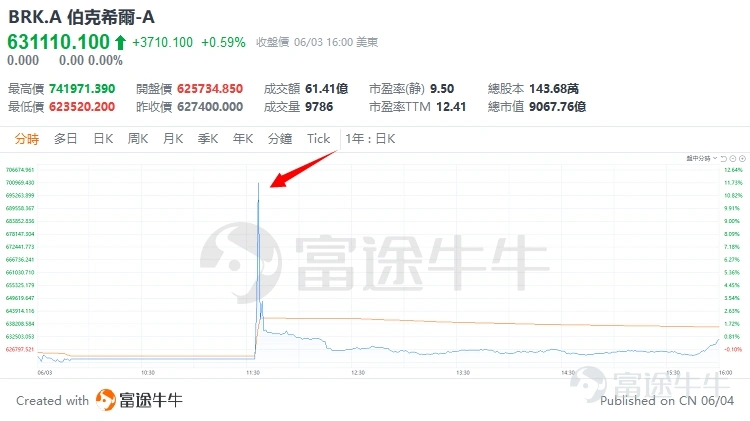
When the price returned to normal, because there was a large amount of buy orders piled up, the price surged all of a sudden, rising by 15% at one point. After the buy orders were absorbed, the price quickly fell back.
An extremely abnormal market event occurred last night (June 3)! Buffett's$Berkshire Hathaway-A (BRK.A.US)$also affected! Although he has experienced technical halts in the US stock market four times, his own stocks plummeted by 99.97%, this phenomenon is also the first time for old Buffett to see! What is the logic behind this incident, what impact does it have? How to cleverly use order types to avoid losses in such events? How to do risk control well and better protect your wallet?Mr. mooer will explain one by one below. What is the logic and impact behind this? What exactly is the situation?The reason is that the NYSE (New York Stock Exchange) was responsible for handling the software upgrade for quotes, which led to technical issues causing significant volatility and trading halts for stocks such as Berkshire Hathaway, Bank of Montreal, Barrick Gold, and others. Normal operations have now resumed. As an investor, what kind of impact will this have on you?In theory, this is a BUG, and when prices are abnormal, you cannot buy in, which will not have a long-term impact on the market. However, in the short term, it is indeed possible for some investors to incur losses as a result. For example, some investors submitted Market Orders during abnormal market conditions at the time, and did not have the opportunity to cancel the order later, or were unable to cancel the order due to brokerage restrictions. When the price returned to normal, they bought at market price. Once the price returned to normal, due to a large number of buy orders stacking up, the price quickly surged, rising by as much as 15% at one point. After the buy orders were absorbed, the price quickly fell back...
For these investors, they may have bought at a high point, originally intending to bargain hunt, but ended up falling into a pit. If they had activated the margin trading feature at this time, using leverage, their Account would suffer even more!
Will losses occur in Futu under the above scenario? No!Because although such extreme events are not common, once they occur, they may cause significant losses to investors. Therefore, Futu has established strict risk control measures for this.
Market orders themselves have fast execution speed, but the price is not very controllable. Therefore, in order to avoid significant deviations in price leading to losses, in scenarios with insufficient liquidity, Futu prohibits the use of market orders. For more information, everyone can click here to learn more.Click here to learn more.In this event, not a single user at Futu suffered any losses.
2. By using different types of orders cleverly, you can earn more and incur less losses!
What does this case study illustrate?In special market conditions, there is a high risk with Market Orders! At the same time, it is a very important skill in investing to choose the appropriate order types at the right time.
At Futu, there are plenty of order types for you to choose from. Let's have mooer explain in detail. First, let's briefly talk about Limit Orders and Market Orders.
(1)Limit Order:You determine the fill price, and the final purchase price is either lower or better than the price you set. However, you need to wait for the match, and there may be delays in the execution time.
(2)Market Order:Executes at the current market price, fast execution speed, but high price volatility and uncontrollable.
Based on these 2 basic orders, mooer also wants to introduce 3 advanced orders to you, including stop-loss order, take-profit order, and trailing stop-loss order.
(3) Stop-Loss Order (including Limit and Market):
After buying stocks, if you are worried about a significant price drop and want to reduce losses, you can consider setting a sell stop-loss order.
After short selling stocks, if you are concerned about a significant price increase and want to reduce losses, you can consider setting a buy stop-loss order.
If you do not hold positions but predict a significant increase (or decrease) in stock price, you can also submit a buy (or sell) stop-loss order.
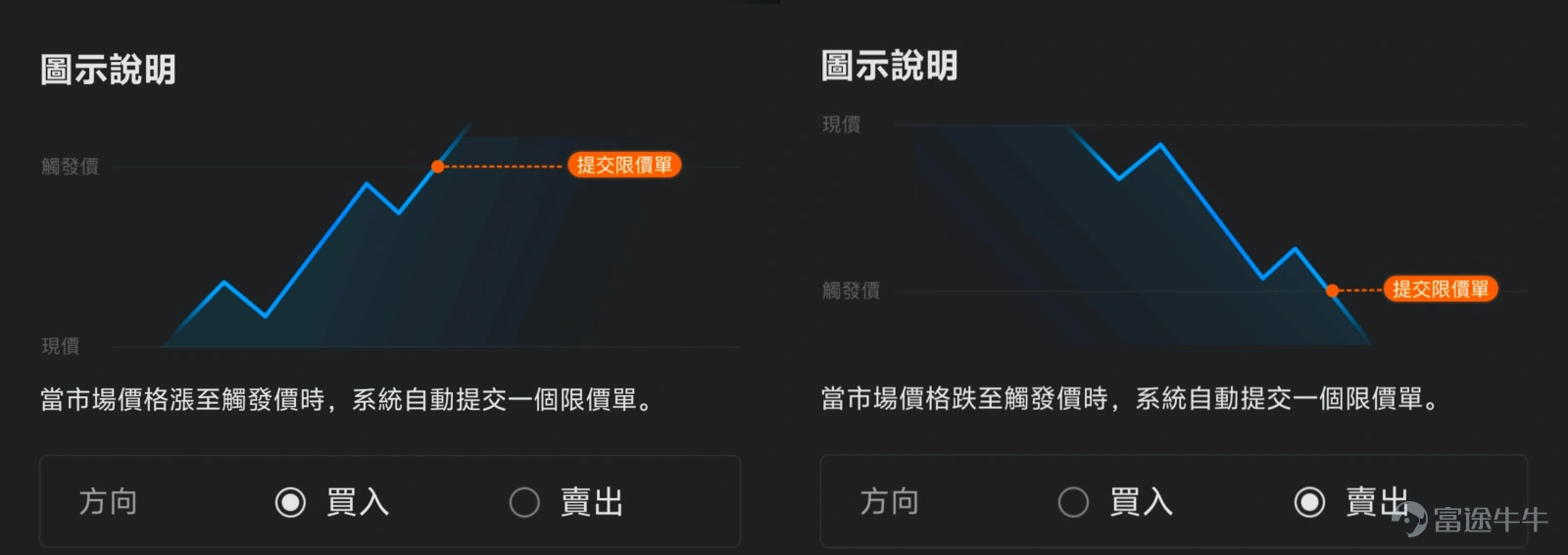
When placing an order, you need to set a trigger price. When the market price reaches this trigger price, the system will automatically submit a stop-loss order.
(The diagram shown above illustrates a Limit Order, Market Order is similar to this)
(4) Take-Profit Order (including Limit and Market):
After buying stocks, if you are worried that the stock price will change from rising to falling, for security, you can consider setting a sell stop order (also known as a stop-loss order).
After Short Selling stocks, if you are worried that the stock price will change from falling to rising, for security, you can consider setting a buy stop order.
If you do not hold positions, but predict that the stock is about to rise significantly (or fall significantly), you can also place a sell (or buy) stop order.
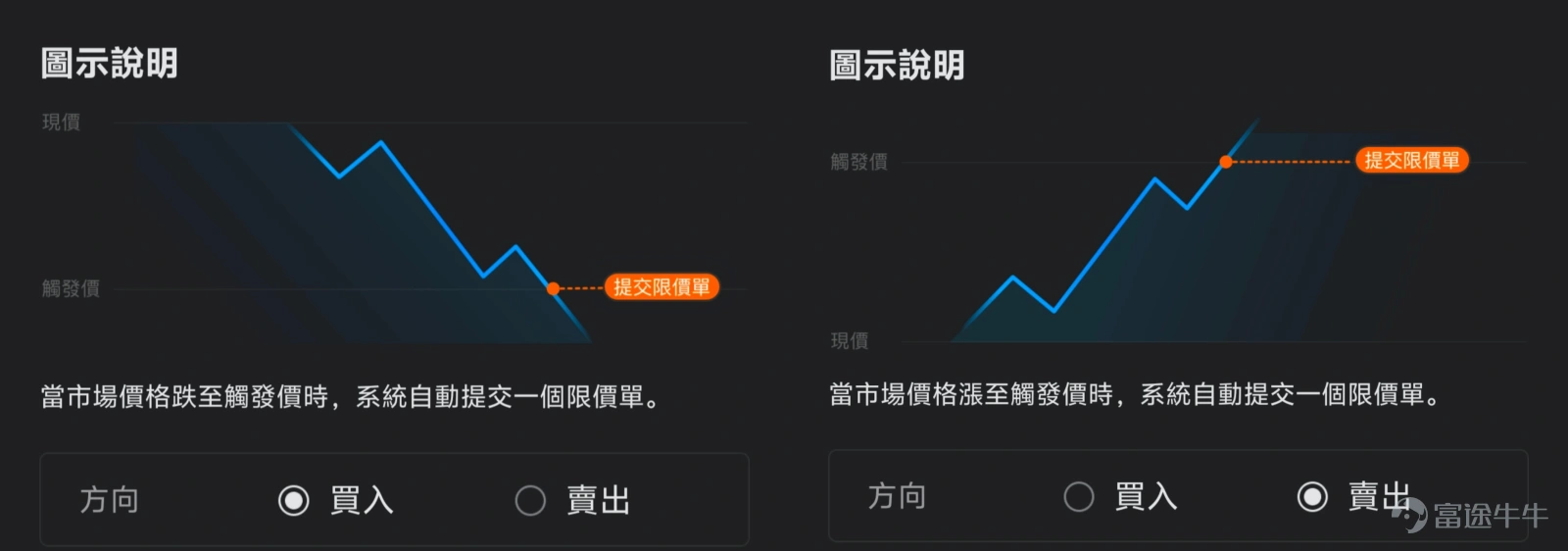
When placing an order, you need to set a trigger price. When the market price reaches this trigger price, the system will automatically submit a stop order.
(The diagram above shows the icon for a limit order, a market order is similar to this).
(5) Trailing Stop Orders (including limit and market orders):
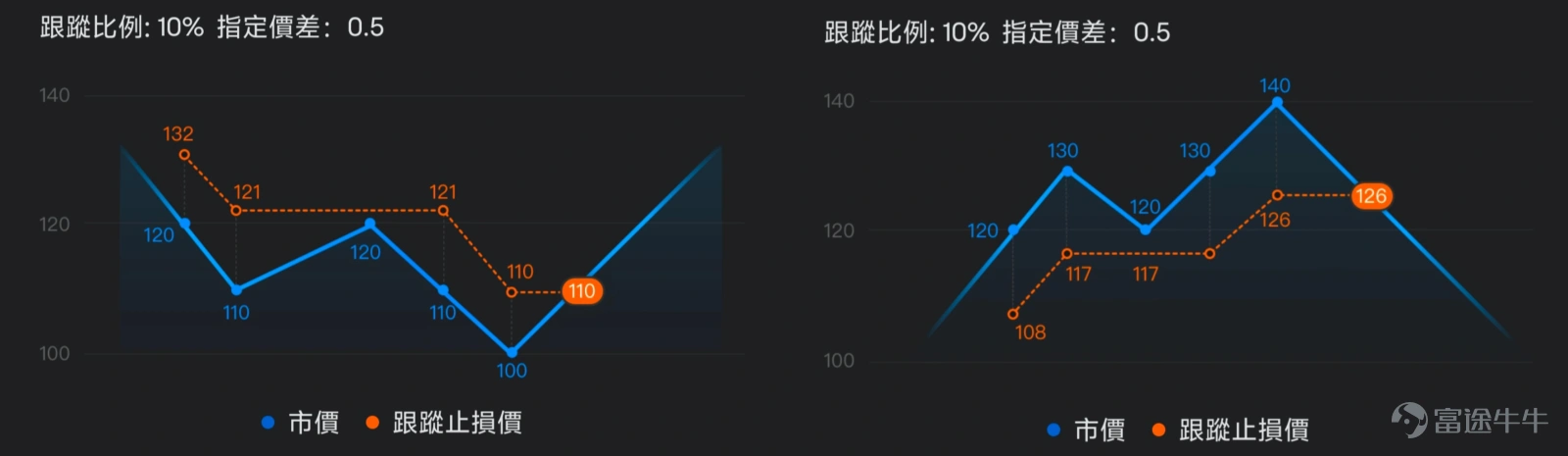
In volatile market conditions where the trigger price for stop orders cannot be determined, you can consider setting a trailing stop order for dynamic management. You need to set a trailing ratio or amount (if it is a limit order, you also need to set a specified price difference), specific information combined with examples.
If the stock price is $120 and you set a buy trailing stop order with a tracking ratio of 10%, then the initial trigger price is $132. When the stock price reaches this price, a buy order will be submitted. Subsequently, as the stock price changes, if the price drops to $110, the trigger price becomes $110*1.1=$121.
If the stock price rises next, the trigger price will remain unchanged until the stock price falls below $110 again. For example, when it reaches $100, the trigger price will be adjusted to $100*1.1=$110. In other words,In the trailing stop order for buying, the trigger price only decreases and does not increase.
If the stock price rises to (or above) the trigger price, the system will automatically submit a buy market order. If it is a market order, it will be submitted at market price, whileIf it is a limit order, the system will submit the order price as the trigger price + the specified price difference.
Conversely,In the trailing stop order for selling, the trigger price only increases and does not decrease.The system will submit the corresponding order when the stock price drops to (or below) the trigger price at that time.The order price submitted for a limit order is the trigger price minus the specified price difference.
(On the left is the Buy Trailing Stop Order, and on the right is the Sell Trailing Stop Order; the diagram shown is for a Market Order, a Limit Order is similar to this).
If you can cleverly use these types of orders, it can help you automate your trading management, reduce emotional decisions, and also reduce the possibility of losses or missing profits due to not keeping up with rapid market changes. How can you find the above types of orders? Just follow the steps below!
An extremely abnormal market event occurred last night (June 3)! Buffett's$Berkshire Hathaway-A (BRK.A.US)$also affected! Although he has experienced technical halts in the US stock market four times, his own stocks plummeted by 99.97%, this phenomenon is also the first time for old Buffett to see! What is the logic behind this incident, what impact does it have? How to cleverly use order types to avoid losses in such events? How to do risk control well and better protect your wallet?Mr. mooer will explain one by one below. What is the logic and impact behind this? What exactly is the situation?The reason is that the NYSE (New York Stock Exchange) was responsible for handling the software upgrade for quotes, which led to technical issues causing significant volatility and trading halts for stocks such as Berkshire Hathaway, Bank of Montreal, Barrick Gold, and others. Normal operations have now resumed. As an investor, what kind of impact will this have on you?In theory, this is a BUG, and when prices are abnormal, you cannot buy in, which will not have a long-term impact on the market. However, in the short term, it is indeed possible for some investors to incur losses as a result. For example, some investors submitted Market Orders during abnormal market conditions at the time, and did not have the opportunity to cancel the order later, or were unable to cancel the order due to brokerage restrictions. When the price returned to normal, they bought at market price. Once the price returned to normal, due to a large number of buy orders stacking up, the price quickly surged, rising by as much as 15% at one point. After the buy orders were absorbed, the price quickly fell back...
Speaking of this, I don't know if you have mastered these types of orders or not? Let me test you, what type of order would you set if you bought Stock A at $70 and have already made some profit, but are worried about a future price drop? How would you set it up?
3. How to effectively control risks and safeguard your financial resources?
Of course, besides using the right order types, this event also demonstrates the importance of risk control.
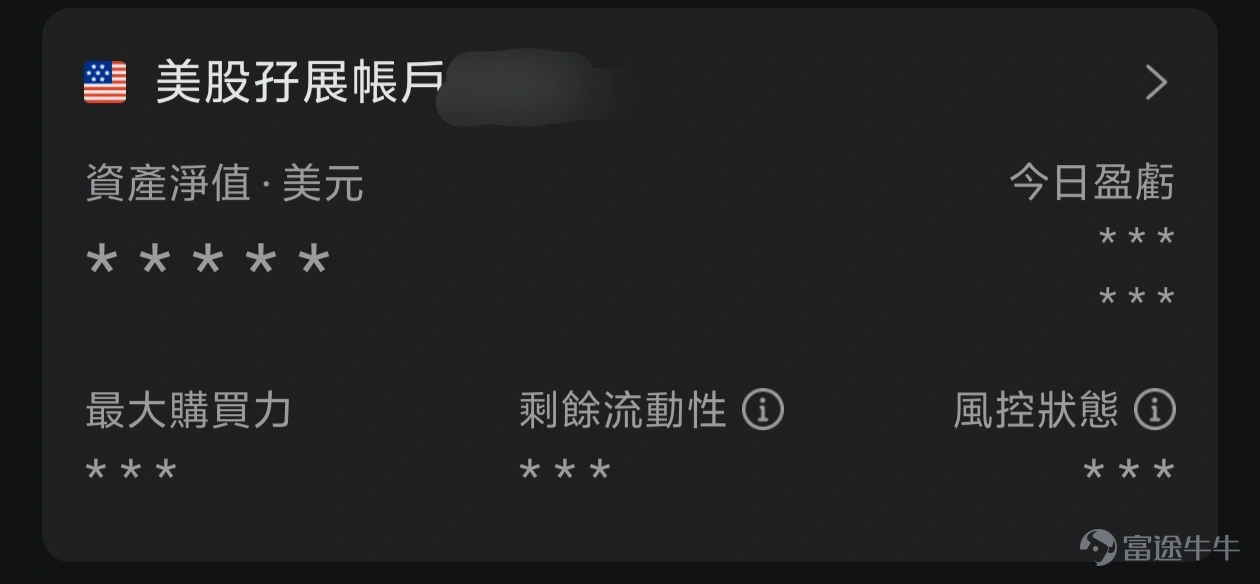
風控一方面要靠券商提供靠譜的保護機制。例如牛sir前面提到的,富途對於異常行情的市價單限制。類似的風控手段還有很多,比如富途賬戶的“剩餘流動性”和“風控狀態”,使你可以查看距離危險還有多少距離,從而提前進行資金安排、降低風險。
An extremely abnormal market event occurred last night (June 3)! Buffett's$Berkshire Hathaway-A (BRK.A.US)$also affected! Although he has experienced technical halts in the US stock market four times, his own stocks plummeted by 99.97%, this phenomenon is also the first time for old Buffett to see! What is the logic behind this incident, what impact does it have? How to cleverly use order types to avoid losses in such events? How to do risk control well and better protect your wallet?Mr. mooer will explain one by one below. What is the logic and impact behind this? What exactly is the situation?The reason is that the NYSE (New York Stock Exchange) was responsible for handling the software upgrade for quotes, which led to technical issues causing significant volatility and trading halts for stocks such as Berkshire Hathaway, Bank of Montreal, Barrick Gold, and others. Normal operations have now resumed. As an investor, what kind of impact will this have on you?In theory, this is a BUG, and when prices are abnormal, you cannot buy in, which will not have a long-term impact on the market. However, in the short term, it is indeed possible for some investors to incur losses as a result. For example, some investors submitted Market Orders during abnormal market conditions at the time, and did not have the opportunity to cancel the order later, or were unable to cancel the order due to brokerage restrictions. When the price returned to normal, they bought at market price. Once the price returned to normal, due to a large number of buy orders stacking up, the price quickly surged, rising by as much as 15% at one point. After the buy orders were absorbed, the price quickly fell back...
另一方面,也需要牛友們有自己的風控策略。關於這個部分,牛sir在這裡就不多說了,感興趣的可以通過《如何減少投資風險?》這門課學習更多。
若你能夠做好風控、用好工具,那牛sir相信你離投資獲利就又進了一步!而在避開風險、捕捉機會之餘,牛sir知道大家對於真金白銀的福利也很感興趣,特此帶來一個福利,點擊此處即拎高達$2000的驚喜獎賞>>
*活動對象:限年滿18歲以上,香港地區已註冊富途APP但未開立證券帳戶的特邀存量用戶參與
Risk Disclaimer: The above content only represents the author's view. It does not represent any position or investment advice of Futu. Futu makes no representation or warranty.Read more
Thumbs Up
130
Heart
9
Nose Pick
1
Emm
1
Respect
2
180K Views
Report
Comments (26)
Write a Comment...
26
143
290