
English
Back
Open Account
雪豹财经社
wrote a column · ·

Tencent buying Tencent at a low price, Tencent selling "Tencent".

Author: Yan Xuegong Cover | Visual China  If someone claims to buy Tencent at a low price$TENCENT (00700.HK)$Never missing a beat, this person is either a fraud or Tencent itself.   Tencent has had at least 7 waves of intensive buybacks in its history, all bought at low prices, with significant subsequent gains, to the extent that its buybacks have been jokingly referred to by the outside world as the "indicator for buying Tencent at the bottom".   At the beginning of 2022, Tencent once again embarked on a journey of buying at the bottom. As of the first 15 working days of January 21st, Tencent's Hong Kong stocks conducted 10 buybacks, totaling 2 billion Hong Kong dollars. From the beginning of 2022 to January 21st, Tencent's stock price has accumulated a 7.08% increase.   While buying Tencent at a low price, Tencent is also selling "Tencent". Before the intensive buybacks, Tencent also made significant reductions in holdings of two "Tencent-related" companies.   On the first working day of 2022, Tencent sold a 2.6% stake in Southeast Asian internet behemoth Sea Ltd. at a price of 3.1 billion dollars, reducing its stake from 21.3% to 18.7%. In December 2021, Tencent reduced its stake in JD.com through dividend distribution, reducing its stake from 17% to 2.3%, no longer the largest shareholder of JD.com, and Tencent CEO Ma Huateng also exited the board of JD.com.   Frequently buying its own Tencent at a low price, Tencent is also actively narrowing down its long-operated investment map. What is the intention behind Tencent's seemingly contradictory actions? Frequent buying at the bottom, never failed. Share repurchases usually occur when a company believes its current stock...
Author: Yan Xuegong
Cover | Shutterstock

If someone claims to be buying the dip on Tencent...$TENCENT (00700.HK)$Has never missed, this person is either a fraud or Tencent itself.

Tencent has experienced at least 7 waves of intensive buybacks in its history, all buying at low stock prices, and subsequently seeing significant increases, to the extent that its buybacks have been jokingly referred to as the 'indicator of buying the dip on Tencent' by outsiders.

At the beginning of 2022, Tencent once again embarked on a journey of buying the dip. In the 15 working days leading up to January 21st, Tencent's Hong Kong stocks conducted 10 buybacks, totaling 2 billion Hong Kong dollars. From the beginning of 2022 to January 21st, Tencent's stock price has increased by 7.08%.

While bottoming out Tencent's stock, Tencent is also selling its own shares. Before the intensive buybacks, Tencent also made substantial reductions in holdings of two "Tencent-affiliated" companies.

On the first working day of 2022, Tencent sold a 2.6% stake in the Southeast Asian internet giant Sea Ltd (referred to as Sea) for $3.1 billion, reducing its holdings from 21.3% to 18.7%. In December 2021, Tencent reduced its stake in JD.com through dividends, decreasing its holdings from 17% to 2.3%, no longer being JD.com's largest shareholder, and Tencent's CEO, Ma Huateng, also stepped down from JD.com's board.

Frequently bottoming out on its own Tencent shares, Tencent is also actively narrowing the investment landscape it has operated in for many years. What is the intention behind these seemingly contradictory actions by Tencent?
Frequent bottom fishing, never defeated.
Share repurchases usually occur when a company believes that the current stock price is far below the intrinsic value of the company, hoping to stabilize the stock price and enhance investor confidence through this operation.

Throughout Tencent's history of 7 waves of intensive buybacks, both in terms of bottom fishing timing and subsequent stock price changes, they have delivered textbook-level outstanding performance, regarded as a golden buying point.

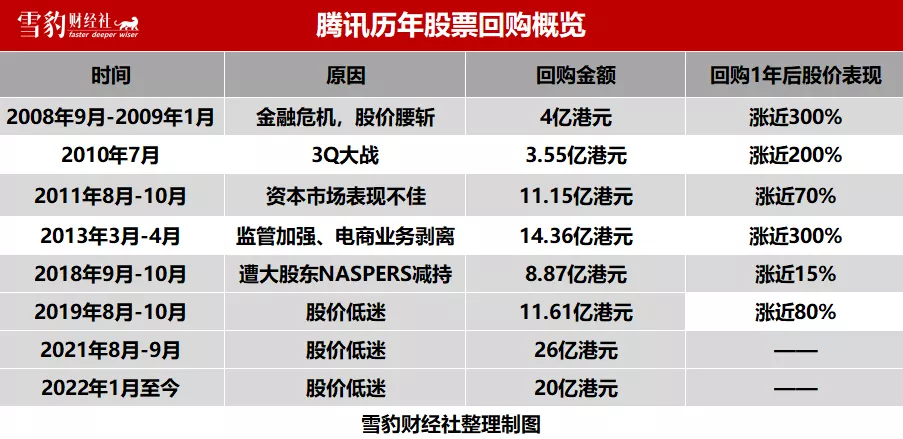
During the 2008 financial crisis, with the stock price low, Tencent continuously initiated 36 share repurchases within 5 months, repurchasing 8.273 million shares worth 0.4 billion Hong Kong dollars. A year later, Tencent's stock price had more than tripled. This was also Tencent's longest-lasting buyback.

From 2010 to 2019, Tencent subsequently carried out 5 waves of intensive share repurchases, lasting from 1 to 3 months, with the highest repurchase amount reaching 1.436 billion Hong Kong dollars. These bottom fishing actions also brought Tencent considerable profits (see table below).
Author: Yan Xuegong Cover | Visual China  If someone claims to buy Tencent at a low price$TENCENT (00700.HK)$Never missing a beat, this person is either a fraud or Tencent itself.   Tencent has had at least 7 waves of intensive buybacks in its history, all bought at low prices, with significant subsequent gains, to the extent that its buybacks have been jokingly referred to by the outside world as the "indicator for buying Tencent at the bottom".   At the beginning of 2022, Tencent once again embarked on a journey of buying at the bottom. As of the first 15 working days of January 21st, Tencent's Hong Kong stocks conducted 10 buybacks, totaling 2 billion Hong Kong dollars. From the beginning of 2022 to January 21st, Tencent's stock price has accumulated a 7.08% increase.   While buying Tencent at a low price, Tencent is also selling "Tencent". Before the intensive buybacks, Tencent also made significant reductions in holdings of two "Tencent-related" companies.   On the first working day of 2022, Tencent sold a 2.6% stake in Southeast Asian internet behemoth Sea Ltd. at a price of 3.1 billion dollars, reducing its stake from 21.3% to 18.7%. In December 2021, Tencent reduced its stake in JD.com through dividend distribution, reducing its stake from 17% to 2.3%, no longer the largest shareholder of JD.com, and Tencent CEO Ma Huateng also exited the board of JD.com.   Frequently buying its own Tencent at a low price, Tencent is also actively narrowing down its long-operated investment map. What is the intention behind Tencent's seemingly contradictory actions? Frequent buying at the bottom, never failed. Share repurchases usually occur when a company believes its current stock...
In 2021, the stock prices of technology internet companies collectively declined, and China's highest market cap internet company, Tencent, was not spared. Since reaching a high of 751.1 Hong Kong dollars in February 2021, Tencent's stock price has continuously dropped by 47% to a low of 400.1 Hong Kong dollars in August, nearly halving. As of the close of August 31 of that year, Tencent's static PE ratio was only 20.39, hitting a 14-year low.

It was also from this time that Tencent, after a two-year hiatus, once again began to buy back its own shares.

In August and September 2021, Tencent conducted over 30 repurchases totaling nearly 2.6 billion Hong Kong dollars. In September, almost every repurchase amount reached 0.1 billion Hong Kong dollars. Subsequently, Tencent's stock price rebounded, briefly surpassing 500 Hong Kong dollars.

Intensive share repurchases coupled with strategic adjustments are standard moves for Tencent to weather difficult times.

After the "3Q Battle" in 2010, Tencent, known for its intensive share repurchases, shifted from a closed model to an open one. Leveraging the core advantages of "traffic + capital," it successively invested and handed non-core business to allies. In 2018, after Tencent's major shareholder Naspers reduced its holdings, Tencent repurchased shares 24 times, spending nearly 0.9 billion Hong Kong dollars, and simultaneously reorganized the company's organizational structure by establishing six major business groups.

However, relying on share buybacks to boost stock prices is not a one-size-fits-all solution for every company.

In 2021, Xiaomi spent 8.4 billion Hong Kong dollars to buy back shares 56 times, accounting for 22% of the total repurchase amount in the Hong Kong stock market that year, making it the "repurchase king" in the Hong Kong stock market. However, this did not boost Xiaomi's stock price as intended. During that year, Xiaomi's stock price declined from a high of 33.6 Hong Kong dollars to around 18 Hong Kong dollars, nearing the issue price of 17 Hong Kong dollars.
Selling "Tencent" to cope with the harsh winter.
While conducting intensive repurchases, tencent is also significantly reducing its holdings.

On January 4th, tencent announced a reduction in its holdings of Southeast Asian internet company sea, decreasing its stake from 21.3% to 18.7%. They pocketed $3.1 billion, equivalent to nearly 20 billion yuan. Sea, which owns the largest gaming company Garena in Southeast Asia, has tencent as its largest shareholder, hence being referred to as the "Southeast Asian Tencent" by the public.

Although tencent's reduction this time is small, the key point is to convert all Class A shares (with voting rights) into Class B shares (ordinary shares). In other words, tencent voluntarily gave up most of its voting rights, expecting the voting rights to decrease to below 10%. This may be aimed at addressing regulatory issues that Sea faces during its overseas expansion.

In December 2021, tencent reduced its stake in jd.com through a dividend method, reducing its stake from 17% to 2.3%, involving HK$127.7 billion.

By buying back shares and reducing holdings of tencent-related companies, tencent's strategy of "playing both sides" reveals what kind of investment logic?

When announcing the reduction of holdings in jd.com, tencent responded by stating that it was exiting when "the invested company has the ability to sustain self-financing." Tencent also stated, "We believe it is the right time to directly share our investment results in jd.com with tencent shareholders."

This aligns with the investment logic of "when the melon is ripe, it will fall." In the current low stock price environment, cashing in on matured shares can improve tencent's own profit status, as well as release investment results and enhance shareholder confidence.

2021 was considered a cold winter for internet technology companies, with Chinese concept stocks collectively plummeting, making it a tough time for tencent as well.

According to Tencent's latest financial report, the net income attributable to equity holders under non-IFRS declined by 2% to 31.751 billion yuan year-on-year, marking the first decline in nearly 10 years. The continuous drop in the share price of listed companies they invested in also affected Tencent's financial data. In Q3 2021, Tencent suffered a loss of up to 36.4 billion yuan due to changes in the fair value of financial assets.

The cold winter is not over yet, Tencent may continue to sell its shares in Tencent.

CICC predicts that adjusted net income of Tencent in Q4 2021 is expected to decline by 25% year-on-year. Bloomberg Industry Research also believes that Tencent may reduce its shareholding in Meituan and PDD, mentioning that Tencent can cash in on mature and profitable shares, dispelling concerns that massive unrealized gains may never be realized.
Letting go of the 'other share'.
After the battle of the third quarter, Tencent, which has abundant traffic and capital, quickly expanded its territory, building a dominant 'Tencent ecosystem' in the Chinese internet circle through investments. In 2015, Ma Huateng publicly stated that Tencent only has half a life, and 'the other half of life is given to partners'.

At the annual investment conference in 2018, Liu Chiping revealed that the new value created by Tencent's invested companies exceeded Tencent's own market cap, equivalent to Tencent creating another Tencent. As of Q3 2021, the fair value of companies invested by Tencent reached a staggering 1196.6 billion yuan, equivalent to 26.7% of Tencent's market cap.

However, in the second half of 2021, this previously unstoppable strategy over the past decade seemed to lose its magic. Tencent, once known as the 'King of Investment,' has also begun to retreat, letting go of the 'other half share'.

On the one hand, most of the companies Tencent has invested in over the past few years have entered a mature stage, nearing their growth ceiling, which brings relatively limited long-term returns to Tencent. Through active shareholding reductions, Tencent can release the close relationship with affiliated companies from a capital perspective, which might not be a bad thing in terms of short-term returns.

On the other hand, with the gradual implementation of the new regulations on interconnection, the trend of dismantling the walls of internet platforms is inevitable. This means that tencent.com's traffic attractiveness to high-quality partners is greatly reduced.

However, shrinking the investment landscape of tencent.com does not mean tencent.com is giving up on investing in this golden goose.

Currently, tencent.com is shifting its investment strategy from wanting to control various tracks to returning to its main businesses of gaming, social networking, and content. During the Q3 2021 earnings conference call, tencent.com's senior management stated that they will focus on investing in the gaming sector, enterprise service sector, and short video field in the future.

From precise bottom fishing to large-scale shareholding reductions, tencent.com's recent major moves have a consistent investment logic behind them. It needs to boost its stock price, improve its profitability, enhance investor confidence in the short term, and explore investment strategies more suitable for the new environment.

After all, in the cold winter of the internet, even giants like tencent.com need to find better ways to survive the winter.
Risk Disclaimer: The above content only represents the author's view. It does not represent any position or investment advice of Futu. Futu makes no representation or warranty.Read more
Thumbs Up
9
634K Views
Report
Comments (6)
Write a Comment...
6
9
31