
蘋果Q4財報不及預期,庫克稱受供應鏈影響

Tesla's trillion-dollar market capitalization, FB points to the metaverse, but Apple has stalled?
At a time when Facbook changed its name to Meta and Tesla with a market capitalization of trillions of dollars, Apple, which had always performed well, handed over a financial report that fell short of expectations.
Apple released financial results for the fourth quarter of fiscal year 2021 (FY2021Q4, ending September 25) after the US stock market on Thursday (October 28, local time). Although revenue still achieved double-digit annual growth in the fiscal quarter of this report, it fell short of expectations for the first time in five years due to the impact of tight supply chains and chip shortages:
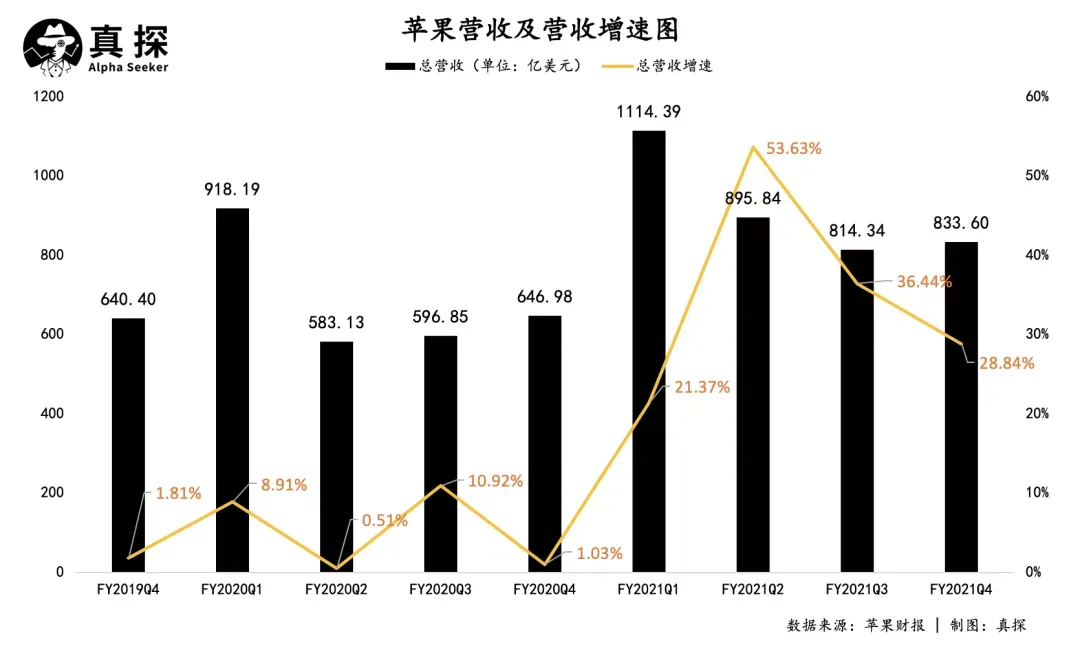
Revenue increased 28.9% year over year to reach US$83.36 billion, falling short of Wall Street's expectations of US$84.68 billion;
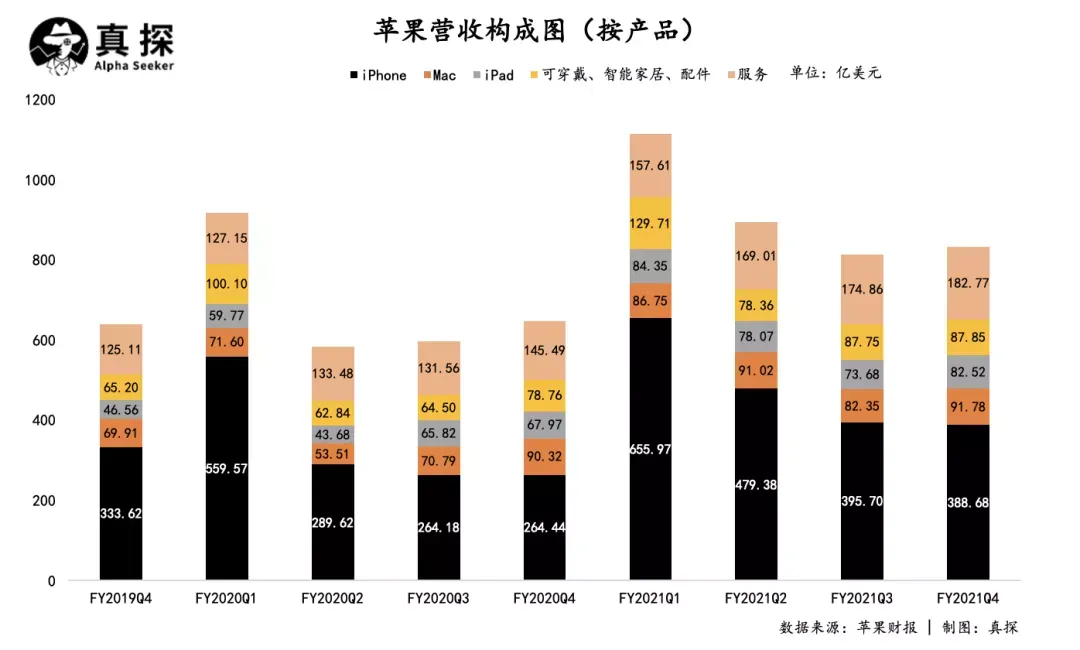
The sales revenue of hardware products (including iPhone, iPad, Mac, wearable devices, etc.) was 65.083 billion US dollars, up 29.8% year on year. Among them, iPhone sales revenue reached 38.87 billion US dollars, an increase of 47% year on year, but fell short of expectations;
Revenue from services (including music subscriptions, advertising, etc.) was US$18.28 billion, exceeding Wall Street expectations, with an annual increase of 25.6%;
Gross profit of US$35.17 billion and gross margin of 42.2% exceeded expectations.
The market is too accustomed to Apple's “far exceeding expectations” performance. Although revenue growth is still impressive this time, the results fell short of expectations and Cook's judgment on the supply chain at the earnings conference, causing Apple to drop 3.53% in after-hours trading, and the stock price remained at $147.19.
Even Apple, a student who has always excelled in supply chain management lessons, is unable to escape the ongoing global supply chain crisis. Cook told CNBC that the supply restrictions were greater than expected, and the impact on revenue was estimated at around $6 billion. “The reason for the tight supply chain is the well-known shortage of chips across the industry and the suspension of manufacturing due to the pandemic in Southeast Asia.”
It is worth noting that because of Apple's release pace, the first fiscal quarter of each fiscal year is usually the peak sales season for Apple. As a result, Apple expects that the release of new products such as the iPhone 13 and MacBook Pro will achieve record revenue in the next fiscal quarter.
Shortages of labor and parts, as well as logistics issues, also had a significant negative impact on Amazon. The Q3 earnings report released on the same day fell short of expectations, and the stock price fell 4% after the market.
The past fiscal year was a year where Apple created a miracle in the supply chain crisis. Sales grew rapidly every quarter. Annual revenue for FY2021 increased 33% over 2020, reaching 366 billion US dollars.
After the consumer hardware boom brought about by the pandemic, how to ensure the stability of the supply chain and face the lack of cores became the core issues Apple needed to solve.
Supply chain issues are urgent
Looking at the split revenue structure, hardware sales still account for the majority, accounting for 78.07% of total revenue in FY2021Q4, of which:
iPhone revenue was US$38.87 billion, up 47% year over year, falling short of expectations of US$41.6 billion;
Mac's revenue was $9.18 billion, a growth rate of only 1.62%, and is expected to be $9.3 billion;
iPad brought in revenue of $8.25 billion, which is expected to be $7.16 billion, a growth rate of 21.41 percent;
Revenue from the wearables division was $8.79 billion, falling short of expectations of $9.27 billion, an increase of 11.5% over the previous year;
Service revenue continued to grow steadily, rising 25.6% year over year, exceeding expectations of $17.57 billion.
Apple phone sales are strong. According to the latest data from Canalys, Apple ranked second in smartphone shipments in the third quarter of this year, surpassing Xiaomi and returning to runner-up. The market share rose from 12% in the same period last year to 15% in the third quarter of this year. With the launch of the new phone in September, Apple attracted an increase in demand. According to KGI Securities, in the first 8 days after the launch of the new iPhone, Apple's pre-order volume in China reached 5 million units.
However, supply chain shortages may lead to a situation where supply is in short supply. Needham analyst Laura Martin believes supply chain issues may cause Apple's sales and earnings to decline over the next year. The bank reduced Apple's iPhone 13 shipments by 10 million units in the fourth quarter of 2021. Needham now expects 80 million iPhone 13 shipments in the first quarter of fiscal year 2022.
Evercore ISI analyst Amit Daryanani said that in most countries, the expected delivery time for the iPhone 13 series has been extended. He pointed out that the waiting time for the iPhone 13 Pro and Pro Max to arrive in the US is 31 days and 35 days in China, which is higher than the previous estimate of 29 days and 28 days, while the average delivery time in other countries is 28 days.
Apple CFO Luca Maestri said during an earnings call with analysts that iPad sales are expected to drop year over year in December due to tight supply.
Apple's plans to move its supply chain to Southeast Asia had to be put on hold due to the pandemic. In October of last year, according to NetEase Technology, Apple suppliers such as TSMC, Foxconn, and Heshuo were all pressured to move 15-30% of their production operations out of China and to Southeast Asian countries such as Vietnam, India, and Thailand. As a result, due to the lack of effective control of the Southeast Asian epidemic, China's supply chain recovered rapidly, and a large number of orders returned to China.
Mac growth has been weak during this fiscal quarter. New products were released last week, and the “notch screen” became a sticking point, but the M1 Pro and M1 Max super chips really excited the market. Apple wants to win back the hearts of professional users and is going further and further along the way to developing its own chips.
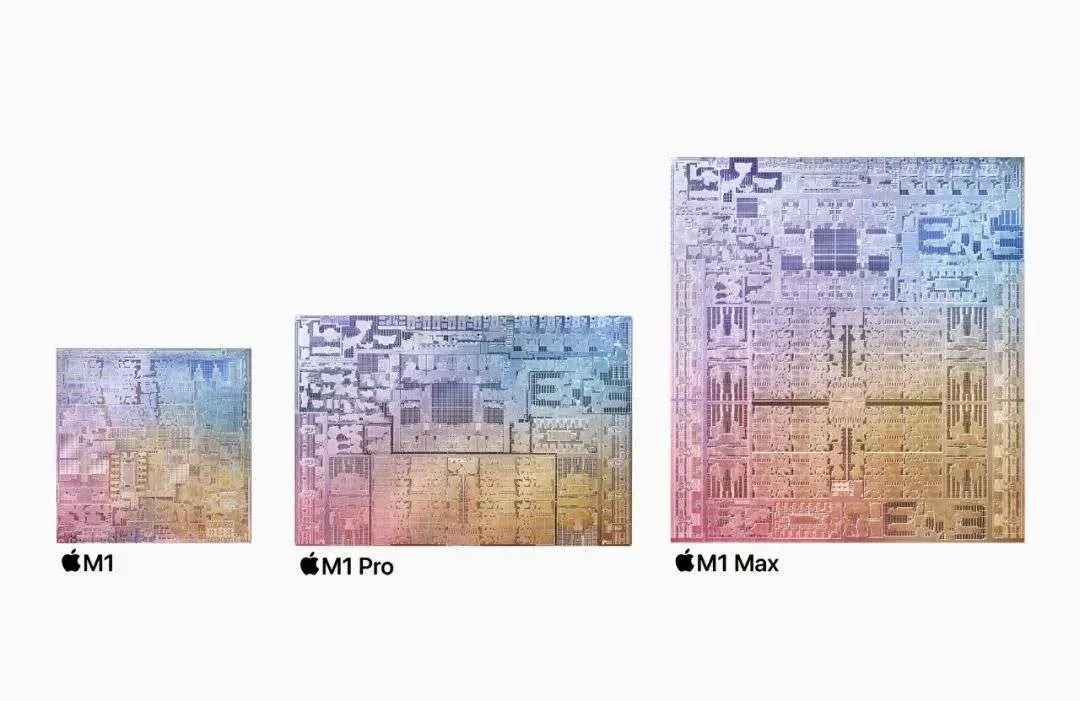
In addition to the iPhone, the strongest growth in Apple's revenue segment is its services business, which includes sales from the App Store, music and video subscription services, advertising, extended warranties, and licenses.
Cook said that Apple currently has 745 million paying users. This includes not only first-party services such as Apple Music, but also subscriptions through the App Store. “[Service revenue] increased by $160 million over the same period last year, a fivefold increase in five years. It's been a pretty impressive growth cycle,” Cook said.
FY2021Q4, Apple's operating profit was US$23.786 billion, and net profit was US$20.551 billion.

Strong growth in Greater China
Apple is not only inseparable from China in its supply chain; it still needs this huge consumer market to achieve growth in product sales.
FY2021Q4, revenue for the Americas was US$36.820 billion, Europe was US$20.794 billion, Greater China was US$20.794 billion, Japan was US$5.991 billion, and the rest of the Asia-Pacific region was US$5.192 billion. Although the American region accounts for a high share, the market situation has been saturated over the years, making it difficult to achieve significant growth. Currently, the main growth engine is the Greater China region.
In the past fiscal year, Greater China achieved four consecutive annual revenue increases of more than 50%, and achieved a year-on-year increase of 83.27% during this reporting quarter.
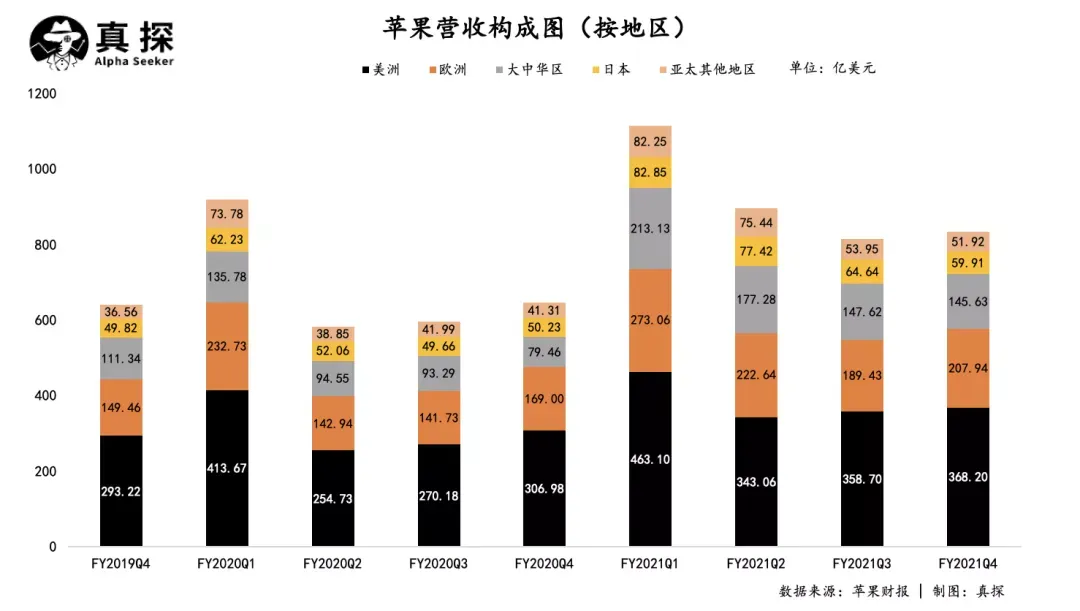
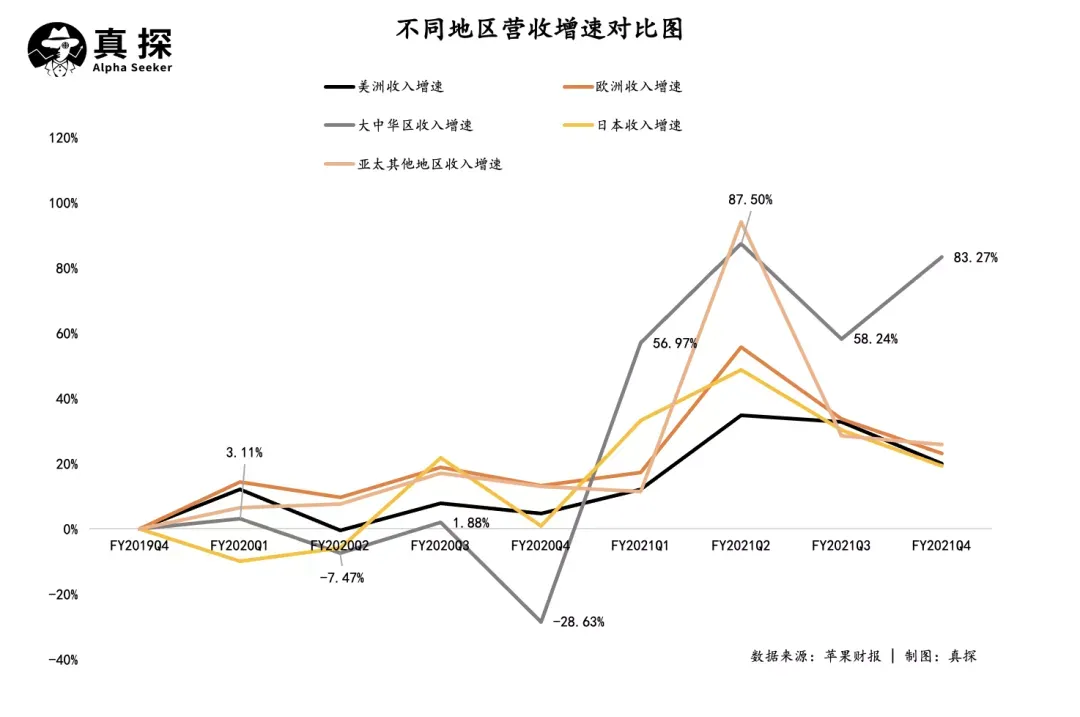
In the last fiscal season, “Chinese users had a very enthusiastic response to the iPhone 12 series, which brought huge sales growth.” Cook specifically mentioned during the earnings call that the popularity of Apple phones was inseparable from the mid-year promotions of major e-commerce platforms. The upcoming Double Eleven is also expected to stimulate a wave of switching.
As Huawei's lack of cores is limited, there is a gap in the high-end phone market in China, and Apple has become the first choice for high-end models. Although Honor, Xiaomi, OPPO, and vivo set the main theme of competition to high-end, they are unable to catch up with Apple in this market in the short term. However, the old rival Samsung is showing signs of returning to the Chinese market, focusing on folding screen phones.
Looking at the Chinese smartphone market as a whole, according to the latest data from the authoritative research agency Counterpoint Research, due to weak demand and supply chain shortages, total Q3 shipments were 76.5 million units, down 9% year on year, but up 3% month-on-month:
vivo ranked first with a 23% share, with shipments up 21% year on year and 2% month on month;
OPPO ranked second with a 20% share, a year-on-year increase of 26% and a month-on-month decline of 1%;
The next step is to return to the third glory with a 15% share. Shipments fell 7% year on year, but increased 96% month-on-month, and are rapidly recovering lost ground;
Xiaomi ranked fourth with a 14% share. Shipments increased 15% year over year and fell 14% month over month;
The fifth is Apple, with a 13% share. Shipments increased 48% year over year and fell 9% month over month.
Antitrust hasn't hurt Apple
What needs to be alerted is that in addition to supply chain issues, there are also various lawsuits that make Apple frequently make headlines. As the legal dispute with Epic Game continues to advance and the anti-monopoly crackdown on tech giants by various countries continues, Apple has suffered, but no serious negative effects have been seen in financial reports so far.
In September, the California court ruled on the Fortnite (Fortnite) developer Epic Games against Apple's antitrust case. Apple must not prohibit app developers from setting up connections and guide users to choose in-app purchase methods other than Apple. If Apple's appeal fails, the ban will take effect on December 9.
Developers from all over the world have been struggling with Apple taxes for a long time. In South Korea, the National Assembly passed an amendment to the “Telecom Business Act” in August this year, prohibiting Google, Apple, etc. from using their status to force developers to use their specific payment methods.
Apple itself is also adjusting App Store rules. The updated terms last week allow developers to communicate with users about other payment methods that can be used in addition to their apps. At the same time, the commission policy has also been lowered.
In April of this year, due to the Spotify complaint, the European Union first initiated an antitrust lawsuit against Apple, questioning that Apple misused its dominant position to distort competition in the streaming media market. If it wins, Apple may be fined 10% of global revenue.
Although the anti-monopoly scythe hasn't hurt Apple much at the moment, this is just the beginning.
Author | Chen Wenqi
Risk Disclaimer: The above content only represents the author's view. It does not represent any position or investment advice of Futu. Futu makes no representation or warranty.Read more


Comments (12)
to post a comment
22
114