NVIDIA's revenue doubles, beating expectations; is the AI trade narrative making a comeback?

NVIDIA FY2027 Q2: An earnings report that instantly debunks the "peak demand" narrative
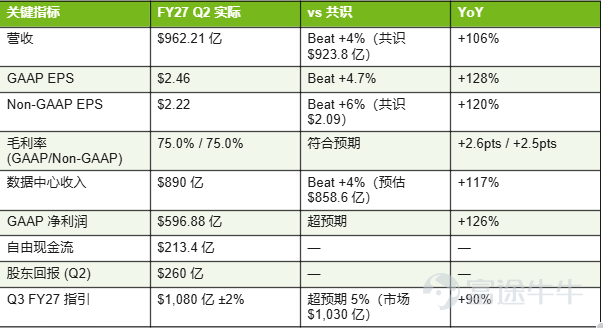
Last night, NVIDIA delivered its strongest earnings report in history: FY2027 Q2 revenue reached $96.221 billion, a year-over-year surge of 106%, with Non-GAAP earnings per share $2.22(+120%), and GAAP net income $59.688 billion(+126%). The data center business carried the weight, with a single-quarter $89 billionin revenue, up 117% year-over-year, beating Wall Street consensus on nearly every metric.

But what truly ignited the market were three major highlights hidden in the earnings report.
First: NVIDIA provided full-year guidance for the first time ever. Jensen Huang announced on the conference call that FY2028 revenue would grow 70%significantly, far exceeding analysts' expectations of approximately 45%. He stated bluntly, "Real demand is much higher than 70%; this is a 'discounted' figure constrained by production capacity," implying that unconstrained demand growth exceeds 100%. This marks the first time since its IPO that NVIDIA has issued a full-year performance outlook. The underlying signal of certainty is clear: orders are booked through 2028, giving management the confidence to make such bold projections.
Second: Amazon placed a massive additional order for 2 million GPUs. On top of the existing 1 million units, Amazon ordered another 2 million GPUs (to be deployed between 2027 and 2028, covering Blackwell Ultra, Rubin, and Rubin Ultra). This serves as the strongest rebuttal to the market's biggest concern: whether AI capital expenditure is entering a digestion phase. When the most cost-conscious cloud computing giant commits real capital, the narrative of a bubble naturally dissolves.
Third point: Early disclosure of the downward trajectory for gross margins. Q3 gross margin is projected at 74%,bottoming out at 71-72% in Q4,and recovering to 72-73% by FY28. The primary driver is the "extreme price hikes" for DRAM/HBM memory, with supply bottlenecks expected to persist until the end of FY28. Management characterizes this as "benign industry inflation," attributing upstream price increases to robust demand rather than a decline in competitiveness. This represents the sole earnings blemish for the coming quarters and the largest source of expectation divergence.
Additionally, management directly addressed controversies surrounding circular financing: $50 billion has been invested in Frontier Labs, with $500 billion raised in collaboration with Blackstone and BlackRock. The CFO denied the use of circular financing, stating that the company generates dual revenue streams from "hardware + compute power sharing." Vera Rubin is now in full-scale mass production, contributing 20% of data center revenue in Q3 alone. Although China operations were entirely excluded from the guidance, they retain a pure incremental option value for the future.
Summary:This is an earnings report with "impeccable fundamentals, reasonable valuation, and the only variables being profit margins and financing models." The first full-year guidance of 70% growth for FY28, coupled with Amazon's large order for 2 million GPUs, constitutes the strongest incremental information this quarter, directly countering the bears' narrative of "peaking demand."
Recommendation:Existing holders should continue to hold; the Q4 gross margin bottom reflects cost-driven rather than demand-driven pressure, making any pullback a window to add positions. Those not yet invested can build positions in tranches during the post-earnings volatility period, without waiting strictly for a deep correction. Three risk signals to monitor:the next round of capex guidance from the five major cloud providers, the inflection point for memory prices, and the quarterly exposure disclosures of the circular financing platform, warranting a reassessment if any of these deteriorate.
Disclaimer:The above content is based on public data and quantitative analysis and is for reference only; it does not constitute investment advice. The market involves risks, so invest with caution. Any investment decision should be made independently based on personal risk tolerance, financial status, and investment objectives, consulting licensed professional institutions when necessary. Past performance does not indicate future returns.
Content Disclosure: Personal opinion
Risk Disclaimer: The above content only represents the author's view. It does not represent any position or investment advice of Futu. Futu makes no representation or warranty.Read more

Comments
to post a comment
4