Is the food delivery war coming to an end? Meituan's Q2 profits exceed expectations

After nearly three years, Jack Ma has once again increased his stake in Alibaba. What signal does this send?
$BABA-W (09988.HK)$ After the HK$80 billion private placement triggered a sharp drop in share price, Jack Ma stepped in.
On August 25, sources revealed that Alibaba founder Jack Ma had been increasing his holdings in Alibaba's Hong Kong-listed shares for several consecutive days, with total investments exceeding HK$600 million.
Meanwhile, Alibaba Group Chairman Joe Tsai and CEO Eddie Wu also bought Alibaba shares for two consecutive days. Specifically, Joe Tsai cumulatively increased his holdings by approximately HK$160 million, while Eddie Wu invested around HK$40 million. Thus, the total amount recently added by Jack Ma and Alibaba's management has exceeded HK$800 million.
On August 23, Alibaba announced an HK$80 billion new share placement, with all proceeds to be invested in AI and related infrastructure construction. As the new share placement brings certain equity dilution pressure, Alibaba's stock price faced significant downward pressure after the announcement.

It is precisely for this reason that the collective increase in holdings by Jack Ma, Joe Tsai, and Eddie Wu at this time is not just a routine insider buying activity, but more like a 'vote of confidence' cast jointly by Alibaba's core management for its AI strategy.
Jack Ma acts decisively at a critical juncture once again
In fact, this is not the first time Jack Ma has increased his holdings during a downturn for Alibaba.

--
--
--
In January 2024, market rumors circulated about Jack Ma and Joe Tsai increasing their stakes in Alibaba. At that time, Alibaba's stock price was at a multi-year low, with Hong Kong-listed shares briefly falling to near HK$70. The market held divergent views on e-commerce competition, corporate reforms, and future growth prospects.
Subsequently, with organizational restructuring, enhanced capital returns, and the heating up of AI business, Alibaba's stock price gradually recovered, reaching a high of nearly HK$180. In retrospect, Jack Ma's增持 at that time indeed bought in at a relatively low level.
If the share buybacks in 2024 were primarily aimed at establishing a floor for Alibaba's long-term value, then this move in 2026......carries even clearer strategic implications: endorsing Alibaba's massive investment in AI. It represents two bets: one that "Alibaba is undervalued," and the other that "AI can reopen growth avenues for Alibaba."
This increase in holdings may signal three key messages:
First, management believes the current stock price has become attractive.
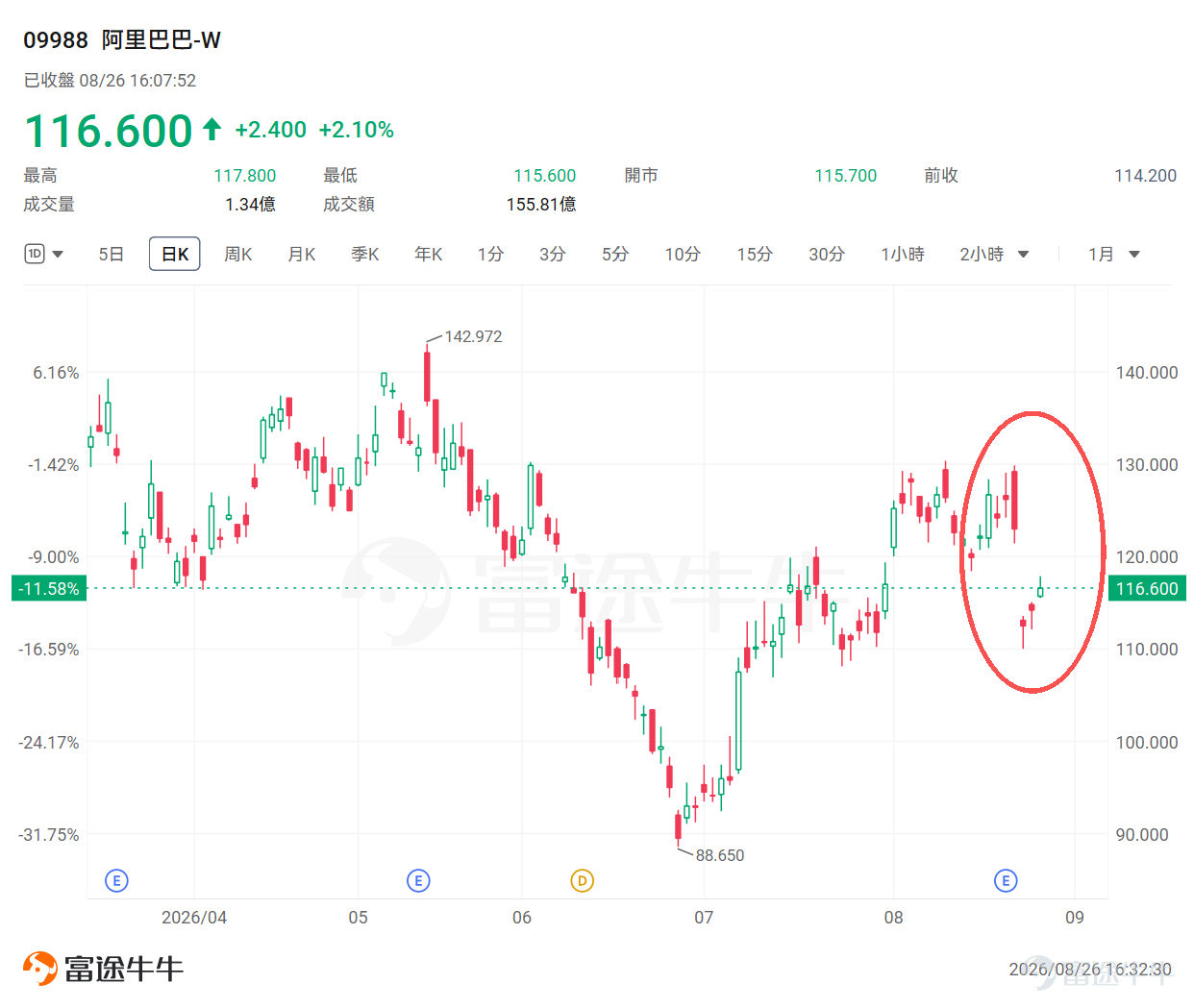
Jack Ma invested over HKD 600 million consecutively over several days, while Joe Tsai and Eddie Wu also bought shares near the HKD 112 level. This suggests that core management views the short-term decline caused by the placement as having already partially priced in equity dilution and capital expenditure pressures.
This has established a relatively clear "management cost zone" in the range of HKD 112 to HKD 116. On August 26, Alibaba's stock price rebounded above HKD 116, indicating that market sentiment is recovering.
Second, Alibaba's investment in AI has entered a capital-intensive phase.
The HKD 80 billion placement was not intended to supplement general working capital; instead, all proceeds are dedicated to AI development. This means Alibaba is accelerating investments in data centers, computing power, cloud infrastructure, and the large model ecosystem, willing to endure short-term pressure on profits and cash flow to seize the initiative in the next technological cycle.
Finally, Jack Ma and the current management team are sending a signal of strategic alignment to the market.
Although Jack Ma has stepped away from Alibaba's daily operations, his shareholding actions still hold strong symbolic significance. With Jack Ma, Joe Tsai, and Eddie Wu all committing real capital to increase their stakes simultaneously, they are effectively telling the market that the founder, the Chairman, and the CEO are aligned on Alibaba's AI direction.
A vote of confidence does not equate to "the stock price has bottomed out"
However, while the increase in holdings by management signals confidence, it does not mean that the stock price has definitively bottomed out.
The purchase amount exceeding HK$800 million may seem substantial, but compared to the HK$80 billion placement size, it represents only about 1%. This capital cannot offset the dilution effect caused by the new share issuance, nor can it directly guarantee that AI investments will necessarily translate into profits.
What truly determines Alibaba's mid-to-long-term stock price remains several core issues: whether cloud business can sustain high growth, whether AI revenue can accelerate commercialization, whether massive capital expenditures can generate sufficient returns, and when free cash flow will recover.
Therefore, the most significant implication of this round of increased holdings is not to tell the market that "the stock price is about to rise immediately," but to demonstrate that Alibaba's key figures are willing to use their own funds to share the uncertainty of the AI transformation with ordinary shareholders.
Last time, Jack Ma correctly identified Alibaba's value low; this time, he is betting on Alibaba's AI future.
Whether this vote of confidence exceeding HK$800 million will pay off will ultimately be answered by Alibaba's future performance.
Risk Disclaimer: The above content only represents the author's view. It does not represent any position or investment advice of Futu. Futu makes no representation or warranty.Read more


Comments (9)
to post a comment
24
48