US Stock Market Talk | The Fed Resumes Rate Hikes After a Three-Year Pause! Is a New Shift Ahead for

Gaozhan Weekly Rate Analysis | Minutes Reveal Hawk-Dove Divide! Where Is September FOMC Pricing Headed?
Issue No. 202623
In the previous column, we dissected the logic behind the dual cooling of PPI and retail sales accelerating the ebb of rate hike expectations, as well as the pricing paradox of soaring oil prices and a bear steepening yield curve.
Building on this, the current issue will further analyze how the July minutes exposed internal divisions within the FOMC, and the impact of Warsh's potential reduction of forward guidance on the market's pricing anchor.
Last week, the July minutes revealed that several members favored a rate hike, and it was reported that Warsh was considering scaling back forward guidance, causing the probability of a September hike to rebound from 30.1% to 38.9%.
Meanwhile, Goldman Sachs' Hatzius still believes a September rate hike is"highly unlikely"Daly stated that there is no evidence to support an early rate hike.
This article systematically analyzes the core pricing logic of the current period from three dimensions: divergence in the minutes, communication reforms, and cross-central bank dynamics.
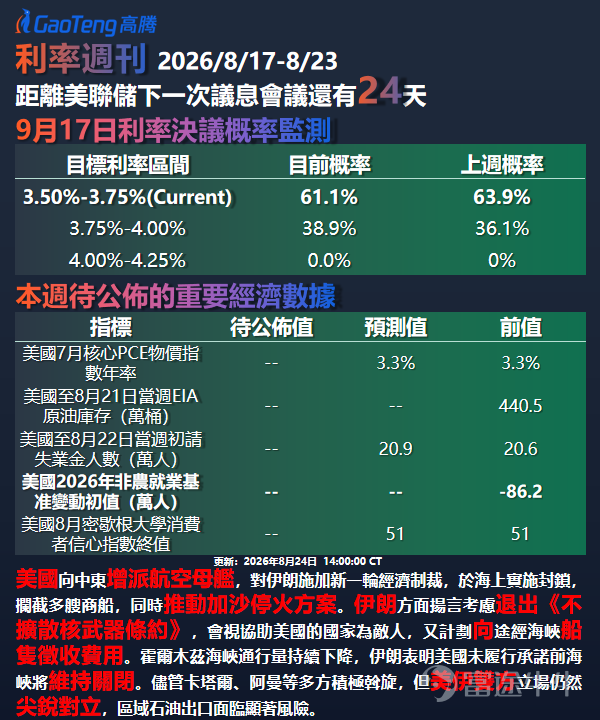
▌ FedWatch Data Snapshot
CME FedWatch (as of August 24) shows that with 24 days remaining until the next FOMC meeting, the probability of holding rates at 3.50%-3.75% is 61.1%, while the probability of a rate hike to 3.75%-4.00% is 38.9%.
Compared to the rate hike probability of 30.1% a week ago (August 17), it rebounded by nearly 9 percentage points last week. The drivers were the internal divergences exposed in the July minutes and Bessent's intervention in the bond market, leading to a marginal increase in implied volatility for short-term instruments.
▌ Minutes reveal divergence; rate hike expectations rebound from retreat
The July minutes showed that most participants supported holding rates steady, but several favored a rate hike, with some believing that financial conditions might not be tight enough.
The market priced this as a marginal hawkish increment, causing the probability of a September rate hike to rebound from 30.1% to 38.9%. Signals of cooling in retail sales and PPI have not fully faded, resulting in a short-term divergence between data and policy pricing.
▌ Communication reforms intensify pricing volatility
Warsh is considering reducing the frequency of monetary policy meetings and cutting back on forward guidance; Goldman Sachs warns that this move will exacerbate market volatility.
Decreased communication transparency compresses the market's ability to anchor expectations for the policy path, leading to an expansion in term premium implied volatility.
Treasury Secretary Bessent intervened in the bond market in an attempt to suppress long-end yields, but analysts believe this move could force the Federal Reserve to raise rates more aggressively. The interplay between fiscal and monetary policy has become a new variable in long-end pricing.
▌ Fed Developments
The July minutes confirmed that the hawk-dove divide within the FOMC is no longer subtle. Waller is pushing for communication reforms, reducing forward guidance and considering fewer meetings, which has marginally weakened the market's ability to anchor its expectations for the policy path.
US President Trump publicly confirmed frequent calls with Waller, as the shadow of political intervention continues to expand.
▌ Internal Divergence
Hawks: The minutes showed that several participants favored rate hikes, believing this could avoid further tightening in the future; some participants were concerned that financial conditions were not tight enough to bring inflation back to the 2% target. The market priced this in as marginal support for the probability of a September rate hike.
Doves: San Francisco Fed President Daly stated there is no evidence to support an early rate hike; Goldman Sachs' Hatzius believes weak retail sales and slowing inflation make a September rate hike"highly unlikely". There is a significant deviation between dovish pricing and market-implied probabilities.
Centrists: Most participants supported keeping interest rates unchanged, but reserved"If inflation does not decline, rate hikes will be necessary"conditional guidance. Warsh's communication reforms have made the pricing implications of a centrist stance more ambiguous.
▌ Key Data: July FOMC Minutes
The minutes from the Fed's July 28-29 meeting showed that most participants supported holding rates steady, a few favored hiking, and some believed financial conditions might not be tight enough.
Nearly all members agreed to retain"the commitment to achieving price stability"phrasing.
The minutes released marginal hawkish signals, leading the market to reprice the probability of a September rate hike from 30.1% to 38.9%, though subsequent comments by dovish officials partially offset this impact.
▌ Historical perspective
In 2019, the Fed attempted to use"mid-cycle adjustment"Replacing explicit forward guidance has led to confusion in market pricing of the policy path, causing a significant rise in volatility.
After approximately three months of ambiguous communication, authorities were forced to revert to a data-dependent framework.
Historical experience suggests that reduced communication transparency is often accompanied by an expansion in term premiums.
▌ Scenario Analysis
Scenario 1 (Hold steady in September): The probability of a rate hike falls below 25%, short-end yields decline, the curve bull-flattens, and gold benefits from falling real rates. Cooling data and dovish remarks from officials support this scenario.
Scenario 2 (Rate hike in September): Short-end yields surge, the bear-steepening of the curve deepens, and gold faces pressure. Hawkish signals in the minutes and intervention by Bessent constitute upside risks.
Current market pricing lies between the two scenarios, with marginal increases in volatility.
▌ Market Sentiment Snapshot
Expectations for rate hikes oscillate between ebbing and rebounding, while the anchor for market pricing has weakened due to communication reforms.
Investors are caught between cooling data and policy uncertainty, with implied volatility in term premiums expanding.
▌ Other Major Central Bank Developments
PBOC: The LPR remained unchanged for the 15th consecutive month (1-year at 3.0%, 5-year at 3.5%). While there were zero injections via 7-day reverse repos, outright reverse repo operations were conducted. Gold holdings increased by 19.9 tons in July, marking the highest monthly increase since gold purchases resumed.
BOJ: Core CPI rose 1.8% year-on-year in July, marking the 59th consecutive month of increase, primarily driven by turning positive energy prices. Many institutions expect a very high probability of a rate hike in September; Kazuo Ueda has hinted at tightening in September, strengthening expectations for a narrowing US-Japan interest rate differential.
ECB: Chief Economist Lane warned that inflation is approximately one percentage point above the 2% target, with inflation expected to hover around 3% for the rest of the year. Governing Council member Rehn advocated for retaining forward guidance, contrasting with the Fed's direction on communication reforms.
▌ Market Reaction: Dual Impact from Minutes and Communication Reforms
The probability of a September rate hike rebounded from 30.1% to 38.9%, with marginal increases in short-end implied volatility.
Oil prices remained elevated, while gold fluctuated amid the tug-of-war between real interest rates and safe-haven demand.
Long-end US Treasury yields were supported by Bessent's intervention and an expanding term premium, with the bear steepening curve continuing to price in policy uncertainty.
The market priced the hawkish signals from the minutes alongside dovish officials' remarks as widening divergence rather than a确立ed directional shift.
▌ Note at the End
The core pricing logic this period centers on the FOMC minutes exposing internal divisions, compounded by Waller's communication reforms and Bessent's fiscal intervention, leading to a rebound in rate hike expectations after a previous decline.
Investors should monitor Waller's remarks at the Jackson Hole symposium in late August and the September FOMC meeting. If inflation data remains moderate, the probability of a rate hike could fall back below 25%; if oil prices break through $90 or fiscal intervention persists, policy uncertainty may further drive up the term premium. The Bank of Japan's potential rate hike in September constitutes an additional cross-asset variable.
$GaoTeng WeInvest Money Market Fund (HK0000478930.MF)$ $GaoTeng WeValue USD Money Market Fund (HK0000584752.MF)$ $Gold Futures (DEC6) (GCmain.US)$ $Crude Oil Futures (NOV6) (CLmain.US)$ $Brent Last Day Financial Futures (DEC6) (BZmain.US)$ $GaoTeng WeFund-GaoTeng Asian Income Fund (HK0000447943.MF)$ $USD (USDindex.FX)$ $U.S. 1-Year Treasury Bills Yield (US12M.BD)$ $U.S. 30-Year Treasury Bonds Yield (US30Y.BD)$ $Hang Seng Index (800000.HK)$ $Hang Seng TECH Index (800700.HK)$ $Nasdaq Composite Index (.IXIC.US)$ $S&P 500 Index (.SPX.US)$ $Dow Jones Industrial Average (.DJI.US)$
Risk Disclaimer: The above content only represents the author's view. It does not represent any position or investment advice of Futu. Futu makes no representation or warranty.Read more


Comments
to post a comment
4
1