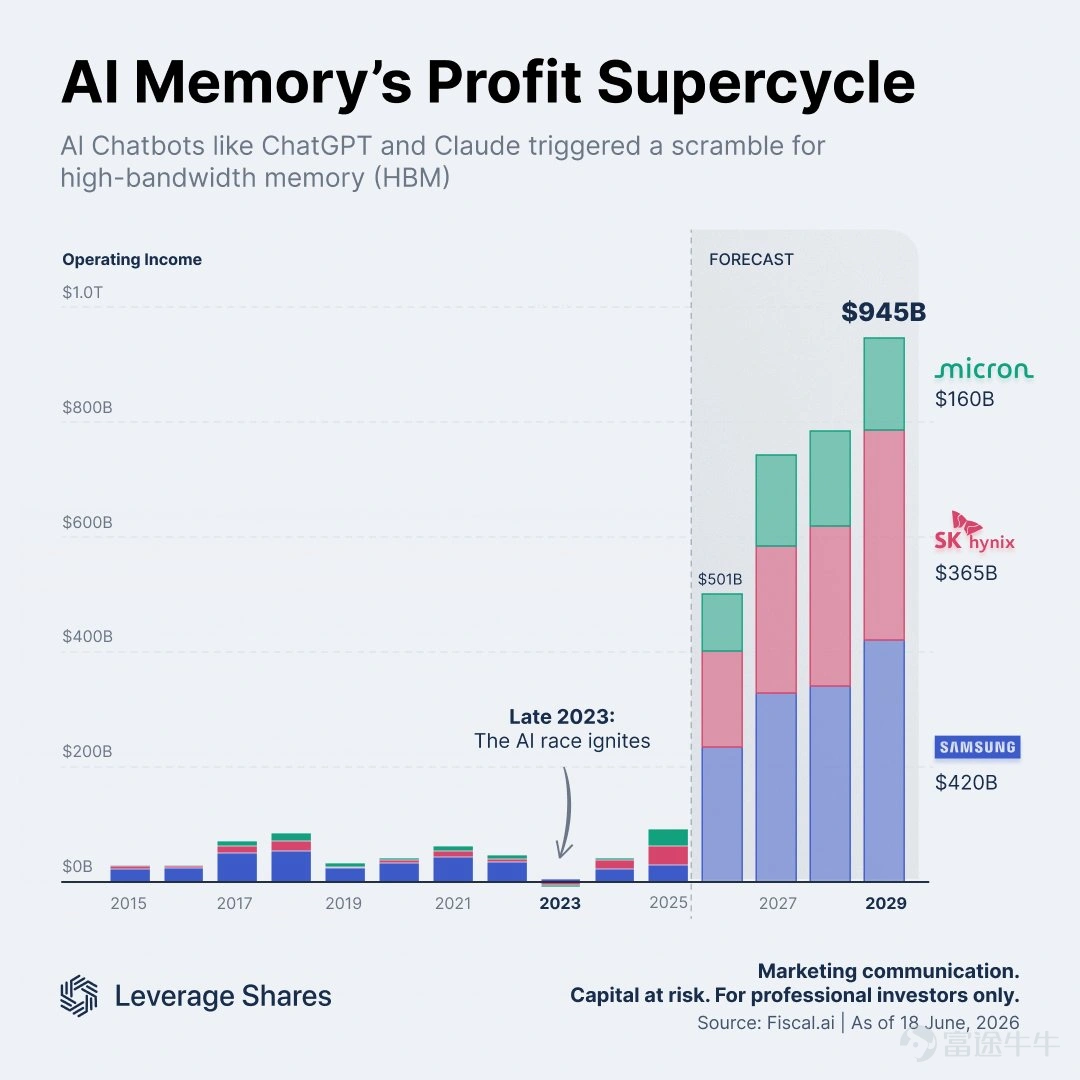
HBM shortages drive up chip prices: Is the memory supercycle continuing?

Memory chip giants are collectively "splashing cash"! Which company is offering the most generous shareholder returns?
The most famous curse in the chip industry is none other than "the cycle":Chip shortage triggers price surge → frantic capacity expansion → overcapacity → price collapse.
Historically, memory chips have been the most nerve-wracking "cyclical commodity" in the semiconductor industry. When demand is strong, prices and profits skyrocket; once new capacity comes online en masse, inventory levels, prices, and profitability quickly reverse course.
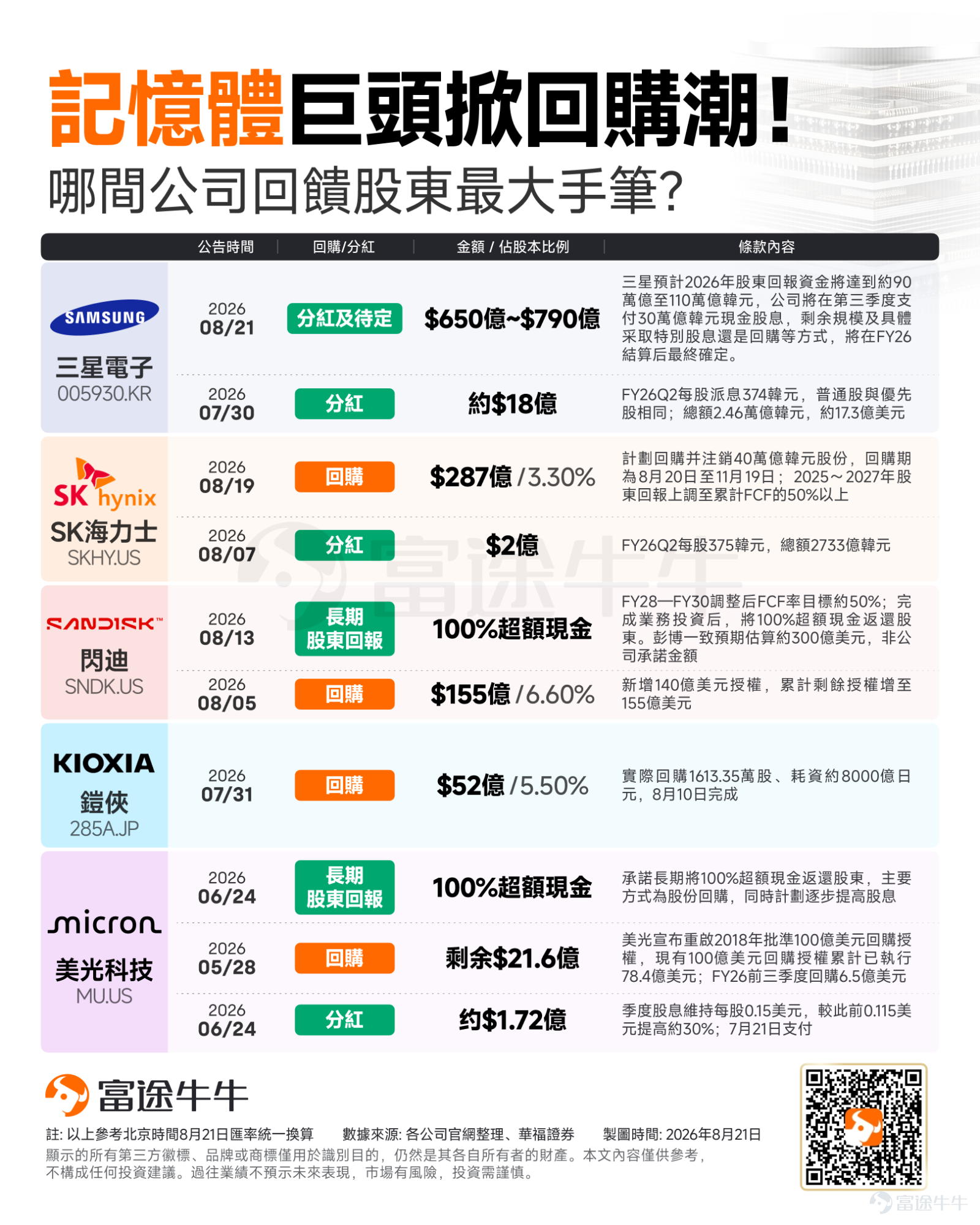
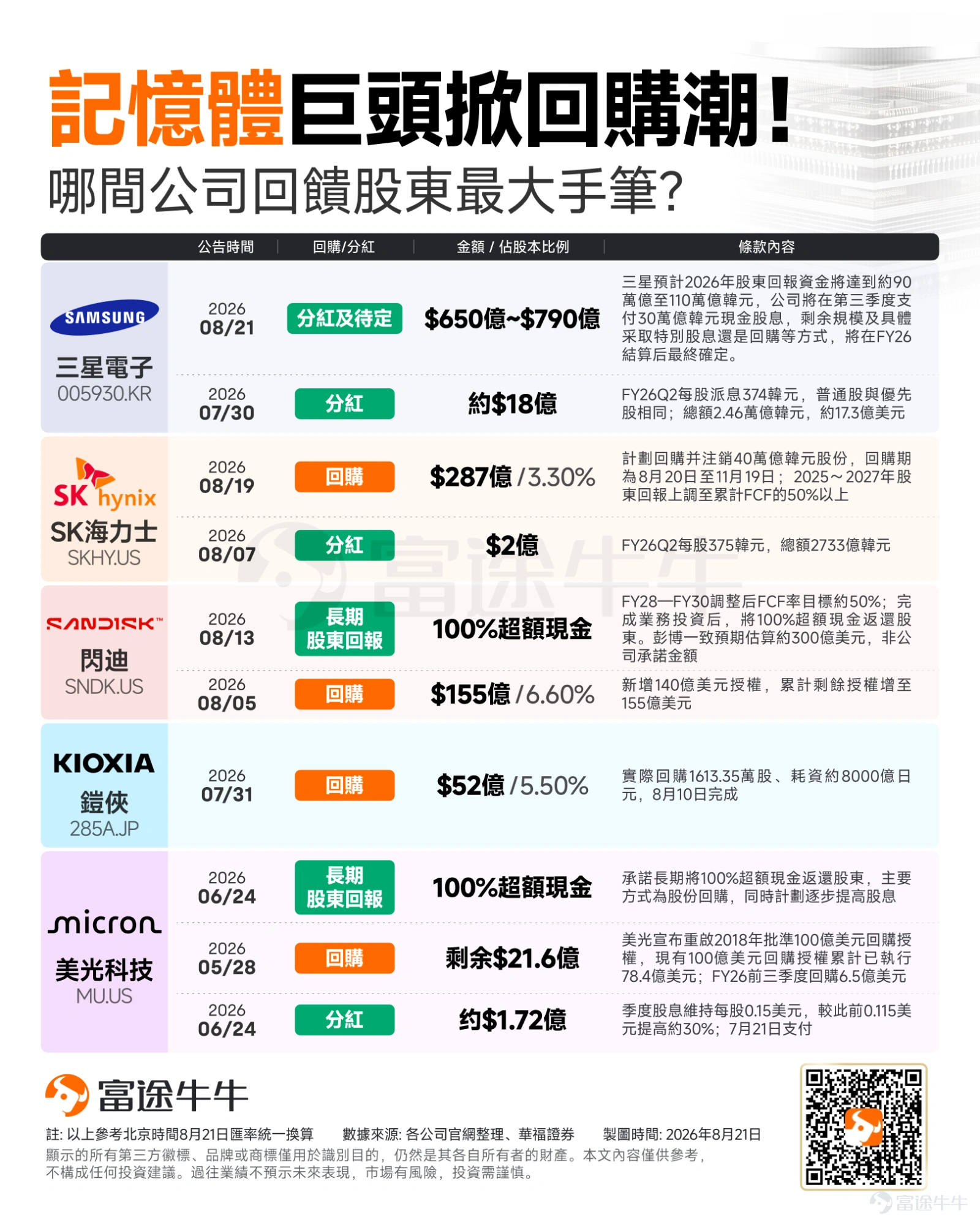
But this time, memory giants are trying to rewrite the script.Over the past two months, $SK hynix (SKHY.US)$ 、 $SanDisk (SNDK.US)$ 、 $Kioxia Holdings (285A.JP)$ 、 $Micron Technology (MU.US)$ successively increased share buybacks and cash dividends; $Samsung Electronics (005930.KR)$ today announced the largest shareholder return plan in history, with up to KRW 110 trillion to be returned to shareholders.
While this wave of capital distribution certainly aims to stabilize market confidence, the more noteworthy aspect is not just that memory chip companies have suddenly become cash-rich, but that manufacturers are now placing long-term contracts, free cash flow, and shareholder returns on par with technological upgrades and capacity investments.
In other words, while the memory chip sector has not yet escaped its cyclical nature, the industry is attempting to install guardrails around the cycle.
How staggering is the scale of the collective shareholder returns from memory chip giants?
Today, $Samsung Electronics (005930.KR)$ The company announced its largest-ever shareholder return plan, committing to return up to KRW 110 trillion to shareholders. It also declared a cash dividend of approximately KRW 30 trillion for the third quarter and a separate share buyback of about KRW 15 trillion for employee compensation incentives.
--
--
--
On August 19, $SK hynix (SKHY.US)$ The board approved the buyback and cancellation of shares worth KRW 40 trillion (approximately USD 28.6 billion) within about three months. Based on the previous day's closing price, this involves approximately 24.07 million shares, representing about 3.3% of total share capital, marking the largest share cancellation plan in the history of Korean listed companies.
More importantly, the company raised its shareholder return target for 2025–2027 from 'no more than 50% of cumulative free cash flow' to 'more than 50%,' indicating that it may further increase returns through fixed dividends, special dividends, and additional buybacks. As of the end of Q2 this year, SK Hynix's net cash reached approximately KRW 69 trillion, providing the financial strength behind its bold KRW 40 trillion buyback.
$SanDisk (SNDK.US)$ The intensity is equally aggressive,The company added a USD 14 billion buyback authorization. With a previously approved USD 6 billion (of which approximately USD 4.5 billion has been executed), the remaining executable authorization has increased to USD 15.5 billion. Furthermore, at the Investor Day on August 13, SanDisk further committed to returning 100% of excess cash to shareholders after completing business investments.
$Kioxia Holdings (285A.JP)$ Another player announced on July 31 a buyback of up to JPY 800 billion, capped at 30 million shares, exhausting the entire amount within just 10 days. Micron also proposed in June to return 100% of excess cash to shareholders in the long term and to increase its quarterly dividend.
Massive buybacks quickly reversed market sentiment. SK Hynix surged nearly 13% shortly after the plan was announced,This proves that after the sharp pullback in memory stocks, actual share buybacks backed by real capital are far more convincing than any verbal claims of "undervaluation."
Why now, of all times?
The most direct reason is the rapid retreat of memory stocks from their previous highs.
The market has begun to worry about whether AI capital expenditure can be sustained, whether memory prices are nearing a peak, and whether super-normal profits can continue. When the decline in stock price stands in stark contrast to the company's cash generation capability, share buybacks become the most direct way for management to convey confidence in valuation.However, the fundamental basis for the wave of buybacks remains the explosion in cash flow driven by AI.
In the past, memory demand was mainly driven by PCs, smartphones, and consumer electronics, with fragmented downstream customers, volatile demand, and limited product differentiation. Original manufacturers could only engage in repeated price games in the spot and short-term contract markets. Today, products such as HBM, enterprise SSDs, and high-bandwidth flash memory are gradually becoming key bottlenecks for AI servers. Memory is no longer just a "capacity accessory," but a core component that directly impacts computing power utilization, bandwidth, power consumption, and inference efficiency.
With increased product value, longer customer certification cycles, and supply concentrated in the hands of a few original manufacturers, memory industry leaders have gained pricing power and cash flow visibility rarely seen in the past.
Take SanDisk as an example: the company's adjusted free cash flow for the fourth quarter of fiscal year 2026 exceeded $5 billion, with a non-GAAP gross margin of 84.6%. Its model for fiscal years 2028 to 2030 is even more impressive: revenue maintaining mid-to-high double-digit growth, non-GAAP gross margin around 80%, and adjusted free cash flow margin around 50%.
However, these figures belong to the company's long-term target model rather than locked-in actual performance. They reflect management's confidence in the business model but remain subject to risks related to demand, pricing, capacity, and execution.
The true paradigm shift is that demand is beginning to move toward long-term contracts.
If buybacks are the only measure, this round of changes may still be just a large-scale market support operation.What could truly weaken the memory cycle is that long-term supply agreements are gradually replacing the previous quarterly price negotiations.
SanDisk refers to this model as the "New Business Model" (NBM). NBM agreements typically include committed purchase volumes, minimum financial guarantees, and structured pricing mechanisms."SanDisk Investor Day Ignites the Market: 80% Gross Margin, Massive Cash Flow, and HBF... How Is It Rewriting the Memory Valuation Logic?"The article also stated that the company has signed contracts with eight customers, covering approximately 50% of its shipment bits for fiscal year 2027 and about two-thirds for fiscal year 2028.
Micron also indicated that multi-year strategic customer agreements can enhance the durability and predictability of revenue and profits. The industry is seeing an increasing number of three- to five-year agreements, often accompanied by advance payments, minimum price clauses, or default protections, relieving manufacturers from complete reliance on quarterly renegotiations.
This effectively adds a layer of "demand insurance" to the memory industry:For customers,Long-term agreements can ensure that AI infrastructure construction is not halted due to supply shortages;For manufacturers,Locking in orders can enhance revenue and cash flow visibility, while reducing the risk of sudden price collapses;For investors,earnings forecasts no longer need to revolve solely around spot prices, but can increasingly reference contract coverage ratios and mid-cycle free cash flow.
However, it is important to note thatwhile long-term agreements can mitigate demand uncertainty, they cannot eliminate the inherent cyclicality of demand itself.
Can the wave of share buybacks truly transform memory chips into "Apple-style blue chips"?
The answer remains no.Apple relies on its brand, ecosystem, and stable cash flows to sustain long-term buybacks; the memory chip industry remains capital-intensive, with prices highly sensitive to supply and demand dynamics.
Share repurchases and cancellations can reduce the number of outstanding shares and boost earnings per share (EPS), but they cannot prevent memory prices from falling. Furthermore, a buyback authorization does not guarantee actual execution, nor does it signal a permanent floor for the stock price.
Additionally, long-term agreements are a double-edged sword. While they improve order visibility, they may also embolden manufacturers to expand capacity prematurely. If long-term demand falls short of expectations, these agreements—intended to smooth out cycles—could instead catalyze the next round of overcapacity.
Furthermore, SanDisk's forward-looking targets for fiscal years 2028 to 2030 include a gross margin of approximately 80% and a free cash flow margin of 50%; these are not yet validated mid-cycle levels. If supply increases and prices decline in the future, related models may still be downgraded.
Therefore, while share buybacks, long-term contracts, and product upgrades can reduce cyclical amplitude, they are insufficient to prove that the cycle has disappeared.
Whether the memory industry can achieve a valuation reshaping ultimately depends on whether giants can control capital expenditure and the growth rate of bit output during periods of high prosperity.
Conclusion
This wave of share buybacks among memory industry giants is not merely about supporting stock prices after a sharp decline. A more significant shift is that manufacturers are beginning to prioritize free cash flow, long-term contracts, and shareholder returns on par with technological upgrades and capacity investment.
This represents a rare shift in capital allocation within the memory industry, creating the potential for an upward re-rating of valuation centroids.
However, the ability to conduct buybacks does not mean the cycle has been broken. The true test lies in whether giants can restrain their impulse to expand capacity when the next wave of concentrated capacity release occurs, and whether long-term contracts and buybacks can support earnings and per-share value when prosperity wanes.
The memory industry has not yet shed its 'cyclical' label, but it has the opportunity to transform the previously uncontrollable price avalanches into an industrial cycle with smaller amplitude and more stable cash flows.
The real answer will only be revealed in the second half of 2027 through 2028.
Risk Disclaimer: The above content only represents the author's view. It does not represent any position or investment advice of Futu. Futu makes no representation or warranty.Read more


Comments (25)
to post a comment
57
69