SpaceX's second wave of lock-up expirations is here; how should investors position themselves in spa

Bai Dao Options Opportunity Pool | SpaceX Faces Major Test with Second Lock-up Expiry, Alibaba Earnings Take Center Stage!
Hello, fellow investors! Welcome to this week’s BaiDao Options Opportunity Pool! Each week, we focus on clear market themes and highlight low-barrier options opportunities worth watching. We don’t chase tales of 1,000x returns in a day—instead, we focus on: what’s the logic, is it worth your attention, and where lies the risk?
This Week’s Market Focus
There are no major macroeconomic data releases or events this week, aside from the FOMC minutes (which reflect the Fed's meeting from three weeks ago), making it essentially a "vacuum period." However, at the corporate level, there are still two main themes particularly suitable for expressing views through options.
First,SpaceX will see its second wave of post-IPO share lock-up expiration on August 20 (Thursday), involving 320 million shares.It has been only two weeks since the massive unlock of nearly 900 million shares on August 6. At that time, the market did not crash as many had expected; instead, we saw a scenario where "prices rose rather than fell after the lock-up expiration." With this tranche of 320 million shares being smaller in volume, whether the miracle can be repeated has become one of the most watched events of the week.
Second,Alibaba (BABA) will also release its earnings in the pre-market session of US stocks on the same day, serving as the headline act of the super earnings week for Chinese concept stocks, attracting significant market attention. Interestingly, the implied volatility before this earnings report (the market's expectation of future stock price fluctuations) is not extreme—this is largely related to the overall sentiment in the Chinese concept stock sector.
These two main themes—one being a clear timed event and the other a clear earnings catalyst—are both typical scenarios for using options to "bet on direction." Let's break them down one by one.
Target #1: $SpaceX (SPCX.US)$
As a recently listed ticker, SpaceX is currently in a critical window period for the wave of lock-up expirations. If we clarify the timeline, you will understand the significance of this "lock-up test":
The second trading day after the first earnings releaseInitially release up to 20%, which isAugust 6911.5 million shares;
Subsequently, on the70th, 90th, 105th, 120th, and 135th days after listing,release approximately 7% on each of these days;(Note: The 70th day refers to the 300 million shares the market is set to absorb this week)
After the Q3 earnings report,release another ~28%, approximately 1.3 billion shares;
toOn December 8,the 180-day lock-up period expires, and the float will surge from the current 639 million shares to 5.33 billion shares, accounting for approximately 40% of the total share capital.
In other words, from now until the end of the year, SpaceX's float will be diluted by nearly 8 times. Each wave of lock-up expirations tests the market's absorption capacity. The 320 million shares becoming tradable on August 20 represent the second hurdle following August 6.
Meanwhile, recent fundamental and news developments regarding SpaceX have been quite active: $NVIDIA (NVDA.US)$ Indirect holdings of approximately $21 billion via xAI, Harvard's disclosure of a $2.2 billion position making it their largest single-stock holding, and the completion of a $60 billion acquisition of AI coding company Cursor.Whether sustained buying interest emerges is a critical backdrop for determining if this lock-up expiration can be smoothly absorbed.
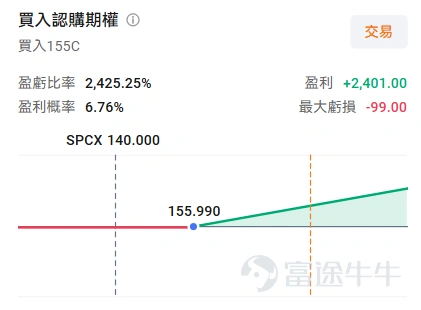
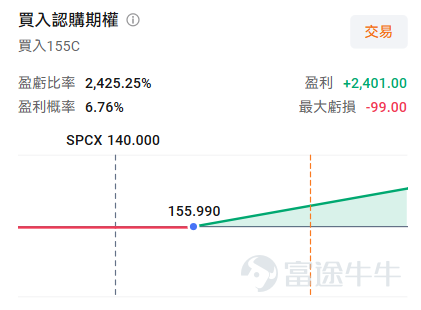
(The design images shown on screen are for illustrative purposes only and do not constitute investment advice or guarantees; market conditions change rapidly, and the displayed option prices do not reflect real-time data. Options shown are filtered around the $1 strike price.)
Bullish rationale:
The release of nearly 900 million shares on August 6 did not crash the market but instead led to a strengthening trend, indicating strong market absorption. With this current batch of 320 million shares being smaller in volume, selling pressure is relatively controllable, and the scenario of 'price rising after lock-up expiration' may repeat itself;
Heavyweight institutions like NVIDIA and Harvard continue to increase their positions, showing that the market buys into SpaceX's long-term narrative. Institutional holdings are relatively stable, making short-term unlocked shares easier to absorb;
The $60 billion acquisition of Cursor, along with $Tesla (TSLA.US)$ ongoing news about technological synergies with the Roadster, has kept thematic热度 high, providing upward imaginative space for the stock price.
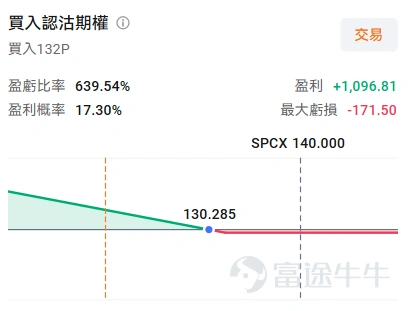
(The design images shown on screen are for illustrative purposes only and do not constitute investment advice or guarantees; market conditions change rapidly, and the displayed option prices do not reflect real-time data. Options shown are filtered around the $1 strike price.)
Bearish Thesis:
The previous performance of 'no drop upon lock-up expiration' may have already priced in market optimism—just because it didn't fall last time doesn't mean it won't fall this time. Once absorption capacity weakens, deferred selling pressure could be released all at once;
This is only the second hurdle in the wave of lock-up expirations, with a series of staggered expirations still to come. Long-term dilution pressure remains, and any failure to absorb a wave could trigger a chain reaction;
Recently listed stocks lack long-term holder stability, leading to significant divergence in valuation and pricing. Their volatility is inherently high, and without new catalysts after events materialize, they are prone to a pullback due to "buy the rumor, sell the news" dynamics.
Target #2: $Alibaba (BABA.US)$
Now, let's look at Alibaba. As the bellwether of this week's super earnings cycle for Chinese ADRs, Alibaba's results serve as a barometer for sentiment across the entire sector, naturally drawing maximum attention. In recent news, HH International, managed by Duan Yongping, reduced its NVIDIA holdings in Q2, $Alphabet-A (GOOGL.US)$ but established a new position in Alibaba. This move by "smart money" has also sparked market discussion.
Here is a special note for fellow investors:Alibaba has options available in both the Hong Kong and US stock markets.We will useUS stock optionsfor this demonstration, as US options have higher trading activity and better liquidity. If you plan to execute trades, we also recommend choosing US options—better liquidity means tighter bid-ask spreads and smoother entry and exit.
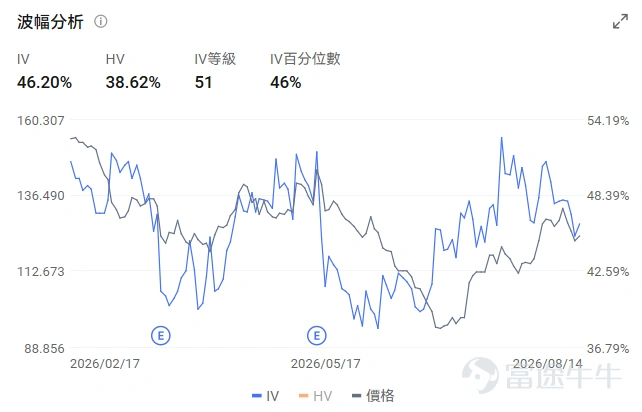
Another detail worth noting: Alibaba's implied volatility ahead of this earnings releaseNot extreme, which is related to the relatively mild sentiment across the entire Chinese concept stock sector. Low implied volatility means that the premium for "betting on significant earnings swings" in options has not been driven up excessively, creating a relatively favorable environment for buyers.
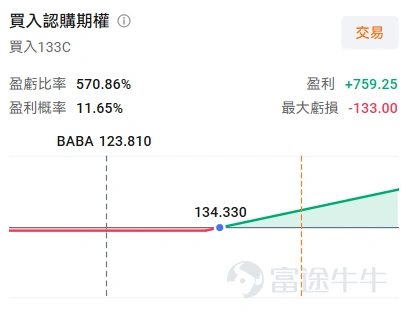
(The design images shown on screen are for illustrative purposes only and do not constitute investment advice or guarantees; market conditions change rapidly, and the displayed option prices do not reflect real-time data. Options shown are filtered around the $1 strike price.)
Bullish rationale:
The acceleration of Alibaba Cloud's growth, combined with increased AI investment, is currently the most valued narrative in the market. If cloud business growth and AI-related revenue in this earnings report exceed expectations, it could easily ignite investor enthusiasm for revaluing the "AI + Cloud" segment;
Duan Yongping established a new position in Alibaba in Q2, signaling that value-oriented capital is beginning to allocate assets. This reflects market recognition of Alibaba's current valuation attractiveness and provides support on the sentiment front;
Overall sentiment in the Chinese concept stock sector is warming up. As a heavyweight leader, Alibaba is likely to attract clustered capital inflows if its earnings drive a broader sector rally.
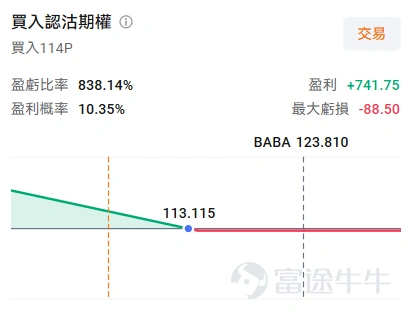
(The design images shown on screen are for illustrative purposes only and do not constitute investment advice or guarantees; market conditions change rapidly, and the displayed option prices do not reflect real-time data. Options shown are filtered around the $1 strike price.)
Bearish Thesis:
Massive capital expenditure is a double-edged sword—a RMB 380 billion investment will erode profits in the short term. If the market worries about a mismatch between investment and return timelines, concerns over "heavy investment, slow monetization" could suppress the stock price;
The core e-commerce business faces fierce competition from instant retail and flash sales sectors. Increased subsidy spending may continue to drag down profits;
The stock price is currently in the lower-middle range of its 52-week interval ($91.99 - $190.92). Overhead trapped positions and technical resistance remain, so the possibility of a pullback after encountering resistance during a rebound should not be ignored.
Important Notice
As usual, let's lay out the risks clearly:
Options may expire worthless. Whether you are bullish or bearish, if your directional judgment is wrong at expiration or the move is insufficient, you could lose the entire premium paid. While hundred-dollar options have a low entry barrier, "low barrier" does not equal "low risk."
Event-driven strategies carry a high degree of uncertainty.The outcome of SpaceX's lock-up expiration and Alibaba's earnings figures are both "blind box"-style events, making their direction and magnitude difficult to predict. Especially for Alibaba's earnings, even if implied volatility is not extreme, the phenomenon of "uncertainty removal leading to automatic option price shrinkage" (IV Crush) may still occur after the announcement.
Suggestions on timing for position building.For event-driven opportunities, as the event date (lock-up expiration or earnings release) approaches, time value in options decays faster. Avoid establishing heavy positions too early in anticipation, and do not chase highs by buying only on the day of the event; carefully balance your entry rhythm.
The two underlying assets have different characteristics. SpaceX is a recently listed stock with violent volatility and an unstable shareholding structure; Alibaba is a mature large-cap stock with ample liquidity (although Alibaba's market cap is currently far smaller than SpaceX's). Position allocation should be handled differently for each.
In a week where events and earnings reports intertwine, regarding how to choose direction and whether to act, the principle remains: establish your logic first, then determine your position size.
Not familiar with options basics? Study up before jumping in.
If, while reading this opportunity list, you're still unclear about concepts like 'What is a Long Call?' or 'How do I interpret strike prices?', don’t rush to place orders—take some time first to solidify your foundation. We’ve compiled practical beginner resources below; consider bookmarking them:

Finally, we’ve got a little perk for our fellow investors—feel free to claim it!Options Starter Pack~
*This promotion is exclusively available to invited Hong Kong users. Click to learn more.Detailed terms and conditions of the promotion >>
Disclaimer
This content does not constitute an offer, solicitation, recommendation, opinion, or any guarantee regarding any securities, financial products, or instruments. The risk of loss in trading options can be substantial. In certain circumstances, your losses may exceed the initial margin deposit. Even if you place contingent orders, such as 'stop-loss' or 'limit' orders, there is no assurance that losses will be avoided. Market conditions may prevent these orders from being executed. You may be required to deposit additional margin on short notice. If you fail to meet the required margin within the specified time, your open positions may be liquidated. Nevertheless, you remain liable for any deficit balance in your account resulting from such events. Therefore, you should thoroughly research and understand options before trading, and carefully consider whether such trading is suitable for you based on your financial condition and investment objectives. If you trade options, you should familiarize yourself with the procedures for exercising options and handling expiration, as well as your rights and obligations upon exercise or expiration.
Risk Disclaimer: The above content only represents the author's view. It does not represent any position or investment advice of Futu. Futu makes no representation or warranty.Read more


Comments
to post a comment
29
14