HK Stock Market Barometer | Revisiting the September 24 Rally! Is the National Day Trading Window Ab

Decoding Star Stock Earnings | Why Is It Called "1x Short SK Hynix"? A Guide to Reading Xiaomi's Financial Report
On August 18 (Tuesday), $XIAOMI-W (01810.HK)$ will announce its financial results for the second quarter of 2026.
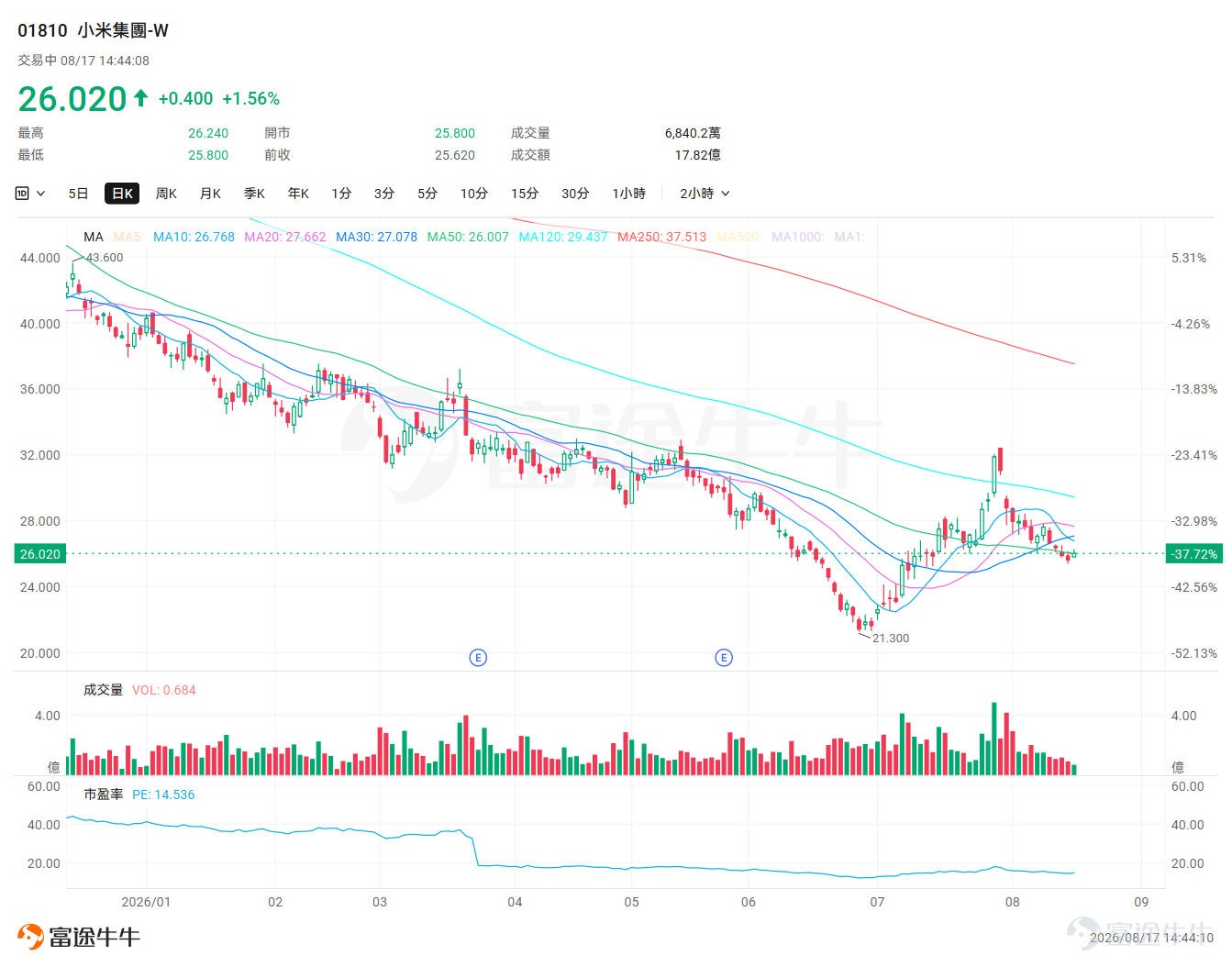
Xiaomi's stock performance this year has been one of the most dramatic among Hong Kong-listed tech stocks: it continued to fall since the beginning of the year, then rebounded nearly 50% from its bottom after late June driven by multiple catalysts, significantly outperforming $Hang Seng TECH Index (800700.HK)$ , before pulling back nearly 20% from its July 29 high.

What's more notable is that the market has given Xiaomi a rather stinging nickname in recent months—"1x Short Hynix"Why is a company that sells phones and cars referred to as the inverse proxy of South Korean memory giant SK? $SK hynix (SKHY.US)$
This article uses Xiaomi’s upcoming earnings report as a case study to walk beginner investors through the complete process of analyzing financial performance, broken down into five steps:First, review institutional expectations; then break down the core business composition; next, analyze operational data; followed by understanding the nuances of the share buyback quiet period (which can be compared with last week's); $TENCENT (00700.HK)$finally, unravel the mystery of "1x Short Hynix."。

Institutional Expectations: Revenue and profit both decline, but Q2 may mark the annual earnings trough
The first step in analyzing earnings is to gauge market sentiment. Consensus estimates show Xiaomi’s Q2 revenue is projected at RMB 108.823 billion (-6.15% YoY), with EPS estimated at RMB 0.200 (-55.67% YoY). To summarize in one sentence—Revenue dipped slightly, while profits shrank significantly.

Interestingly, institutional ratings are not pessimistic at all: among 38 analysts,"Strong Buy" ratings account for 78.95%, "Buy" ratings for 15.79%, with only 5.26% recommending "Hold" and no "Sell" ratings; the average target price is HK$46.30, while the current price is only around HK$26.7—leaving more than 70% upside potential to the average target.
Strong ratings but weak expectations may seem contradictory, but this is actually the first lesson investors need to learn:Stock prices do not reflect the numbers themselves, but the difference between "actuals vs. expectations" (Beat/Miss).Analysts are bold enough to issue "Strong Buy" ratings precisely because they believe the bad news is already fully priced in.
The mainstream institutional consensus is:These earnings figures will look relatively poor, but this is likely the worst quarter of the year—Adopting this "bottom-fishing" perspective is far more important than just focusing on the declining percentages. Goldman Sachs explicitly identifies Q2 as the "earnings trough" for the year—short-term pressures on smartphones and AIoT are largely reflected in the price, marginal benefits from rising memory chip prices will gradually improve, and catalysts such as new automotive products, AI, and the self-developed Xuanjie chip will take the baton in Q3,The focus should now shift to the "recovery after the trough."
Core Business Breakdown: Four business lines, where does the revenue come from?
Open Xiaomi's page on Futubull, navigate to "Company" → "Financials" → "Revenue Composition," where you can toggle with one click to view the revenue structure by business segment, product, and region.
Taking the full year 2025 as an example:Smartphones: RMB 186.44 billion, accounting for 40.77%; IoT and lifestyle consumer products: RMB 123.20 billion, accounting for 26.94%; Smart electric vehicles and related businesses: RMB 106.07 billion, accounting for 23.20%; Internet services: RMB 37.44 billion, accounting for 8.19%, with the remainder attributed to other businesses.Smartphones remain the core foundation, but the automotive segment has quietly grown to represent nearly a quarter of the company's scale.

Smartphones—the "core foundation"—are experiencing declining volumes but rising prices. According to Omdia data, Xiaomi's Q2 shipments fell 26% year-over-year to 31.2 million units; Goldman Sachs estimates the Q2 average selling price (ASP) at approximately RMB 1,339, up 25% year-over-year—The price-hike strategy is being executed, but higher prices do not necessarily translate to improved gross margins. The smartphone gross margin is projected at only about 8.2%, down 3.3 percentage points year-over-year, primarily due to rising costs for upstream memory chips (DRAM, NAND). For mid-to-low-end models, storage costs account for over 10% of the selling price, and price pass-through is the slowest in this segment. Essentially, these profits have been $Micron Technology (MU.US)$ 、 $SanDisk (SNDK.US)$ captured by these memory giants.
IoT and lifestyle consumer products—the "second core foundation"Product categories range from robot vacuums to air conditioners, tablets, and laptops, sharing the "human-vehicle-home ecosystem" user base with smartphones. Institutions expect revenue from this segment to rebound quarter-over-quarter in Q2, serving as a key stabilizer beyond mobile phones.
Smart electric vehicles and AI-driven innovative businesses—the "new growth curve"Goldman Sachs expects Q2 revenue from automobiles, AI, and other new businesses to reach approximately RMB 26.2 billion, a 23% year-over-year increase; the segment's gross margin is projected to rise from 20.1% in Q1 to 20.6%.The market had previously worried that Xiaomi's aggressive pricing to boost sales volume would drag down gross margins, but economies of scale and supply chain integration are offsetting price pressures. The key highlight of the conference call is whether management will maintain the annual delivery target of 550,000 units for Xiaomi Auto, as well as progress in AI areas such as the MiMo large language model.
Internet services—the "invisible cash cow"Although its share is small, this is Xiaomi's highest-margin business (advertising, gaming, fintech) and serves as a profit stabilizer; the more phones sold and the larger the user base, the higher the monetization ceiling for this segment.
Summary of Xiaomi's business structure:Mobile phones are under pressure, while automobiles and AI are the key highlights—Whether these earnings are good or not currently depends less on how many phones were sold (pressure was already expected, and the market will likely accept results as long as they are not too far off), but rather on whether automobile gross margins remain stable and whether the AI narrative remains compelling.
After breaking down the structure, we can further examine operational data. On Futubull, go to the "Company" → "Financials" page and scroll down to find the "Operational Data" section.Switch between mobile phone shipments, market share, and vehicle deliveries with a single click. Use bar charts to view volume and line charts to view growth rates, with both year-over-year and month-over-month dimensions available, allowing you to grasp trends at a glance.

Share Buybacks: Can companies still buy back shares daily during the blackout period? Unpacking the "Automated Share Buy-back Programme"
When we discussed Tencent's earnings last week, we mentioned a rule from the Hong Kong Stock Exchange (HKEX):Listed companies enter a "buyback blackout period" approximately one month before their earnings announcement date, during which they are prohibited from repurchasing shares on the exchange. This is intended to prevent insider trading and ensure market fairness.——Tencent suspended its buybacks after repurchasing HKD 501 million worth of shares on July 9, precisely because it was scheduled to release its earnings on August 12.
Here’s the question:Tencent had to wait patiently for its earnings release before resuming buybacks, so how was Xiaomi still able to buy back shares on August 14?
Checking the buyback records on Futubull ("Company" → "Dividends" → "Buybacks"), Xiaomi has been buying back shares on almost every trading day recently, with a stable daily amount of around HKD 50 million.

The answer lies in Xiaomi's adoption of the"Automated Share Buy-back Programme": On January 22 this year, Xiaomi announced that it had entered into an agreement with an independent broker. Under this agreement, the broker executes share buybacks on the HKEX based on preset parameters, up to a maximum of HKD 2.5 billion. Simply put:The company pre-sets buy programs for its "bots." During the quiet period, the company itself does not execute trades manually, while brokers continue to execute purchases as scheduled.——Since the mechanism does not involve insider information, it naturally avoids crossing the red line of the quiet period.
Why is Xiaomi going to such lengths? Look at the stock price and you'll understand: it has fallen over 30% year-to-date, and pulled back nearly 20% from its July highs. The company chose to demonstrate confidence with real capital at low valuations, and all repurchased shares are cancelled, directly enhancing per-share value. This is the unique advantage of an automated repurchase plan: it institutionalizes and normalizes the expression of "corporate confidence."
So, don't panic when you see "buybacks suspended"; first check if it is during a quiet period.;Don't be surprised by "continuous buybacks" either; it could be the automated plan in operation. Tencent's suspension of buybacks is an open move, while Xiaomi's continuous buybacks are a mechanism—both express the company's stance, just in different ways.
The Mystery of "1x Short SK Hynix": Capital Preferences and Sector Rotation
Finally, let's decode this nickname. In recent months, a phrase may have been circulating among many fellow investors:"Xiaomi stock is equivalent to a 1x short position on SK Hynix."。」
It sounds like a joke at first, but upon closer inspection, it reveals a complete industry chain logic:Explosion in AI computing demand → Memory manufacturers prioritize capacity for server clients → Mobile phone industry gets sidelined → DRAM and NAND prices surge → Profit margins of phone manufacturers get squeezed。
Thus, we draw the following conclusion:SK Hynix rises → Xiaomi's margins suffer → stock price under pressure; SK Hynix falls → Xiaomi's costs ease → stock price recovers—The two stocks exhibit an inverse relationship, so "going long on Xiaomi" is roughly equivalent to "shorting SK Hynix 1x" in terms of memory exposure. In the HK stock market, $CSOP SK Hynix Daily Max (2x) Leveraged Product (07709.HK)$ is a ready-made tool for "going long on SK Hynix." I wonder if anyone actually treats Xiaomi as a contrarian position to bet on memory prices.
Behind this nickname lies actually the most distinct feature of 2025–2026:capital preferences and sector rotation: Amid the AI wave, capital has flowed upstream to the "shovel sellers"—memory and computing power chip stocks have rallied strongly; meanwhile, end-device hardware manufacturers are viewed as those "footing the bill for the arms race," with their valuations repeatedly suppressed. Xiaomi’s persistent decline since the start of the year is half due to its own earnings pressure and half due to capital shifting within the supply chain.And July, when Xiaomi saw a violent rebound, coincided precisely with the period when AI hardware stocks, represented by SK Hynix, underwent a collective correction.
This Xiaomi earnings report serves as a rare case study: institutional expectations teach you what an "expectations gap" is, revenue composition teaches you how to break down income, operational data teaches you how to read trends, buyback mechanisms teach you how to gauge attitude toward shareholders, and finally, the "1x short SK Hynix" analogy teaches you to view the company through a supply chain lens. On August 18, let’s witness together what answers this "trough-period report card" will deliver.
Risk Disclaimer: The above content only represents the author's view. It does not represent any position or investment advice of Futu. Futu makes no representation or warranty.Read more


Comments (4)
to post a comment
19
28