US CPI data released Wednesday! Combined with major Hong Kong stock earnings reports, what should yo

Chart Preview | Xiaomi Group Q2 Earnings Incoming! Mobile Business Under Pressure Amid Rising Memory Costs; Auto Revenue Poised for Sustained High Growth; Gross Margin Stability Emerges as Key Variable in Financial Report
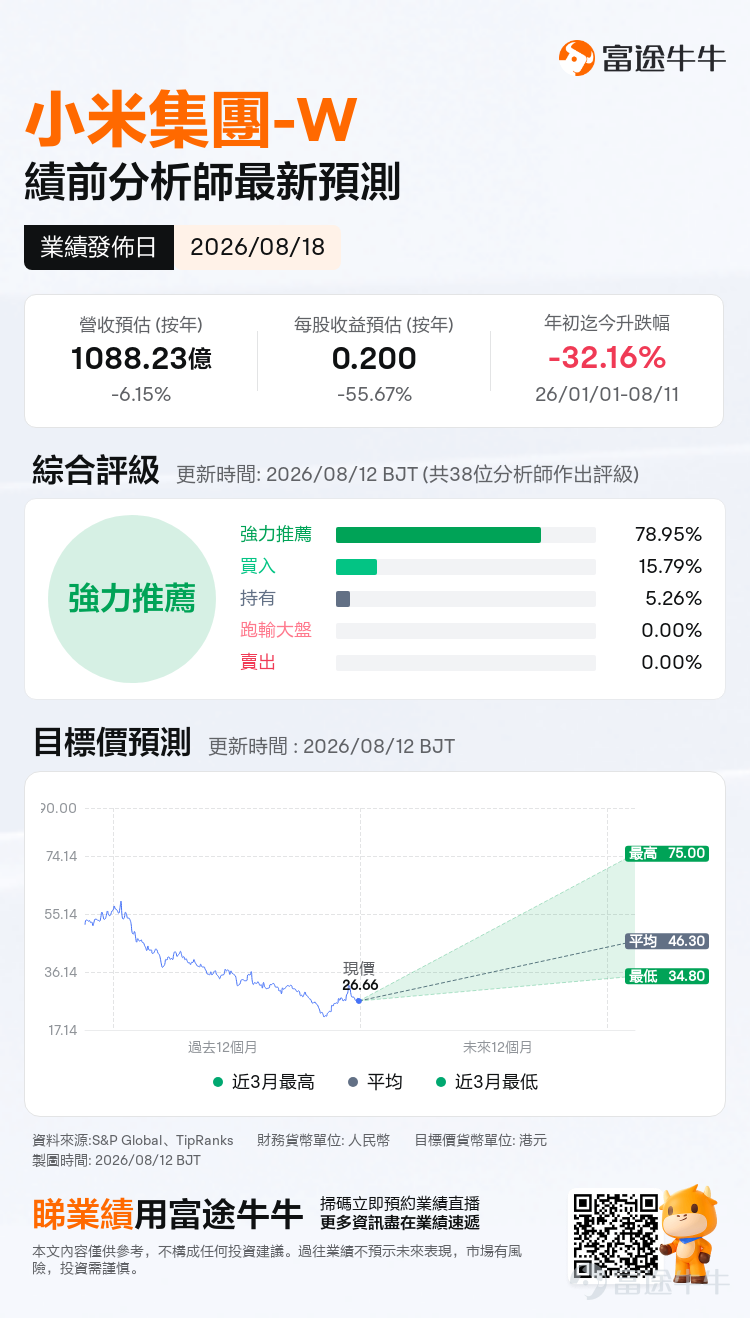
$XIAOMI-W (01810.HK)$ will announcePost-market release of FY2026 Q2 earnings for Hong Kong-listed stocks on Tuesday, August 18, institutional consensus expects Xiaomi Group to report Q2 2026 revenue of RMB 108.823 billion, a 6.15% year-on-year decrease; expected EPS is RMB 0.200, a 55.67% year-on-year decrease.
Currently, Xiaomi has established a four-pillar growth strategy driven by "Smartphones + AIoT + Internet Services + Smart EVs." In Xiaomi's Q2 financial report,the market will focus on validating the growth momentum across its four major segments: smartphones, IoT and lifestyle consumer products, internet services, and smart electric vehicles,assessing the automotive business's ability to convert rapid delivery ramp-ups into revenue, as well as the resilience of the smartphone business amid global memory chip shortages.

Business Outlook
– Smartphone Business: Declining volume but rising prices; gross margins under pressure due to higher memory costs
The market expects Xiaomi Group's smartphone shipments in Q2 2026 to decline year-on-year, putting pressure on smartphone revenue growth compared to the same period last year, while ASP (Average Selling Price) is projected to rise slightly quarter-on-quarter from Q1.Goldman Sachs expects the gross margin for mobile phones in Q2 to be 8.2%, a year-on-year decrease of 3.3 percentage points and a quarter-on-quarter decrease of 1.9 percentage points, with the primary constraint stemming from upward pressure on memory chip costs.
The global smartphone market faced significant headwinds in Q2 2026. According to Counterpoint data, global shipments fell 11% year-on-year, hitting the lowest level for a second quarter since 2013. Xiaomi's global market share declined from 14% in Q2 2025 to 12% in Q2 2026. Regionally, IDC data shows that Xiaomi's share in the Chinese market dropped from 15.1% to 12.4%, with shipment volumes declining 21.7% year-on-year.
This decline was primarily driven by shortages and sharp price increases in memory chips (DRAM and NAND), which pushed up bill of materials costs and forced manufacturers to raise prices, particularly impacting entry-level and mid-range models. Memory price hikes in the first half exceeded early-year expectations, creating a seesaw dynamic of "amplified shipment declines and passively elevated ASPs."
Industry data compiled by Goldman Sachs indicates that the quarter-on-quarter increase in contract prices for traditional DRAM and NAND is expected to be significantly lower in Q3 compared to the previous two quarters. Looking ahead, Xiaomi's cost increases are expected to gradually converge. Coupled with industry-wide alignment on ASP adjustments and sufficient inventory buffers, pressure on gross margins is expected to ease over the medium to long term.
– Smart electric vehicle business: Revenue continues to grow at double-digit rates
The automotive business is one of the key highlights of Xiaomi's earnings report this quarter,Goldman Sachs expects revenue from electric vehicles, AI, and other new businesses to reach RMB 26.234 billion in Q2, a 23% year-on-year increase; the gross margin for electric vehicles is projected at 20.6%, up 0.5 percentage points quarter-on-quarter.Xiaomi's large user base, accumulated over years in smart terminals and AIoT businesses, is empowering its automotive segment through its "Human x Car x Home" full ecosystem strategy, creating differentiated advantages in smart cockpits and cross-device connectivity.
According to data from the China Passenger Car Association, Xiaomi's cumulative deliveries in the first half of 2026 exceeded 180,000 units. In Q2, monthly deliveries surpassed 30,000 units for three consecutive months—36,702 in April, 32,759 in May, and 34,738 in June—totaling approximately 104,000 units for the quarter.
In terms of production capacity, the combined monthly capacity of Xiaomi's two Beijing factories has stabilized at over 45,000 units. The Wuhan factory began trial production in May 2026, ramped up in July, and achieved a stocking capacity of 15,000 units in August, with plans to reach a monthly output of 35,000 units by October. The dual-model lineup of SU7 and YU7 forms a combination of "high-volume sedans + SUVs for market expansion." The SU7 recorded cumulative sales of 80,496 units in the first half, becoming the best-selling pure electric sedan priced above RMB 200,000.
Notably, Xiaomi Auto's cumulative deliveries in the first half exceeded 180,000 units. However, relative to the full-year target of 500,000 units, the completion rate remains below 50%. Even with the concentrated launch and volume ramp-up of the Pengcheng N90 and N70 extended-range SUVs, achieving the annual target remains challenging given Xiaomi's current production capacity reserves.Meanwhile, considering the R&D and capacity investments during this phase of scale expansion, the market will closely monitor the extent to which Xiaomi narrows its loss per vehicle.
– IoT and Lifestyle Consumer Products Segment: Revenue is expected to return above RMB 30 billion, though gross margins may face short-term pressure.
Xiaomi's IoT and lifestyle consumer products business covers categories such as smart TVs, wearables, and smart home devices. It is currently transitioning from a strategy of 'expanding high value-for-money hit products' to a new stage focused on 'deep restructuring via large AI models and the integration of a comprehensive ecosystem connecting humans, vehicles, and homes.'
Benefiting from the boost of the June 18 shopping festival,Institutions expect Xiaomi's IoT segment revenue to grow quarter-on-quarter, likely returning to above RMB 30 billion. While year-on-year figures remain in decline, the rate of decrease continues to narrow compared to Q1.Market outlook focuses primarily on strong growth in major home appliance categories, overseas market expansion, and whether high gross margins can be sustained.
The market expects Xiaomi's gross margin for this segment in Q2 to be approximately 20%,representing a significant decline from Q1's 25.2%, exceeding typical seasonal fluctuations. This is mainly attributed to weak domestic consumer demand and the overall underperformance of the June 18 promotional event. Given the uncertainty in domestic demand, attention will remain on the strength of consumer recovery in the second half of the year.
Furthermore, as of the last quarter, the number of devices connected to Xiaomi's AIoT platform exceeded 1.1 billion (excluding smartphones, tablets, and laptops). As ecosystem stickiness increases (evidenced by the continuous growth in users owning five or more IoT products), the effects of cross-terminal interoperability and AI-driven restructuring will be further validated in future financial reports.
– Internet Services Business: Expected to maintain high gross margins
Although Xiaomi's Internet Services segment accounts for the smallest share of revenue, it is renowned for its high gross margins and serves as a significant contributor to the group's profits. In the first quarter of 2026, revenue reached RMB 9.348 billion, with gross margins remaining at a high level of 76.1%.Market expectations suggest that the company's internet business revenue will remain largely flat year-over-year, with a slight quarter-on-quarter decline; gross margins are expected to stay at elevated levels.
As a stabilizer for the group's profits, this business is accelerating its penetration into the global high-engagement user ecosystem and cross-device scenarios involving smart vehicles. Xiaomi's global monthly active users (MAU) have surpassed the 700 million mark, while the proportion of overseas internet services continues to rise steadily. With a large user base in overseas markets, localized advertising and content subscriptions will become the primary growth engines.
Summary
Overall, Xiaomi's Q2 revenue is expected to decline slightly year-over-year due to sustained high prices for upstream core components (such as memory chips), continued increased upfront investment in innovative businesses like automobiles, and the phasing out of certain consumer subsidies. Adjusted net profit faces significant pressure to narrow considerably on a year-over-year basis.
Control over expense ratios and stability in gross margins have become the key variables for Xiaomi's current earnings season. Main concerns focus on the slope of smartphone demand recovery, profitability within IoT categories, and the timing of returns on investments in new businesses.
 AI breaks down earnings highlights in seconds—set up in three stepsOptions strategies! Open Futubull > Stock page > Tap [Company] >Earnings Flash
Risk Disclaimer: The above content only represents the author's view. It does not represent any position or investment advice of Futu. Futu makes no representation or warranty.Read more


Comments
to post a comment
3