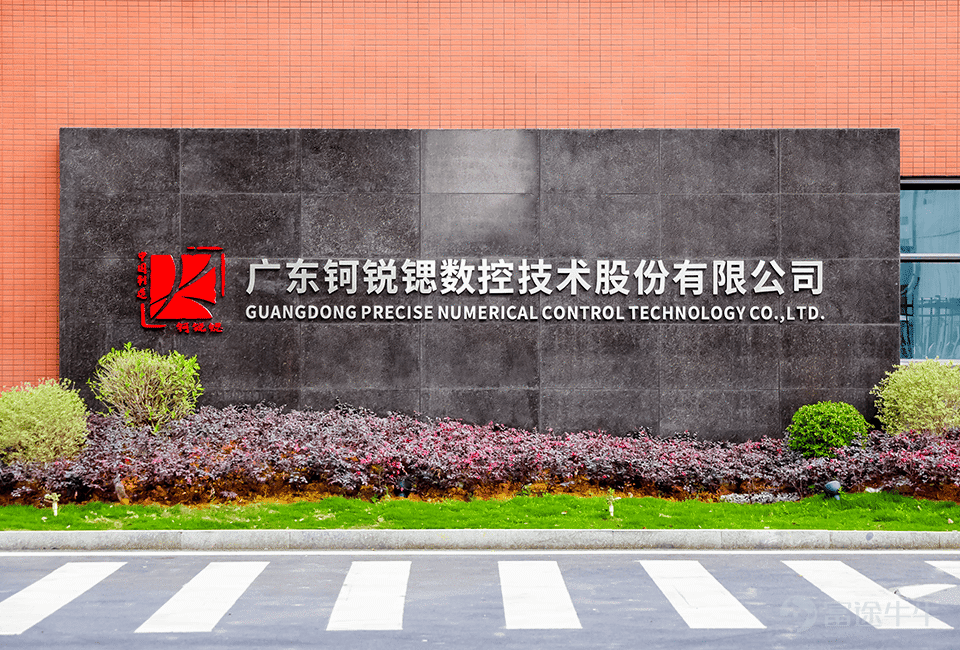

As "industrial master machines" move toward self-reliance and controllability, Keruisi is redefining the fundamental logic of industry competition.
Produced by | Bullet Finance
Author | Yuan Jun
Edited by: Lightning
Art Direction by | Qianqian
Reviewed | Songwen
According to information released on the Shanghai Stock Exchange (SSE) website on August 10, the STAR Market IPO of Guangdong Keruisi CNC Technology Co., Ltd. (hereinafter referred to as "Keruisi") is scheduled for review on August 17.
Established in 2016 as a national high-tech enterprise, the company is a domestic leader in all-direct-drive CNC machine tools. It is also one of the few enterprises that possess both PWM-type and bus-type CNC systems, with both types achieving significant sales volume.
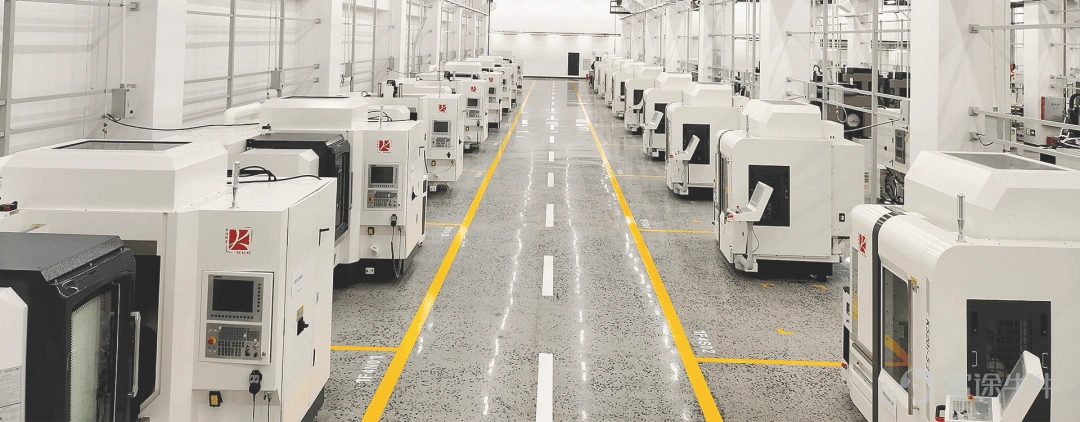
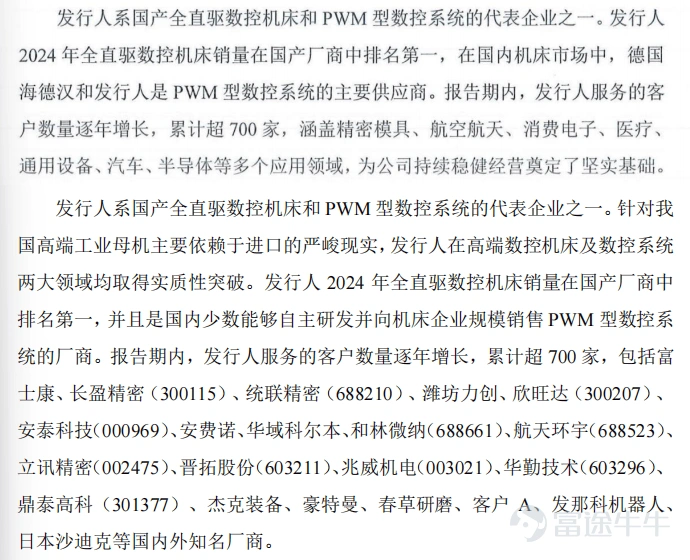
Data from the latest prospectus disclosed for the listing review shows that Keruisi ranked first among domestic manufacturers in sales volume of all-direct-drive CNC machine tools in 2024. Meanwhile, alongside Germany's Heidenhain, the company is a major supplier of PWM-type CNC systems in the domestic machine tool market. It has served over 700 clients cumulatively, covering sectors such as precision molds, aerospace, consumer electronics, automotive, and semiconductors.
In fact, the machine tool sector where Keruisi operates is at a historic turning point in its development. In 2025, China's machine tool exports reached €8.6 billion, surpassing Germany for the first time to rank first globally. With an output value of approximately €30 billion, China contributed 37% of global machine tool production, firmly maintaining its position as the world's largest producer and consumer of machine tools. However, behind this scale leadership lies the concern of structural imbalance. Currently, the localization rate for high-end CNC machine tools remains low; in the CNC system sector, three foreign brands—Fanuc, Siemens, and Mitsubishi—collectively hold approximately 63% of the domestic market share.
As uncertainty in global supply chains compounds with the rigid demand for China's manufacturing sector to transition toward high-precision and advanced technologies, achieving self-reliance and controllability in "industrial mother machines" has shifted from an optional choice to a mandatory requirement. In this breakthrough battle,KeRuiSi, a Chinese company on the verge of listing on the STAR Market, is attempting to redefine the underlying competitive logic of high-end CNC machine tools through a fully direct-drive technological pathway.
1. The "Breakthrough Moment" for Domestic Industrial Mother Machines
Machine tools are known as "industrial mother machines" because they are the machines that manufacture other machines.
Understanding the importance of machine tools requires no complex theory, only a simple fact: virtually every industrial product, from raw materials to finished goods, undergoes cutting, forming, and precision machining by machine tools.
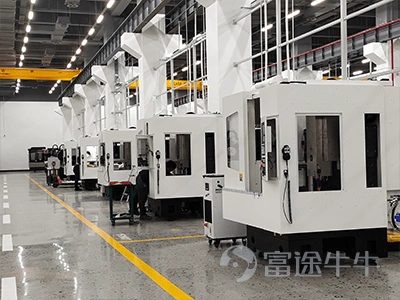
For instance, the machining precision of automotive engine blocks determines fuel efficiency, the surface quality of aerospace turbine blades dictates engine lifespan, and the precision of components in semiconductor equipment defines the limits of chip fabrication processes.These "last mile" challenges that determine industrial prowess are, at their core, competitions in machine tool precision.
There is a common saying in the mold industry: while a precision mold may be worth only hundreds of thousands of yuan, the products it manufactures can be worth hundreds or even thousands of times more. Yet, precision molds themselves cannot exist without high-end CNC machine tools.
However, in stark contrast to China's massive manufacturing scale is a long-standing and unavoidable gap: the equipment foundation for high-precision machining capabilities still relies heavily on imports. For example, nearly 70% of the core processing equipment on the production lines of a leading domestic consumer electronics structural component manufacturer comes from Japan and Germany; the import ratio for key process equipment at an aerospace engine blade manufacturer may be even higher. This is not an isolated incident but a widespread reality in the high-end manufacturing sector.
This gap is also evident across multiple dimensions. In terms of CNC adoption rates, China's CNC rate for metal-cutting machine tools is expected to reach approximately 64% by 2025, whereas Japan has consistently maintained a rate above 80%, and the United States and Germany generally exceed 70%.
From the perspective of high-end market penetration, premium categories such as five-axis simultaneous CNC machine tools remain dominated by German and Japanese brands. Although the localization rate has increased significantly, domestic products still hold a relatively low share in core equipment sectors like automotive manufacturing. In terms of core components, precision parts such as spindles, lead screws, and guide rails also rely heavily on imports.In the cost structure of domestically produced high-end machine tools, outsourced core functional components often account for more than 40%, with this proportion being even higher for certain ultra-precision models.
These figures collectively point to one conclusion: China's machine tool industry still faces clear shortcomings in the core segments that determine its competitive height.
A greater risk lies in the uncontrollability of the supply chain. Reports indicate that in some high-end machine tool sectors, international manufacturers embed remote monitoring and lockout features in exported equipment, while export licenses explicitly restrict end users and intended uses. This means that although the equipment is physically located in Chinese factories, the ability to operate it normally is not entirely under the control of the enterprises.
Meanwhile, due to a lack of experience in manufacturing high-end machine tools, companies often depend on imported machines to produce high-quality products. Once this cycle becomes entrenched, the initiative for upgrading the manufacturing sector will no longer be in their own hands.
It is precisely this acute pain that has spurred the primal momentum for change. The forces capable of breaking this cycle are now accumulating simultaneously along two dimensions.
From the policy perspective,The outline of the 15th Five-Year Plan has, for the first time, listed industrial master machines (machine tools) and integrated circuits as key areas where "extraordinary measures will be taken to drive breakthroughs in critical core technologies across the entire chain." Policy support for industrial master machines is unprecedented.
From the demand side,Over the past few years, China's manufacturing sector has achieved a leap from following to running alongside, and even leading, in fields such as consumer electronics, new energy vehicles, photovoltaics, and semiconductors. The rise of these emerging industries has not only generated massive demand for high-end CNC machine tools but also catalyzed an unprecedented shift: local manufacturers now have both the capability and willingness to provide validation scenarios and application opportunities for domestically produced equipment.
Therefore, as policy support and market demand converge, a historic window for the domestic substitution of industrial mother machines (high-end CNC machine tools) is fully opening. In this breakthrough campaign, the choice of technological path often determines how far a company can go.
2. A Reconstruction of the Physical Foundation of Machine Tools
In fact, the underlying logic of traditional high-end CNC machine tools has been in operation for over a century. Rotary motors provide power, which is transmitted through couplings to ball screws; the rotation of the screws drives the nuts in linear motion, ultimately moving the worktable. This conversion mechanism constitutes the most basic transmission architecture of modern machine tools.
Under this architecture, companies from Japan, Germany, and other countries have leveraged decades or even centuries of accumulation in materials science, heat treatment processes, and precision machining capabilities to advance the positioning accuracy of ball screws from the micron level step by step, building nearly insurmountable barriers.
However, this system is not omnipotent. Clearance must be maintained between the screw and the nut, resulting in backlash errors with each direction change. Furthermore, friction-induced heating of the screw during high-speed motion causes thermal elongation, leading to drift in the positioning reference. Long-term wear on the contact surfaces of the screw and guide rails also leads to a gradual decay in precision over time.
To address these issues, top global machine tool enterprises have spent considerable time attempting to approach this physical limit through material upgrades, cooling optimization, and compensation algorithms. However, approaching the limit is not the same as breaking through it. The fundamental issue is that as long as mechanical contact exists, wear, clearance, and thermal deformation are inevitable. The physical ceiling inherent in this framework cannot be broken through by mere patchwork fixes.
Against this backdrop, the Chinese company Keruisi made a choice different from most machine tool manufacturers. Instead of catching up within the old framework, it replaced the foundation with a new framework known as 'full direct drive.'
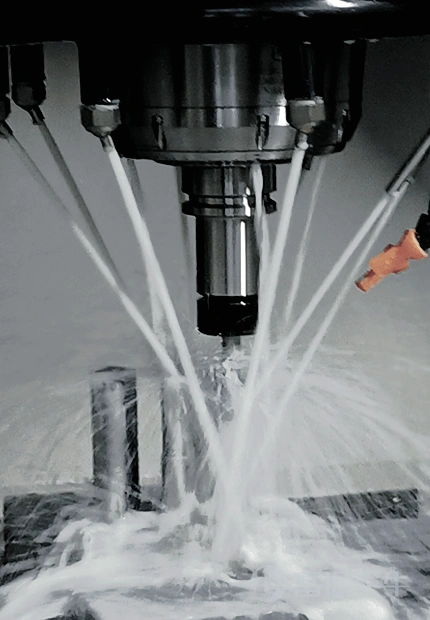
So-called full direct drive eliminates the entire mechanical transmission chain. Keruisi replaces ball screws and worm gears with linear motors and torque motors, achieving direct conversion from 'current to thrust to worktable movement.' Data shows thatfull direct drive technology can increase the dynamic stiffness of machine tools several times over, significantly reducing cumulative errors in the transmission system in high-precision scenarios such as high-speed milling, while extending precision lifespan through its wear-free characteristics.
But this is only the first step. Full direct drive imposes far higher requirements on control systems than traditional machine tools, as any minute control deviation will directly reflect in machining precision. This is why many companies have attempted full direct drive but ultimately abandoned it: while mechanical structures can be replicated, the matching control algorithms cannot. This is precisely the core of Keruisi's technological moat.
All of Keruisi's direct-drive CNC machine tools are equipped with its self-developed PWM-type CNC system(U Series)。Under the PWM architecture, the controller sends synchronized PWM signals directly to the drivers, with the position, velocity, and current loops all centralized within the controller to achieve closed-loop control. Compared to traditional architectures that rely on bus communication, this approach offers shorter signal transmission paths and higher synchronization precision. In the domestic machine tool market, Keruisi and Germany's Heidenhain have become the two core suppliers in this field.
Even more impressively, Keruisi also masters bus-based CNC systems(N Series)technology, making it one of the few domestic companies to possess both technical routes and achieve scaled sales for each.This dual-track capability is not a simple aggregation; it means that the algorithm libraries, compensation logic, and drive matching solutions for the two systems were developed completely independently. The ability to master both technical routes and commercialize them simultaneously constitutes a proof of capability in itself.
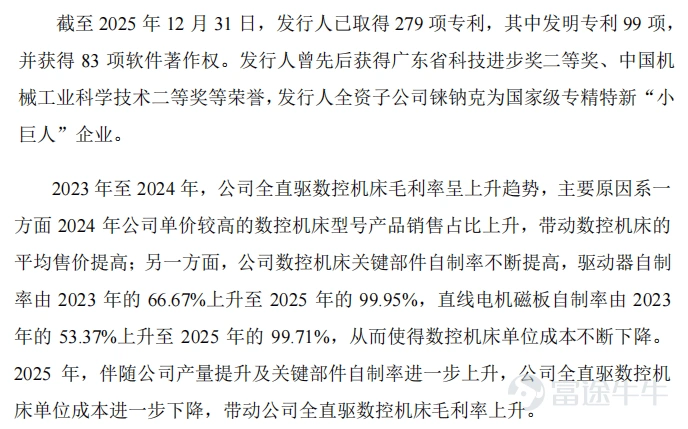
The draft prospectus submitted for review shows that,as of the end of 2025, Keruisi had obtained 279 patents, including 99 invention patents and 83 software copyrights.Its in-house production rate for key components has also continued to rise, with the in-house production rate for drivers increasing from 66.67% in 2023 to 99.95% in 2025, and the in-house production rate for linear motor magnetic plates rising from 53.37% in 2023 to 99.71% in 2025.
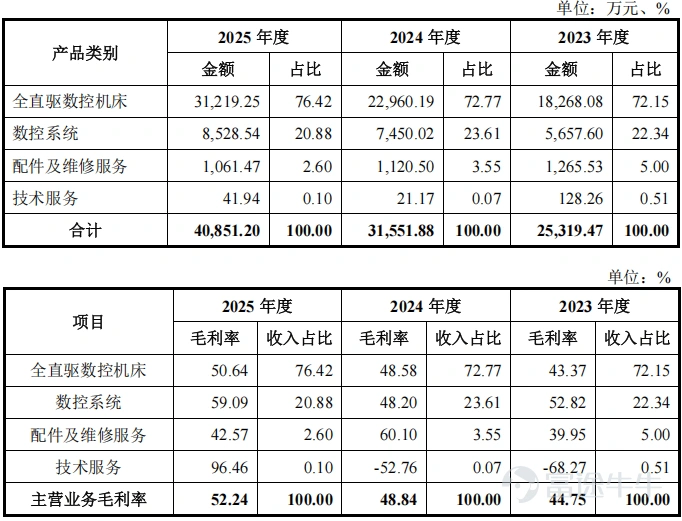
The market has also responded positively to this.From 2023 to 2025, the company's revenue grew from RMB 253 million to RMB 409 million;The revenue share of fully direct-drive CNC machine tools increased from 72.15% to 76.42%. Meanwhile, the gross margin of its core business rose from 44.75% to 52.24%, indicating that revenue growth was underpinned by a simultaneous improvement in profitability.
By pushing fully direct-drive technology to its limits, retaining control over control systems, and increasing the in-house production rate of core components, Keresi is essentially redefining the underlying logic of high-end CNC machine tools.
In the past, Chinese machine tool companies were accustomed to building houses on others' foundations; today, Keresi is laying its own foundation. Only with a solid foundation can the structure be built tall and stable.
3. The "invisible infrastructure" of emerging industries
Once fully direct-drive technology solved the problem of how to achieve greater precision, a new question arose: Where will these capabilities be directed?
The answer is being rewritten by the wave of AI computing power and robotics. This time, the slope of the demand-side growth curve far exceeds that of traditional manufacturing.
Data shows that global AI server shipments will increase by 46% year-over-year in 2025. According to statistics from the Semiconductor Industry Association (SIA), global chip sales will reach USD 791.7 billion in 2025, a 25.6% year-over-year increase, and are expected to climb to approximately USD 1 trillion in 2026. AI servers have much higher requirements than traditional servers for hardware density, space utilization, power density, and system coordination. Taking NVIDIA's GB200 as an example, the server system contains 1.2 million components, imposing extreme demands on the precision (down to micron or even sub-micron levels), surface quality, and microstructure of internal parts.
Meanwhile, humanoid robots have opened up entirely new dimensions of demand. IDC's "Global Humanoid Robot Market Analysis" report indicates that global humanoid robot shipments will reach approximately 18,000 units in 2025, a year-over-year increase of about 508%. Internal components of humanoid robots must meet characteristics such as small size, lightweight design, compact structure, and high integration, while also achieving precise transmission, high-density drive, fast response, and extremely high motion control accuracy.
It is evident thatUnderpinning these emerging industries is a common infrastructure: high-speed, high-precision CNC machine tools.Whether it involves micro-hole machining for chip test sockets, precision milling of AI server structural components, or complex surface machining of internal robot parts and joints, these critical bottlenecks in the industrial chain essentially boil down to a competition in CNC machining capabilities.
This is where full direct-drive technology comes into play. The stringent requirements for dynamic response and synchronization in high-speed, high-precision scenarios highlight the core advantage of PWM-based CNC systems over bus-type systems. As more emerging industries demand high-speed and high-precision machining capabilities, full direct-drive technology—once quietly accumulating expertise in a niche sector—is now positioned at the forefront of industrial demand.
The prospectus submitted for review shows thatKeruisi has cumulatively served over 700 clients,spanning multiple sectors including precision molds, aerospace, consumer electronics, healthcare, general equipment, automotive, and semiconductors, with notable clients such as Foxconn, Changying Precision, Luxshare Precision, Tonglian Precision, Sunwoda, and Jintuo Shares.
Disclosure materials responding to regulatory inquiries further reveal that in 2025, the company generated RMB 23.2217 million in revenue from CNC machine tools applied in the robotics industry, RMB 17.3142 million in the semiconductor sector, and achieved a breakthrough from zero to RMB 14.233 million in the AI server segment.
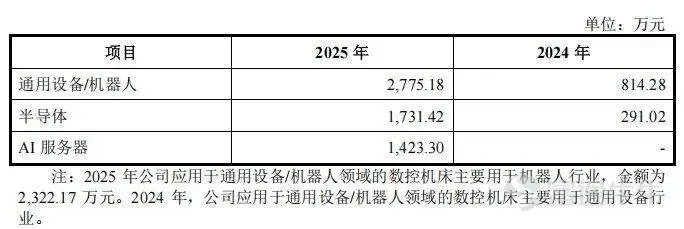
While the figures are modest, the structure is shifting. Clients in these emerging fields no longer view domestic machine tools as a secondary option, a transformation that opens up new growth potential for high-end domestic equipment.
As emerging industries call for new manufacturing paradigms, traditional transmission logic may no longer be the sole answer. From breaking Heidenhain’s monopoly on PWM-based CNC systems to reconstructing the physical foundation of machine tools with full direct-drive technology, and securing a strategic position in key manufacturing nodes for the AI and robotics era,Keruisi’s technological roadmap and industrial pacing are shaping a more fundamental narrative.
As the global landscape for high-end machine tools undergoes rapid restructuring, this company is leveraging its core technological strengths to address a pivotal question of our time: Can Chinese manufacturing evolve from a follower to a standard-setter?
Risk Disclaimer: The above content only represents the author's view. It does not represent any position or investment advice of Futu. Futu makes no representation or warranty.Read more
Comments
to post a comment