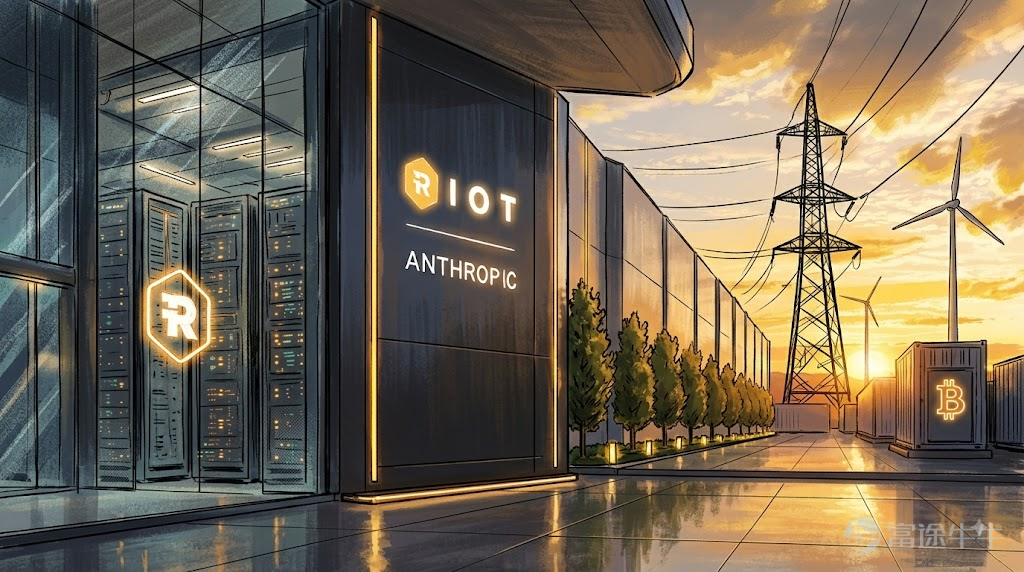

Riot becomes Anthropic's AI compute 'landlord,' reshaping miners' valuation logic

Author: Jae, PANews
Amid the heatwave at its Rockdale, Texas campus, a facility once filled with the roar of tens of thousands of Bitcoin mining rigs is undergoing a profound asset transformation.
According to Bloomberg, AI company Anthropic has signed a 20-year supercomputing colocation agreement with Bitcoin miner Riot Platforms, valued at $9.1 billion. Riot’s after-hours share price surged more than 25% on the news.
The AI giants’ computing power arms race has thrust former crypto miners into the spotlight.
On August 11, Anthropic reached a $9.1 billion AI data center (AIDC) computing power agreement with Bitcoin miner Riot Platforms to meet the rapidly growing demand from Claude users. Riot stated it will supply 191 megawatts of power—equivalent to simultaneously powering approximately 143,000 households—under a 20-year contract.
According to SEC filings, Anthropic and Riot’s computing power partnership will not come online immediately: the first tranche of 96 megawatts is expected to be delivered by December next year, with full capacity deployment scheduled for June 2028.
In the arms race among leading AI labs, guaranteed access to computing power has become a lifeline for large model developers. Demand for compute resources for both model training and inference is growing exponentially, and the production capacity and scheduling capabilities of any single cloud provider are increasingly insufficient to meet their needs.
To avoid upstream bottlenecks and control long-term costs, Anthropic is weaving a global infrastructure network characterized by 'asset-light, long-duration' arrangements:Rather than building its own data centers, Anthropic is locking in power, space, and computing capacity years in advance through customized 15- to 20-year build-to-suit lease agreements.
In recent years, beyond partnerships with public cloud providers like AWS and Google Cloud, Anthropic’s infrastructure strategy has expanded aggressively across multiple fronts:
It signed a 20-year lease agreement with TeraWulf for 401 megawatts of load, valued at $19 billion;
Signed a $10 billion supply agreement with infrastructure startup Volta Infra Holdings;
Finalized an intent to purchase nearly $45 billion worth of computing power from xAI;
Simultaneously established AI data center partnerships with Hut 8 and Fluidstack.
It has only one strategic objective:To secure physical computing resources for the next several decades well in advance.
Compared with building its own AI data centers—which typically involve multi-year construction timelines, massive capital expenditures, and operational risks—this 'long-term lease' model allows Anthropic to guarantee computing capacity for decades ahead while preserving maximum financial flexibility. It shifts the burden of heavy-asset development onto more specialized infrastructure providers, enabling Anthropic itself to focus on model development and commercialization. This is also a typical strategy adopted by leading players as the AI arms race enters its deep phase:The competition is no longer just about who can buy chips—it’s about who can lock down power and land fastest.
Driven by both Bitcoin halving and the AI boom, virtually all U.S.-listed mining companies have pivoted toward AI data centers (AIDCs). Core Scientific, TeraWulf, IREN, Hut 8, and Cipher Mining—each is now pitching a 'computing power hosting' narrative. PANews believes there are three key reasons why Anthropic ultimately awarded its $9.1 billion super-order to Riot Platforms.
1. Power: Scarce 'already-energized' sites
The biggest bottleneck in global AI data center (AIDC) development today is securing interconnection permits from substations and high-voltage power grids. Traditional data center developers often face a 2- to 4-year wait from the time they apply for grid interconnection until electricity is actually connected.
Riot Platforms' Rockdale campus is one of the largest single-site digital infrastructure campuses in North America. It has already received approval from the Texas power grid (ERCOT) and achieved high-voltage grid connectivity, making it one of the few ready-to-use sites in the U.S. that can be directly converted into an AI computing hub.
In contrast, most of Core Scientific’s capacity has already been locked in by CoreWeave, and TeraWulf’s existing capacity has been significantly diverted to clients like Fluidstack. For Anthropic, which urgently needs to bring capacity online, Riot’s 'plug-and-play' power allocation is virtually irreplaceable in the current market.
Texas has become a popular destination for AIDCs due to its low electricity prices, but caution is warranted:Large-scale, high-load facilities are increasingly drawing regulatory scrutiny due to their impact on the power grid.
Bitcoin mining is highly flexible and can shut down instantly to support grid load-balancing, whereas AI model training and inference require uninterrupted 24/7 power—a fundamentally different demand on grid stability. As sustained high loads continue to strain the grid, local regulators may tighten oversight.
2. Delivery Certainty: Engineering Capability Validated by AMD
Cutting-edge AI labs are extremely sensitive to compute delivery timelines. Construction delays mean delayed model training, postponed product launches, and disrupted fundraising schedules—potential costs that far exceed capital expenditures.
Riot Platforms’ engineering execution capability has already been validated by the market. In January this year, it signed its first 50-megawatt data center lease agreement with AMD. By the second quarter, it had completed and delivered the first phase of 25 megawatts of IT capacity on time and within budget.
More importantly, Riot is not merely a 'sublandlord.' It owns its own engineering, manufacturing, and assembly facilities in Denver and Houston, giving it end-to-end control—from transformer design and customized cooling systems to site construction—significantly reducing risks of supply chain disruptions and construction delays.
However, in the rapidly evolving AI sector, a two-year engineering window is fraught with uncertainty:Chip architectures may evolve, compute demand structures could shift, and construction costs might overrun.
3. Financial resilience: A sufficiently strong balance sheet can withstand heavy-asset transformation
Upgrading a Bitcoin mining facility into an AI data center (AIDC) requires massive investment: industry average retrofitting capital expenditure stands at $7.5 million per megawatt. Many small and mid-sized miners have collapsed due to fragile balance sheets and broken cash flow chains.
As of the end of Q2 this year, Riot Platforms held over $1.2 billion in liquid assets, including approximately $549 million in cash and a Bitcoin reserve of 11,380 BTC. To support the development of its Rockdale campus, it also secured a $573 million bridge financing agreement with Morgan Stanley.
With cash on hand, Bitcoin reserves, and bank credit lines, Anthropic need not worry about Riot running out of funds mid-construction.
However, whether Riot Platforms or other Bitcoin miners transitioning their operations, their current large orders remain heavily dependent on a handful of AI labs and cloud providers.If their commercial monetization or fundraising pace fails to keep up with enormous capital expenditures, their ability to fulfill long-term colocation agreements will face market skepticism.

This $9.1 billion deal represents not just a business upgrade for Riot Platforms, but a fundamental restructuring of the capital logic underpinning Bitcoin mining companies.
Enhanced profitability: Revenue efficiency increases by 1–3x
The most immediate impact is a qualitative leap in revenue efficiency per megawatt of power.
Historically, Bitcoin mining profitability was tightly tied to cryptocurrency price volatility and network difficulty. After the halving, profit margins have continued to narrow and exhibit strong cyclicality. By shifting power capacity to compute hosting, however, annualized revenue per megawatt now approaches USD 2.4 million—1 to 3 times more efficient than mining. More importantly, this revenue stems from long-term contracts, delivering highly predictable cash flows and insulation from crypto market cycles.
Valuation reset: From high-beta crypto stock to infrastructure operator
An even more profound shift than revenue is the change in valuation logic.
Capital markets have traditionally assigned Bitcoin miners discounted valuations, with EBITDA multiples typically ranging from 6x to 12x. In contrast, data center infrastructure operators with stable, long-term cash flows commonly trade at EBITDA multiples of 20x to 25x.
With long-term contracts totaling 241 megawatts and approximately USD 9.8 billion now secured with AMD and Anthropic, Riot Platforms is on the verge of a strategic transformation: evolving from a highly volatile crypto stock into a utility-like infrastructure company.
Capital allocation: Selling Bitcoin to buy hard assets
Underlying this pivot is also a broader reallocation of capital within the crypto industry.
To fund construction for its AIDC retrofit, Riot sold 9,665 Bitcoins in Q2 this year, raising approximately USD 733 million. This move may signal a growing consensus among miners: converting Bitcoin reserves—which no longer generate cash flow—into physical hard assets capable of producing stable, long-term income.
Mining companies will no longer be mere 'miners' of Bitcoin but will instead become 'landlords' of computing power resources. Leveraging their prior engineering expertise and physical assets, they are emerging as indispensable infrastructure providers in the AI era.
Of course, such a transformation is never instantaneous. Delivery capabilities, technological shifts, and regulatory risks all pose significant challenges. Yet those players who have secured resources early on will ultimately see their value reassessed in this AI-driven wave.
Risk Disclaimer: The above content only represents the author's view. It does not represent any position or investment advice of Futu. Futu makes no representation or warranty.Read more
Comments
to post a comment
1