NVIDIA's revenue doubles, beating expectations; is the AI trade narrative making a comeback?

Daily Options Income Strategy | NVIDIA's $500 Billion AI Financing Plan Sparks Controversy! Jensen Huang Responds to 'Circular Financing' Panic—How to Navigate Heightened Volatility?
I. Market Barometer
The three major U.S. indices closed slightly lower in the previous trading session, with the semiconductor sector under broad pressure and showing divergence, $NVIDIA (NVDA.US)$ leading the decline by nearly 3%. NVIDIA's $500 billion AI infrastructure financing plan has sparked intense market debate over the risks of circular financing, and the heightened volatility has created an attractive window for options sellers.
II. Watchlist Highlights
NVDA: The $500 billion AI financing plan has fueled sharp bullish-bearish divergence, driving the stock to reverse from intraday highs and close down nearly 3%
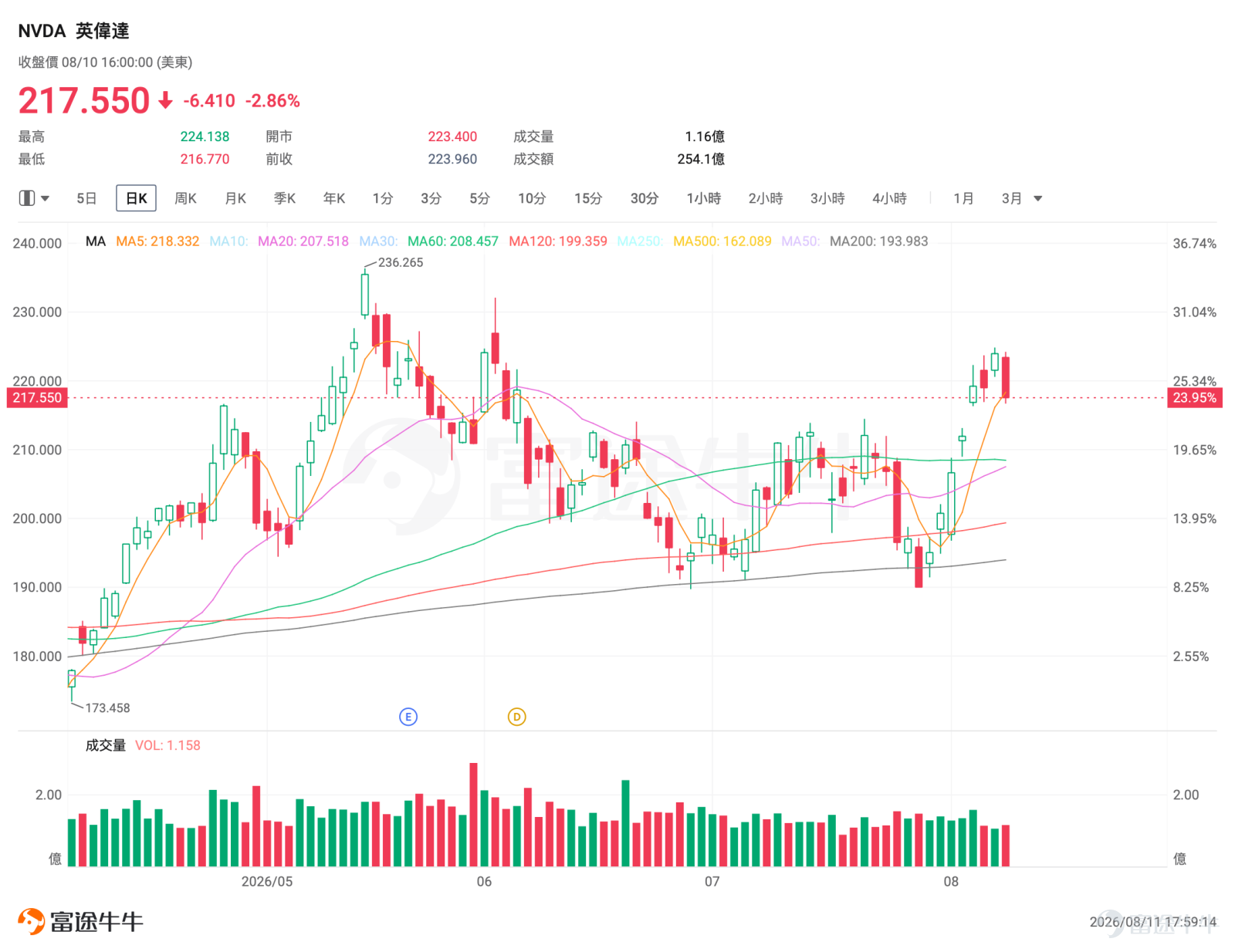
$NVIDIA (NVDA.US)$ It declined 2.86% in the previous trading session (Monday), closing at $217.55 with a trading volume of $25.41 billion.
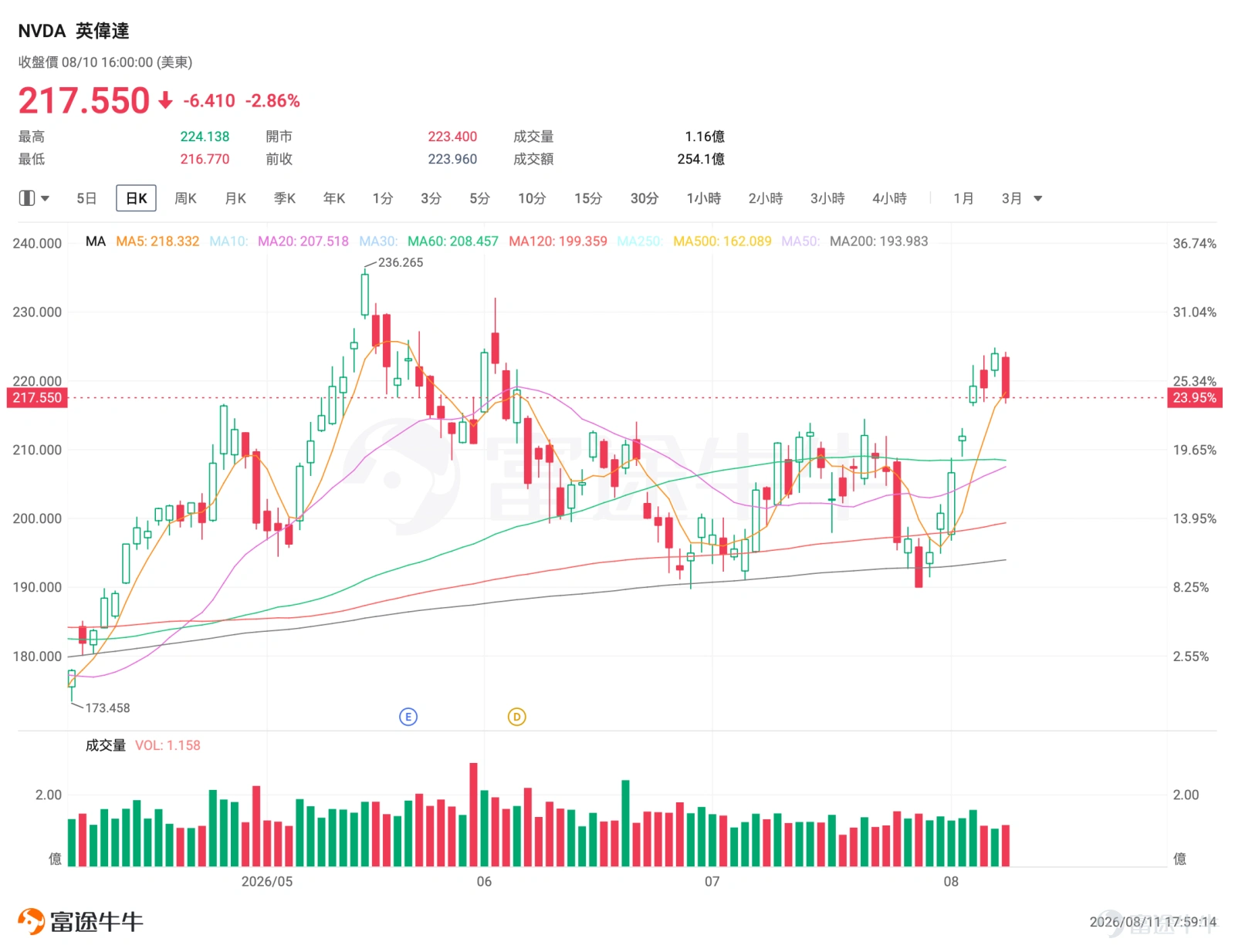
From a technical standpoint, NVDA has recently shown a pattern of rallying sharply before pulling back.The stock rebounded from its July 29 low of $190.01, climbing steadily to $223.96 on August 7, marking a cumulative gain of approximately 18%.On the previous trading day, it opened higher but immediately faced selling pressure, closing below its 5-day moving average and forming a high-volume bearish candle. Near-term resistance lies in the $224.14–$224.76 range (a dense cluster of recent daily highs), while key support is seen at $210–$212 (a consolidation zone contested multiple times in mid-July). The current short-term outlook is characterized as 'rally-and-pullback'—after consecutive gains, the stock met resistance near prior highs, triggering profit-taking that amplified the single-day decline, resulting in near-term technical correction pressure.
From a news perspective, NVIDIA announced, alongside Apollo, Blackrock, Blackstone, and other Wall Street institutions, a $500 billion AI infrastructure financing initiative.CEO Jensen Huang defined chips as an 'investable asset class,' attempting to accelerate AI compute deployment through financialization. While this announcement itself constitutes a major industry catalyst, market reaction has been negative—some investors worry the structure carries 'circular financing' risk, as NVIDIA is both a chip supplier and participates in financing guarantees, potentially creating a closed-loop credit risk.The stock opened higher but closed lower on the day, reflecting market divergence over the plan: bullish factors (unlocking trillion-dollar AI infrastructure demand) and bearish concerns (potential credit risk and increased capital structure complexity) coexist.
Huang responded urgently with a detailed 10,000-character post clarifying that this is 'absolutely not circular financing,' emphasizing that AI factories are becoming an investable asset class.On August 10, Huang posted on social platform X to systematically explain the logic behind this financing model. He stressed that the $500 billion represents total third-party capital—'neither NVIDIA's revenue nor a commitment from a single fund or to a single customer.' Demand comes from leading AI labs, AI-native startups, enterprise clients, and cloud providers, and 'the demand is real.' Each capital provider will independently conduct due diligence on every project, while NVIDIA only offers a platform and a 'residual value support mechanism' of no more than 25%, intended to supplement—not replace—independent due diligence.He specifically noted, 'This measure was precisely designed to address concerns about circular financing.'
The market is currently pricing in an expectation gap regarding:Is the $500 billion financing plan a 'demand accelerator' or a 'credit risk amplifier'? Key variables to monitor include: the actual rollout pace of the financing program, the timing of actual capital commitments by third parties, and whether NVIDIA’s next earnings report—due on August 27—can sustain its streak of beating expectations.
If the market continues to interpret this plan as a credit risk event rather than a demand catalyst, short-term selling pressure could intensify further.
Wall Street analysts remain overwhelmingly bullish on NVDA overall.Of 37 analysts, 97.30% have issued Buy ratings, with an average price target of $309.94, a high of $500, and a low of $250. In an August 11 research note, Morgan Stanley stated that market concerns over 'circular financing' are overblown. The firm believes NVIDIA provides only a 'residual value support mechanism' of up to 25% within this structure, with decision-making authority and funding sources fully controlled by independent third parties—structurally addressing circular financing concerns. This arrangement also opens a near-100% gross margin annuity-style revenue-sharing stream for NVIDIA, with FY29 revenue share projected to exceed $10 billion, driving EPS upward by more than 10%.
3. Options Premium Collection Strategy
1. Cash Secured Put
Sell 1 contract of $NVIDIA (NVDA.US)$ 260904 205P, Estimated required margin (for reference only): $20,500
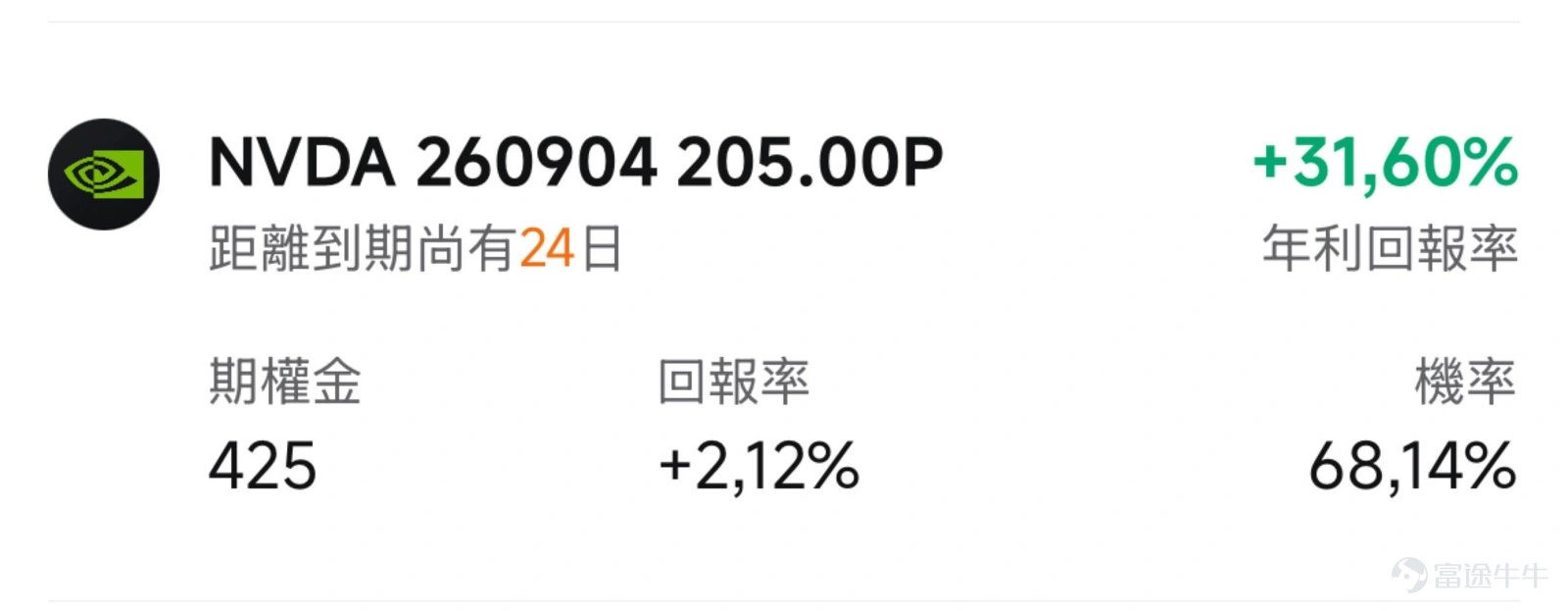
Opportunity Rationale:
For investors who recognize NVIDIA's long-term AI moat but have not yet established a position, the current share price has pulled back amid controversy over its $50 billion financing platform. However, Wall Street analysts also suggest this arrangement could potentially open up high-margin revenue-sharing channels.
By selling put options, investors can collect elevated option premiums driven by rising implied volatility (IV) if the stock consolidates or experiences a corrective rebound from current levels. If the share price continues to decline due to short-term panic-driven momentum, they may also get the opportunity to establish a position at a more attractive cost basis.
2. Covered Call
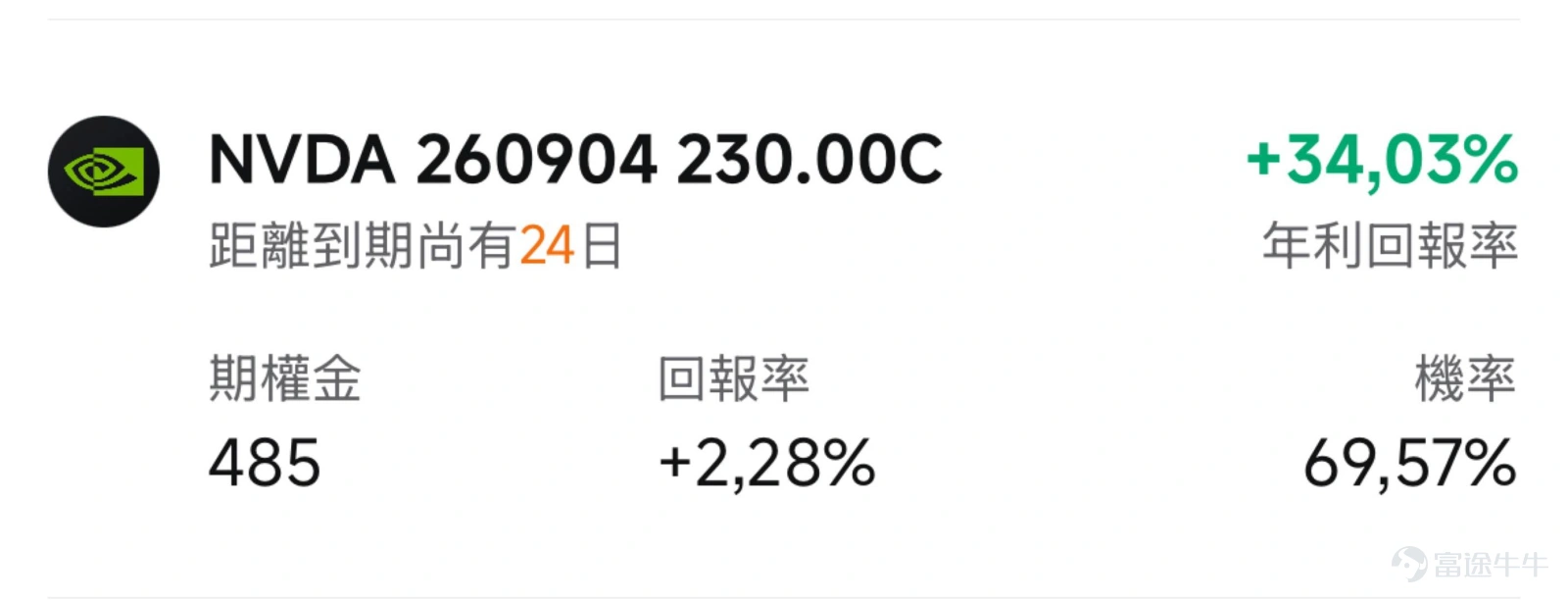
Opportunity Rationale:
For investors already holding NVIDIA, the share price faces near-term pressure amid controversy over the financing plan. Although Jensen Huang has clarified that the term 'circular financing' is a misunderstanding, market sentiment will take time to recover, and uncertainty is heightened as the August 26 earnings date approaches.
Investors bullish on the long-term AI growth thesis but concerned about short-term controversy and pre-earnings volatility can consider selling call options. If the stock trades sideways around current levels, the collected premiums can gradually lower their cost basis. If a strong Q2 earnings report drives the share price above $230 and triggers assignment, it effectively realizes a partial profit-taking exit.
IV. Risk Management Advisory
Although seller strategies have a high win rate, investors must still implement proper risk management:
– Position management is everything.: The biggest risk for option sellers lies in black swan events. It is recommended that margin allocated to any single underlying should not exceed 20% of total capital. Never sell options beyond your capacity to absorb losses just for the sake of collecting higher premiums.
– Covered Call and Timely Rolling: When a covered call becomes deeply in-the-money (i.e., the stock price far exceeds the strike price), if you remain bullish on the underlying stock, you should decisively 'roll' the position—buy to close the current option and simultaneously sell a longer-dated call with a higher strike price—to avoid having your shares called away at an unattractive price.
– Cash-secured put options: Beware of 'left-tail risk': For cash-secured puts, if the stock price crashes due to fundamental deterioration (rather than a normal pullback), don’t hold on stubbornly. In such cases, exit with a stop-loss or roll the position down to buy time while waiting for volatility to normalize.
Make good use of the Options Seller Hub to understand income strategies for selling options and earnOption premiums!

Options Risk Disclosure
An option is a contract that gives the holder the right—but not the obligation—to buy or sell an underlying asset at a predetermined price on or before a specified date. Option prices are influenced by multiple factors, including the current price of the underlying asset, the strike price, time to expiration, and implied volatility. Implied volatility reflects the market's expectation of future volatility over the life of the option and is derived by back-solving from the Black-Scholes option pricing model. It is commonly viewed as an indicator of market sentiment. When investors anticipate higher volatility, they may be willing to pay more for options to hedge their risk, leading to higher implied volatility. Traders and investors use implied volatility to assess the attractiveness of option prices, identify potential mispricings, and manage risk exposure.
Disclaimer
This content does not constitute an offer, solicitation, recommendation, advice, opinion, or any guarantee regarding any securities, financial products, or instruments. The risk of loss in trading options can be substantial. In certain circumstances, your losses may exceed the initial margin deposit. Even if you place contingent orders, such as 'stop-loss' or 'limit' orders, there is no guarantee they will prevent losses. Market conditions may render such orders unexecutable. You may be required to deposit additional margin on short notice. If you fail to meet the required margin within the specified timeframe, your open positions may be liquidated. Nevertheless, you remain fully responsible for any resulting deficit in your account. Therefore, prior to trading options, you should thoroughly study and understand options and carefully consider whether such trading aligns with your financial situation and investment objectives. If you trade options, you should become familiar with the procedures for exercising options and handling expiration, as well as your rights and obligations upon exercise or expiration. Options trading involves substantial risk and is not suitable for all investors. Investors should carefully read 'Characteristics and Risks of Standardized Options' before engaging in any options trading strategy.
Risk Disclaimer: The above content only represents the author's view. It does not represent any position or investment advice of Futu. Futu makes no representation or warranty.Read more


Comments (2)
to post a comment
6
15