Jensen Huang signals at shareholder meeting: The era of 'AI factories' has arrived

NVIDIA Leverages $500 Billion onto AI's 'Five-Layer Cake': Super Cycle or Circular Financing?
NVIDIA is no longer satisfied with just selling chips—it now aims to turn those chips into assets that can be priced, collateralized, and financed by Wall Street.
On August 10 local time, $NVIDIA (NVDA.US)$ announced a partnership with $Apollo Global Management (APO.US)$ 、 $Blackrock (BLK.US)$ 、 $Blackstone (BX.US)$ 、 $Brookfield (BN.US)$ 、 $Goldman Sachs (GS.US)$ and $KKR & Co (KKR.US)$ to launch an independent computing power financing platform, aiming to mobilize over $500 billion in third-party capital over the long term to build data centers and 'AI factories' for cutting-edge AI labs, enterprises, governments, and AI cloud providers.
It should be noted that this $500 billion represents a planned pool of funds to be gradually mobilized in the future—it is not capital already on hand, nor revenue NVIDIA can immediately recognize. Final agreements, individual institutional commitments, and disbursement timelines have not yet been disclosed.
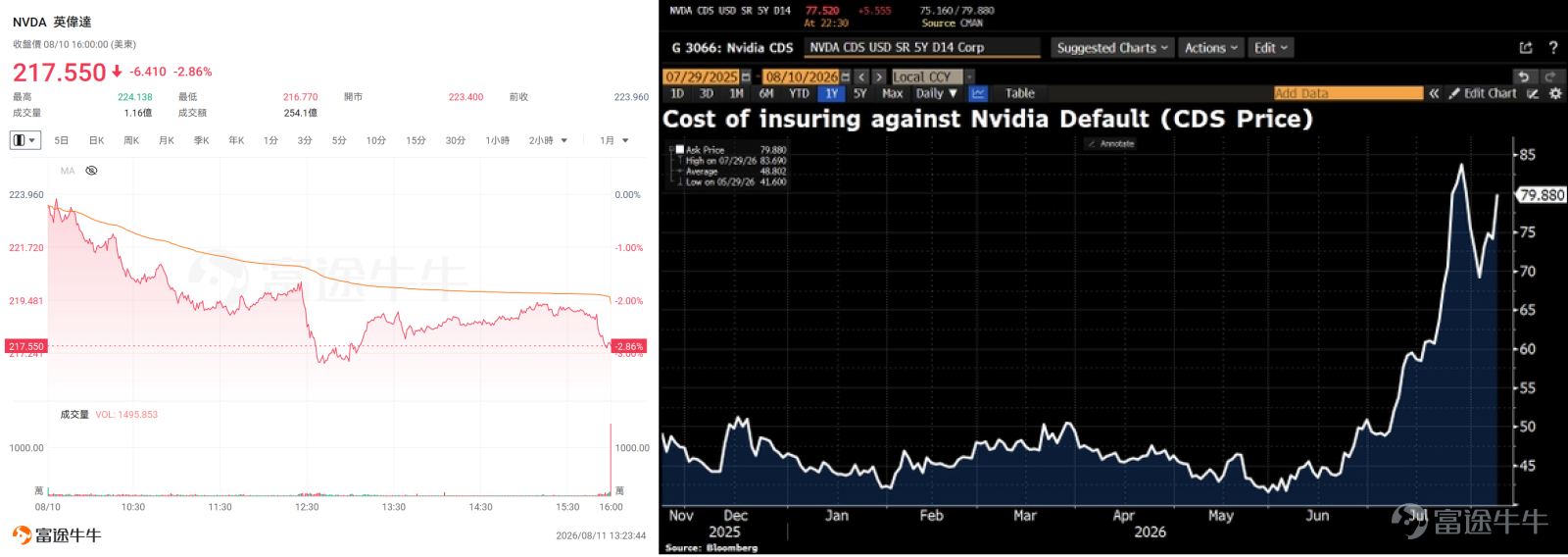
Yet capital markets have already voted with their feet. $NVIDIA (NVDA.US)$ The company’s stock price fell 2.86% that day, and its 5-year credit default swap (CDS) spread surged by nearly 6 basis points following the announcement.

This does not mean the market is pricing in an imminent default by NVIDIA, but it does indicate that investors are now demanding higher premiums to insure against the company's potential contingent risks.
On one side, six major financial giants are willing to open their balance sheets to fund computing power; on the other, both equity and credit markets are simultaneously raising risk premiums. These two reactions may seem contradictory, but they actually point to the same underlying question:Has AI computing power already become infrastructure generating long-term cash flows, or is Wall Street using increasingly complex financing structures to convert chip orders—still unvalidated by end-user demand—into revenue prematurely?
To understand this debate, we need to place the $500 billion back into Jensen Huang’s 'five-layer cake' framework.
From industrial landscape to capital structure: How does $500 billion flow through the 'five-layer cake'?
At Davos this year, Jensen Huang proposed that AI is not a single model or application, but rather a cake composed of five layers: at the bottom is energy, followed upward by chips, infrastructure, models, and applications.
Layer One: EnergyEvery token generated requires electricity, power transmission and distribution, land, and cooling—the grid’s capacity sets the physical ceiling for scaling computing power.
Layer Two: ChipsGPUs, CPUs, HBM, networking, and optical interconnects convert electricity into computational power, determining the efficiency and cost of generating tokens.
The third layer is infrastructure:Data centers, AI clouds, server clusters, and scheduling systems integrate tens of thousands of chips into 'AI factories' that deliver sellable computing power.
The fourth layer is models:Labs such as OpenAI, Anthropic, and xAI purchase training and inference computing power, transforming it into intelligence.
The fifth layer is applications:Enterprise software, autonomous driving, robotics, healthcare, and financial services convert model capabilities into customer revenue—this is where the entire stack ultimately generates economic returns.

--
--
--
This $500 billion does not add a sixth layer; instead, it adds a 'capital pipeline' around the five-layer cake:Wall Street’s long-term capital primarily flows into energy, chips, and data centers. Model companies acquire computing power through leases or usage-based contracts, and revenue generated by top-layer applications flows downward to pay for model and computing costs, ultimately servicing project debt and delivering returns to capital providers.
Therefore, the key to this structure’s viability is not whether GPUs can be sold, but ratherwhether the top-layer applications can consistently generate sufficient cash flow that cascades down through the five-layer stack.。Financing can accelerate construction speed, but it cannot magically create terminal returns.
What NVIDIA truly aims to do is turn CUDA into a form of 'credit enhancement.'
Traditional tech hardware struggles to serve as long-term collateral for financing due to rapid iteration and high depreciation; once demand weakens, the resale value of used equipment can plummet quickly.
What NVIDIA needs to convince Wall Street of is precisely that GPUs are no longer ordinary electronics, but productive assets capable of generating recurring token-based revenue.
This argument rests on three pillars: first, NVIDIA GPUs can be used across models and workloads; second, the hardware can be transferred or leased among different cloud providers and operators; and third, CUDA software continuously optimizes performance and compatibility for older hardware, extending its economic lifespan.
As long as secondary market prices, leasing rates, and utilization remain stable, GPUs can be financed based on future rental income—much like airplanes, communication towers, or server facilities.
This is exactly what Bank of America Securities noted in its research report:"NVIDIA is insuring asset value, not the loan itself":—NVIDIA doesn’t necessarily need to lend all the capital itself; as long as the CUDA ecosystem supports GPU residual value and liquidity, it effectively provides a layer of technological credit to the underlying asset.
In other words, NVIDIA is evolving beyond a chip supplier into a triple role: it is simultaneously a hardware manufacturer, a standard-setter for compute assets, and a deal originator channeling Wall Street capital into the AI industry.
If this model proves viable, NVIDIA's moat will extend beyond developer ecosystems and software compatibility to also includea financing cost moat—for the same data center, adopting NVIDIA’s platform could make it easier to secure loans and potentially enjoy lower funding costs.
Why Bank of America is bullish: shifting capital pressure to Wall Street and extending the AI investment cycle
From a bullish perspective, the current constraint on AI expansion may not be demand orders, but rather access to capital, power, and construction capacity.
Large cloud providers can rely on their own cash flows to invest, but frontier model companies, Neoclouds, sovereign AI initiatives, and non-investment-grade enterprises often lack comparably strong balance sheets. The $500 billion funding pool aims to lower financing barriers for these buyers and convert future years’ compute demand into projects that can commence immediately.
In its research report, BofA Securities viewed this arrangement as positive, primarily because independent underwriting and capital structuring by firms like Apollo and Blackstone can disperse most credit risk across financial syndicates and specific projects, rather than concentrating it all on NVIDIA’s own balance sheet.The report suggests this could support its projected $1.7 trillion AI systems market by 2030 and extend the current AI infrastructure investment cycle.
More importantly, third-party financing can also alleviate market concerns about NVIDIA both investing in customers and selling chips to them simultaneously.
BofA estimates that NVIDIA has committed approximately $70 billion in direct equity investments to ecosystem partners, including $30 billion to OpenAI, up to $10 billion to Anthropic, and investments in $Intel (INTC.US)$ 、 $Synopsys (SNPS.US)$ 、 $CoreWeave (CRWV.US)$ 、 $NEBIUS (NBIS.US)$ 、 $Lumentum (LITE.US)$ 、 $Coherent (COHR.US)$ 、 $Marvell Technology (MRVL.US)$ 、 $Corning (GLW.US)$ and $IREN Ltd (IREN.US)$ investments in companies such as

--
--
--
Source: Bank of America
These positions cover almost the entire five-layer cake:
Energy and data center layer,including $IREN Ltd (IREN.US)$ , Nscale, $CoreWeave (CRWV.US)$ and $NEBIUS (NBIS.US)$ ;
Chip, EDA, and interconnect layer,including $Intel (INTC.US)$ 、 $Synopsys (SNPS.US)$ 、 $Marvell Technology (MRVL.US)$ 、 $Lumentum (LITE.US)$ 、 $Coherent (COHR.US)$ and $Corning (GLW.US)$ ;
Model layer,including OpenAI, Anthropic, and xAI;
The application layerincludes autonomous driving company Wayve.
$70 billion seems substantial, but it represents only about 15% of Bank of America's projected $469 billion in free cash flow for NVIDIA in fiscal years 2026–2027.
If future incremental financing is primarily shouldered by external capital, NVIDIA can continue supporting its five-layer ecosystem while retaining more cash for buybacks and shareholder returns. This is also why Bank of America considers the new platform healthier than direct 'supplier financing.'
But this isn't purely off-balance-sheet funding: the $125 billion support option leaves tail risk.
The issue is that the risk hasn’t fully left NVIDIA.
Jensen Huang stated on X that NVIDIA has the right to provide up to $125 billion in support—approximately 25% of the platform’s total size—for potential transactions.

Source: Jensen Huang's X account
Having the 'right to provide support' doesn’t mean NVIDIA must pay the full $125 billion, nor does it mean this amount has already become a corporate liability; however, it does mean this initiative cannot be simply described as one where all risk is borne entirely by third parties.
The ultimate risk exposure depends on the specific form of the support: whether it involves a small equity stake, first-loss capital, repurchase commitments, minimum rent guarantees, or recourse-backed guarantees. Different structures will have vastly different impacts on NVIDIA’s free cash flow, credit rating, and buyback capacity.
This is also where Bank of America's research report still retains caveats.Although the report preliminarily concludes that the primary financing burden will be borne by the consortium, it simultaneously emphasizes that NVIDIA’s exact role still awaits confirmation from the final agreement and the earnings call on August 26.
If additional cash injections are required later, the free cash flow originally earmarked for buybacks could come under pressure.
Whether 'circular financing' exists hinges not on funds merely circling back, but on whether end users actually pay.
Market concerns about circular financing are not entirely unfounded.
NVIDIA invests in model companies and AI cloud providers; financial institutions then lend to these firms, which use the proceeds to purchase NVIDIA systems, allowing NVIDIA to recognize revenue—indeed forming a kind of closed loop from a cash flow perspective.
But a closed loop does not necessarily equate to a bubble.Aircraft leasing, telecom equipment, and large-scale energy projects similarly rely on joint financing arrangements among equipment vendors, long-term capital providers, and operators.
What truly distinguishes 'infrastructure financing' from 'artificially circular demand creation' is whether there are independent, sustainable, and paying end customers outside the closed loop.
If enterprises can increase revenues or reduce costs by using AI, application companies will be willing to purchase model services, and model companies can pay for compute capacity in cash. In such a scenario, project financing would be backed by real cash flows. Leverage would then serve to lower funding costs and accelerate supply build-out, creating a virtuous cycle where payments flow back layer by layer—from applications all the way down to energy.
Conversely, if model revenues are insufficient and compute utilization relies on related-party contracts, and GPU orders are primarily driven by looser credit, then financing merely pulls forward future demand.
When chip iterations accelerate, rental rates decline, or funding costs rise, data center residual values and debt-servicing capacity could deteriorate simultaneously, potentially causing risk to flow back to NVIDIA through guarantees, buyback commitments, or lease obligations from Neocloud and special-purpose vehicles.
Thus, a rise in CDS spreads can be interpreted as the market repricing this tail risk, but it alone cannot prove that a bubble is about to burst. CDS reflects not only default expectations but also hedging demand, liquidity, and trading positions—it acts more like an alarm than a verdict.
To determine whether this is a supercycle or a bubble, consider the following five indicators:
First, how much recourse risk is NVIDIA actually assuming?Whether the final agreement sets a $125 billion support cap and the form this support takes will determine whether this constitutes 'asset validation' or a de facto vendor guarantee.
Second, who is the ultimate off-taker?Projects backed by long-term, take-or-pay, or minimum-volume contracts with high-credit customers will have significantly higher cash flow quality than those relying solely on a single startup model company.
Third, can GPU residual values and rental rates endure across product cycles?Secondary market prices, cloud rental rates, cluster utilization, and the economic viability of older architectures on new models will directly test the core assumption that 'compute power is an investable asset.'
Fourth, whether application-layer revenue can keep pace with infrastructure-layer capital expenditures.If model inference calls, enterprise AI spending, and inference-related revenue continue to accelerate, it indicates that cash flows have already formed across the five layers; however, if capital expenditures keep growing while end-user monetization stalls, concerns about reliance on continuous fundraising will intensify.
Fifth, how NVIDIA allocates its free cash flow.If, after third-party financing platforms are implemented, the company can still maintain strong share buybacks and shareholder returns, it suggests risks have indeed been effectively diversified; however, if customer support, guarantees, and leasing commitments continue to erode cash reserves, the market will reassess its valuation and credit risk.
Conclusion: The $500 billion figure is not proof of demand—it’s a larger-scale test of demand.
From the perspective of the 'five-layer cake,' NVIDIA’s recent collaboration with Wall Street isn’t simply about securing financing for chip orders—it aims to bundle energy, chips, data centers, models, and applications into an integrated infrastructure system that global capital can hold.
Its bullish logic is clear: NVIDIA uses CUDA to preserve residual value in its compute assets, leverages third-party capital to lower customers’ financing costs, and accelerates AI factory deployment to solidify its share in chips, networking, and software.
If the application layer ultimately generates sufficient cash flow, the $500 billion will act as a catalyst for the AI supercycle, and NVIDIA’s moat will expand from a technology ecosystem to a financial ecosystem.
The bearish argument is equally hard to ignore:$500 billion remains a framework rather than deployed capital at this stage; final agreements have yet to be executed, and NVIDIA may still provide support for certain transactions. If end-user monetization fails to keep up with infrastructure expansion, leverage won’t eliminate risk—it will only amplify overcapacity and asset impairments.
So, the real question this controversy needs to answer isn't whether 'Wall Street is willing to lend money,' but ratherwhether the top layer of the five-layer cake—the application layer—can sustain the increasingly massive assets and debt of the four layers beneath it。
NVIDIA has not only added $500 billion in leverage to the AI 'five-layer cake,' but also set a deadline: over the next few years, AI must shift from a narrative centered on computing power to one grounded in cash flow.
Risk Disclaimer: The above content only represents the author's view. It does not represent any position or investment advice of Futu. Futu makes no representation or warranty.Read more


Comments (24)
to post a comment
65
203