Hong Kong stocks are rebounding—what sectors deserve attention?

At a Glance | Earnings Season Kicks Off for Chinese Tech and Internet Stocks! Tencent and JD.com Report First, Facing Dual Tests from AI and Profitability
In mid-to-late August, Chinese tech and internet stocks will enter a busy period of earnings disclosures.
$TENCENT (00700.HK)$、$JD.com (JD.US)$ / $JD-SW (09618.HK)$Next week, they will be the first to release their latest quarterly earnings.$BABA-W (09988.HK)$ / $Alibaba (BABA.US)$、$Baidu (BIDU.US)$ / $BIDU-W (09888.HK)$、 $Bilibili (BILI.US)$ / $BILIBILI-W (09626.HK)$、 $XIAOMI-W (01810.HK)$ 、 $KUAISHOU-W (01024.HK)$ 、 $MEITUAN-W (03690.HK)$ 、 $PDD Holdings (PDD.US)$ Chinese tech and internet stocks will also陆续 disclose their latest quarterly results.
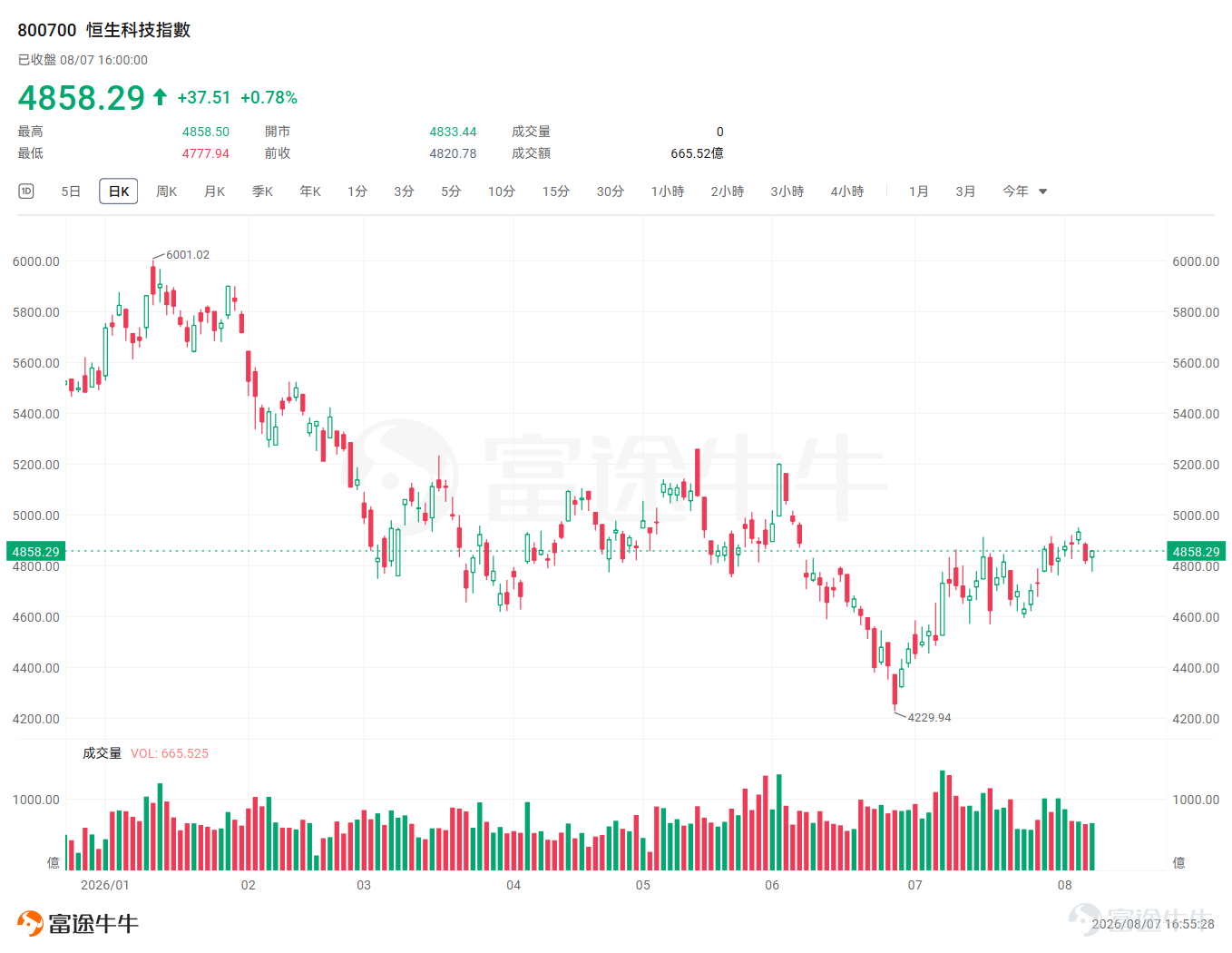
In the first half of the year, represented by technology stocks, $Hang Seng TECH Index (800700.HK)$continued to experience volatile weakness, declining nearly 19% cumulatively. In July, amid escalating Middle East tensions, rising U.S. Treasury yields, and a sharp sell-off in AI hardware-related stocks—three overlapping pressures—global tech equities entered a 'stampede' selloff. However, the Hang Seng Tech Index bucked the trend, posting an independent rally with a gain of approximately 8% over the month.

In August, as major tech and internet giants such as Tencent, JD.com, Alibaba, and Meituan release their earnings reports, market focus on China’s internet leaders has shifted from 'whether they will continue to face pressure' to 'whether they can further validate earnings recovery.' Institutions expect earnings among large internet firms to diverge further, with AIrevenue growth, profit margins, and capital expenditure becoming key focal points.
Based on market expectations, Futu News has compiled earnings forecasts for select popular Chinese tech and internet stocks for investors’ reference:

Next week, tech giant Tencent will be the first to report earnings on Wednesday (August 12), followed closely by JD.com, which will release its results on Thursday (August 13).
According to Bloomberg consensus estimates,$TENCENT (00700.HK)$ Q2 expected revenue stands at RMB 202.781 billion, up nearly 10% year-over-year; adjusted net profit is expected to reach RMB 68.1 billion, an increase of approximately 8% year-over-year.
Regarding gaming operations, Bloomberg consensus estimates Q2 revenue at approximately RMB 65.6 billion, up over 10% year-over-year, with domestic gaming revenue growing about 13% year-over-year, while overseas gaming growth slowed to around 5% year-over-year due to a high base effect.
Regarding advertising (marketing services), Bloomberg consensus expects Q2 revenue of approximately RMB 42.3 billion, up over 18% year-over-year, primarily driven by the strong momentum from the AI-powered ad placement platform (AIM+) and significantly improved ad conversion rates from WeChat Channels and WeChat Mini Stores' closed-loop transactions.
For fintech and enterprise services, Bloomberg consensus forecasts Q2 revenue exceeding RMB 60 billion, up over 8% year-over-year, with enterprise services revenue growth expected to surpass 20% year-over-year, and cloud services growth continuing to accelerate in the second half of the year.
$JD.com (JD.US)$ / $JD-SW (09618.HK)$Q2 revenue is expected to reach RMB 342.096 billion, down approximately 4% year-over-year; adjusted net profit is expected to be RMB 7.969 billion, up over 6% year-over-year.
Institutional estimates project JD.com's retail revenue in Q2 to decline by approximately 6% year-over-year. By category, electronics are expected to see a low double-digit percentage decline due to a high base effect from government subsidies last year and higher pricing for 3C products. Daily necessities and general merchandise are forecast to grow at a mid-single-digit rate year-over-year, slower than last quarter, impacted by a high base from last year’s instant retail performance and weaker overall social consumption and discretionary spending trends.
Food delivery is expected to further narrow losses sequentially in Q2, while losses from Jingxi and international businesses are projected to increase slightly quarter-over-quarter. Among new initiatives, food delivery losses in Q2 are expected to halve year-over-year and continue narrowing sequentially, supported by higher order volume compared to Q1—driven by increased commission and advertising revenue per order, along with optimized subsidies and fulfillment costs. For the full year, the food delivery business will maintain its prior strategic direction: sustaining healthy order growth while continuously reducing losses.
In addition,$BABA-W (09988.HK)$ / $Alibaba (BABA.US)$Revenue growth for the new fiscal quarter is expected to exceed 8%, benefiting from accelerated cloud business growth (approximately 45% year-over-year) and narrowing e-commerce losses; adjusted EBITA has bottomed out, core e-commerce margins are improving, and combined with AI asset revaluation, current valuations appear attractive.
– AI commercialization implementation:Empowering advertising, cloud services, and other businesses; monitor capital expenditures
AI-related revenue is expected to accelerate, as AI-driven enhancements across core businesses—including advertising, cloud computing, and enterprise services—are increasingly materializing.
Since July, domestic AI applications have been rolling out intensively: Alibaba launched its next-generation large model Qwen3.8, MiniMax open-sourced its H3 model, DeepSeek officially released V4-Flash, and Moonshot announced Kimi K3—the largest open-source model globally by parameter count to date. Domestic large models are undergoing rapid technical upgrades, narrowing the gap with global leaders, and accelerating the AI investment-to-monetization cycle.
From an industry trend perspective, large AI models are rapidly transitioning from the training phase to the inference and application phase. Internet platforms, as the core venue for AI application deployment, stand out within the tech sector for their high certainty of benefiting, with clear commercialization pathways in areas such as precision ad targeting, intelligent customer service, and content recommendation.
Currently, major tech companies are in a period of extraordinary investment in AI infrastructure. Cloud giants such as Amazon, Meta, and Google have significantly increased their capital expenditures, which has notably pressured near-term profit growth and free cash flow, prompting the market to closely scrutinize the balance between investment and returns. Regarding earnings reports from domestic large cloud providers such as Alibaba, Tencent, and Baidu,focus should be placed on operating cash flow and capital expenditure figures in their financial reports, as well as management’s guidance on full-year capital expenditures during earnings conference calls.
– Fundamentals and Profit Margins:Core businesses including e-commerce and local services, gaming, and advertising
E-commerce and local services: Revenue growth fluctuates in line with consumer recovery and competitive intensity. Market expectations have shifted from concerns over 'price wars and internal competition' toward improvements in unit economics (UE) and reduced losses. Leading players like Alibaba and Meituan have adopted more restrained subsidy strategies, enhancing earnings visibility and stabilizing the industry structure. Meituan is expected to report improved profitability in its latest fiscal quarter, with reduced competitive intensity in food delivery and on-demand services, and is projected to surpass RMB 100 billion in revenue for the first time in Q2, up approximately 10% year-over-year.
Gaming business:In the first half of the year, 917 domestic game licenses were issued, up 21.1% year-over-year. Domestic leaders have maintained steady growth by leveraging evergreen IPs and expanding into overseas markets. Analysts expect Tencent’s gaming segment to sustain overall year-over-year growth of around 10%, with the continued high issuance of game licenses further reinforcing earnings expectations.
Advertising business:Large AI models and intelligent ad-targeting tools have significantly improved advertising conversion rates, acting as the 'engine' driving both ad pricing power and scale. Inventory potential from channels such as WeChat Channels and search ads—led by Tencent—continues to materialize, supporting sustained double-digit growth in marketing services revenue.
Hardware and consumer electronics business: Certain device makers, such as Xiaomi, face near-term pressure on revenue and gross margins due to rising smartphone memory chip prices and an increased share of low-margin IoT products, pending marginal easing of cost pressures.
 AI breaks down earnings highlights in seconds—set up in three stepsOptions strategies! Open Futubull > Stock page > Tap [Company] >Earnings Flash
Risk Disclaimer: The above content only represents the author's view. It does not represent any position or investment advice of Futu. Futu makes no representation or warranty.Read more


Comments
to post a comment
4
1