NEBIUS and CoreWeave raise prices: Is the surge in AI computing demand here to stay?

Daily Options Income Strategy | AI Catalyst Drives Shopify’s Earnings Far Beyond Expectations! How to Capture the Generational Opportunity in the Leading E-commerce SaaS Company?
I. Market Barometer
On the previous trading day (2026-08-05), the three major U.S. indices diverged: the Dow Jones rose 263 points to a new all-time high, while the Nasdaq declined for the first time in five days. Shopify released its Q2 FY2026 earnings report, which significantly beat expectations across the board. The stock surged more than 20% intraday and closed up nearly 17%, offering options sellers a rare premium window amid heightened volatility.
II. Watchlist Highlights
SHOP: Earnings beat across the board, e-commerce SaaS leader surges nearly 17% in a single day
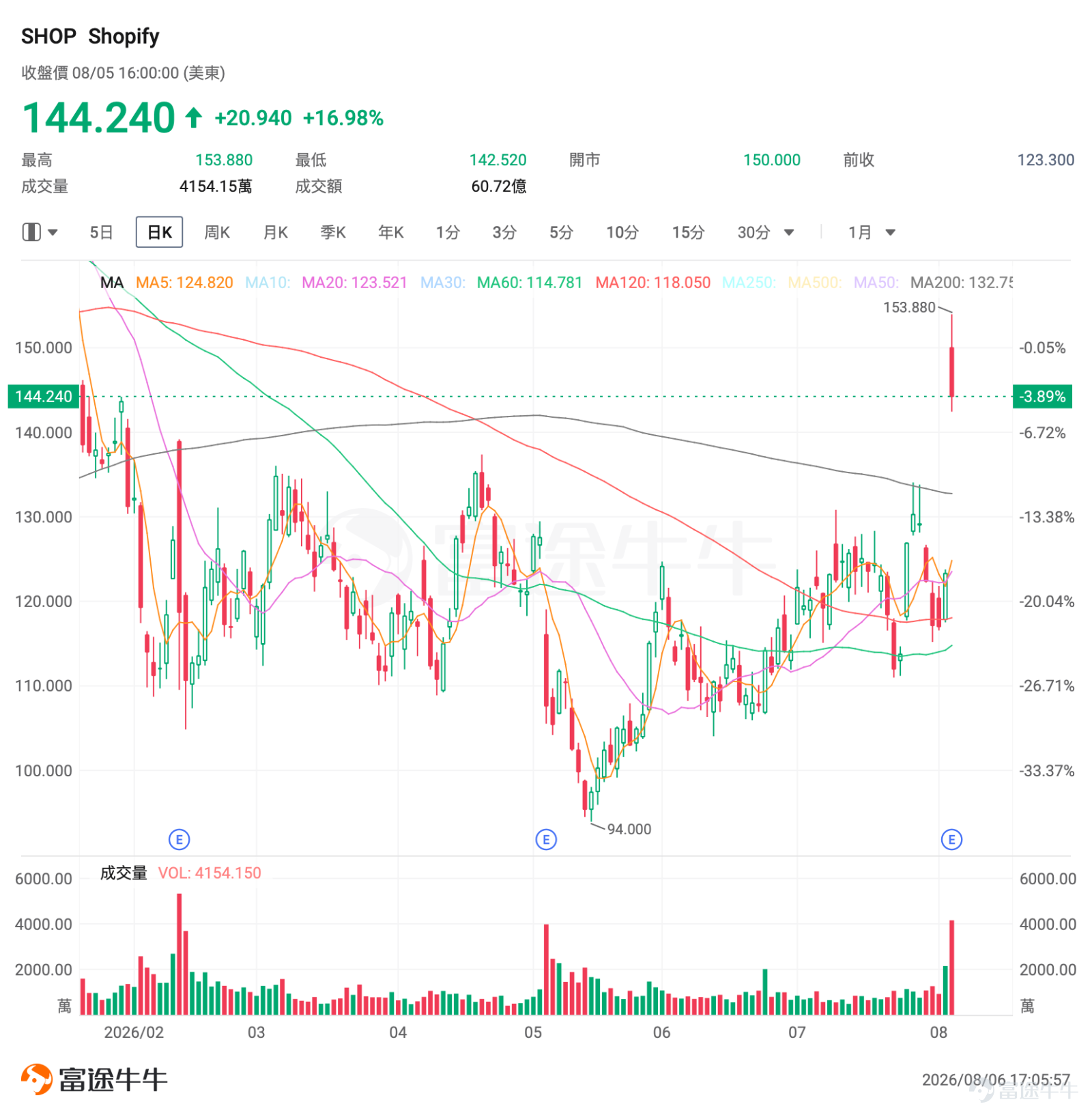
$Shopify (SHOP.US)$ The stock rose 16.98% in the previous trading session, closing at $144.24, hitting an intraday high of $153.88, with a trading volume of $6.072 billion and a volume ratio of 3.30, indicating significant capital inflows.

From a technical perspective, SHOP had been consolidating in the $117–$124 range before gapping up sharply to open at $150 on August 5, then pulling back intraday to close at $144.24, forming a candlestick with a long upper shadow.The current share price has decisively broken through the previous high’s dense trading zone ($135–$137), placing it in a strong short-term breakout position.However, the nearly 17% single-day gain combined with the intraday pullback from highs suggests that short-term profit-taking pressure cannot be ignored.
Fundamentally, the core driver behind SHOP’s surge is its fiscal Q2 2026 earnings report, which significantly exceeded expectations across all key metrics.In Q2, the company reported revenue of $3.583 billion, up 33.69% year-over-year, substantially surpassing the market expectation of $3.442 billion; EPS reached $1.16, surging 68.12% year-over-year—nearly four times the market consensus of $0.306; net income came in at $1.502 billion, up 65.78% year-over-year, far exceeding the expected $404 million.
These results comprehensively validate Shopify’s robust growth momentum in the e-commerce SaaS space—not only maintaining revenue growth above 30%, but also achieving a qualitative leap in profitability.
The AI-powered narrative received its strongest validation yet, with AI-driven conversion efficiency showing marked improvement.The Q2 earnings call disclosed several quantified AI-impact metrics: AI-driven traffic and order volume doubled year-over-year; new buyer order rates from AI channels were approximately double those from other channels; AI search powered by Catalog achieved twice the conversion rate of crawler-based data; Sidekick AI assistant’s daily active merchants grew 3.6-fold year-over-year, handling nearly 34 million conversations in Q2, creating over 36,000 custom apps, and increasing the share of new merchants achieving five orders within 15 days by 8%.
In addition, Shopify President Harley Finkelstein publicly stated that AI is ushering in a 'golden age of entrepreneurship,' implying that the company's AI tools are accelerating merchant growth and platform monetization, further reinforcing market confidence in its long-term growth narrative.
Among analyst opinions, 93.75% of the 16 covering analysts have issued a 'Strong Buy' rating, with an average price target of $156.37 and a high target of $192. Following the earnings release, multiple institutions swiftly raised their price targets: JPMorgan increased its target from $175 to $185, Jefferies raised its target from $160 to $175, and Evercore ISI lifted its target from $135 to $175.
3. Options Premium Collection Strategy
1. Cash Secured Put
Sell 1 SHOP 260814 129P, estimated margin requirement (for reference only): $12,900

Opportunity Rationale:
For investors who agree with $Shopify (SHOP.US)$ the long-term thesis of AI-powered e-commerce but have not yet established a position, the stock has already surged to $144 following the earnings catalyst, increasing the risk of chasing prices in the short term.
However, solid fundamentals—including Q2 results that beat expectations across the board and AI-driven order conversion efficiency doubling—provide strong support. By selling put options, investors can collect premium income in the current high implied volatility environment if the stock consolidates at current elevated levels or continues to rise; if the price pulls back due to short-term profit-taking, they may also get the opportunity to establish a position at a more attractive price.
2. Covered Call
Hold 100 shares, sell 1 SHOP 260807 150C

Opportunity Rationale:
For investors who already hold Shopify and have accumulated unrealized gains, the stock has surged to $144 following the earnings catalyst, creating a need for technical consolidation after such a rapid short-term move. Although Q3 guidance is optimistic, it remains to be validated whether AI’s continued赋能 (enablement) holds up and how macro consumer trends evolve.
Investors who are bullish on the company's long-term competitiveness in the AI-era e-commerce SaaS space but concerned about a potential technical pullback after the recent overbought rally could consider selling call options. If the stock consolidates sideways near current highs, the option premium would help lower the cost basis; if the stock subsequently breaks above $150 and gets assigned, it effectively achieves a staged profit-taking exit at a key resistance level.
IV. Risk Management Advisory
Although seller strategies have a high win rate, investors must still implement proper risk management:
– Position management is everything.: The biggest risk for option sellers lies in black swan events. It is recommended that margin allocated to any single underlying should not exceed 20% of total capital. Never sell options beyond your capacity to absorb losses just for the sake of collecting higher premiums.
– Covered Call and Timely Rolling: When a covered call becomes deeply in-the-money (i.e., the stock price far exceeds the strike price), if you remain bullish on the underlying stock, you should decisively 'roll' the position—buy to close the current option and simultaneously sell a longer-dated call with a higher strike price—to avoid having your shares called away at an unattractive price.
– Cash-secured put options: Beware of 'left-tail risk': For cash-secured puts, if the stock price crashes due to fundamental deterioration (rather than a normal pullback), don’t hold on stubbornly. In such cases, exit with a stop-loss or roll the position down to buy time while waiting for volatility to normalize.
Make good use of the Options Seller Hub to understand income strategies for selling options and earnOption premiums!

Options Risk Disclosure
An option is a contract that gives the holder the right—but not the obligation—to buy or sell an underlying asset at a predetermined price on or before a specified date. Option prices are influenced by multiple factors, including the current price of the underlying asset, the strike price, time to expiration, and implied volatility. Implied volatility reflects the market's expectation of future volatility over the life of the option and is derived by back-solving from the Black-Scholes option pricing model. It is commonly viewed as an indicator of market sentiment. When investors anticipate higher volatility, they may be willing to pay more for options to hedge their risk, leading to higher implied volatility. Traders and investors use implied volatility to assess the attractiveness of option prices, identify potential mispricings, and manage risk exposure.
Disclaimer
This content does not constitute an offer, solicitation, recommendation, advice, opinion, or any guarantee regarding any securities, financial products, or instruments. The risk of loss in trading options can be substantial. In certain circumstances, your losses may exceed the initial margin deposit. Even if you place contingent orders, such as 'stop-loss' or 'limit' orders, there is no guarantee they will prevent losses. Market conditions may render such orders unexecutable. You may be required to deposit additional margin on short notice. If you fail to meet the required margin within the specified timeframe, your open positions may be liquidated. Nevertheless, you remain fully responsible for any resulting deficit in your account. Therefore, prior to trading options, you should thoroughly study and understand options and carefully consider whether such trading aligns with your financial situation and investment objectives. If you trade options, you should become familiar with the procedures for exercising options and handling expiration, as well as your rights and obligations upon exercise or expiration. Options trading involves substantial risk and is not suitable for all investors. Investors should carefully read 'Characteristics and Risks of Standardized Options' before engaging in any options trading strategy.
Risk Disclaimer: The above content only represents the author's view. It does not represent any position or investment advice of Futu. Futu makes no representation or warranty.Read more

Comments
to post a comment
18
9