HBM shortages drive up chip prices: Is the memory supercycle continuing?

Hot Topic in 5 Minutes | SanDisk and Western Digital Plunge After Earnings—Has the Storage 'Super Cycle' Peaked?
After US market hours last night (August 5), the two storage giants $SanDisk (SNDK.US)$ and $Western Digital (WDC.US)$ jointly released their Q4 fiscal year 2026 results (corresponding to calendar Q2).
Both reported stellar earnings—revenue, gross margin, and EPS all beat expectations—yet both stocks plunged in after-hours trading: SanDisk dropped over 8% at one point, and Western Digital fell more than 11%.Today in Asia-Pacific markets, South Korea's KOSPI fell over 4%, $SK Hynix (000660.KR)$ and $Kioxia Holdings (285A.JP)$ both down more than 10%, $Samsung Electronics (005930.KR)$ and another down over 6%.
It’s that familiar pattern again: great earnings, terrible stock price.What’s really going on? Has this storage 'super cycle' run its course? Sharp-eyed fellow investors may have noticed that the hot $CSOP SK Hynix Daily Max (2x) Leveraged Product (07709.HK)$ What does today's name change signify?
The market doesn't want 'good'—it wants 'better.'
Looking at the numbers first, both companies delivered quite impressive results.
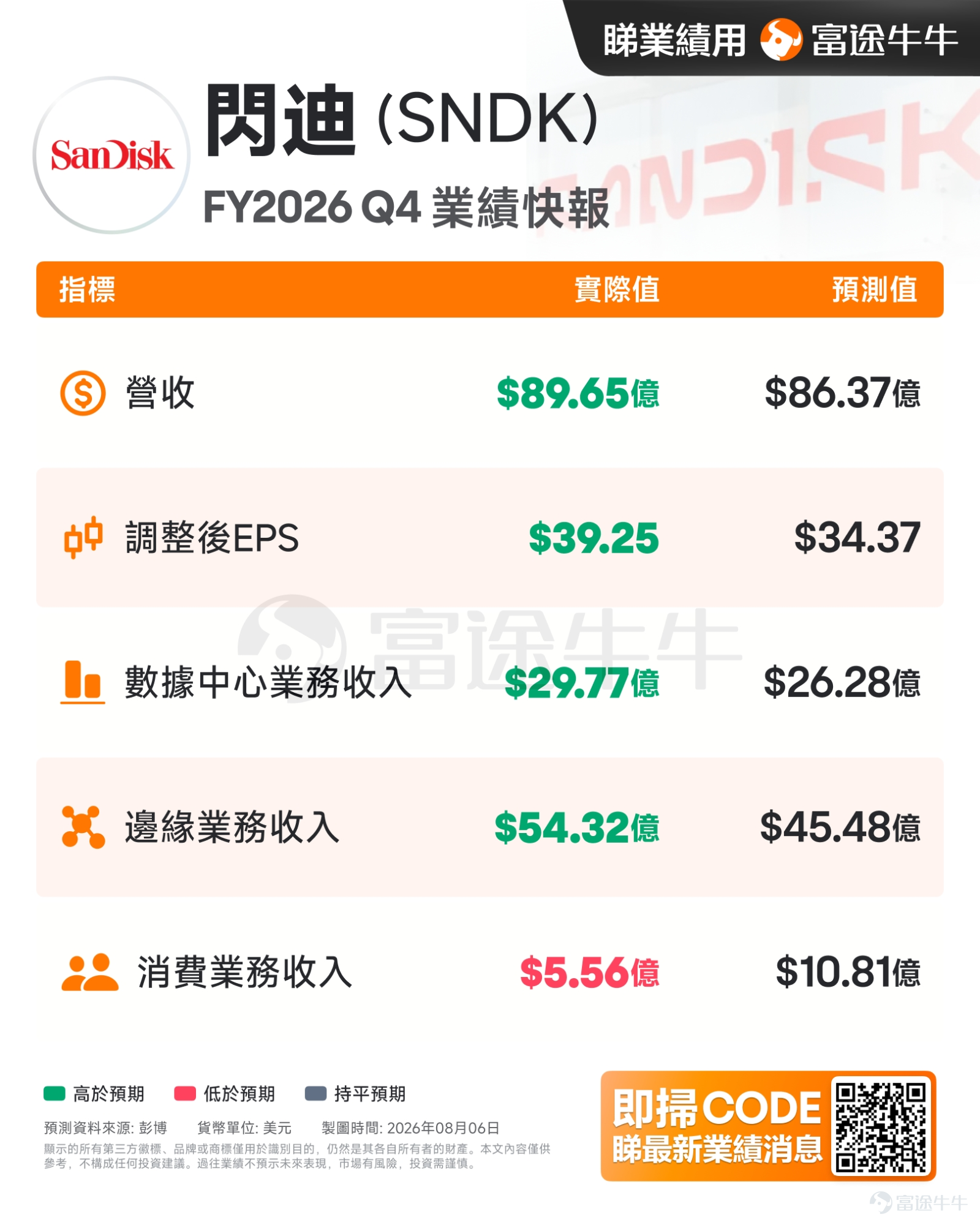
SanDisk (Q4 of fiscal year 2026, ended June 30): Revenue came in at $8.97 billion, a staggering 372% year-over-year increase, surpassing the market expectation of $8.39 billion; gross margin was 84.6%; adjusted EPS was $39.25, about 10% higher than expected. Even more significantly, the board approved$14 billion share repurchase program。

Western Digital (fiscal year aligned with SanDisk): Revenue of $3.75 billion, up 44% YoY, slightly above expectations; gross margin of 54.4%, about 2 percentage points higher than expected; adjusted EPS of $3.56, also beating expectations.
The issue lies in the guidance. SanDisk provided Q1 FY2027 revenue guidance midpoint of $10.55 billion—below market expectations of $10.8 billion or higher; gross margin guidance midpoint of 84%, versus market expectations of 86.7%.Western Digital’s guidance midpoint is $4.1 billion, roughly in line with market expectations ($4.04 billion), but the market wanted a 'surprise,' not just 'meeting expectations.'
Both companies delivered strong results, but the market has already positioned memory/storage as the sexiest AI-related sector, with sky-high expectations—so if you don’t beat expectations, you’re seen as 'missing.'
SanDisk’s circle: Western Digital is its 'mother,' Kioxia is its 'sibling,' and SK Hynix is its new ally.
Many investors new to the memory/storage space may be confused about the relationships among the major players. Here, we’ll use SanDisk as the focal point to clarify how these storage giants are intricately connected.
SanDisk’s 'mother' is Western Digital. On February 21, 2025, Western Digital spun off its NAND Flash business, and SanDisk relisted as an independent company on the Nasdaq under the ticker SNDK.That’s why their earnings reports have recently always been released on the same day—their fiscal years and quarters are fully synchronized, and even their guidance styles are similar. But note: today’s SanDisk and Western Digital no longer have significant ties (Western Digital has gradually divested its SanDisk stake); only the historical 'parent-child' connection remains.
SanDisk's 'brother' is Kioxia. This relationship goes back even further—Kioxia was formerly Toshiba Memory. Back then, SanDisk and Toshiba jointly established fabrication plants, operating several joint venture wafer fabs in Yokkaichi and Kitakami, Japan, with SanDisk holding approximately a 49% stake. The two companies were not only shareholders but also major customers of each other, with Kioxia supplying large volumes of NAND wafers to SanDisk.Their cooperative relationship remains very close to this day.Thus, when SanDisk plunged after hours, Kioxia dropped nearly 10% today—the two companies have always been 'eating from the same pot.'
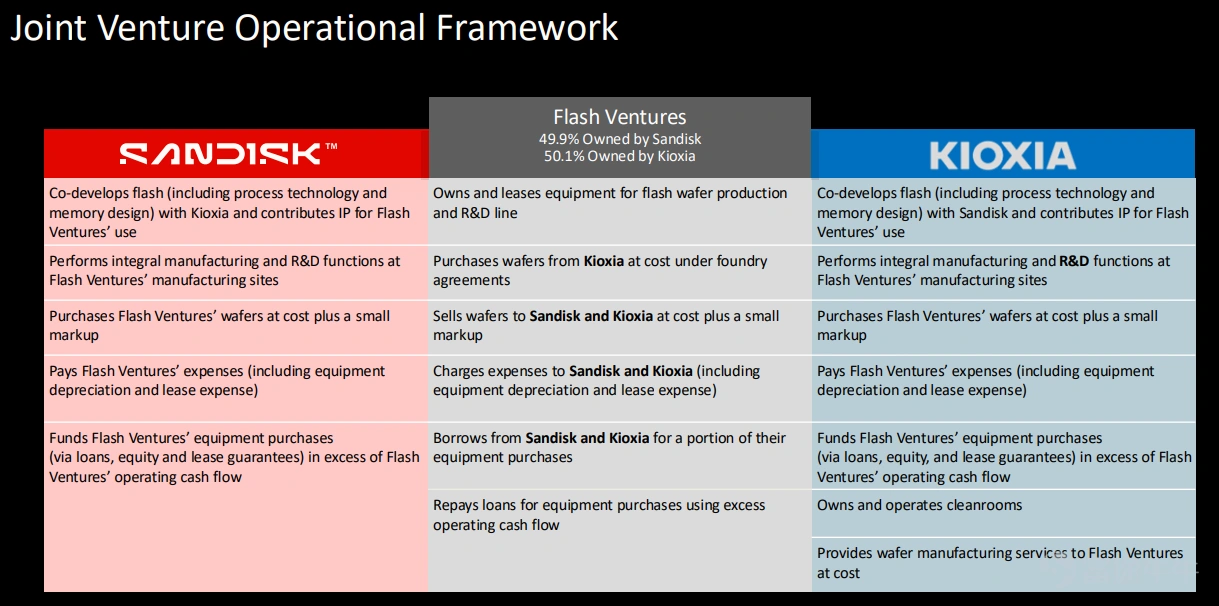
Image source: SanDisk
SanDisk’s new ally is SK Hynix. Just one day before its earnings announcement (August 4), at the Flash Memory Summit (FMS) 2026 held in California, USA,SK Hynix and SanDisk jointly unveiled the first specification standard for High Bandwidth Flash (HBF),with tech giants like Google also joining the alliance.
What is HBF? Think of it as a 'new storage tier between HBM and SSD': it offers significantly higher bandwidth than SSDs, while being cheaper and higher-capacity than HBM, specifically designed to address the 'memory wall' bottleneck in the AI era. This marks a new piece in the AI storage landscape—previously, SK Hynix dominated the HBM market (with roughly 58% market share), while SanDisk shared NAND production capacity with Kioxia. Now, by jointly defining the next-generation AI storage standard, the two companies are securing an early strategic position.
However, HBF is still in the early stages of industrialization and has not yet achieved mass production at scale. According to industry forecasts,commercial applications of HBF are expected to begin between late 2027 and early 2028.
The trend of rising volume and prices remains unchanged; what has shifted is market expectations.
After the earnings sell-off, many investors’ immediate reaction was, 'Has the memory market peaked?'Yet the industry is still right in the middle of its strongest price rally cycle in history.
Prices surged sharply in the first half of 2026, with Q1 increases of 90%–95% and Q2 exceeding 60%. Driven by renewed spot market strength, Q3 and Q4 are each expected to see price increases of over 20%. In 2027, supply-demand tightness is expected to persist, pushing average selling prices (ASPs) up another 20%–30%. Moreover, amid heightened AI-driven customization and shortage concerns, long-term agreements could account for 30%–40% of the overall DRAM market.
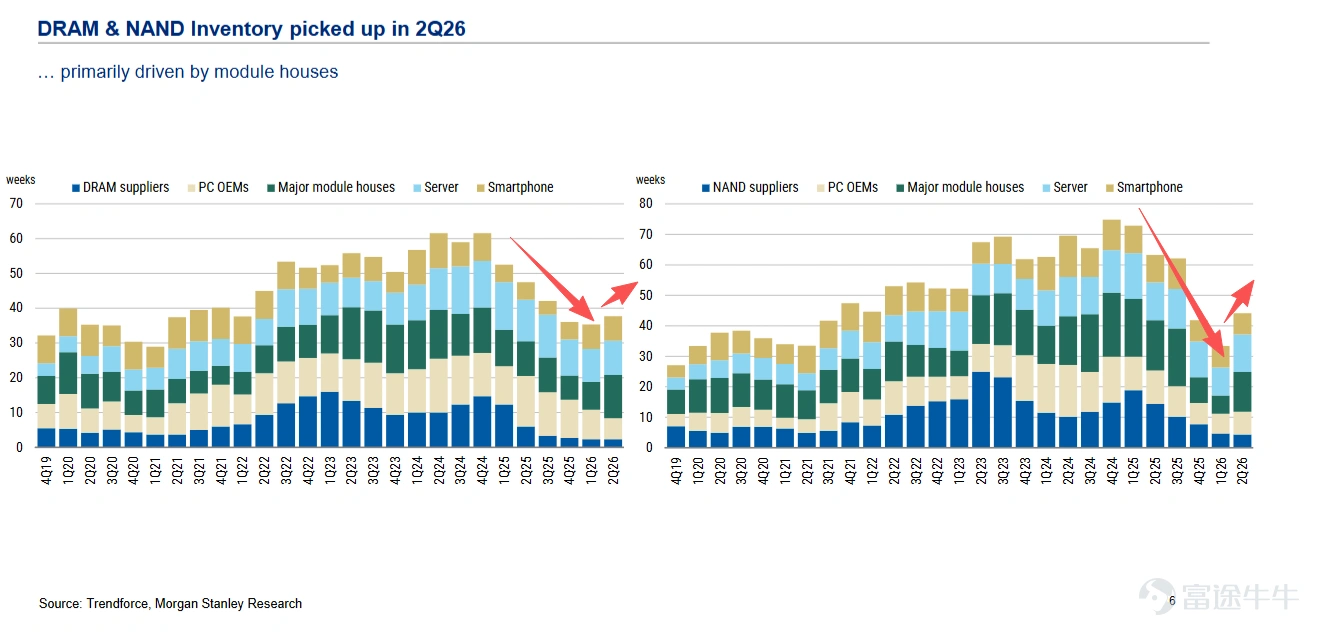
However, there have recently been some differing views in the market. Morgan Stanley believes that although the cycle is lengthening rather than collapsing immediately, momentum is slowing—the 'second derivative' of prices, or the rate of price increases, is decelerating. In addition, in Q2 2026, after multiple quarters of inventory drawdowns, there are early signs of a slight reversal, with both DRAM and NAND inventories rising, primarily driven by module makers.
However, these developments do not currently confirm a turning point in the industry cycle(prices are rising more slowly but still rising; inventories have not yet built up significantly), and investors should closely monitor whether these indicators deteriorate significantly in the future.
Let’s return to the capital markets—SanDisk and Western Digital both delivered strong quarterly results, so why did their stocks plunge after hours? We actually discussed this issue early in Q2 earnings season; fellow investors interested can revisit that discussion~
For a sector like memory storage—one that the entire market closely watches and has already seen massive gains (even after the July pullback)—stock prices trade more on 'expectations' than on 'current reality.'
In this environment, merely 'meeting expectations' isn’t enough—The market demands consistent outperformance to justify current valuations.Even forward guidance that is merely 'in line with expectations,' rather than 'significantly exceeding them,' gets interpreted as a signal of marginally slowing growth—especially since neither company’s outlook satisfied the market’s appetite.
Think of it this way: a student who consistently scores above 95 on exams leads everyone to expect a 98 next time. But if he says his next score will be at most 96—still an excellent absolute result—that 2-point shortfall below expectations is enough to crack the 'myth narrative.' That’s exactly where memory stocks stand right now.
However, there’s another key supportive variable for the sector:The memory industry is shifting from 'cash-burning capacity expansion' to 'shareholder returns.'
铠侠 announced a massive share buyback plan of up to JPY 800 billion (approximately USD 5 billion) at the end of July, targeting a total shareholder return of around 50%. Meanwhile, SanDisk has also just unveiled a significant repurchase program. Following SK Hynix's U.S. listing, the company is currently in a quiet period, and the market widely expects it to announce an epic shareholder return plan by late August or early September, with some institutions forecasting an initial buyback of approximately USD 8.5 billion.
Driven by AI, these companies are experiencing explosive free cash flow growth, and the peak of their capital expenditure cycle hasn’t even arrived yet—so that cash has to go somewhere—Buybacks plus dividends could become the main driver supporting the sector in the next phase.
7709 has been renamed, but it’s still mostly 2x.
Finally, let’s address something many fellow investors are concerned about: $CSOP SK Hynix Daily Max (2x) Leveraged Product (07709.HK)$ It is one of the world’s first leveraged ETFs tracking individual Korean stocks, launched by CSOP Asset Management in Hong Kong in October 2025. At its peak, it became the largest exchange-traded product on the Hong Kong Stock Exchange, with assets surpassing HK$130 billion—overtaking Tracker Fund of Hong Kong (TraHK).
In July alone, it went through a hellish rollercoaster: its net asset value dropped more than 80% from its high, and its assets evaporated by over HK$100 billion in a single month. On July 31, when Korean equities staged a sharp rebound, the ETF surged 67% in a single day (with an exaggerated ‘fat-finger’ spike at market open).
Starting this week, the product has switched from a 'fixed 2x leverage' to a 'flexible leverage' model, and its name now includes the phrase 'up to (2x)'.This change follows the updated regulatory framework for leveraged and inverse products issued by the Securities and Futures Commission (SFC) of Hong Kong on July 24: fund managers can now announce the applicable leverage ratio for the next trading day after each market close, with an upper limit of 2x but potentially lower during extreme market conditions.
In plain terms:The name has changed, but under most normal market conditions, it still operates at 2x, so your existing '2x response strategy' remains largely applicable—estimate NAV movements based on twice the underlying stock’s volatility. Just remember:
Leverage multiples are not fixed commitments; under extreme market conditions, 'deleveraging' may occur, and actual returns could be lower than 2x;
It operates on a 'daily reset' mechanism, so holding for more than one day,compounding effects will amplify losses—especially evident in highly volatile markets with sharp swings—and it is unsuitable for long-term holding.
The essence of this recent decline isn’t that the 'fundamentals have changed,' but rather 'overly optimistic expectations + leveraged deleveraging.' Core fundamentals—such as rising volume and prices, tight supply-demand dynamics, and increased buybacks—are still intact and even strengthening. Precisely because of this, retail investors must clearly distinguish among three scenarios:Is this a 'price correction' (profit-taking after excessive gains), a 'liquidity washout' (forced liquidation of leveraged positions), or a 'fundamental reversal' (weakening demand and downward earnings revisions)?Currently, it appears more likely to be the first two.
As for how to respond: it’s a familiar refrain but worth repeating—don’t use leverage to chase storage plays; if you believe in the long-term thesis, don’t panic-sell high-quality assets; and keep dry powder ready to deploy gradually.
Risk Disclaimer: The above content only represents the author's view. It does not represent any position or investment advice of Futu. Futu makes no representation or warranty.Read more


Comments (33)
to post a comment
91
250