
Options Hub: SpaceX's second wave of lock-up expiration takes effect today! How should options strat
Bai Dao Options Mini-Class 04 | Long Call: A Small Saw Taking on a Big Tree—Can a Bicycle Become a Motorcycle?
Every Wednesday, 'The $100 Options Mini-Class' starts right on time. We begin with the fundamentals and focus on just one concept per episode. Fellow investors, follow along week by week—options really aren’t that hard.
In addition to the Wednesday mini-class, we also have 'Opportunity Pool' on Mondays to discuss potential trade ideas, and 'Weekly Recap' on Fridays to break down cases from the week—each of these three segments has its own focus, and they work even better when consumed together.Follow NiuNiu’s official account 'BaiDao Plays Options' so you never miss an update~
Want a piece of the action but can’t afford the underlying stock?
Fellow investors have probably all felt this way before: watching the 'undisputed AI leader,' $NVIDIA (NVDA.US)$ , itching to get involved in the AI wave yourself.
But here’s the problem—NVIDIA (NVDA) is trading at $211 per share. Buying 100 shares would cost over $20,000, which is a high barrier for many. Although U.S. stocks can be bought one share at a time, buying too few shares means gains won’t feel meaningful even if the price rises; buying too many could hurt your portfolio—and your nerves—if the stock pulls back.
Is there a way to use a small amount of capital to 'bet' on a big surge in a stock’s price?
Yes. That’s exactly what we’re going to talk about today—Long Call。
In this episode, we’ll use a concrete example to thoroughly explain the long call: what it is, how it makes money, the maximum possible loss, and when it’s most appropriate to use.
What is a long call? Think of it as a 'ticket to bet on upside potential.'
Let’s start with an analogy.
Suppose you’re bullish on a concert and believe tickets will skyrocket in price. However, regular tickets cost $10,000, and you don’t want to pay the full amount right now. So, you pay $200 to a scalper for a 'priority purchase right'—an agreement that gives you the option to buy one ticket at $1,000 one month from now.
One month later:
If ticket prices indeed surge to $2,000, you exercise your right, buy the ticket for $1,000, and immediately resell it for a net profit of $800 (after deducting the $200 premium).
If the concert turns out to be unpopular and ticket prices drop to $500, you simply let the option expire—you lose only the $200 premium.
A long call is essentially the stock market version of this 'priority purchase right'—you pay a small fee (the option premium) to acquire the right, but not the obligation, to buy the underlying stock at a predetermined price before a specified date.
Real-world example: How much can you earn with a $200 investment?
Let’s do a quick calculation using NVIDIA (NVDA).
NVDA is currently trading at $211 per share. Let's assume you believe it will rise above $240 next month.
(To make it easier for fellow investors to understand, we’re not using real-world option chains; instead, we’re illustrating with round-number option premiums.)
You open the option chain and buy one contract:
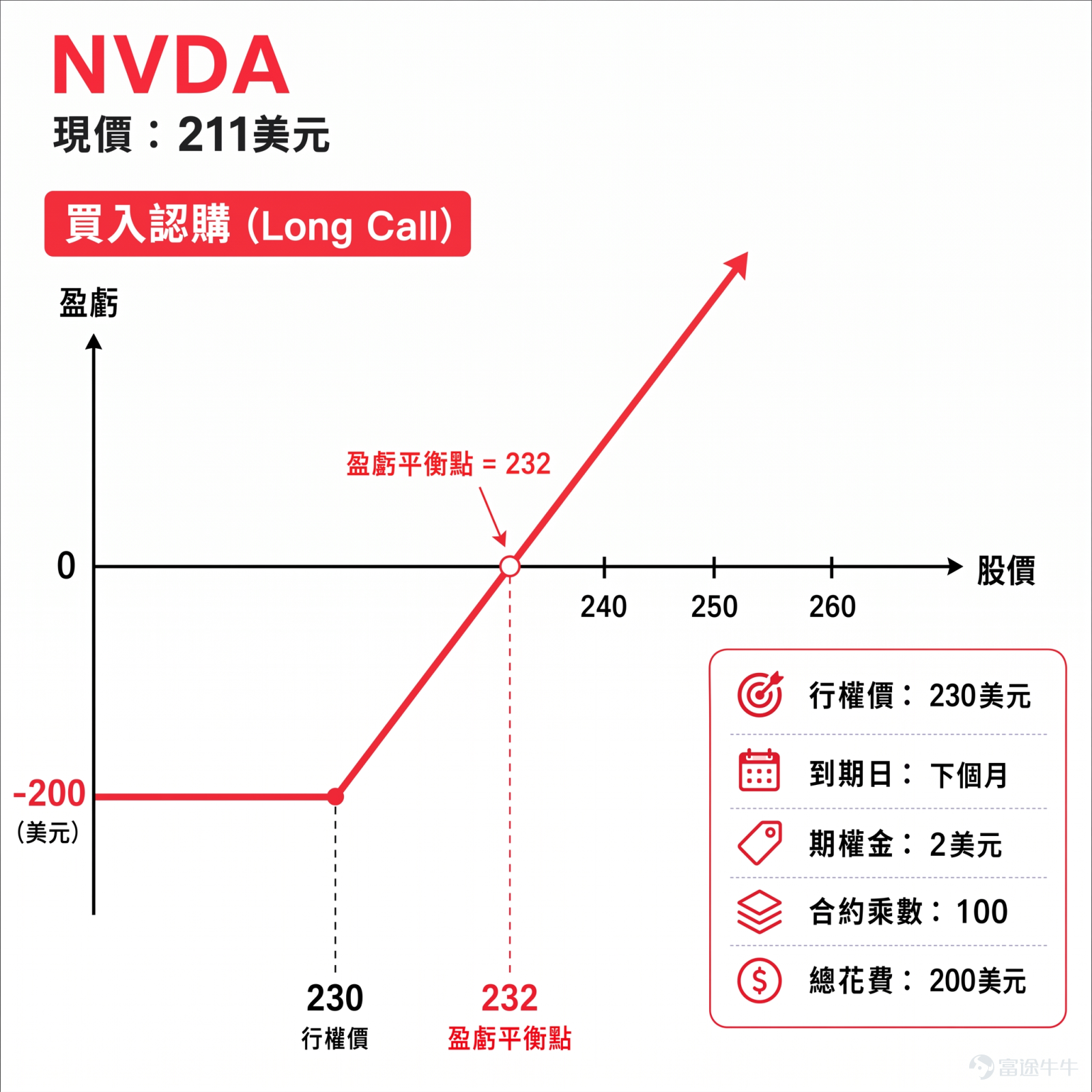
Strike price: $230
Expiration date: Next month
Option premium: $2
Contract multiplier: 100 (one option contract corresponds to 100 shares)
Total cost: $2 × 100 = 200 US dollars

Scenario 1: NVDA rises to $245
Your call option is now in the money. You have the right to buy at $230 and sell at the current market price of $245, earning $15 per share.
Profit calculation:
(245 - 230 - 2)× 100 = $1,300
You invested $200 and earned back $1,300, achieving a 650% return.
Scenario 2: NVIDIA doesn’t rise and remains at $211
Your option’s strike price is $230, but the stock price is only $211. Exercising the option would mean buying high and selling low—no one would do that.
So you choose not to exercise it, and this option expires worthless.
Loss:Maximum loss: $200(which is the premium you paid for the option)
Where is the breakeven point?
You bought a call option with a $230 strike price and paid a $2 premium. At what stock price do you start making real profit?
The answer is:$230 + $2 = $232
This is your 'breakeven point.'
Stock price below $232: loss (but maximum loss is capped at the $200 premium paid)
Stock price at $232: break even
Stock price above $232: starts generating profit, with higher prices yielding greater gains
Remember this rule: Breakeven point for a long call = strike price + premium. The stock price must rise above this level for you to profit.
A fellow investor might ask: What if NVIDIA’s stock doesn’t reach $245 until three months later, but the option expires in one month while the stock remains stuck around $210?
This is the most common pitfall for beginners.Your option has only a one-month expiration. Even if the stock eventually surges later, if it doesn’t rise above the strike price before expiration, your option will expire worthless.
Options are not stocks—they have an 'expiration date.' Even if your directional view is correct, if the timing is off, you’ll still lose money.
So when buying call options, besides estimating how much the stock price can rise, you also need to assess 'how soon it will rise.' If you think it’ll take three months for the stock to go up, don’t buy an option expiring in one month—either choose a longer-dated contract or simply wait and watch for now.
When is buying calls appropriate?
Now that we’ve clarified the mechanics, let’s summarize the use cases:
Three scenarios where buying calls makes sense:
You’re bullish on a significant short-term rally in a specific stock—Note: it has to be a 'big move.' A small increase might not even cover the premium paid for the option.
You want to risk a small amount of capital for potentially large returns—Rather than investing thousands of dollars upfront, you’d prefer to test the waters with just a hundred or two, keeping potential losses limited.
You want to add leverage to your position without borrowing money——Buying call options provides built-in leverage, yet losses are capped.
Situations where it's not suitable:
You're only 'mildly bullish' or think the stock will 'gradually rise'—Time is the enemy of option buyers; time value (which we’ll elaborate on later) decays every day.If the stock price doesn’t rise above the breakeven point before expiration, your option will steadily lose value and may eventually expire worthless.
Key takeaway
Buying a call (Long Call) = Paying a small premium for the right to buy the underlying stock at a predetermined price
Maximum loss = premium paid (limited); maximum gain = theoretically unlimited (profits increase as the stock rises)
Breakeven point = strike price + premium; the stock price must rise above this level to start generating profit
Suitable for investors expecting a sharp short-term rally and seeking leveraged exposure with limited capital
After finishing this session, fellow investors can try it out themselves:
Open Futubull → Find a stock you're watching → Tap 'Options' → Enter the options chain → Check the approximate premium for call options at different strike prices.
You'll find that for many stocks, you can open an options contract for just a couple of hundred dollars. You don't need to place a real order—just get a feel for 'If I bought this option and the stock price rose 10%, how much would I make?'
If you don't want to jump in with real money right away, you can first use Futubull's 'Paper Trading' feature to experience the full process—including placing orders, expiration, and exercise—with virtual funds. Once you're comfortable, you'll feel more confident trading with real capital.
Finally, a reminder: options involve leverage—while potential gains are amplified, so are risks. Use spare cash, start small, manage your position size carefully, and take it slow.
Finally, we’ve got a little perk for our fellow investors—feel free to claim it!Options Starter Pack~
*This promotion is exclusively available to invited Hong Kong users. Click to learn more.Detailed terms and conditions of the promotion >>

Disclaimer
This content does not constitute an offer, solicitation, recommendation, advice, opinion, or any form of guarantee regarding any securities, financial products, or instruments. Trading options carries substantial risk of loss. In certain scenarios, your losses may exceed the initial margin deposit. Even if you set contingency instructions such as 'stop-loss' or 'limit orders,' these may not necessarily prevent losses, as market conditions could render such instructions unexecutable. You may be required to deposit additional margin on short notice. If you fail to meet the margin call within the specified timeframe, your open positions may be liquidated. Nevertheless, you remain fully liable for any resulting deficit in your account. Therefore, prior to trading options, you should thoroughly study and understand options trading and carefully consider whether such trading aligns with your financial situation and investment objectives. If you do trade options, you must become familiar with the procedures, rights, and obligations associated with exercising options and their expiration.
Risk Disclaimer: The above content only represents the author's view. It does not represent any position or investment advice of Futu. Futu makes no representation or warranty.Read more


Comments (2)
to post a comment
25
21