
AMD: Record-high revenue, stellar earnings—but the stock price crashed
I stared at my screen three times last night just to make sure I wasn’t seeing things.
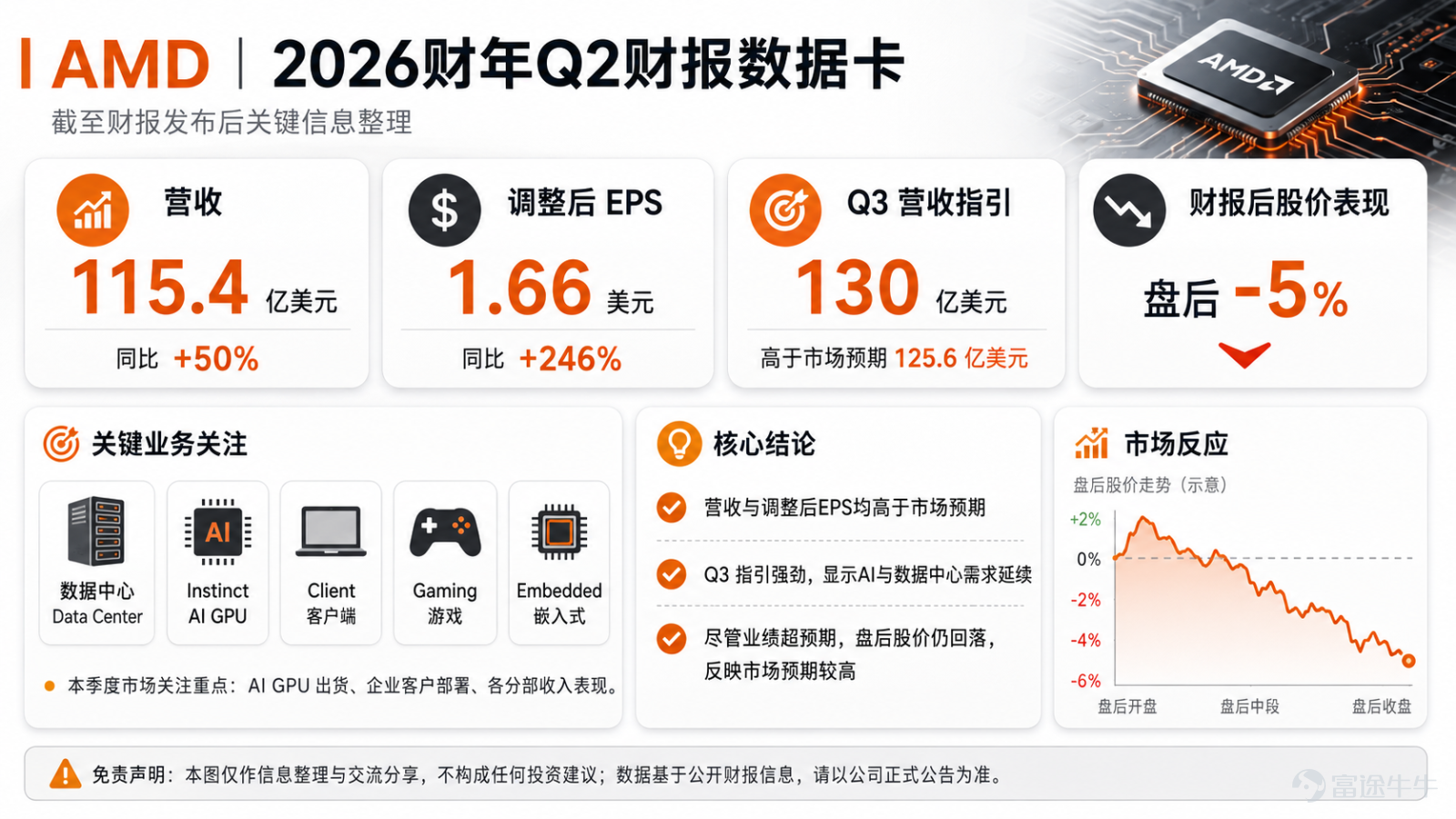
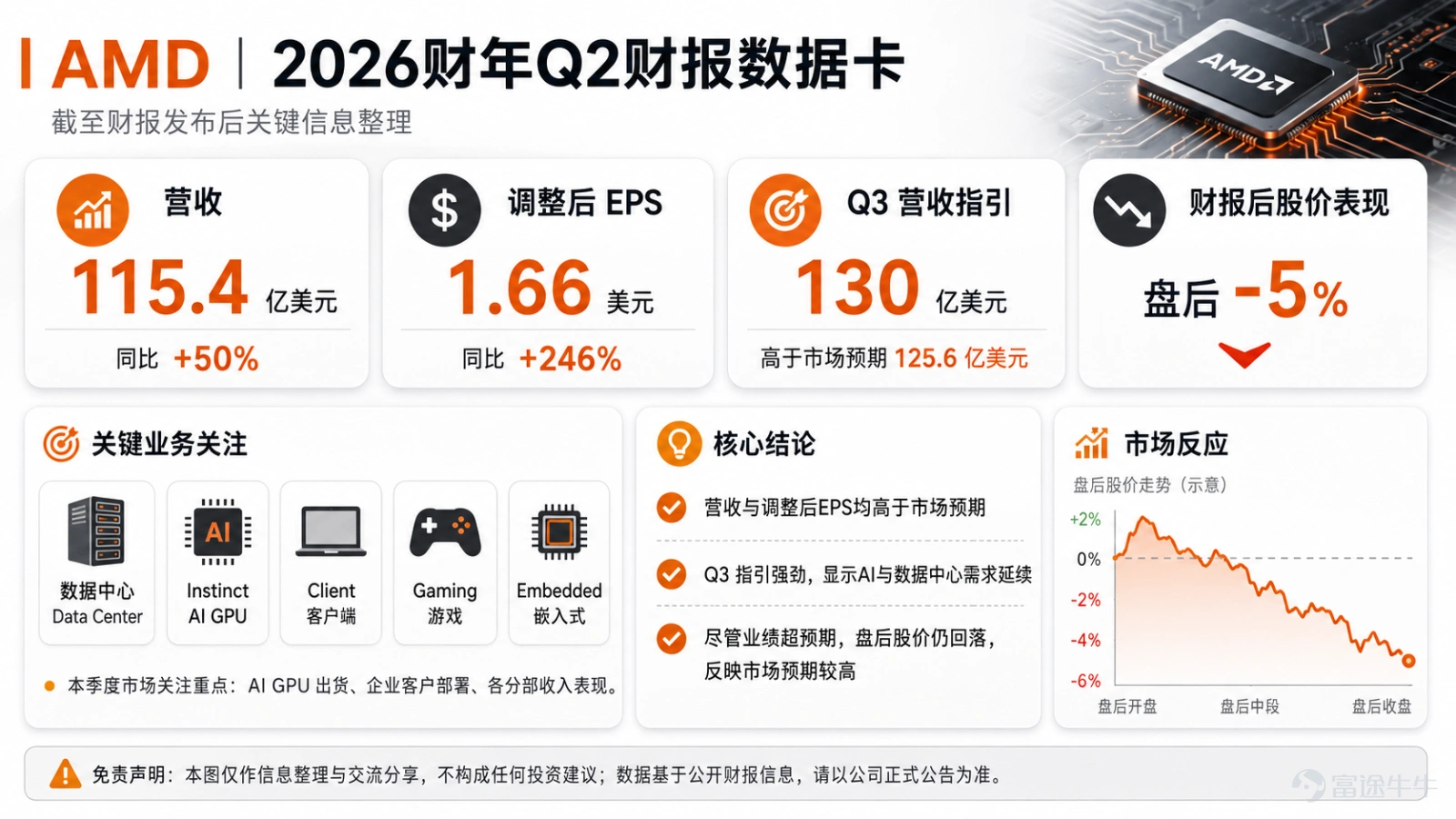
Revenue hit $11.54 billion, up 50% year-over-year—a record high. Earnings per share were $1.66, surging 246% year-over-year.Both figures beat expectations. The stock closed at $518.58, up 7%, with an intraday high of $530 and a low of $502—swinging 28 points throughout the day. That move alone was already wild enough. Then, after-hours trading sent it crashing straight down to $472.94, a drop of 8.8%.
Man, this rollercoaster dives straight from Mount Everest into the Mariana Trench. In a single day, AMD packed a year’s worth of price action into just 16 hours. One second you’re counting profits, the next you’re selling a kidney to cover your margin call.
Was the earnings report solid or not? In one sentence: solid enough to crack walnuts.
Data Center revenue hit $6.7 billion, soaring 107% year-over-year. EPYC server sales are flying off the shelves, and Instinct AI GPUs are shipping like crazy. Client PC revenue rose 23%.
Gross margin of 54%, net profit of $2.3 billion, surging 163%. Lisa Su stated directly: 'Revenue and profitability both reached record highs.'
Wall Street: Got it—time to dump the stock.
It’s like you aced your class exam, but when you got home, your dad glanced at your report card and slapped you: **'Why didn’t you get a perfect score?'**
AMD is now that kid—standing in the corner, completely numb.
Three questions—and each one is deadly.
First, where did all the money go? Capital expenditures came in at $808 million versus a market expectation of $298.6 million—nearly triple. AI infrastructure, manufacturing capacity, Instinct development. You call it investment in the future; Wall Street calls it reckless spending.
Second, guidance is $13 billion versus an expected $12.5 billion—it beat estimates. But a bunch of gamblers were betting on $14 billion. You scored 95; they expected 100. Five points short—and suddenly you’ve failed.
Third, the stock has doubled over the past year, with Wall Street issuing 36 buy ratings, 10 hold ratings, and zero sell ratings. When everyone is fully long and expecting something extraordinary, delivering merely 'excellent' gets you punished.
The technicals are even harsher.
Closing price at $518.58, barely holding above the 50-day moving average of $515. After-hours trading dropped to $472—plunging 46 points below the 50-day line.
The range between 546 and 555 has rejected the price four times in past rebounds. The all-time high of 584 now seems as distant as Mars.
Support levels are getting progressively weaker: 473 is the first line of defense, but after-hours trading has already dipped to 472. The next supports sit at 465/460. 424 marks the starting point of this V-shaped rebound.
Three scenarios ahead.
Bull case: If 472 holds, a bounce back to 510 could happen—only then can we talk about regaining footing. If it doesn’t hold? Run.
Bear case: If 472 breaks, the next targets are 460 → 450 → 430.
Most deceptive scenario: A fakeout rally up to 520 to trap retail investors, followed by a drop to 380–360.
One-sentence summary.
AMD isn’t bad—but it was born in NVIDIA’s era. The market leader takes all; the runner-up gets crumbs.
In this sector, growth alone isn’t enough—you need explosive momentum. Otherwise, even beating expectations just gives you a different way to get punished.
Wall Street, if you’ve got the guts, swap NVIDIA’s and AMD’s earnings results.

Risk Disclaimer: The above content only represents the author's view. It does not represent any position or investment advice of Futu. Futu makes no representation or warranty.Read more


Comments (2)
to post a comment
3
7