
What was your first ETF purchase?

The Great ETF Showdown | How to Pick U.S. AI ETFs? After Cloud Giants Rally and Hardware Chain Volatility, Which Segment Should You Buy?
Recently, the U.S. AI-related market has shown clear divergence.
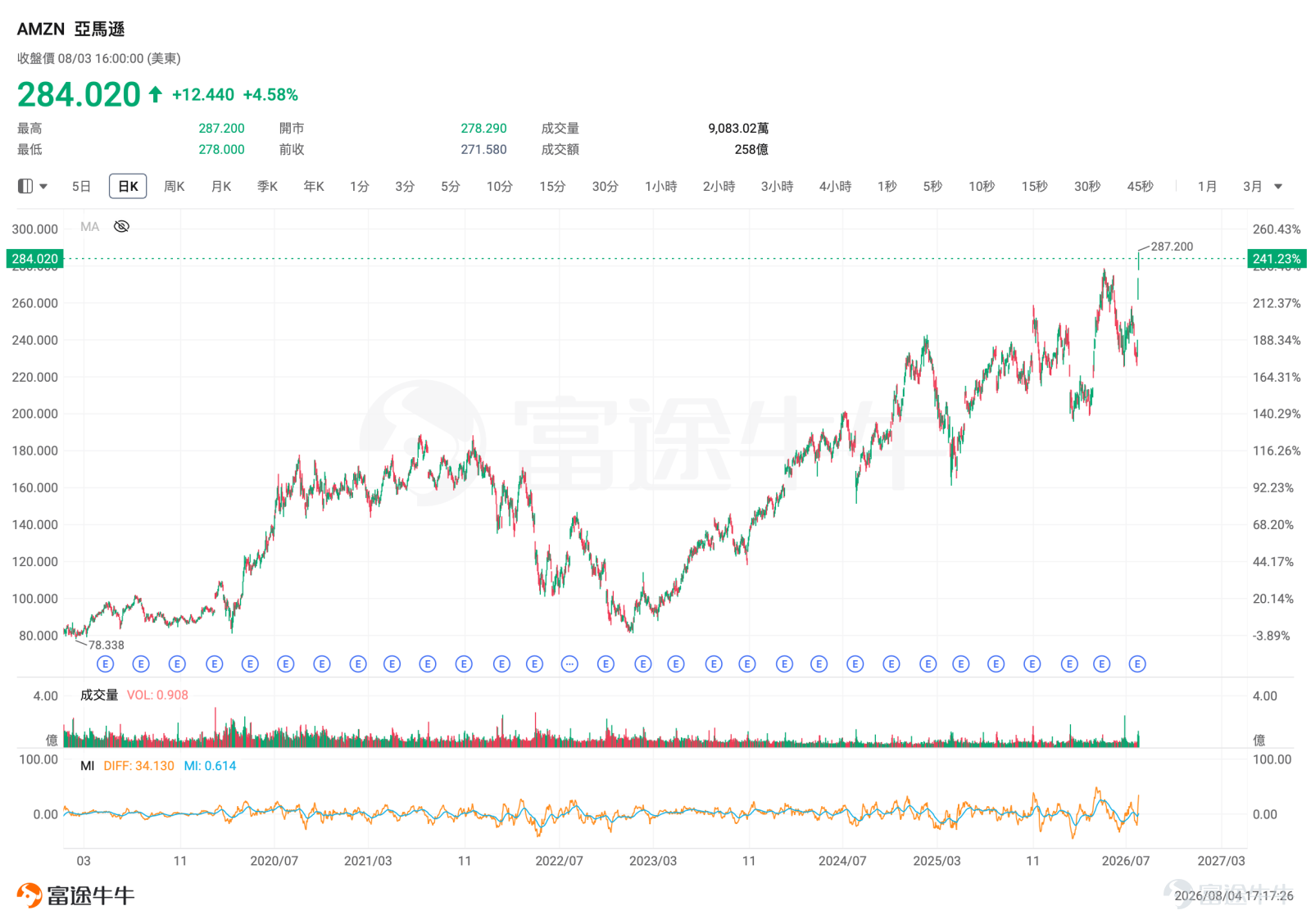
$Microsoft (MSFT.US)$、$Amazon (AMZN.US)$ Cloud giants have continued strengthening after reporting earnings, as the market increasingly recognizes the virtuous cycle among cloud revenue growth, monetization of AI services, and capital expenditures. Meanwhile, semiconductor, memory, and AI hardware stocks experienced significant volatility over the past month, prompting investors to reassess valuations, supply-demand cycles, and the sustainability of AI infrastructure spending.
The AI rally is still unfolding, but the market is gradually shifting toward comparison:Who can effectively convert AI investments into revenue and profits, and which sectors still offer room for earnings and valuation upside.
For fellow investors, this also makes ETF selection even more important.

Although all labeled as AI ETFs, some primarily hold Microsoft, Amazon, and Alphabet; others are heavily weighted toward $NVIDIA (NVDA.US)$ NVIDIA, Broadcom, and Taiwan Semiconductor; some focus exclusively on the memory segment, bundling HBM, DRAM, and NAND leaders into a single portfolio; while others bet on robotics and industrial automation.
These ETFs are not capturing the same AI opportunity, and they carry vastly different risk profiles. This article will help you break down how to choose U.S. AI-themed ETFs.
AI-related stocks are diverging—understand what you're buying before choosing an ETF
Since April, the most direct thesis behind AI-driven trades has been:Cloud giants are increasing capital expenditures, driving demand for GPUs, storage, semiconductor equipment, and optical communications.
However, as hardware stocks have accumulated significant gains, the market is now more focused on whether this capital spending will ultimately translate into revenue, profits, and cash flow. Recently, cloud giants have performed strongly after earnings precisely because cloud revenue and AI demand are starting to provide more concrete evidence of commercialization.
In contrast, although the hardware supply chain still offers high earnings elasticity, it is more sensitive to factors such as valuations, earnings visibility, and cyclicality. Therefore, when choosing an AI ETF today, the question shouldn't just be ‘Am I bullish on AI?’ but rather:
1. Am I bullish on AI commercialization by cloud giants, or on hardware demand?
2. Do I want exposure to the broader AI trend, or am I betting specifically on a particular bottleneck?
U.S.-listed AI ETFs can primarily be divided into four categories:
1. Cloud Giants and Tech Platforms
These products may not all be labeled as 'AI ETFs,' but they likely align most closely with recent market trading trends. Investors are buying into multiple revenue streams from large-cap tech companies, including: cloud revenue and enterprise AI services; monetization via advertising, e-commerce, and productivity tools; and long-term returns driven by massive capital expenditures.
$Roundhill Magnificent Seven ETF (MAGS.US)$ It features concentrated exposure to seven large-cap tech companies—Microsoft, Amazon, Alphabet, Meta, Apple, NVIDIA, and Tesla—offering clear positioning but also high concentration risk.
$Defiance AI Hyperscale Leaders ETF (AIHY.US)$ This is an actively managed ETF launched in July 2026, primarily investing in companies that build, operate, or benefit from AI hyperscale computing. Its initial holdings are heavily weighted toward platform giants like Microsoft, Amazon, Alphabet, and Meta, making it highly sensitive to the earnings performance of these cloud leaders.

However, AIHY is still a very new product, with limited fund size and secondary market liquidity at this stage. Before trading, investors should pay close attention to intraday trading volume, bid-ask spreads, and order execution prices—avoid jumping in solely because of its thematic appeal.
It’s worth noting that there remain significant differences among platform-focused ETFs. MAGS concentrates on the ‘Magnificent Seven’ tech stocks, whereas AIHY takes a more direct bet on cloud platforms and AI hyperscale computing infrastructure.
2. Broad AI Theme
$Alternative Investment Trust (AIQ.AU)$and $ROUNDHILL GENERATIVE AI & TECHNOLOGY ETF (CHAT.US)$ Better suited for investors who are bullish on AI’s long-term prospects but uncertain which segment—cloud platforms, semiconductors, storage, or software—will outperform.
These ETFs typically hold:
– Large-cap tech platforms;
– Semiconductor and storage companies;
– AI software and data companies;
– Networking, cloud services, and infrastructure companies.
However, broad-based AI exposure does not equate to low risk.
Some products may appear to hold a large number of stocks, yet their top ten holdings can still be heavily concentrated in large-cap tech and semiconductor companies. When expectations for AI-related capital expenditure decline, these holdings may all pull back simultaneously.

When comparing such products, focus on whether they are actively or passively managed, the number of holdings, the concentration in the top ten holdings, and the respective allocations to platforms, hardware, and software—rather than just comparing names.
3. Semiconductors and Hardware
$VanEck Semiconductor ETF (SMH.US)$ and $iShares Semiconductor ETF (SOXX.US)$ Although it doesn’t include 'AI' in its name, it is one of the most commonly used ETFs for gaining exposure to the AI capital expenditure cycle.
They typically cover:
– GPUs and AI accelerators;
– Wafer foundries;
– Memory chips;
– Networking and connectivity chips;
– Semiconductor equipment and materials.
SMH typically has a higher concentration in market leaders and is more sensitive to the performance of large companies such as NVIDIA, $Taiwan Semiconductor (TSM.US)$ 、$Broadcom (AVGO.US)$ while SOXX has a relatively more balanced portfolio, generally resulting in lower impact from any single company.
The advantages of these products include a longer track record, higher trading liquidity, and a direct link to AI infrastructure demand. However, when the market revises down capital expenditure, orders, or earnings expectations, valuations and share prices can adjust very quickly.
Semiconductor ETFs can diversify single-company risk but cannot eliminate volatility across the entire semiconductor cycle.
4. Segment Bottlenecks and the Next Phase
DRAM, EUV, BOTZ, and ROBO are better suited for expressing clear views on specific sub-segments.
$Roundhill Memory ETF (DRAM.US)$ It primarily invests in HBM, DRAM, NAND, SSD, and other memory-related companies, with the core thesis being that AI servers are driving demand for high-performance memory and that supply constraints create pricing and earnings upside.
$Corgi Lithography & Semiconductor Photonics ETF (EUV.US)$ Focuses on areas such as lithography, semiconductor equipment, inspection, optical components, silicon photonics, and optical communications—betting on key bottlenecks in advanced semiconductor processes and high-speed data transmission.
$Global X Robotics & Artificial Intelligence Thematic ETF (BOTZ.US)$ and $Humanoid Global Holdings Corp (ROBO.CA)$ Leans more toward robotics, industrial automation, autonomous driving, and Physical AI, with revenue sources that do not fully overlap with those of cloud platforms and AI chips.
These products are not simple substitutes for SMH; rather, they further narrow the investment scope. When the underlying thesis is correct, these specialized ETFs may offer higher upside potential; however, if industry conditions, technology roadmaps, or valuation expectations shift, drawdowns can also be more concentrated.
For most individual investors, specialized ETFs are better suited as complementary positions rather than the sole AI holding in a portfolio.

When selecting AI ETFs, individual investors should focus on four key considerations:
1. Clarify your own investment thesis first
Formulate your industry outlook before choosing an ETF. Don’t reverse-engineer a justification for buying simply because a fund has recently risen sharply.
2. Examine actual holdings—not just the fund’s name
Review at least the following four pieces of information:
– The largest holding and its weighting;
– Combined weighting of the top 10 holdings;
– Allocation across platforms, semiconductors, memory/storage, and software;
– Whether concentrated in the same country or the same industry cycle.
An ETF holding many companies does not necessarily imply diversified risk. If most of these companies rely on the same wave of AI-related capital spending, they could still decline together if market sentiment shifts.

3. Check for overlap with existing holdings
Many investors already hold QQQ, S&P 500 ETFs, Microsoft, Amazon, NVIDIA, or semiconductor ETFs.
Buying MAGS, AIQ, or CHAT on top of these may simply add more exposure to the same group of large-cap tech stocks and might not provide meaningful new sector exposure.
Before buying, ask yourself: Does this new ETF actually add exposure to cloud platforms, semiconductors, memory/storage, or robotics—or does it merely further concentrate your portfolio in tech stocks?
4. Finally, compare liquidity, fees, and market expectations
For newer funds such as AIHY, DRAM, and EUV, beyond their thematic focus, you should also specifically examine: whether daily trading volume is sufficient; whether bid-ask spreads are too wide; whether holdings are overly concentrated; and whether the market price significantly deviates from the fund’s net asset value (NAV).
Being correct about a niche sector doesn't mean any purchase price is reasonable. When a product lacks liquidity, even a correct directional call may result in higher effective trading costs due to wider bid-ask spreads and limited market depth.
Overall, we are bullish on cloud revenue and AI monetization,and you could consider ETFs focused on tech giants, such as MAGS or AIHY.; if you're bullish on sustained AI-driven capital expenditure boosting the hardware supply chain, you couldclosely compare SMH and SOXX.; if you favor niche segments like HBM, optical communications, or robotics, you coulduse ETFs such as DRAM, EUV, or BOTZ to express your view,though you’ll need to tolerate higher concentration and volatility.
ETFs can reduce single-stock uncertainty but cannot eliminate risks such as market downturns, valuation compression, industry cycles, or principal loss. Before investing, you should carefully review a fund’s holdings, fees, assets under management, and trading characteristics based on your investment horizon and risk tolerance.
The Futu Wealth Creation Conference on August 8, 2026, is coming soon! Join thousands offline to explore investment opportunities for the next decade together.
This event has invited multipleTop investment experts, renowned economists, and million-follower financial KOLs will be onsite to share wealth-building opportunities face-to-face.
Interested fellow investors canClick here to register and claim your ticket >>Seats are limited—first come, first served!

Risk Disclaimer: The above content only represents the author's view. It does not represent any position or investment advice of Futu. Futu makes no representation or warranty.Read more


Comment (1)
to post a comment
12
58