
Rumors swirl that top-tier PE firms are acquiring Workday! Could this trigger a valuation re-rating

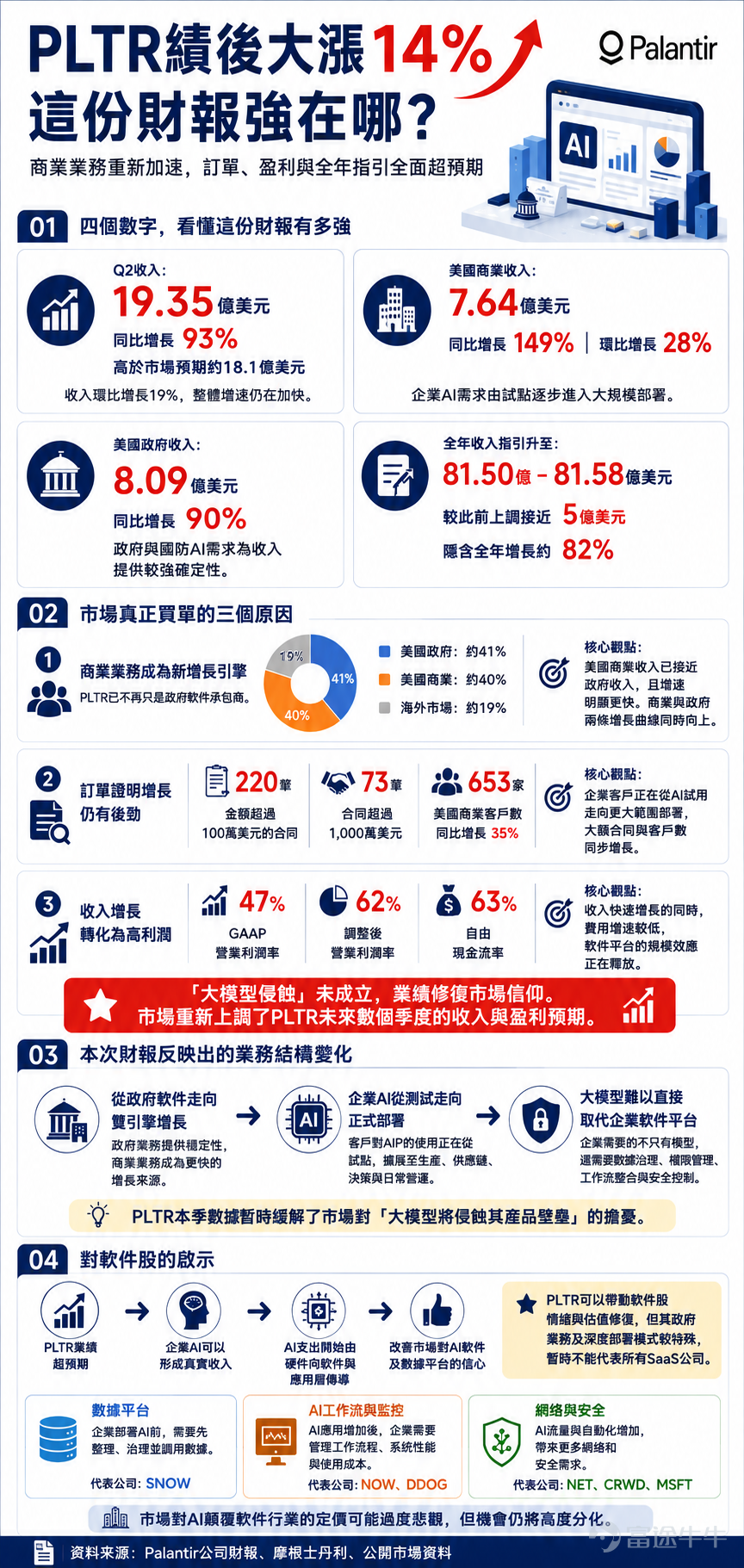
60-Second Infographic | PLTR Surges Over 14% Post-Earnings: Strong Results Silence Doubters—Can It Spark a Rally in Software Stocks? One Chart Explains the Logic Behind the Move
Yesterday $Palantir (PLTR.US)$ After announcing its second-quarter results, the stock price surged more than 14% in after-hours trading.
The immediate driver of this rally was that revenue, earnings, and guidance all exceeded market expectations.Beneath the surface, the momentum stems from the convergence of two key expectation gaps being corrected:First, U.S. commercial business—which had slightly cooled last quarter—reaccelerated; second, market concerns that large models and AI agents might erode Palantir's product moat were temporarily alleviated by this quarter's strong order and customer spending data.
Key highlights from this earnings report at a glance:
I. Why Did PLTR Surge? Earnings Restored Market Confidence
1. PLTR’s revenue mix is undergoing a significant shift
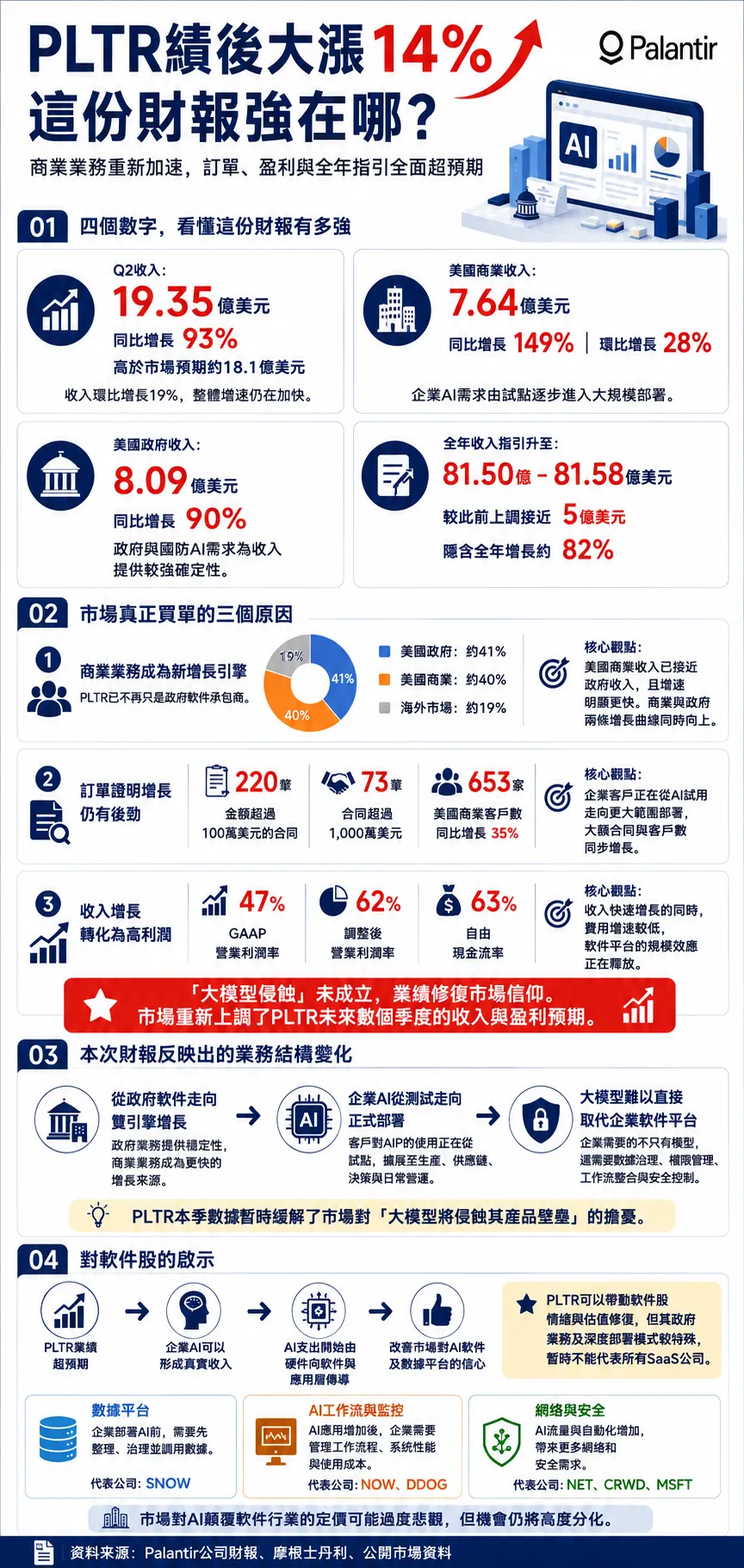
The company initially relied heavily on government and defense contracts, but U.S. commercial revenue is now nearly on par with government revenue. In Q2, U.S. commercial revenue reached $764 million, up 149% year-over-year and 28% quarter-over-quarter, while U.S. government revenue grew 90% to $809 million, becoming an even faster-growing engine.
Government business provides order stability, while commercial business unlocks greater growth potential; with both trajectories trending upward simultaneously, overall revenue visibility has improved.
2. Order data further confirms sustained growth momentum
Revenue is a lagging indicator; orders better reflect future growth.
The company signed 220 contracts in the quarter worth over $1 million each, including 73 exceeding $10 million. Its U.S. commercial customer count grew to 653, up 35% year-over-year. This indicates that enterprise clients are expanding their use of AIP from testing and pilots into core processes such as production, supply chain, and day-to-day operations.
The market had previously worried that large models and AI agents might erode the value of traditional software platforms. Palantir’s (PLTR) latest-quarter results have temporarily alleviated this concern.Enterprises need more than just models—they also require data governance, permission management, workflow integration, and security controls. These complex components form Palantir’s product moat.
3. Profitability is equally impressive.
The company reported a GAAP operating margin of 47%, an adjusted operating margin of 62%, and a free cash flow margin of 63%. As revenue grows rapidly, expense growth remains relatively low, demonstrating accelerating economies of scale from its software platform.
4. What truly drives a re-rating of the stock price is the upward revision of full-year guidance.
The company raised its full-year revenue guidance to $8.150–$8.158 billion, an increase of nearly $500 million from its prior outlook.Implied full-year revenue growth of approximately 82%. The market's core buying rationale has expanded from a single quarter's earnings beat to upward revisions in the revenue and profit trajectory for the next several quarters.
5. High expectations also bring high demands; the key point of divergence remains the elevated valuation.
High valuation means the company must consistently deliver results above expectations. Following the prior share price correction, Palantir’s valuation pressure has been somewhat alleviated.Based on current analyst consensus estimates, the market’s expectation for 2027 implies revenue of approximately $11.2 billion.Based on the pre-market price of $146, the forward price-to-sales (P/S) ratio for 2027 revenue is approximately 30x.
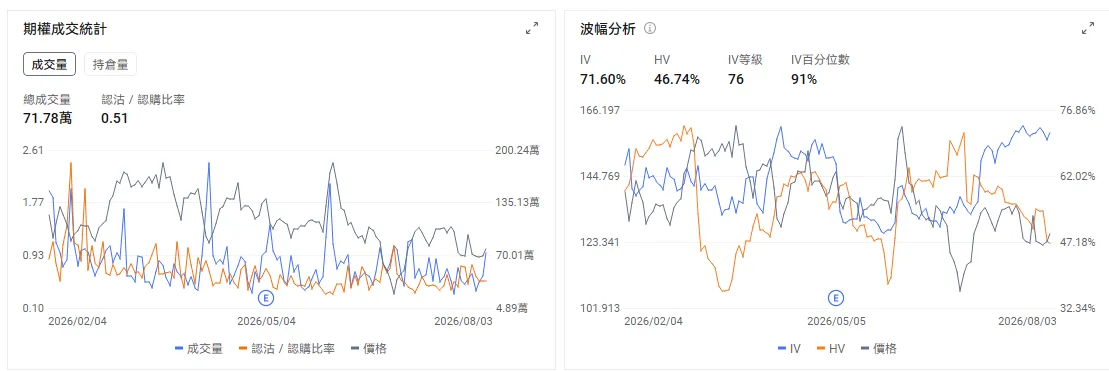
$Palantir (PLTR.US)$ Shares rose after hours to approximately $144.45, up nearly 15%, already exceeding the ~12.2% expected move priced into options ahead of earnings. This suggests the easiest 'earnings gap' trade has already occurred, and options traders should manage costs and volatility risk carefully. PLTR’s implied volatility (IV) is around 71%, with an IV Percentile of approximately 91%, indicating options remain relatively expensive. Historically, PLTR’s implied volatility drops by about 28% on average after earnings. Therefore, post-earnings strategies should prioritize spreads or short premium structures to mitigate the impact of declining IV and time decay.
If you believe the earnings report confirms fundamental improvement and that the stock still has upside after absorbing the gap move—but wish to avoid the high cost of naked calls—you could consider a bull call spread. If you’re bullish on PLTR over the long term and are willing to buy on a pullback, a cash-secured put sale may be worth considering.
2. Can Palantir's (PLTR) earnings drive a rally in software stocks?
This earnings report also carries positive implications for the software sector.A number of software companies are set to release their earnings reports over the next two weeks.
It demonstrates that AI spending is beginning to shift from chips, servers, and data centers toward software and application layers. Companies in data platforms, AI workflows, cloud monitoring, and cybersecurity may thus gain more opportunities for valuation recovery.
However, Palantir has a relatively high exposure to government contracts and its product deployment depth is significantly greater than that of standardized SaaS companies, so its performance cannot directly represent the entire software industry.Whether software stocks can sustain a rally still depends on whether other companies can convert AI demand into revenue, profits, and cash flow. In the near term, sentiment and valuations for software stocks are likely to continue recovering; whether the momentum broadens in the medium term will require more earnings reports to confirm.
Morgan Stanley believes thatthe market may be overly pessimistic in pricing the disruptive impact of AI on the software industry, but opportunities will remain highly differentiated.
and specifically named the following stocks:Companies meeting both criteria include:Microsoft, Palo Alto Networks, CrowdStrike, Shopify, Cloudflare, ServiceNow, Datadog, and Snowflake; Adobe and Workday face relatively greater challenges. Specifically:
1. Cybersecurity: The most certain theme in the AI cycle
Representative companies: $Palo Alto Networks (PANW.US)$ 、 $CrowdStrike (CRWD.US)$ 、 $Cloudflare (NET.US)$
Morgan Stanley believes cybersecurity stands to benefit throughout the entire AI investment cycle. As enterprises deploy more large models, AI agents, and automated workflows, risks related to identity and access management, data leakage, model security, and automated attacks will rise, making it difficult to cut security spending.
2. Data Platforms: Enterprises must organize their data before deploying AI
Representative companies: $Snowflake (SNOW.US)$
Snowflake is Morgan Stanley's core holding in the data infrastructure space. Its investment thesis aligns closely with Palantir’s latest earnings report: before enterprises can move AI investments into production environments, they must first complete data integration, governance, access control, and real-time data retrieval.
3. Observability and Cloud Operations: More AI workloads mean stronger monitoring needs
Representative companies: $Datadog (DDOG.US)$
After AI applications are deployed, system complexity increases significantly. Enterprises need to monitor model response times, GPU utilization, cloud costs, application failures, and data pipelines.
4. Enterprise Workflows: Companies that control workflow entry points are harder to replace
Morgan Stanley believes ServiceNow’s core value lies in its control over enterprise workflows in IT, customer service, human resources, and security operations. While AI agents can enhance automation in these processes, they still require access to enterprise permissions, historical records, and existing systems.
Microsoft is its highest-rated software company, viewed as a high-quality investment with both a deep moat and a clear AI monetization path.
5. Application-layer AI: Prioritize companies with shorter monetization paths
Representative companies: $Shopify (SHOP.US)$
Shopify is included on the list primarily because its AI assistant, Sidekick, can directly integrate into merchants' daily operations—such as product listings, marketing, customer service, and data analytics. Morgan Stanley believes Shopify may have one of the shortest AI monetization paths among software companies.
6. Adobe and Workday face more questions regarding their 'moats' or 'AI transformation pathways.'
$Adobe (ADBE.US)$ Its content creation capabilities are being disrupted by generative AI tools, and the market is still watching whether Firefly can generate sufficient incremental revenue; $Workday (WDAY.US)$ Its revenue is closely tied to enterprise employee seats, recruitment, and HR processes; if AI reduces corporate staffing or alters seat pricing models, growth could face pressure.
For the software sector, PLTR represents a key validation point.It signals that the AI rally is expanding from hardware into certain software and application layers.Next, the market will be looking to see whether other software companies can demonstrate they too can convert AI demand into revenue, profits, and cash flow.
 Want to pick stocks or get your portfolio diagnosed? Curious about the opportunities and risks in your holdings? Any investment-related questions,just ask Futubull AI!
Risk and Disclaimer Notice: 'Futubull' is an all-in-one financial investment trading platform. Brokerage services are provided by Futu Securities International (Hong Kong) Limited. This content does not constitute an offer, solicitation, recommendation, advice, opinion, or any guarantee regarding any securities, financial products, or instruments.
Risk Disclaimer: The above content only represents the author's view. It does not represent any position or investment advice of Futu. Futu makes no representation or warranty.Read more


Comments (7)
to post a comment
73
161