
South Korean stocks are now tradable! Invest globally with one app
Open your phone— the South Korean government is helping you lose money.
(This article was written by Laika Think Tank and published by TMT Post with authorization)
By LaiKa Think Tank
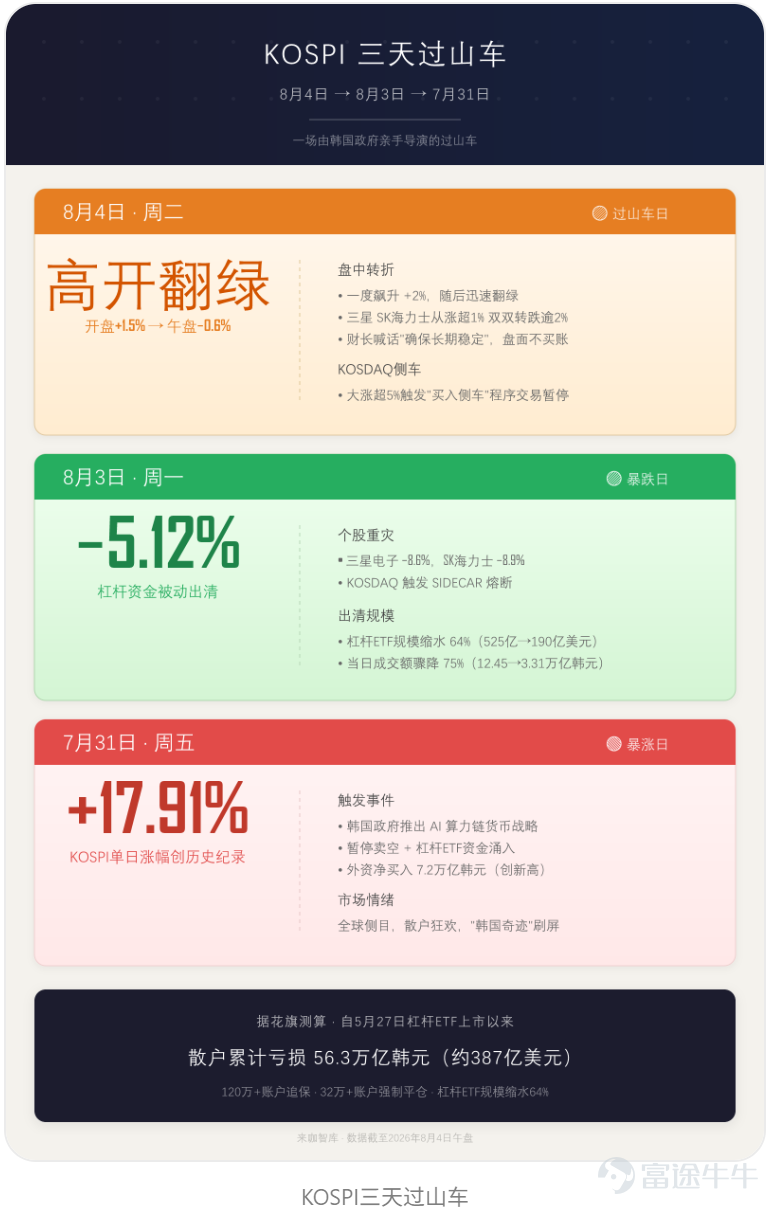
Up 18%, down 5%, opening high then turning negative—three days, three reversals. The leveraged ETFs created by the South Korean government are now backfiring on the market.
If you just opened your phone, your financial app probably pushed a notification like this: "KOSPI opened 1.5% higher, surged to up 2%, then turned negative. Samsung Electronics turned lower. SK Hynix turned lower."
You might be thinking: Wait, wasn’t it up nearly 18% last Friday?
If you hold any fund linked to Korea—whether an Asia-themed ETF, a tech QDII, or even an A-share fund heavily invested in Samsung’s supply chain—your net asset value curve over the past three days probably looks something like this.
Up 18%, down 5%, opened high then turned negative—three days, three reversals.
You might think the market has gone crazy.
No, it's the government that's gone crazy.

You might not invest in Korean stocks. But this isn't just a 'story from someone else’s backyard'—it may well be the most outrageous regulatory failure in global financial markets over the past decade, bar none.
On August 3, Kim Yong-beom, Head of the Presidential Policy Office, formally faced criminal charges.
Lee Jong-bae, a former Seoul city council member and conservative lawmaker from the opposition People Power Party, filed a criminal complaint via the government’s online petition system with the Prosecutors’ Office, alleging abuse of authority, coercion, and obstruction of business operations.
In January this year, shortly after Kim Yong-beom remarked in an interview, 'If Nasdaq allows products like this, why can’t Korea?', the Financial Services Commission (FSC) announced it would permit the launch of 2x single-stock leveraged ETFs.
Lee Jong-bae contends that the FSC had already been internally reviewing the relevant plan since January, originally intending to roll out the product only after establishing a regulatory framework in the second half of the year. However, Kim Yong-beom disregarded risk warnings from financial regulators and forcefully directed that the product be launched on May 27—right at the peak of the bull market.
‘If he exerted pressure to push the product’s listing through, that constitutes coercion and obstruction of business,’ Lee Jong-bae said.
Kim Yong-beom’s statement from January has now become courtroom evidence.
How did leveraged ETFs turn into killing machines?
The mechanics of leveraged ETFs are simple—they track double the daily moves of an index. However, their fatal flaw lies in daily rebalancing: to maintain 2x leverage, the fund must buy more as prices rise and sell more as prices fall before market close each day.
These 16 products were listed on May 27, with their combined market capitalization rapidly expanding from KRW 4.4 trillion (approximately USD 3.1 billion) on the first day to a peak of KRW 11.9 trillion (approximately USD 8.3 billion) on July 15. Their average daily trading volume rose from KRW 10.4 trillion to KRW 13 trillion. Samsung Electronics and SK Hynix alone account for 51% of the KOSPI’s total market cap, and leveraged ETFs contributed 11.4% of the 30-day average trading volume of these two stocks—meaning when they dump shares en masse, the entire index trembles.
When large enough, this mechanism becomes a market kill switch.

On July 29, 40 funeral wreaths appeared outside the National Assembly of Korea, with ribbons reading 'Massacre of the Ants.'
The first round of measures took effect on July 16: halting new product listings, banning promotional advertising, and mandating pre-investment education extended to three hours.
On the first day of the new rules, total trading volume of the 16 leveraged and inverse ETFs plunged from KRW 12.45 trillion to KRW 3.31 trillion—a 75% drop.
However, Korean regulators realized that merely restricting new inflows is far from sufficient—they also need to reduce existing holdings. The latest proposal involves amending the law.
The Financial Services Commission (FSC) and the Financial Supervisory Service (FSS) have initiated revisions to the Capital Markets Act. The core provision grants regulators emergency authority to directly lower leverage ratios—from 2x down to 1.5x during periods of severe market volatility, and as low as 1.1x under extreme circumstances—without going through the standard product amendment process. Other supporting measures include:
Raising the margin requirement from KRW 10 million to KRW 30 million, which must be paid in cash
Individual investors must not hold leveraged products exceeding 20% of their total investment.
"Suspension of new subscriptions" and the implementation of "single-price trading" for specific stocks are also under discussion.
This proposal draws on the flexible leverage mechanism implemented by the Securities and Futures Commission of Hong Kong effective July 24, which requires fund managers to adjust leverage ratios flexibly on a daily basis according to market conditions, with a minimum reduction to 1.1x under extreme circumstances. CSOP Asset Management has applied this flexible leverage mechanism comprehensively to its 12 Hong Kong-listed single-stock products since August 3.
However, it won't be easy for Korea to adopt this approach directly. The legal hurdle lies in beneficiary meetings.
Under current Korean law, changing the leverage ratio of existing products requires approval at a beneficiary meeting, needing both a majority of voting rights present and at least one-quarter of all issued beneficiary certificates. Byun Je-ho, Director-General of the Financial Services Commission’s Capital Markets Bureau, previously acknowledged: "This requires convening a beneficiary meeting, which is even more difficult than holding a shareholders’ meeting."

Prior to the formal implementation of emergency action authority in mid-August, position adjustments during the transition period could themselves cause temporary market disruptions.
Sell-side institutions have shown subtle divergence regarding whether Korea’s leverage risks have been fully resolved.

The optimistic camp believes the issue has largely been digested.JPMorgan’s co-head of Asia and Global Emerging Markets Equity Strategy, Batra, assessed: "Deleveraging of Korean leveraged ETFs is largely complete, and hedge funds have finished about 90% of their deleveraging." Citi maintained its KOSPI index target of 10,000 points, stating that "liquidity headwinds have turned into tailwinds."
Foreign investors have voted with their feet. On July 31, foreign net buying of KOSPI reached approximately KRW 7.2 trillion, a record high. Goldman Sachs and Morgan Stanley had already signaled a buying opportunity earlier.
Cautious analysts argue that tail risks remain.Huatai Securities’ strategy team noted that overall leverage risk has been significantly reduced but not yet fully cleared. Conservatively estimated, the risk exposure of leveraged ETFs now accounts for approximately 1.1% of the underlying stocks’ free-float market capitalization—a relatively low level. However, this exposure still represents 11.4% of the 30-day average trading volume of Samsung Electronics and SK Hynix, making it a key factor keeping Korean equity volatility at historically elevated percentiles. Huatai expects high-volatility oscillations in Korean equities to persist until mid-August, when policy measures are implemented, marking the final phase of risk deleveraging.
Guotai Haitong adopts a more conservative stance. Composite indicators tracking margin financing balances and net subscriptions/redemptions of leveraged ETFs suggest that overall leverage levels have declined only modestly, hovering around 50% on most trading days since July. Although the ratio of margin financing balances to custodial cash has retreated from prior highs, it remains at the 16th percentile over the past decade. They caution: 'Only if inflows into leveraged ETFs slow and custodial cash stabilizes can overall leverage meaningfully improve.' Their conclusion is: 'Passive deleveraging has achieved interim progress, but active deleveraging still needs to be advanced.'
Let’s conclude with a summary of the lessons learned.
The South Korean government sought to use leveraged ETFs to boost market liquidity and encourage retail participation in trading semiconductor bellwethers. The intention was sound, but the tool was poorly chosen. When the products launched on May 27, the KOSPI index had already begun retreating from its June peak. Retail investors rushed in with 2x leverage to catch the falling knife, and the ETFs’ rebalancing mechanism triggered concentrated selling near the close, creating a negative feedback loop of cascading declines.
The intraday rebound on August 4 suggests the most intense selling pressure may have passed. JPMorgan stated that leverage unwinding is 'largely complete,' Huatai said Korea’s market has 'entered the final stage of risk clearance,' and Citi maintains its KOSPI target of 10,000 points. Yet Guotai Haitong highlighted a critical fact: half of the margin leverage remains outstanding in the market, and active deleveraging by investors is far less prevalent than forced liquidations. Tail risks persist.
When a policy instrument itself becomes an amplifier of market volatility, policymakers are no longer mere referees—they become participants as well.
Whether the revised Capital Markets Act can bypass the beneficiary assembly hurdle by mid-August will be the next key observation window. But the true signal won’t be whether the KOSPI rises or falls—it will be when net subscriptions of leveraged ETFs turn negative and retail deposits stop declining. Only then will deleveraging truly be complete.
Risk Disclaimer: The above content only represents the author's view. It does not represent any position or investment advice of Futu. Futu makes no representation or warranty.Read more

Comments
to post a comment
1