
US equity warrant strategies: Popular stocks don't necessarily have good products; only those with suitable terms offer trading value
Currently, all US equity-linked products listed in Hong Kong are warrants—there are no equity CBBCs—and many underlying stocks have only one call or one put warrant available.
This means investors aren't choosing 'the best product among many,' but rather:
Whether the single product available in the market is suitable for expressing your directional view.
Some underlying stocks show strong momentum, yet their call warrants are too far out-of-the-money; others are weakening, but their put warrants offer more reasonable strike prices and delta levels.
Therefore, trading value doesn't necessarily appear in the stocks with the largest gains.
Amazon $Amazon (AMZN.US)$ : Best suited for trend-following trades, but avoid blindly chasing after sharp rallies
Amazon's latest share price is around $284. After earnings, it surged sharply, breaking above its previous resistance zone near $270, posting a weekly gain of over 22%. The RSI has risen to 72, indicating the stock is already overheated in the short term.
The terms of existing Amazon call warrants are relatively practical:
– Strike price of $245 is already in-the-money;
– Delta is approximately 79%;
– Effective leverage is about 6x;
– Premium is approximately 2.5%;
– Expiry is in late September.
The real advantage of this product is not its particularly high leverage, but ratherits ability to track the underlying stock more directly.。
For investors, it is better suited for the following two scenarios.
Scenario 1: Breakout continuation
If Amazon can stabilize above $285 and break through $290, the call warrant can be used for short-term tracking.
Type 2: Pullback Support
If the stock price retests the $270–$275 range and holds firm, this level offers better risk-reward than chasing entries above $284.
Because the area around $270 has shifted from resistance to support, it’s also easier to set a stop-loss level.
If the stock price breaks below $268–$270 and fails to recover, it suggests the earnings gap is starting to be filled, and long positions should exit first.
The Amazon put warrant has a strike price of only $180, a delta of approximately 5%, and a premium exceeding 35%. If you only expect the share price to pull back from $284 to $270, this product may not effectively reflect that move.
Amazon warrants currently offer value on the call side, but they’re better suited for buying on dips rather than chasing at elevated levels.
Microsoft $Microsoft (MSFT.US)$ : The warrant terms aren’t bad, but the underlying stock needs to digest its recent sharp rally first.
Microsoft’s latest share price is around $488, up more than 25% in a week, with an RSI as high as 78. The daily chart has broken above the $450–$470 resistance zone, showing strong momentum, but it’s clearly overheated in the short term.
Existing Microsoft call warrants:
– Strike price: $450;
– Delta approximately 63%;
– Effective leverage around 7.5x;
– Premium approximately 4.5%;
– Expiry in early October.
The purpose of this product is clear: to capture Microsoft’s move toward $500 after consolidation.
However, the underlying stock has risen too sharply recently; even if investors are correct on direction, they may suffer unnecessary pullbacks due to entering at too high a price.
More attractive entry levels would be:
– $470 to $480, watching whether the post-earnings gap holds firm;
– $500, observing whether a formal breakout occurs.
If the share price retests the $470–$480 range and stabilizes, the risk-reward profile of the call warrant will be more favorable. If it breaks directly above $500 and holds steady, that could signal the start of a second leg upward.
If it breaks below $465, it signals the market has started filling the earnings gap, and long positions should no longer be stubbornly held in the short term.
Microsoft put warrants with a strike price of $390 are too far from the current price, with a delta of only about 11%, making them unsuitable for capturing typical pullbacks.
It's not that Microsoft can't be traded—it's just that one should wait until after consolidation. The biggest risk right now is entry timing, not the company's fundamentals.
Nvidia $NVIDIA (NVDA.US)$ : The underlying stock has conditions for a rebound, but existing callable warrants are not ideal.
Nvidia’s latest share price is around $207, having stabilized again above $200. The RSI is approximately 53 and remains above key moving averages. Technically, it is testing the resistance zone between $210 and $215.
The underlying stock’s trend isn’t poor, but existing call warrants have a strike price as high as $275—over 30% above the current price:
– Delta is approximately 20%;
– Effective leverage is about 6.9x;
– Implied volatility is around 46%;
– Premium is close to 40%.
This means that even if Nvidia's stock rises from $207 to $220—a gain of about 6%—the corresponding call warrant may not fully reflect this move.
This product is truly suitable only when investors expect Nvidia to do more than just rebound—specifically, to break above $220 in the short term and push toward $240 or higher.
If you only expect the stock to rebound from $200 to $215, the terms of the current call warrants may not be appropriate.
The put warrants are also deep out-of-the-money; if the stock price merely declines to $195, their sensitivity may be insufficient.
Nvidia’s underlying stock is worth watching, but the existing warrants may not be worth using under suboptimal conditions.
Sometimes, the most valuable trading decision is simply to wait until product terms improve.
Micron $Micron Technology (MU.US)$Don't just look at leverage—only in-the-money warrants are truly useful
Micron’s latest share price is around $830, having dropped sharply from its recent high of $1,255. The stock remains below both its 20-day and 50-day moving averages, but its long-term uptrend hasn’t been completely broken, and intraday volatility remains extremely high.
There are currently two Micron call warrants available in the market:
$700
Approximately 73%
Approximately 2.6x
Already in-the-money, better tracks the underlying stock
$1,800
Approximately 18%
Approximately 3.8x
Deeply out-of-the-money with very high premium
Many investors are initially drawn to the 3.8x leverage, but the product with a $700 strike price is actually more practical for trading.
This is because it is already in-the-money, with a delta exceeding 70%, so it more directly reflects gains when the underlying stock rebounds.
Although the $1,800 strike price product offers higher leverage, its premium exceeds 100%, making it meaningful only if Micron experiences a very substantial rally.
How can Micron be traded?
Currently, it's more suitable to play a rebound rather than chasing higher prices.
If the stock price stabilizes around $780–$800 and breaks back above $850, call warrants with a $700 strike price can be used to capture a rebound toward $900–$950.
If the price falls below $750, it indicates the correction is not yet complete, and long positions should exit first.
Micron’s underlying stock itself is highly volatile, so even though the call warrant has only about 2.6x leverage, the product’s volatility is already quite high.
For Micron, the most suitable warrant isn't necessarily the one with higher leverage, but rather an in-the-money call warrant that closely tracks the underlying stock.
Tesla’s latest share price is around $322, still below its 20-day, 50-day, and 200-day moving averages, with an RSI of approximately 37. Although the stock has rebounded from below $300, the downtrend has not yet truly reversed.
Existing Tesla call warrants:
– Strike price at $490;
– Delta of approximately 5.7%;
– Effective leverage is approximately 10x;
– Premium is close to 57%.
This product appears highly leveraged, but it is actually unsuitable for capturing typical rebounds. Tesla rose from $322 to $340—a significant underlying gain—yet the call warrant remains deeply out-of-the-money with very low sensitivity.
Conversely, the two put warrants have strike prices around $330–$340, close to the current market price:
– Delta is approximately 47% to 51%;
– Premium is about 9% to 11%;
– Effective leverage is approximately 3x.
These terms are better suited for expressing a short-term bearish view.
Clearer trading conditions would be:
– Tesla fails to reclaim the $340–$350 range;
– Fell below $310 again;
– The next level to watch is around $300.
If the stock price rises above and stabilizes above $350, the short position assumption should be abandoned.
Among the stocks listed this time, Tesla clearly offers more trading value in put warrants than in call warrants.
Palantir reported exceptionally strong earnings, with quarterly revenue up 93% year-over-year and raised full-year revenue guidance. The stock traded around $125.65 before earnings and surged sharply in after-hours trading.
However, the terms of existing call warrants are unattractive:
– Strike price at $200;
– Delta of approximately 7.7%;
– Premium of about 61%;
– Implied volatility is around 71%.
This means that even if the underlying stock rises 10% to 15% after earnings, the call warrant will still be deeply out-of-the-money.
Moreover, implied volatility is often repriced at market open following an earnings announcement. If the underlying stock gaps up but implied volatility drops sharply, the call warrant’s gain may fall short of expectations.
What’s truly tradable in Palantir isn’t the earnings figures themselves, but the price action on the first trading day after earnings.
Two key scenarios
If the stock opens higher and holds steady between $140 and $145, it signals the market is willing to reprice the stock, giving the call warrant short-term follow-through potential.
If the stock gaps up but then falls back below $130, beware of a 'sell-the-news' scenario. In this case, a put warrant with a strike price of $140 and a delta of approximately 50% would better reflect the risk of a high-open, low-close move.
With Palantir, don’t simply chase call warrants just because earnings look good—you must first confirm whether the stock can sustain its post-earnings gains after the market opens.
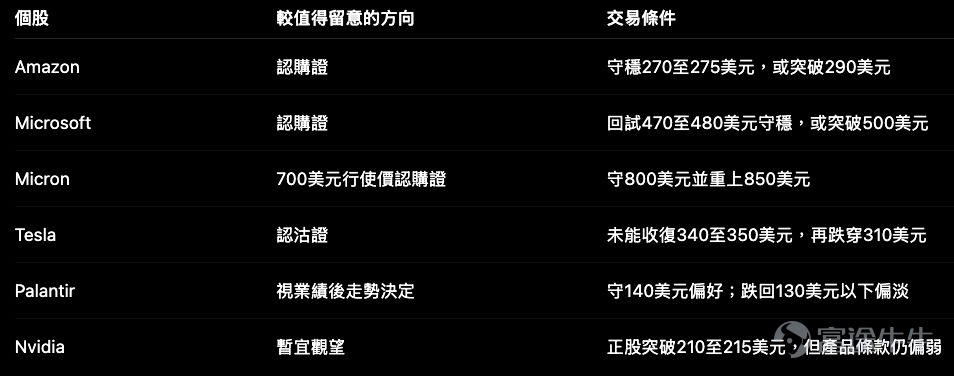
Currently more trade-worthy individual stock products

What matters most about these U.S. equity-linked products isn’t which one offers the highest leverage, but which one genuinely aligns with your specific trading setup.
Amazon, Microsoft, and Micron have more practical in-the-money or near-the-money call warrants; Tesla's put warrants are clearly more reasonable; Nvidia and Palantir's call warrants are notably out-of-the-money and cannot be justified by the underlying stocks' narratives alone.
When the only warrant available in the market has a strike price too far away, delta too low, and premium too high, choosing not to trade isn't missing an opportunity—it's avoiding the wrong instrument.
Risk Disclaimer: The above content only represents the author's view. It does not represent any position or investment advice of Futu. Futu makes no representation or warranty.Read more

Comment (1)
to post a comment
5
1