
Storage giants launch collective buybacks: Where does the supercycle stand?

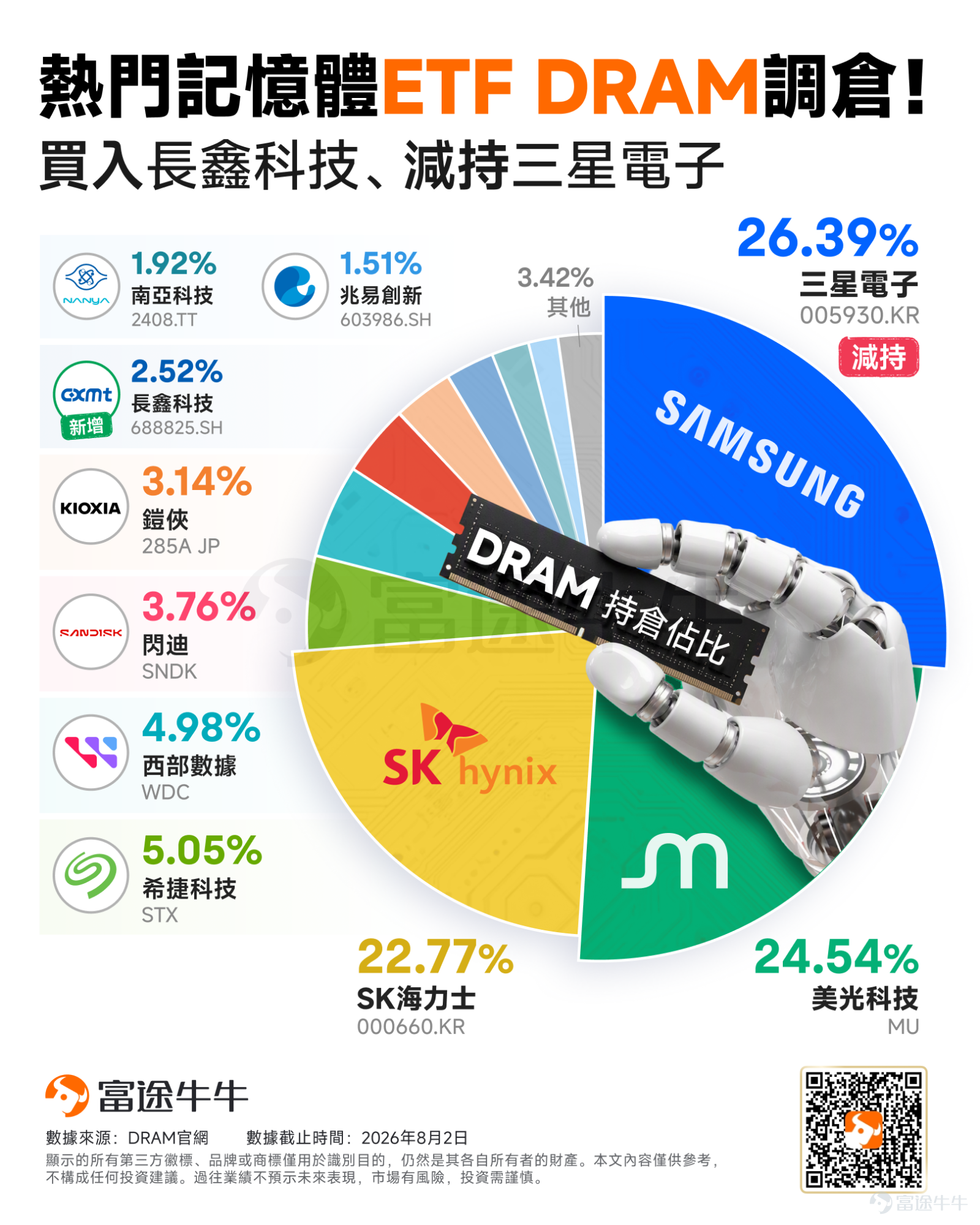
Reducing Samsung holdings, adding ChangXin: Is the popular memory ETF DRAM heading toward a new landscape?
The global memory chip market is witnessing a highly symbolic shift.
U.S. ETF provider Roundhill recently rebalanced its $Roundhill Memory ETF (DRAM.US)$ portfolio, adding $CXMT Corporation (688825.SH)$ for the first time, while simultaneously reducing exposure to certain $Samsung Electronics (005930.KR)$ positions.
As of the latest disclosure, Samsung Electronics, Micron Technology, and SK Hynix remain the fund’s top three holdings, with weights of approximately 26.39%, 24.54%, and 22.77%, respectively—totaling 73.70%. CXMT holds a weight of 2.52%, while GigaDevice accounts for 1.51%.

Why is CXMT’s inclusion symbolically significant?
In June this year, Roundhill already added $GigaDevice Semiconductor Inc. (603986.SH)$ to its holdings. However, GigaDevice primarily focuses on NOR Flash, MCUs, and niche memory products, whereas CXMT is China's largest integrated DRAM developer and manufacturer. Therefore, the true significance of this rebalancing lies in the fact that the ETF has included a domestically developed Chinese DRAM manufacturer in the global memory investment landscape for the first time.
The Roundhill Memory ETF was listed in the U.S. on April 2, 2026, with investments spanning not only DRAM but also HBM, NAND, SSD, NOR Flash, and HDD memory segments. The fund employs active management but periodically rebalances primarily based on market capitalization, the proportion of memory-related revenue, and global market share.
According to the fund’s prospectus, eligible companies must derive at least 50% of their revenue or profit from memory products, have a market cap of no less than $10 billion, and maintain average daily trading volume of at least $5 million. Holdings are generally weighted by modified market capitalization, with a single-company benchmark weight capped at 25%.
This means ChangXin’s rapid fulfillment of the requirements regarding market cap, liquidity, and business purity after its listing was the direct reason for its inclusion. This reflects international capital’s recognition of ChangXin’s 'investability' and should not be simplistically interpreted as fund managers turning broadly bearish on Samsung and shifting bets entirely to ChangXin.
On what grounds did ChangXin enter the global memory investment landscape?
ChangXin’s inclusion is not merely driven by the 'domestic substitution' narrative.
According to the prospectus, the company has established a product portfolio including DDR4, DDR5, LPDDR4X, and LPDDR5/5X, and operates three 12-inch DRAM wafer fabs in Hefei and Beijing. According to Omdia, ChangXin’s global DRAM revenue market share rose to 7.67% in Q4 2025, ranking fourth globally and first in China.
Financial performance has also improved significantly. In 2025, ChangXin reported revenue of approximately RMB 61.8 billion, a substantial year-over-year increase, and net profit of about RMB 7.1 billion, marking its return to profitability. R&D investment that year neared RMB 9.6 billion, representing roughly 15.5% of revenue.
The IPO proceeds will primarily be allocated to three areas: upgrading wafer production lines, advancing DRAM technology iterations, and conducting forward-looking R&D. This signals that ChangXin is shifting from solely meeting domestic Chinese demand toward expanding capacity, reducing costs, and competing globally.
For Roundhill, excluding ChangXin once it completes its IPO and achieves sufficient liquidity would render the fund’s coverage of the global memory industry incomplete.
Conclusion
Roundhill’s latest portfolio adjustment truly signals a shift in how global capital markets define the DRAM industry—global DRAM may be transitioning from a 'three-player oligopoly' to a 'big three plus one Chinese challenger' structure.
Historically, global DRAM investing was virtually synonymous with Samsung, SK hynix, and Micron Technology; now, ChangXin’s inclusion as a core holding in an international memory-themed ETF marks its evolution from an industry 'follower' to a fourth force that global capital can no longer ignore.
However, being added to an ETF’s holdings is only the first step.
Whether ChangXin can truly reshape the global memory landscape ultimately hinges on three factors: its ability to continuously narrow the gap in process technology and yield rates, gain entry into global high-end customer supply chains, and maintain profitability through the next memory downcycle.
Gaining a place in the global investment map is noteworthy; securing a position in the global high-end memory supply chain is the real turning point.
Risk Disclaimer: The above content only represents the author's view. It does not represent any position or investment advice of Futu. Futu makes no representation or warranty.Read more


Comments (21)
to post a comment
73
129