
NVIDIA's earnings report is set to be released on Thursday, putting AI-related trades to the test on

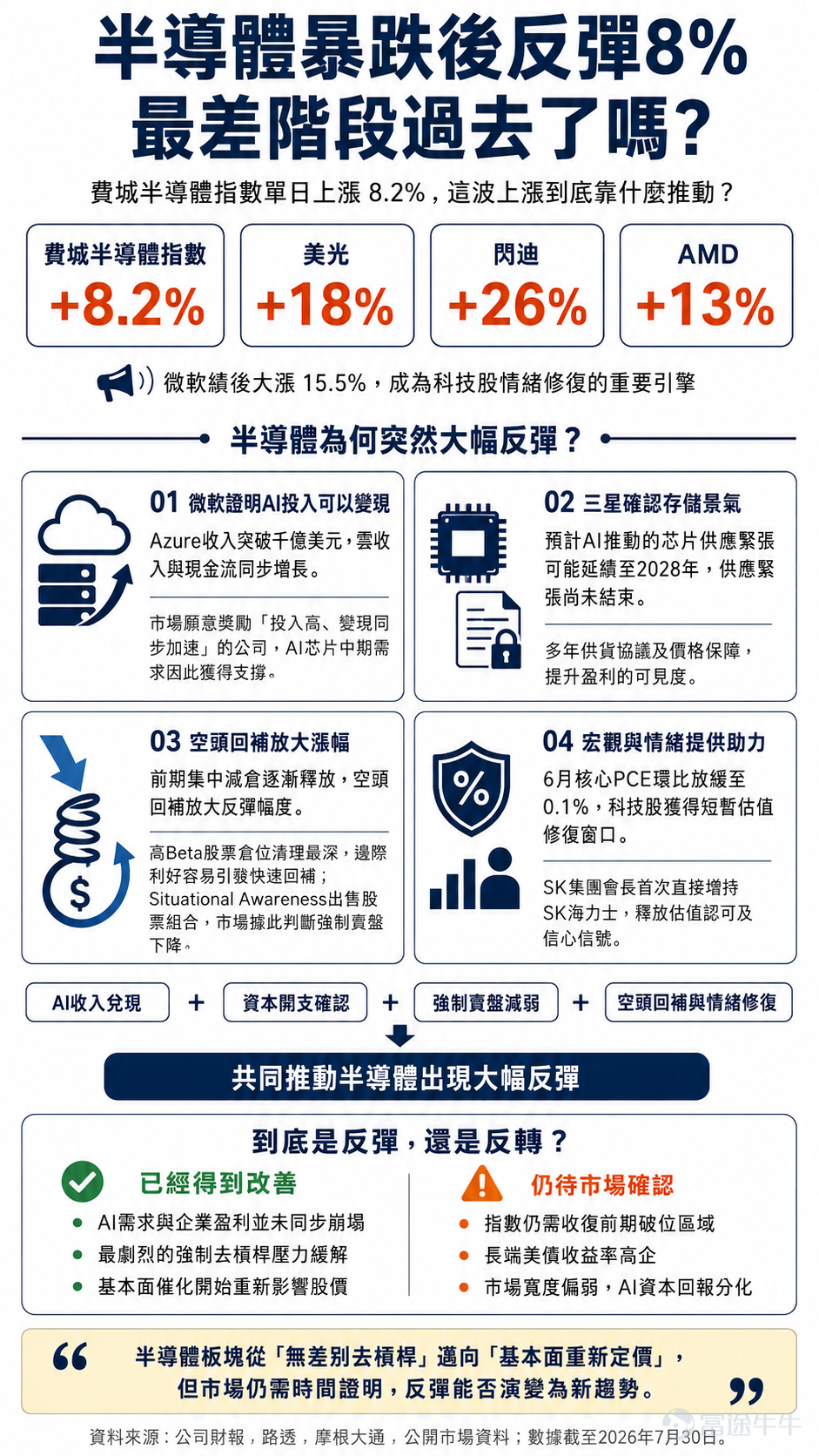
60-Second Visual Breakdown | Semiconductor Stocks Rebound 8% in a Single Day After Sharp Decline: Is the Worst Over? One Chart Explains the Logic Behind the Rebound
After a near-panic sell-off, the semiconductor sector finally saw a strong recovery yesterday. On July 30, $PHLX Semiconductor Index (.SOX.US)$ surged 8.2% in a single day, $Micron Technology (MU.US)$ 、 $SK hynix (SKHY.US)$、 $SanDisk (SNDK.US)$ 、 $Advanced Micro Devices (AMD.US)$ with previously hard-hit, high-beta names leading the rally, $Microsoft (MSFT.US)$ jumped 15.5% post-earnings, becoming a key driver of improving sentiment in tech stocks.

1. This rebound was initially driven by earnings catalysts from Microsoft and Samsung.
Microsoft's Azure revenue and cash flow grew in tandem, indicating that its massive AI-related capital expenditures are still translating into real revenue., easing market concerns about a slowdown in demand for computing power.
Samsung's earnings report further confirmed the strength in the memory market,with AI-driven chip supply tightness potentially extending through 2028,and multi-year supply agreements with price protections have enhanced visibility into future profitability.
After-hours, $Amazon (AMZN.US)$ demand for earnings validation continues,AWS growth accelerated, and capital expenditures were further raised, indicating cloud providers remain strongly committed to AI infrastructure investment, supporting demand for semiconductors, servers, and storage.
2. Market liquidity also amplified the gains
Semiconductor stocks had previously declined consecutively, with high-beta memory and equipment stocks seeing the deepest position unwinding. After Situational Awareness sold its equity portfolio, the market began to assess that forced selling pressure has largely been concentrated and released.As passive deleveraging pressure eases, short-covering naturally drives the strongest rebound in assets that previously suffered the steepest declines.
3. Macro and corporate signals also provide support
The U.S. June PCE price index—a key inflation gauge favored by the Federal Reserve—declined by 0.1% month-over-month, marking its first monthly drop since the pandemic began in 2020.Meanwhile, the core PCE price index rose just 0.1% month-over-month in June, below market expectations, easing concerns about further rate hikes and offering tech stocks a brief window for valuation recovery. The chairman of SK Group directly purchased additional shares of SK Hynix for the first time,Although the amount was relatively small compared to the company’s market capitalization, it sent a strong signal to the market affirming confidence in the company’s valuation and medium- to long-term competitiveness.
4. Rebound or reversal?
This rebound is of higher quality than an ordinary technical bounce, though trading-related factors remain very prominent. AI demand, memory profitability, and capital expenditure are all supported by fundamentals, and the most intense deleveraging pressure may be nearing its end. According to Citi data, among semiconductor companies that have already reported earnings, consensus revenue forecasts for 2026 and 2027 have been revised upward by 4% and 7%, respectively, while EPS forecasts have been raised by 7% and 8%.Earnings expectations continue to be revised upward, forming a critical foundation for sustaining this rebound.
However, BTIG strategist Jonathan Krinsky cautions that even after a momentum-driven selloff, a rebound of around 20% could still be followed by another pullback.Index performance has been primarily driven by Microsoft and semiconductors. Elevated long-end U.S. Treasury yields, diverging AI-related capital returns, and narrow market breadth all contribute to a low margin for error when chasing rapid gains.
Yesterday's market action can be seen as the first step in semiconductors transitioning from 'indiscriminate deleveraging' to 'fundamental repricing.'The market still needs to demonstrate that this rally can move beyond a liquidity-driven rebound and evolve into a trend driven by earnings.
5. Options Strategies
Semiconductor option volatility was already elevated, and the market has strongly priced in significant subsequent swings. Chasing OTM call options expiring within a week after a single-day surge carries relatively high risk. These options have high gamma but experience extremely rapid time decay; even with a correct directional view, losses can occur due to a drop in implied volatility (IV) and theta decay if the stock price moves sideways.
Overall, bull call spreads are best suited for participating in an extended rebound; bull put spreads are appropriate for waiting for a pullback to capture volatility; and protective collars suit investors who already hold positions and worry about a retest of recent lows. The core objective of options strategies at this stage remains maintaining upside exposure while guarding against the market reinterpreting this 'high-quality rebound' as merely a short-lived short-covering rally.
 Want to pick stocks or get your portfolio diagnosed? Curious about the opportunities and risks in your holdings? Any investment-related questions,just ask Futubull AI!
Risk and Disclaimer Notice: 'Futubull' is an all-in-one financial investment trading platform. Brokerage services are provided by Futu Securities International (Hong Kong) Limited. This content does not constitute an offer, solicitation, recommendation, advice, opinion, or any guarantee regarding any securities, financial products, or instruments.
Risk Disclaimer: The above content only represents the author's view. It does not represent any position or investment advice of Futu. Futu makes no representation or warranty.Read more


Comments (2)
to post a comment
39
52