
Is the AI trading theme making a comeback? Japanese and South Korean stocks rebound strongly

ETF Showdown | Is the 2x Leveraged Long SK Hynix ETF getting 'disconnected'? What exactly is 'flexible leverage'?
Recently, global tech stocks—particularly those in the semiconductor sector—have experienced sharp volatility, and leveraged ETFs tracking individual stocks such as $CSOP SK Hynix Daily Max (2x) Leveraged Product (07709.HK)$ have undoubtedly become the absolute focal point of market attention. From plunging from all-time highs to shocking reports of a trader misappropriating funds leading to a blow-up, and now sudden rule changes by Hong Kong’s Securities and Futures Commission (SFC), this once high-flying leveraged ETF—which at its peak surpassed Tracker Fund of Hong Kong (2800.HK) in size—is now facing a complete overhaul of its operating rules.
Lately, many fellow investors have been asking: Is 7709 about to get 'disconnected'? What exactly is this 'flexible leverage' taking effect next month? Could it be that regulators and fund managers don’t want us to recover our losses now that the price has dropped? Today, we’ll cut through the confusion and explain—in plain language—the real rationale behind these rule changes and how ordinary investors should respond going forward.
Latest Statement from 7709: Game Rules Change Starting Next Monday
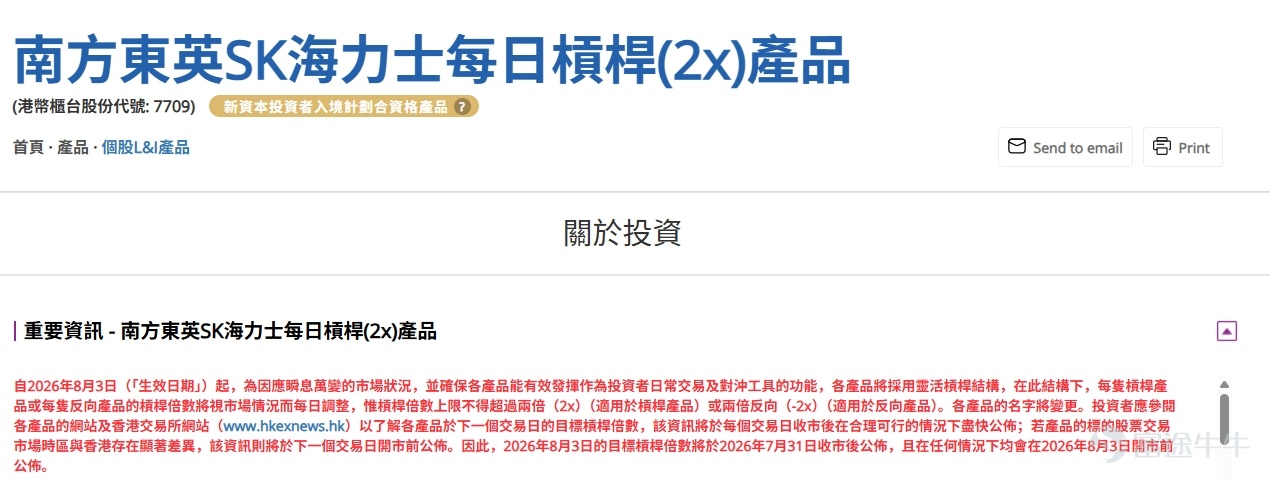
This week, the 2x Leveraged Long SK Hynix ETF released a major announcement. In response to the SFC’s revised "Circular on Listed Structured Products" dated July 24, several of its daily leveraged and inverse productswill officially adopt a 'flexible leverage structure' starting August 3, 2026 (next Monday).

Source: CSOP
Specifically, this adjustment includes the following key points:
Leverage ratio will no longer be fixed at 2x: Originally, the core selling point of 7709 was its 'fixed 2x' daily tracking of SK Hynix's returns, but starting August 3, the leverage ratio will be dynamically adjusted daily based on market conditions.
The cap remains at 2x, but it can be lowered: The maximum leverage for the long leveraged product will remain capped at 2x, but under certain market conditions (such as capacity constraints or cost considerations), the fund manager may proactively reduce the leverage ratio, potentially as low as 1.1x in extreme scenarios.
Product name to be updated accordingly: To clearly reflect the feature that the leverage ratio may fall below the cap, the product name will also be updated simultaneously.
Daily mandatory disclosure: To enhance transparency,the fund manager will publish the target leverage ratio for the next trading day on the product’s official website and HKEXnews after market close each trading day.This means the target leverage ratio effective on the first day (August 3) will be publicly disclosed after market close on July 31.
It is worth noting that this adjustment does not target SK Hynix alone. The products under CSOP Asset Management affected by this adjustment include multiple leveraged and inverse products tracking individual U.S. and Korean stocks.so it's not just SK Hynix—Samsung Electronics' leveraged ETF $CSOP Samsung Electronics Daily Max (2x) Leveraged Product (07747.HK)$also issued the same announcement.。
‘It’s already dropped—does this move mean you don’t want me to break even?’ Examining the real rationale behind the decision.
Following this announcement, many investors expressed concern, questioning whether this was a biased move designed to prevent them from recovering their losses.
These investor concerns are not unfounded. Under the new mechanism, there is a clear 'timing mismatch risk': if a leveraged product reduces its leverage from 2x before a sharp rise in the underlying stock price, it will fail to capture the expected gains.Put simply, if you fully absorbed a 2x loss during a downturn, but the fund manager cuts leverage to just 1.1x when the market turns favorable, your path to breaking even will indeed become extremely long.
So, is this move really targeting retail investors? In fact, there are deeper considerations at play. This rule change is certainly not intended solely to ‘make things difficult’ for investors—it stems from practical factors including market capacity, product characteristics, and regulatory pressures.
(1) The scale has become too large to manage effectively, and counterparty capacity is insufficient.
The assets under management of these single-stock leveraged ETFs have grown too rapidly, approaching the limits of market liquidity. Take 7709 as an example: since its launch in October 2025, the product’s AUM surpassed HK$130 billion in just eight months.It once surpassed the Tracker Fund of Hong Kong (TraHK) to become the largest ETF by assets on HKEX and even topped the list as the world's largest single-stock leveraged ETF.
We previously mentioned that 7709 achieves 2x exposure through swap contracts targeting $SK Hynix (000660.KR)$ 2x tracking of Korean equities (not U.S.-listed ADRs), which requires investment banks to act as counterparties providing the necessary exposure.When the product’s scale expands dramatically, bottlenecks can emerge in the swap capacity provided by investment banks, position limits on futures and options, and the secondary market liquidity required for daily rebalancing.
In extreme market conditions, maintaining a fixed 2x leverage would force the fund to mechanically reduce its position most aggressively precisely when liquidity is worst—easily triggering a vicious cycle where 'the lower the price falls, the more selling pressure there is.'Therefore, allowing fund managers to temporarily reduce leverage when necessary is essentially intended to avoid incurring massive market impact costs when capacity constraints arise.
(2) Sector headwinds: Preventing abrupt product termination ('sudden death')
Secondly, the semiconductor industry is currently undergoing a correction phase, and another key consideration is preventing the product from suffering an abrupt termination amid extreme volatility.
Let’s walk through an extreme scenario:If SK Hynix’s stock price were to halve, would 7709 go to zero?
Under the original fixed 2x leverage scenario,a 2x leveraged long product would only go to zero in a single day if the underlying stock dropped 50% in one day. However, the Korean KOSPI market has daily price limits of ±30%, making a single-day 50% drop physically impossible.
What if the underlying stock declines by 50% cumulatively over a week or a month?Due to the daily reset mechanism, the product would not go directly to zero. However, the magnitude of losses can vary dramatically depending on how the decline unfolds:

With flexible leverage introduced, when signs of extreme market declines emerge, fund managers can proactively reduce leverage. This way, even if the underlying stock plunges sharply in a single day, the product's net asset value won’t suffer further drastic erosion, thereby avoiding a sudden 'death' of the product.
The recent price action of SK Hynix also illustrates this risk. On July 29, $SK hynix (SKHY.US)$ it released its second-quarter earnings report. Although operating profit surged 557%—reaching a record high—the revenue and profit both fell short of market expectations, causing a sharp drop in its share price. As a result, CSOP’s 2x Leveraged Long SK Hynix ETF plunged more than 26% that day,and has declined by over 80% since July. Under such extreme volatility, the risks associated with fixed high leverage are magnified immensely.

(3) Regulatory Pressure: Recent Actions by HKEX and Korean Regulators
Finally, regulatory pressure cannot be ignored. The SFC’s recent rule amendments were largely informed by lessons learned from the Korean market.
The Governor of South Korea’s Financial Supervisory Service recently publicly stated, 'I deeply regret approving leveraged ETFs.'On July 16, South Korea’s Financial Services Commission (FSC) announced a temporary halt on new single-stock leveraged ETF listings and significantly raised the margin requirement from KRW 10 million to KRW 30 million. On July 29, FSC Chair Lee Bok-hyun further indicated that the commission is considering imposing investment limits on individual investors for leveraged ETFs, potentially capping such investments at 20% of an individual’s financial portfolio.
On July 24 (last Friday), Hong Kong’s Securities and Futures Commission (SFC) officially issued a revised circular, explicitly stipulating that 'products whose capacity is highly sensitive to market conditions must adopt a flexible leverage structure.'— The use of the word 'must' indicates a mandatory requirement, not a recommendation. Concerns are mounting globally that single-stock leveraged products could amplify underlying asset volatility. Fueled by the AI investment frenzy, leveraged ETFs have expanded rapidly in scale, and their 'reflexive impact' on underlying asset prices has drawn attention from multiple markets.
The SFC’s move aims to address the extreme volatility in leveraged products triggered by sharp swings in global tech stocks. This is a 'preemptive defusing' measure designed to reduce derivative trading costs and the risk of return deviations.
We’ve repeatedly highlighted the risks associated with leveraged ETFs and earlier this month explained the additional issues caused by the 'Korea-Hong Kong asynchrony' (differences in trading hours, holidays, and premiums). Once these structural risks accumulate beyond a certain threshold, regulatory intervention becomes inevitable. Fellow investors interested in this topic can revisit our previous discussion~

How Should Retail Investors Respond?
Faced with drastic regulatory changes and extreme market volatility, what should we retail investors do? Here are a few suggestions for fellow investors to consider:
If you are truly very bullish on SK Hynix and $Samsung Electronics (005930.KR)$ their long-term value, but are fed up with the volatility decay and rule changes of leveraged ETFs, then the most straightforward approach is—to trade the actual Korean stocks directly。
Niu Niu has already enabled Korean stock trading this week. After activating your trading permissions, you can directly buy shares of SK Hynix and Samsung Electronics listed in Korea. This way, you hold the actual company stock—without NAV drift caused by daily resets, without capacity limits from swap agreements, and without the uncertainty of fund managers suddenly reducing leverage.For investors who believe in the long-term logic of the memory/storage sector, this may be a purer and more hassle-free option.

If you find individual stock volatility too difficult to manage but still want to participate in the tech sector’s upside,then consider shifting to broad-market or sector ETFs. While returns may not be as explosive as those from single stocks, risks are diversified and volatility is relatively lower.
Using Niu Niu’s ETF screener, you can find low-cost, highly liquid broad-market or sector ETFs. As Warren Buffett has long advocated for index fund investing,for most retail investors who can’t monitor the market constantly or lack deep research capabilities, regularly investing in or holding low-cost broad-market ETFs for the long term may be a more prudent choice.
ETFs tracking the S&P 500 $Vanguard S&P 500 ETF (VOO.US)$ 、 $SPDR S&P 500 ETF (SPY.US)$ and $iShares Core S&P 500 ETF (IVV.US)$ The holdings of these three ETFs overlap almost entirely; the key differences lie only in expense ratios and average daily trading volume: SPY offers the best liquidity and is ideal for short-term trading, VOO has the lowest expense ratio and suits long-term holding, while IVV falls somewhere in between. For broader market coverage, $Vanguard Total Stock Market ETF (VTI.US)$ a single ETF can provide exposure to approximately 3,700 U.S. stocks across large-, mid-, and small-cap segments, eliminating the hassle of manual allocation.
Investors who favor a tech-growth style may consider pairing it with $Invesco QQQ Trust (QQQ.US)$ , but should note that its top ten holdings account for over 50% of the portfolio and are heavily concentrated among AI-related mega-cap companies.

Lastly, regardless of which investment vehicle you choose, it’s crucial to understand the product’s fundamental nature. The recent 'power cord pull' incident involving 7709 appears on the surface to be a rule change, but at a deeper level, it reflects a reversion to the intraday trading tool nature of leveraged ETFs. Hong Kong’s Securities and Futures Commission has once again emphasized that leveraged and inverse products are structurally complex and highly volatile, suitable only for professional short-term traders with derivatives experience who can withstand substantial single-day losses. Retail investors should carefully assess their own risk tolerance and avoid using these instruments as medium- to long-term portfolio allocations.
Markets are always evolving, and rules will continue to adapt accordingly. As investors, we cannot change the rules—but we can at least choose the game that suits us best. We hope today’s analysis helps clarify the logic behind the 7709 rule adjustment, enabling you to invest with greater rationality and less blind following going forward.
Risk Disclaimer: The above content only represents the author's view. It does not represent any position or investment advice of Futu. Futu makes no representation or warranty.Read more


Comments (24)
to post a comment
79
382