
Tesla plunged after its earnings report—what’s the outlook ahead?

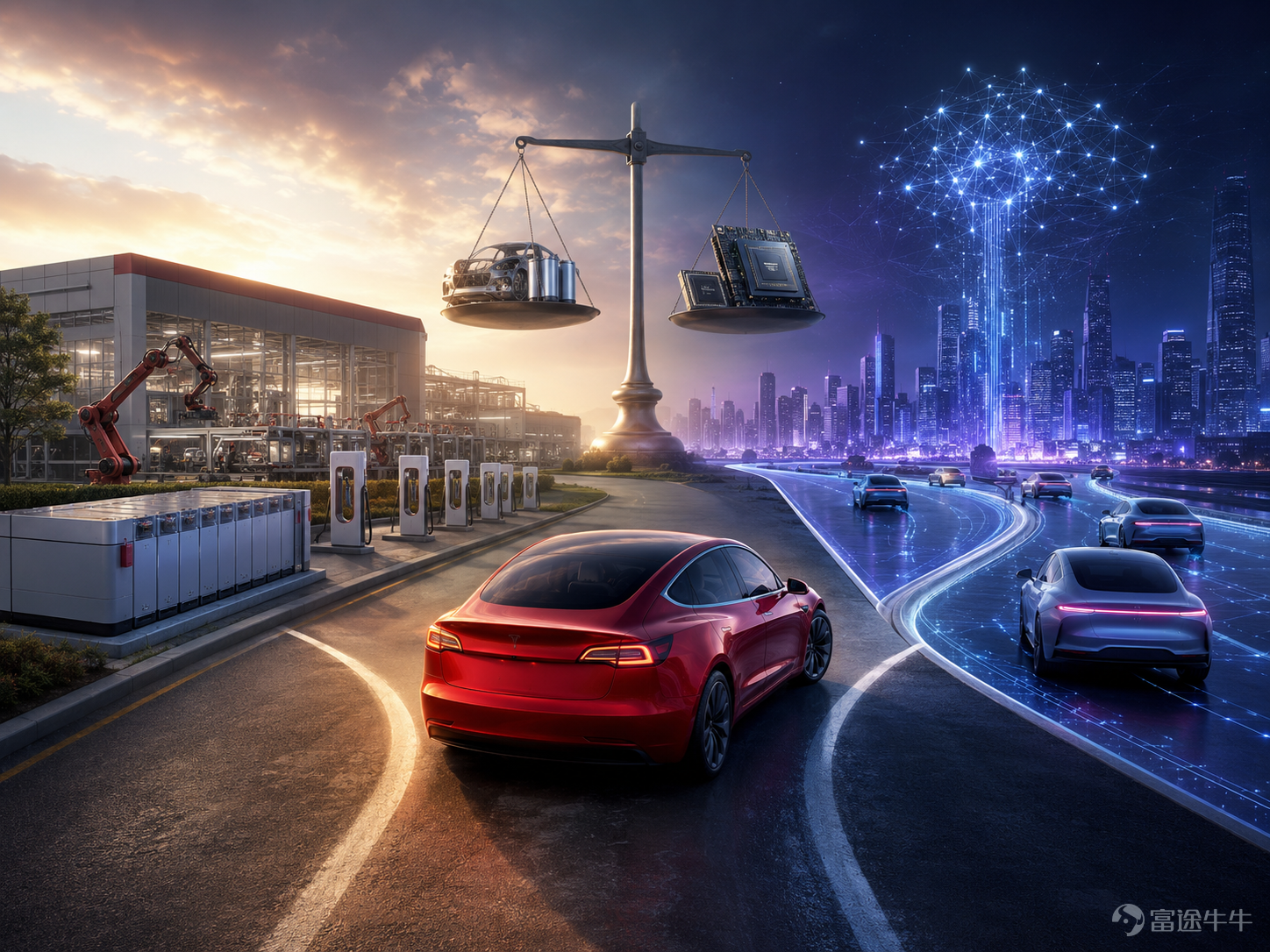
Tesla's valuation core: EV company, AI company, or Robotaxi option?
![The hardest part about analyzing Tesla (TSLA) isn’t forecasting next quarter’s deliveries—it’s that the market has never priced it purely as an automaker. As of July 27, 2026, Tesla’s stock price stood at approximately $313, giving it a market cap of roughly $1.11 trillion and a trailing P/E ratio nearing 290x. This is clearly a valuation no traditional automaker could sustain, reflecting investor expectations not just for EV profits but also for future cash flows from autonomous driving, Robotaxi services, humanoid robots, and its energy platform. Let’s first look at reality. In Q2 2026, Tesla’s revenue grew 26% year-over-year to $28.236 billion, with automotive revenue accounting for $20.516 billion—still the group’s primary revenue source. Quarterly deliveries reached 480,100 vehicles, up 25% year-over-year. In other words, Tesla’s factories, brand, supply chain, charging network, and cash flow today are still fundamentally built on selling cars, not AI services.[Share Link: Tesla’s Q2 Earnings] The problem is that scaling vehicle production hasn’t translated into proportional profitability. Operating income in Q2 was only $398 million, with operating margin falling to 1.4% from 4.1% a year earlier. Capital expenditures surged 142% to $5.789 billion, turning free cash flow negative at $1.092 billion. If Tesla were viewed strictly as an EV manufacturer and valued using frameworks applied to Toyota, BYD, or other major automakers, its current share price would be nearly impossible to justify based on automotive earnings alone...](https://nnqimage.futunn.com/sns_client_feed/40001501/20260727/web-1785155723008-BIZgHQIuAa.png/big?area=1&is_public=true&imageMogr2/ignore-error/1/format/webp)
The hardest part about analyzing Tesla (TSLA) isn’t forecasting next quarter’s deliveries—it’s that the market has never priced it purely as an automaker. As of July 27, 2026, Tesla’s stock price stood at approximately $313, giving it a market cap of roughly $1.11 trillion and a trailing P/E ratio nearing 290x. This is clearly a valuation no traditional automaker could sustain, reflecting investor expectations not just for EV profits but also for future cash flows from autonomous driving, Robotaxi services, humanoid robots, and its energy platform.
Let’s first look at reality. In Q2 2026, Tesla’s revenue grew 26% year-over-year to $28.236 billion, with automotive revenue accounting for $20.516 billion—still the group’s primary revenue source. Quarterly deliveries reached 480,100 vehicles, up 25% year-over-year. In other words, Tesla’s factories, brand, supply chain, charging network, and cash flow today are still fundamentally built on selling cars, not AI services.Tesla’s Q2 Earnings
The problem is that scaling vehicle production hasn’t translated into proportional profitability. Operating income in Q2 was only $398 million, with operating margin falling to 1.4% from 4.1% a year earlier. Capital expenditures surged 142% to $5.789 billion, turning free cash flow negative at $1.092 billion. If Tesla were viewed strictly as an EV manufacturer and valued using frameworks applied to Toyota, BYD, or other major automakers, its current share price would be nearly impossible to justify based on automotive earnings alone.
However, Tesla is not just an ordinary automaker. It possesses a vertically integrated in-car computing platform, vast real-world driving data, a fleet capable of receiving software updates, and the ability to convert hardware customers into subscription users. Active FSD subscriptions rose to 1.48 million in Q2, up 56% year-over-year; FSD subscription penetration among new vehicles in North America has already exceeded 55%. These figures are beginning to demonstrate Tesla's software monetization capability, but the company explicitly states that FSD still requires driver supervision—subscription growth should not be equated directly with the maturity of full self-driving.
Robotaxi sets the valuation ceiling; the automotive business anchors the floor.
Robotaxi is the most significant—and hardest-to-value—option embedded in Tesla’s valuation. The company states the service is now live in seven major U.S. cities, with unsupervised operations expanding in Austin and select Florida cities, and its dedicated Cybercab vehicle has already begun production in Texas. If Tesla ultimately integrates both its own fleet and customer-owned vehicles onto the platform, it could shift from one-time vehicle sales to a transportation network charging per mile traveled. Its revenue model would then resemble Uber’s platform more than traditional manufacturing, while its cost structure could become even more attractive due to the absence of drivers.
The potential here is enormous: assuming a vehicle operates for more than ten hours daily, its lifetime revenue could far exceed the proceeds from selling a single car; additional revenue layers could also emerge from software, dispatching, insurance, charging, and fleet financing. However, this remains an option that has yet to be fully realized. Regulatory approvals, safety incident rates, performance in adverse weather, remote support costs, vehicle depreciation, and insurance payouts will all determine whether Robotaxi becomes a high-margin platform or merely another capital-intensive transportation business. Tesla’s filings also disclose that litigation and regulatory scrutiny related to autonomous driving and Robotaxi remain ongoing.Tesla Q2 10-Q
Even so-called 'AI companies' must distinguish between technical capability and profitability models. Tesla indeed applies AI to the real world—including vision-based driving, fleet learning, chips, data centers, and Optimus—but at this stage, AI primarily manifests as R&D and capital expenditures rather than as standalone, high-margin revenue. Investors applying software-company valuation multiples must see sustained growth in FSD revenue, Robotaxi miles driven, and unit economics—not just increases in compute investment or product launches.
Therefore, a more reasonable interpretation is this: Tesla is a company leveraging its EV and energy businesses to provide scale, cash flow, and real-world use cases, while using AI to develop new revenue models; Robotaxi represents the largest and most uncertain embedded option in its valuation. The automotive business sets the valuation floor, AI elevates the valuation multiple, and Robotaxi defines the ceiling. Its current market capitalization of over $1 trillion indicates the market has already paid a substantial upfront premium for success. Tesla need not be simplistically categorized as either an automaker or an AI company, but investors must acknowledge they are paying not just for current earnings, but for an expensive bet on whether full self-driving can ultimately achieve large-scale commercialization.
(Chip & Compute Series No. 76)
Risk Disclaimer: The above content only represents the author's view. It does not represent any position or investment advice of Futu. Futu makes no representation or warranty.Read more
Comments
to post a comment