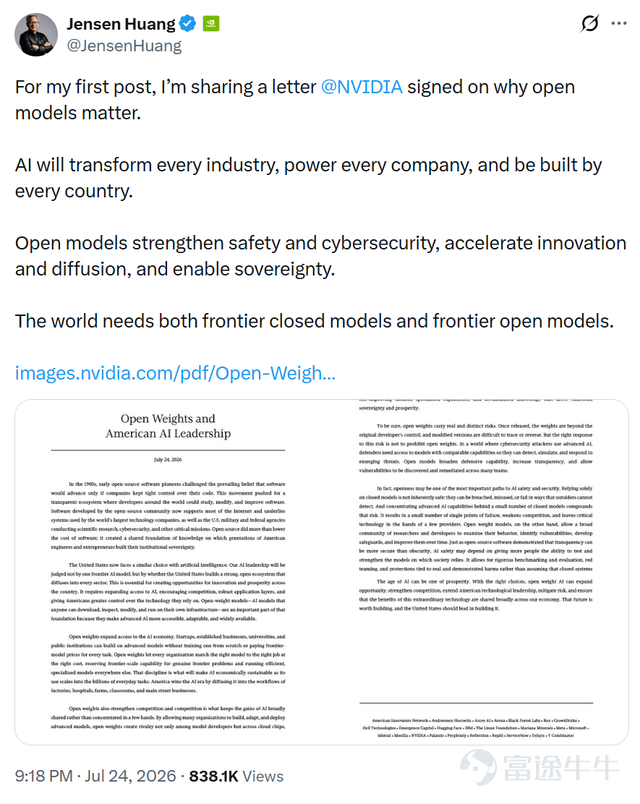

In his first-ever tweet, Jensen Huang joined forces with Microsoft, Meta, and other companies to speak favorably about Chinese open-source models.
On July 24, Jensen Huang made a rare move by signing up for X, and his first post was a lengthy thread. Alphabet AI summarized this long post.

The post contained a document co-signed by NVIDIA, Microsoft, Meta, IBM, Hugging Face, Andreessen Horowitz, and other organizations and companies, extensively discussing the impact of open-weight (open-source) models on the United States.
Although the document did not explicitly state it, its underlying message clearly supported Chinese AI companies such as DeepSeek, Zhipu, and Kimi. It emphasized that open-source models have played an extremely important role in advancing AI development not only in the U.S. but globally.
01
The document first reviewed the historical development of open-source software.
In the 1980s, open-source pioneers challenged the notion that 'software could only advance under strict corporate control of code.' Since then, open-source software has gradually become a foundational element for the internet, technology companies, the U.S. military, and federal research institutions. It has not only reduced software costs but also fostered a shared knowledge ecosystem, providing long-term support for U.S. technological innovation, entrepreneurial ecosystems, and self-reliance capabilities.
The document argues that the U.S. currently faces a similar choice in the field of AI.
To achieve leadership in AI, the U.S. cannot rely solely on a single most advanced closed-source model; success also depends on building an open, competitive ecosystem capable of penetrating diverse industries.
Although open-weight models do not necessarily disclose training data or full training processes, they can significantly enhance the customizability and dissemination of advanced AI.
The document then specifically outlined the value offered by open-weight models.
First, lowering the barrier to AI adoption.
Enterprises, universities, research institutions, and public sector organizations no longer need to train models from scratch or pay the high costs of cutting-edge closed-source models for every task. They can select appropriate models based on cost and requirements, reserving their most powerful capabilities for truly difficult problems and using more efficient specialized models for routine tasks.
This facilitates the adoption of AI in factories, hospitals, farms, schools, and small and medium-sized enterprises.
Second, it promotes market competition.
Open weights enable more organizations to develop, fine-tune, and deploy advanced models, thereby driving competition among models, chips, cloud services, and applications. Competition accelerates innovation, lowers prices, and prevents AI from being monopolized by a few large corporations.
Third, it enhances user control.
Organizations can maintain full control over their data, customize models, and choose their deployment environments, reducing reliance on any single vendor. At the same time, enterprises can retain the value generated through model improvements, specialized expertise, and accumulated knowledge, thereby strengthening their technological autonomy.
Fourth, it improves security and defense capabilities.
The document acknowledges that once model weights are released publicly, they cannot realistically be withdrawn, and modified versions are difficult to track.
The document argues that banning open weights is misguided.
Because when attackers use advanced AI, cybersecurity defenders also need access to models of comparable capability. Open models can undergo broader scrutiny, red-teaming exercises, and vulnerability research, preventing advanced capabilities from being concentrated in a few closed-source systems and creating single points of failure.
The document emphasizes that closed-source software is not inherently secure; on the contrary, transparency may help society identify and fix issues more quickly.
The document recommends that the United States expand access to computing power for startups and researchers, invest in shared datasets, development tools, and evaluation frameworks, and avoid imposing premature or overly broad restrictions on open models, which could stifle competition or drive innovation overseas.
The document also explicitly distinguishes 'model distillation' from illegal theft.
The document states that using the output of one model to train or improve another is a common technique for model optimization, evaluation, and validation, and should not be categorically deemed infringement. Illegal value extraction targeting closed-source models should be addressed through targeted legal and commercial rules, rather than through sweeping restrictions on legitimate technical research.
02
Full translation
Below is the full translation:
In the 1980s, early pioneers of open-source software challenged a then-dominant belief: that software could only advance if companies tightly controlled their code. That movement advocated for a transparent ecosystem where developers worldwide could study, modify, and improve software. Today, software developed by open-source communities underpins much of the internet’s infrastructure and forms the foundation of systems used by the world’s largest technology companies. The U.S. military and federal agencies likewise rely on this software for scientific research, cybersecurity, and other critical missions. Open source has not only reduced software costs but also established a shared knowledge base upon which generations of American engineers and entrepreneurs have built institutional autonomy.
Today, in the field of artificial intelligence, the United States faces a similar choice. The measure of U.S. AI leadership will not be any single cutting-edge AI model, but whether the U.S. can build a robust, open ecosystem that permeates every industry. This is essential to creating nationwide opportunities for innovation and prosperity. Achieving this goal requires expanding AI accessibility, encouraging competition, building a strong application layer, and giving Americans greater control over the technologies they depend on. Open-weight models—AI models that anyone can download, inspect, modify, and run on their own infrastructure—are an indispensable component of this foundation. Such models make advanced AI more accessible, easier to adapt, and more widely deployable.
Open-weight models broaden access to the AI economy. Startups, established companies, universities, and public institutions can build upon advanced models without training them from scratch or paying premium prices for cutting-edge models for every task. Open weights allow every organization to match the right model to the right job at an appropriate cost: only truly frontier problems require frontier-scale capabilities, while other scenarios can run efficient, specialized models. As AI expands to billions of everyday tasks, this rational allocation of resources is what will ensure AI’s economic sustainability. For the U.S. to win the AI era, AI must become embedded in the daily workflows of factories, hospitals, farms, classrooms, and small businesses across neighborhoods.
Open-weight models also strengthen competition—the key mechanism ensuring that the benefits of AI are broadly shared rather than concentrated among a few. By enabling many organizations to develop, fine-tune, and deploy advanced models, open weights foster competition not only among model developers but also across cloud services, chips, applications, and various supporting services. This competition drives innovation, lowers costs, and ensures that the dividends of AI are widely distributed throughout the U.S. economy.
Open-weight models also grant customers greater control. As organizations increase their investments in AI, they want assurance that they won’t be locked into a single vendor’s platform or lose the knowledge and capabilities they’ve built up over time. Open-weight models enable organizations to retain control over their own data, evaluate and adapt models according to their specific needs, and deploy those models in any suitable environment aligned with their business requirements—thus safeguarding this autonomy. When organizations create value using AI, open weights ensure they truly own that value, including continuously self-improving models, specialized capabilities, and accumulated knowledge—all of which will drive U.S. autonomy and prosperity.
Admittedly, open weights do carry real and unique risks. Once weights are released, they are no longer under the original developers’ control, and modified versions are difficult to track or retract. However, the appropriate response to these risks is not to ban open weights. In a world where cyber attackers leverage advanced AI, defenders also need access to models of comparable capability to detect, simulate, and respond to emerging threats. Open models can expand defensive capabilities, enhance transparency, and enable diverse teams to collaboratively identify and patch vulnerabilities.
In fact, openness may be one of the most important pathways to achieving AI safety and security. Relying solely on closed-source models is not inherently safe: they too can be compromised, misused, or fail in ways invisible to external observers. Concentrating advanced AI capabilities within a handful of closed-source models actually amplifies these risks by creating a few critical single points of failure, stifling competition, and placing essential technologies in the hands of only a few vendors. By contrast, open-weight models allow a broad community of researchers and developers to scrutinize model behavior, identify vulnerabilities, build safeguards, and continuously improve the models. As open-source software has already demonstrated, transparency can be safer than obscurity; AI safety may similarly depend on enabling more people to test and strengthen the models society relies upon. Openness facilitates rigorous benchmarking and evaluation, red-teaming exercises, and the development of defenses against real, empirically verified harms—rather than assuming, without evidence, that closed-source systems are inherently more secure.
A robust AI ecosystem will not emerge automatically. Policymakers currently have a critical window of opportunity to act. Possible measures include expanding access to computing power for startups and researchers; investing in shared training resources such as datasets, tools, and evaluation frameworks; and avoiding premature restrictions on open models that could stifle competition or push innovation overseas, thereby ensuring diversity at the frontier of AI. These measures must also consider how to scale autonomously controllable AI applications across the entire economy through strong application-layer capabilities.
In shaping this ecosystem, policymakers should take care not to conflate legitimate model development techniques with improper appropriation of others’ work. Distillation—using the outputs of one model to help train or refine another—is a widely adopted technique for model improvement, evaluation, and validation. This practice continues a long-standing tradition: learning from existing technologies, building upon them, and enhancing them further. Since the rise of the open-source software movement, this tradition has consistently driven innovation. In contrast, illicitly extracting value from closed-source models does raise legitimate concerns. Such issues should be addressed through targeted legal and commercial frameworks—not through broad restrictions on techniques that play a vital role in AI innovation.
The AI era can—and should—be an era of widespread prosperity. With the right choices, open-weight AI can broaden opportunities, strengthen competition, sustain U.S. technological leadership, mitigate risks, and ensure that the extraordinary benefits of this technology are broadly shared across the economy. This future is worth building—and the United States should lead in building it. (Author: Miao Zheng) $NVIDIA (NVDA.US)$$Virtual Reality (LIST2139.US)$$Metaverse (LIST2567.US)$$NVIDIA Portfolio (LIST20882.US)$$Microsoft (MSFT.US)$$MICROSOFT-T (04338.HK)$$Meta Platforms (META.US)$$DeepSeek Beneficiaries (LIST23585.US)$$DeepSeek concept stock (LIST23584.SH)$
Risk Disclaimer: The above content only represents the author's view. It does not represent any position or investment advice of Futu. Futu makes no representation or warranty.Read more
Comments
to post a comment
1