
Storage giants launch collective buybacks: Where does the supercycle stand?

Earnings Season Options Strategy | SK Hynix: Will the US-listed ADR premium persist long-term? Beyond memory price hikes, here’s what else to watch in Q2 earnings
$SK hynix (SKHY.US)$ Q2 earnings will be announced at 9:00 AM on July 29, 2026 (Seoul time), which corresponds to the evening of July 28, 2026, Eastern Time. That day also happens to be when SKHY ADRs and Korean common shares $SK Hynix (000660.KR)$ are expected to resume mutual convertibility.
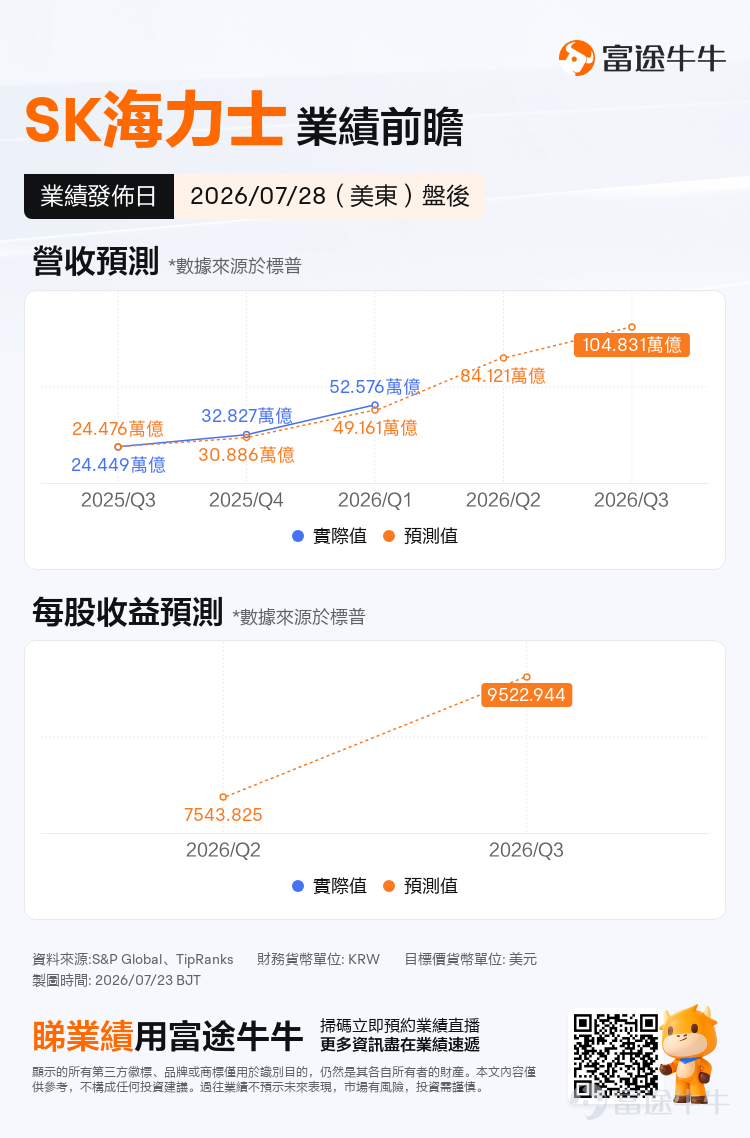
Based on market expectations, Q2 will most likely set another all-time record.Institutional estimates project Q2 2026 revenue of KRW 84.12 trillion and operating profit of approximately KRW 60–63 trillion,with an operating margin of roughly 74%–77%, and estimated earnings per share of KRW 7,543.825.。
What impact will the resumption of mutual convertibility on July 29 have on the US-listed premium? Consensus already expects memory prices to continue rising in Q3—what else should we watch for in Q2 earnings?
Even after mutual convertibility resumes on July 29, the price gap between the US-listed shares and Korean shares may persist over the long term.
As of July 24,SKHY trades at a premium of approximately 41.2% relative to its Korean-listed shares.(SKHY's latest price: $165. Korean-listed share 000660: KRW 1,759,000).
After July 29, SKHY ADRs and Korean ordinary shares are expected to resume mutual convertibility, meaning investors can exchange between the two securities through the depositary bank.Once the conversion mechanism reopens, if the channel for converting ordinary shares into ADRs operates smoothly, the most natural arbitrage trade would be to 'buy the cheaper Korean shares, convert them into ADRs, and sell the more expensive SKHY,' which would result in support for the Korean shares, increased supply of SKHY, and a narrowing of the premium.
However, the Korea Securities Depository (KSD) stated thatSK hynix has capped the total number of locally listed Korean shares eligible for conversion into ADRsCapped at 2.5% of total shares outstandingThe ADR issuance quota has already been fully utilized by the initial public offering. When ADRs are canceled and converted back into Korean ordinary shares, there is no separate quantitative limit; however, converting Korean ordinary shares into ADRs requires checking the remaining issuance quota.
This means thatThe price spread may persist at a certain level over the long term.Converting Korean ordinary shares into ADRs requires the depositary bank to open a book and is subject to constraints including the issuance cap, company approval, and broker operational capacity. Conversion timelines, fees, exchange rate fluctuations, and short-selling instruments all affect arbitrage profits.
Therefore, while the so-called 'resumption of mutual conversion' on July 29 is technically valid, initially only the direction of 'ADR-to-Korean-share conversion' is likely to be practically executable. Conversion from Korean ordinary shares to ADRs is theoretically permitted, but the initial remaining quota is zero;
Conversion of Korean ordinary shares into ADRs must wait either for others to first cancel their ADRs or for the company to raise the 2.5% issuance cap. Since ADRs trade at a premium, ADR holders lack incentive to convert them into lower-priced Korean shares, so the quota may remain unavailable for an extended period;However, if the company raises the conversion cap in the future, increasing ADR supply, the ADR premium could narrow rapidly.
It is already consensus that storage prices will continue rising in Q3—what else should we watch for in Q2 earnings?
1. There are no signs of relief in data center storage shortages, and storage prices may continue rising in Q3.
The main driver of Q2 earnings growth came from higher memory prices.In Q2, prices for commodity DRAM, server DRAM, and NAND continued to strengthen,Demand for high-capacity memory and enterprise SSDs from AI data centers also remained robust.
Q2 contract prices for conventional DRAM rose significantly compared to Q1,74%(PC +49%, Server +67%, Mobile ~80%, Consumer ~85%). Regarding NAND contract prices, overall Q2 CY26 NAND contract prices are expected to increase by approximately60%。
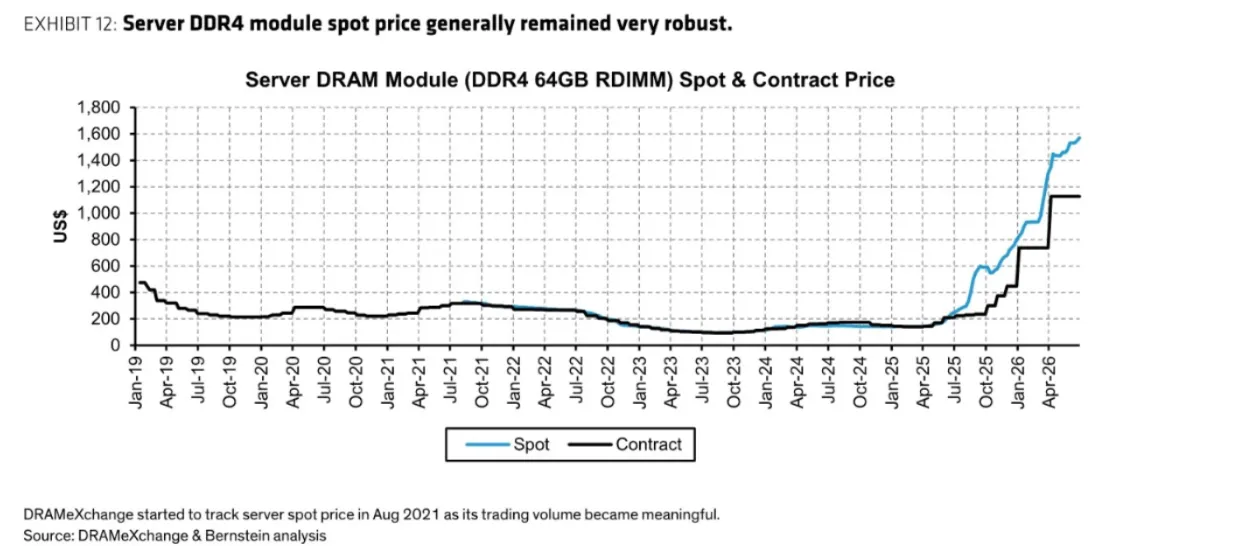
There are no signs of relief in the data center storage shortage. AI inference requires larger system memory, KV cache, and high-performance storage, broadening the beneficiaries beyond HBM. SK Hynix has prioritized allocating some wafer and advanced packaging capacity to HBM, which objectively constrained the supply of commodity DRAM and provided further support to server and general-purpose DRAM prices.
Storage prices may continue to rise in Q3.On July 20, Morgan Stanley semiconductor analyst Joseph Moore stated that Q3 prices for memory products of the same specifications would increase by at least 25% compared to Q2, and described weak signals from consumer markets such as PCs and smartphones as a 'false flag' that could mislead investors.
TrendForce is relatively more conservative but aligns on direction:It forecasts Q3 contract prices for traditional DRAM to rise 13%–18% quarter-over-quarter, and NAND to increase 10%–15%.Although their projected magnitudes differ, both point to continued price increases.
2. Progress on HBM4 will directly impact second-half valuations, especially amid intensifying competition.
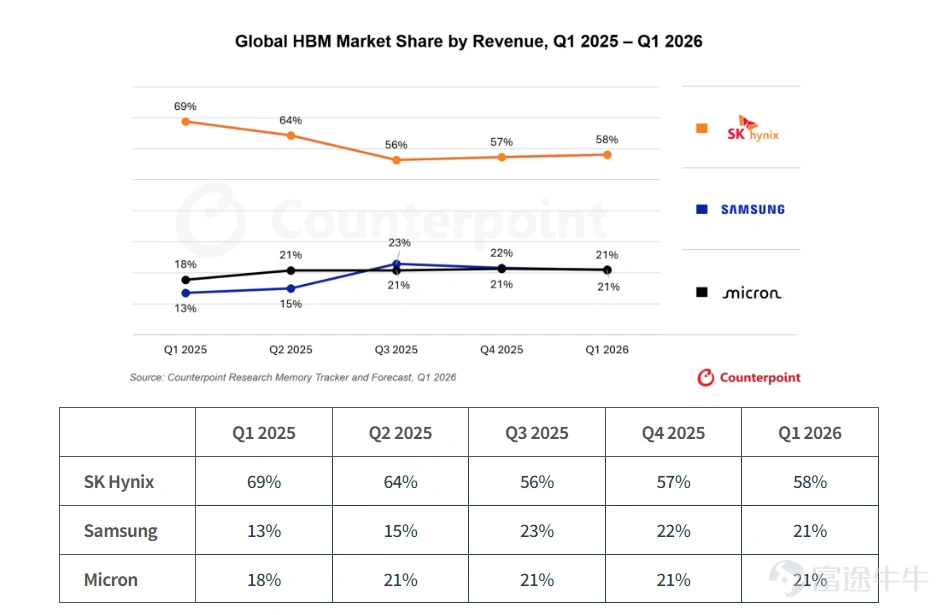
SK Hynix is currently the pricing anchor in the HBM market, with a market share more than 2.5 times that of $Micron Technology (MU.US)$ its closest competitor; as of July 2026, SK Hynix’s HBM revenue will still be primarily driven by HBM3E.In Q1 2026, SK Hynix held 58% of global HBM revenue share, compared to Micron’s 21%;
with the advent of HBM4, Samsung and Micron are no longer just 'also-rans.'Once Samsung completes certifications with more customers, SK Hynix’s market share and pricing premium will come under pressure.Micron disclosed that its HBM4 12-high ramp-up speed is twice that of HBM3E 12-high, with HBM4 revenue already exceeding $1 billion; mass production of HBM4E is expected to begin in 2027.
The market needs confirmation on whether volume deliveries can commence in Q3, whether customer validations are complete, and whether advanced packaging capacity and yields can support scale-up.HBM4’s revenue contribution in Q2 remains relatively limited; management’s commentary on Q3 shipments, product mix, and pricing carries greater forward-looking significance. If production ramps proceed smoothly, a slight Q2 shortfall relative to expectations could still be absorbed by the market; however, if delivery timelines slip further, earnings forecasts will need to be pushed out again.
3. Key customers continue to raise their capital expenditures.
On the demand side, attention should be paid to hyperscalers' capital expenditures and customer inventory levels. Alphabet has just raised its 2026 capital expenditure guidance from $180–190 billion to $195–205 billion.Google Cloud revenue grew by 82%, indicating that AI infrastructure investments continue to expand.
This is an additional positive demand signal ahead of earnings reports, providing support for HBM, server DRAM, and enterprise SSDs.
The risk lies in customers potentially front-loading orders due to concerns about supply shortages; once inventory targets are met, order growth could slow abruptly. Management commentary on customer inventory levels, follow-on orders, and 2027 demand coverage will influence market perceptions of the current cycle's duration.
4. Long-term agreement (LTA) terms also warrant close attention.
SK hynix has already locked in volumes and prices for its HBM, server DRAM, and certain NAND products through long-term supply agreements. Future asset estimates suggest LTAs now cover roughly half of the company’s revenue.UBS notes that some long-term agreements extend beyond five years and lock in a relatively high proportion of future volumes and pricing.
Long-term agreements enhance order visibility over the next few years but also reduce the company's ability to benefit from sharp spot price increases in the short term.Korea Investment & Securities has revised down its Q2 blended DRAM ASP sequential increase forecast from 50% to 28.9%, reflecting the gap between HBM LTA pricing and standard DRAM spot prices. Therefore, even if Q2 earnings fall short of earlier optimistic expectations, this may not necessarily signal weakening AI demand—rather, it likely reflects the market recalibrating the timing of LTA revenue recognition.
Investors need to assess whether 2027 contracts include price renegotiation clauses, cost pass-through mechanisms, or minimum purchase commitments. Strong volume guarantees help mitigate cyclical volatility, but if contract prices significantly trail the market, upside profit potential will be constrained.
5. The company's stance on memory prices and end-market demand is also critical.
SK Group management recently acknowledged that prices are relatively high. PC and smartphone manufacturers have limited cost tolerance, and end-market demand could be compressed due to price hikes. After 2027–2028, new capacity coming online could drive average selling prices (ASPs) lower.
Excessively high memory costs have already started squeezing profit margins for PC and smartphone manufacturers.If management acknowledges a noticeable slowdown in consumer electronics demand or forecasts a sharp deceleration in price increases in Q3, the market might front-run a peak in earnings growth. Capital expenditure plans should also be closely monitored. The recent ADR offering has strengthened the company’s financial position, but more aggressive capacity expansion would heighten supply pressures and investment return risks in 2027–2028.
Options strategies
The current share price has already priced in some earnings downgrades: after KIS released its revised operating profit forecast, the stock in Korea plunged nearly 15% in a single day. Therefore, if actual results land within the range of KRW 62–63 trillion and are accompanied by positive Q3 guidance, the market may trade it as a 'risk-off' scenario.
SKHY.US options market currently exhibitsa tug-of-war between bulls and bears in a high-volatility environment, with an implied volatility (IV) of 136.24%, historical volatility (HV) as high as 192.48%, and frequent unusual options activity recently—put option volume consistently exceeding call option volume, indicating significant market divergence.
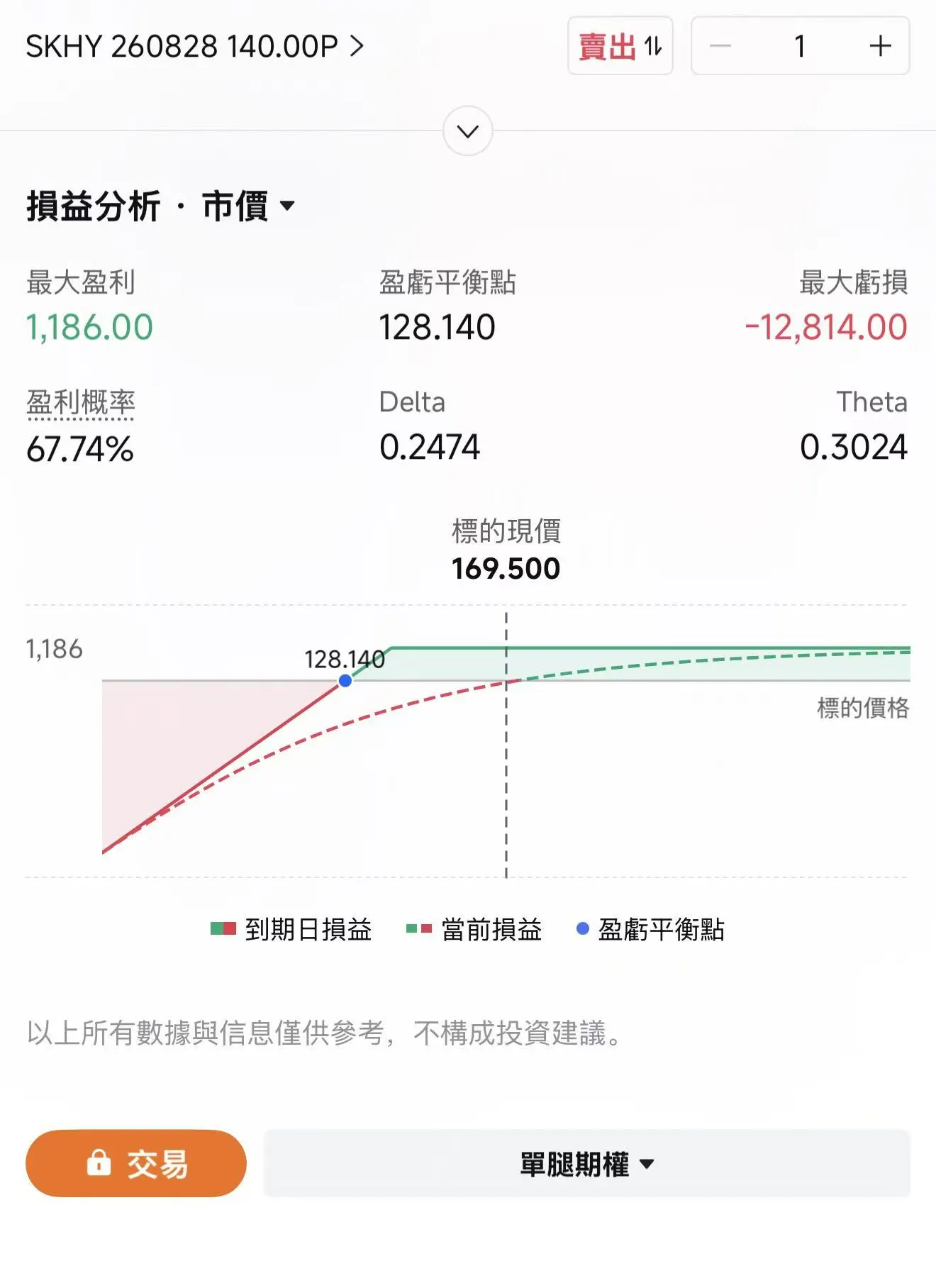
1Strategy 1: Selling cash-secured puts
Appropriate scenariosBullish on SKHY's medium- to long-term value and willing to buy the underlying stock at a low price.
This strategy is essentially a 'cash-secured short put.' If, at expiration, the stock price is above the strike price, the put option will not be exercised, and you get to keep the entire premium. If the stock price falls below the strike price, you can still acquire the corresponding number of shares at your predetermined price.
(The chart below illustrates the simulated profit/loss profile of this strategy at expiration. The displayed graphic is for demonstration purposes only and does not constitute investment advice or guarantees; market conditions change rapidly, and the prices shown do not reflect real-time data.)
Strategy 2: Bull Call Spread
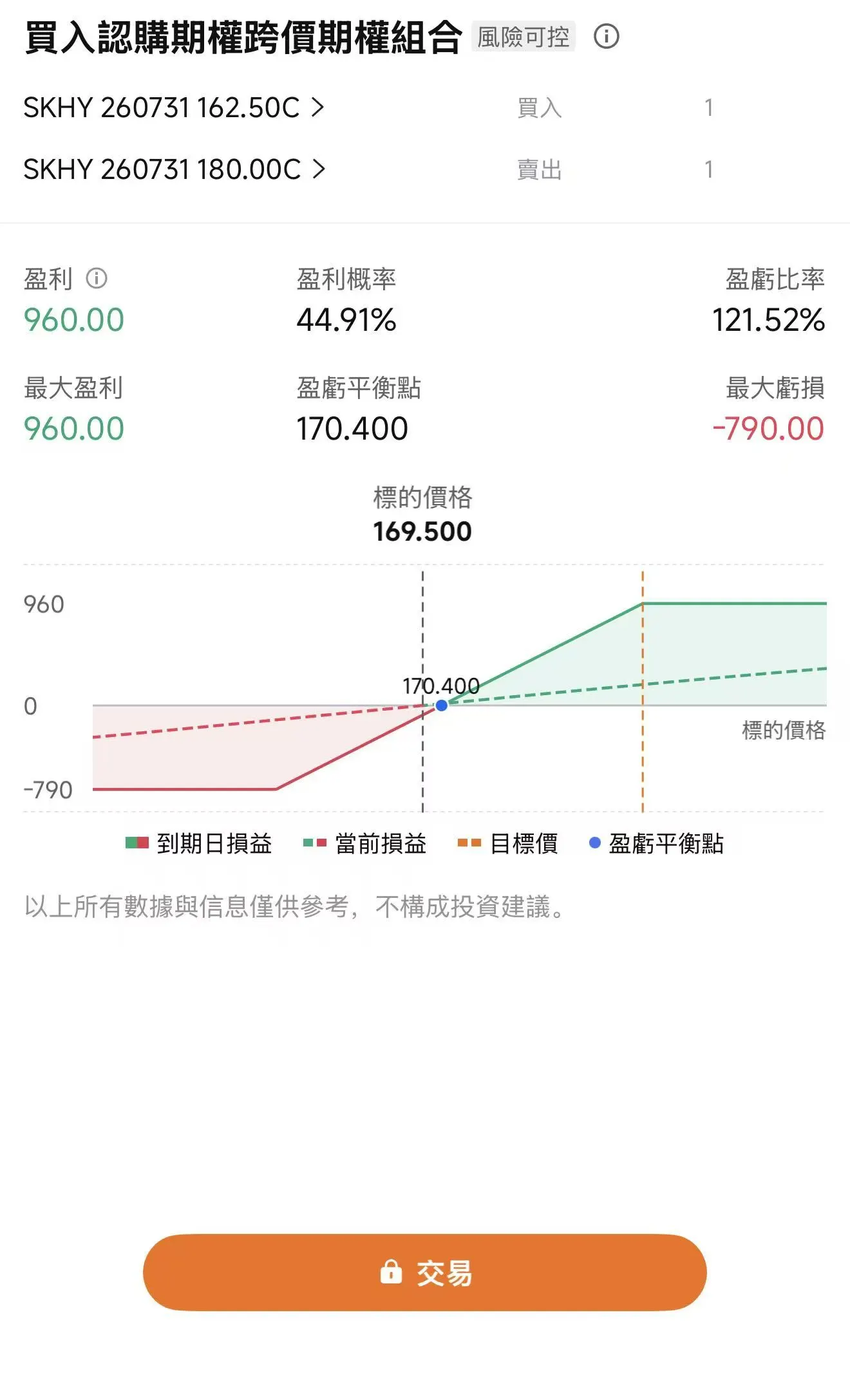
Appropriate scenariosBullish on a rebound following earnings, but unwilling to take on excessive premium risk
A Bull Call Spread involves buying a call option and simultaneously selling another call option with a higher strike price. This reduces the initial cost but also caps potential upside. The strike price of the long leg determines your 'entry point' for participating in upward moves, while the short leg’s strike should be set at what you consider a reasonable short-term target range. This structure covers most moderately bullish post-earnings scenarios and partially offsets the impact of elevated implied volatility by selling the higher-strike call.
(The chart below illustrates the simulated profit/loss profile of this strategy at expiration. The displayed graphic is for demonstration purposes only and does not constitute investment advice or guarantees; market conditions change rapidly, and the prices shown do not reflect real-time data.)
Finally, Options Sir has a small giveaway for fellow investors—feel free to claim it!Options Starter Pack
*This promotion is exclusively available to invited Hong Kong users. Click to learn more.Detailed terms and conditions of the promotion >>
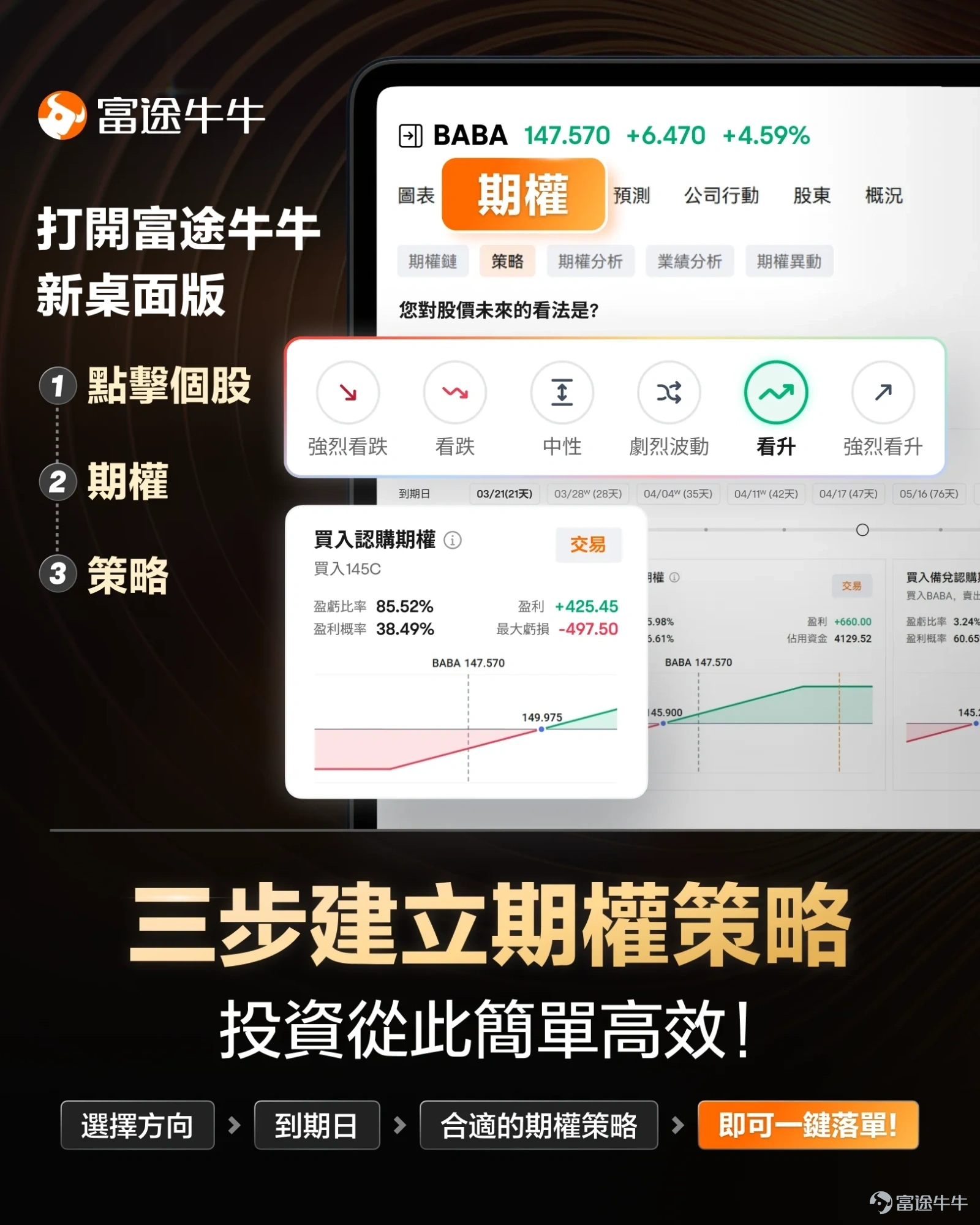
Market conditions are complex and ever-changing,Options strategiesToo many choices and unsure how to proceed? Let Futubull help you build a strategy in three simple stepsOptions strategies, making investing simple and efficient!
Options Risk Disclosure:An option is a contract that grants the holder the right—but not the obligation—to buy or sell an underlying asset at a predetermined price on or before a specified date. Option prices are influenced by multiple factors, including the current price of the underlying asset, the strike price, time to expiration, and implied volatility. Implied volatility reflects the market’s expectation of future price fluctuations over the life of the option; it is derived by reverse-engineering the Black-Scholes pricing model and is commonly viewed as an indicator of market sentiment. When investors anticipate higher volatility, they may be willing to pay more for options to hedge their risk, resulting in higher implied volatility. Traders and investors use implied volatility to assess the attractiveness of option prices, identify potential mispricings, and manage their risk exposure.
Disclaimer:This content does not constitute an offer, solicitation, recommendation, opinion, or any form of guarantee regarding any securities, financial products, or instruments. The risk of loss in trading options can be substantial. In certain circumstances, your losses may exceed the initial margin deposit. Even if you place contingent orders such as 'stop-loss' or 'limit' orders, there is no assurance that losses will be avoided, as market conditions may prevent execution of these orders. You may be required to deposit additional margin on short notice. If you fail to meet such margin calls within the stipulated time, your open positions may be liquidated. You remain fully liable for any resulting deficit in your account. Therefore, prior to trading options, you should thoroughly research and understand how options work and carefully consider whether such trading aligns with your financial situation and investment objectives. If you trade options, you should become familiar with the procedures for exercising options and handling expiration, as well as your rights and obligations upon exercise or expiration. Options trading involves significant risk and is not suitable for all investors. Investors should carefully read"Characteristics and Risks of Standardized Options"。
Risk Disclaimer: The above content only represents the author's view. It does not represent any position or investment advice of Futu. Futu makes no representation or warranty.Read more


Comments (9)
to post a comment
48
76