US Stock Market Chat | NVIDIA is about to report earnings; can it avoid a drop this time?

US Equity Warrants Watch | Tesla Plunges Sharply, Google Gaps Down – What to Truly Avoid Is 'Right Direction, Wrong Terms'
On July 23, US individual stocks saw significantly heightened volatility. Tesla plunged 14.52% in a single day, Google A dropped 7.13%, Amazon fell 4.57%, and Meta declined 3.36%. On the other hand, Micron Technology rose 3.20% against the market trend, while Apple pulled back 1.30% from recent highs.
Such market conditions easily prompt investors to chase gains or losses impulsively. However, looking at the terms of Hong Kong-listed US equity warrants, many stocks have only one or two available products, with significant differences in strike prices and degrees of moneyness. Even if the directional view is correct, certain products may still not be suitable instruments.
Below are five stocks whose warrant terms differ most notably and warrant closer examination.
Tesla$Tesla (TSLA.US)$ : After a 14.5% drop, bearish products appear more reasonable—but that doesn’t mean they’re immediately suitable for entry.
Tesla closed at $319.69, down $54.32 in a single day, hitting an intraday low of $315.735 with significantly higher trading volume. The share price has broken below the lower Bollinger Band around $346, and the short-term RSI has fallen to approximately 15, indicating extreme oversold conditions.
There is currently one call warrant in the market with a strike price of $490, about 37.1% out-of-the-money, expiring in October, offering an effective leverage of roughly 9.3x. However, it has a delta of only around 12%, a premium of approximately 38.4%, and daily time decay of about 3.6%.
This product is very typical: while it appears to offer nearly 10x gearing, the stock price would need to rebound from $319 all the way to nearly $490—a very wide gap. Even if Tesla experiences a 10% technical bounce, the warrant could still suffer from its low delta and a potential decline in implied volatility.
On the bearish side, there are two put warrants with strike prices of $330 and $340—approximately 4.9% to 7.6% out-of-the-money—maturing in December, with deltas of roughly 32% to 36%, implied volatility around 54%, effective gearing of about 3.5x, and premiums of approximately 15% to 17%.
These put warrants are at least closer to the current spot price in terms of strike level, offering noticeably better directional sensitivity than the call warrants. However, after Tesla’s single-day drop of over 14%, short-term implied volatility is typically already elevated. Combined with the severely oversold RSI, entering puts now exposes investors to dual risks: a potential price rebound and a subsequent drop in implied volatility.
For those already bearish on Tesla, a more prudent approach isn’t simply chasing high gearing, but rather waiting for a rebound and then observing whether implied volatility on put warrants has declined. Existing call warrants resemble high-risk instruments suited only for a major rebound scenario—not appropriate as standard tools for modest technical bounces.
Google A $Alphabet-C (GOOG.US)$ : The stock price plunged sharply, but existing call warrants are too far out-of-the-money relative to the current price.
Google A closed at $317.69, down 7.13%. The share price gapped below the lower Bollinger Band at $338.27, with a noticeable increase in trading volume. The short-term RSI is around 36—not yet in extreme oversold territory—but the technical structure has weakened from its previous sideways consolidation.
Currently, there is only one call warrant available, with a strike price of $470 (approximately 42.2% out-of-the-money), expiring in December. It has an effective gearing of about 8.4x, implied volatility of roughly 39.8%, delta of approximately 13%, and a premium of about 43.7%.
The main issue with this type of product is straightforward: even if the stock rebounds from $318 to $350—a gain of roughly 10%—it would still be far from the $470 strike price. The low delta means the warrant may not respond sensitively to the initial rebound in the underlying stock, while the high premium implies that a larger price increase is needed to offset time decay.
Therefore, even if investors believe Google’s recent drop was excessive, the existing call warrant is not an ideal instrument for bottom-fishing. Being bullish on a rebound does not equate to selecting this particular call warrant.
In the absence of more closely priced strike options, it is better to first observe whether the stock can reclaim the $338–$340 range, rather than rushing in solely because the warrant appears cheap.
Amazon $Amazon (AMZN.US)$ : Call warrant terms are relatively balanced, while put warrants are excessively deep out-of-the-money.
Amazon closed at $233.66, down 4.57%, hitting an intraday low of $232.052. The share price neared the lower Bollinger Band at $230.72, with a short-term RSI of approximately 25, technically entering oversold territory.
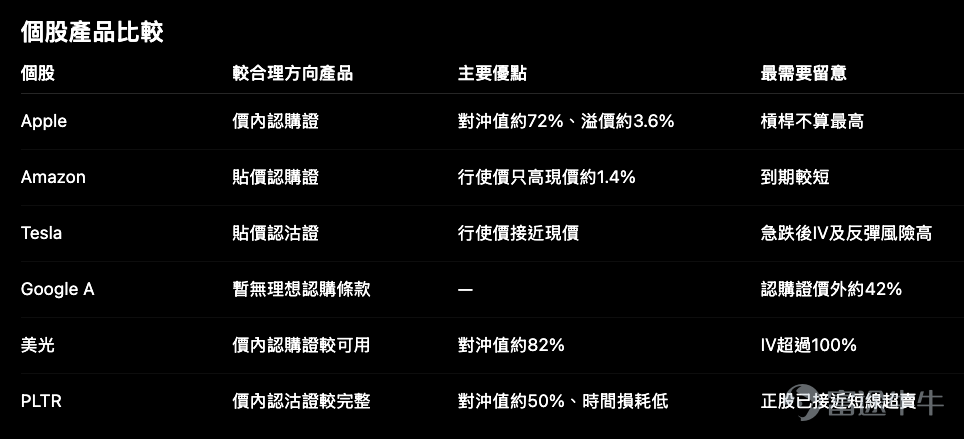
The call warrant has a strike price of $245 (about 1.4% out-of-the-money), expires in September, features an effective gearing of roughly 7.8x, implied volatility of approximately 43.7%, delta of around 50.5%, a premium of about 7.9%, and daily time decay of roughly 1.27%.
Among the current Amazon stock-linked products, this is a relatively complete set of bullish terms. The strike price is close to the current share price, with a delta of approximately 50%. If Amazon’s stock rebounds from the $230–$234 range to $245–$250, the product should theoretically exhibit a clearer price response.
Note that there are only about two months left until expiry. If the stock price merely trades sideways, time decay will gradually accelerate. Therefore, this product is better suited for investors who have a clear expectation of the timing of a rebound, rather than those planning to wait patiently for a price recovery over an extended period.
The put warrant has a strike price of $180, which is about 25.5% out-of-the-money, expires in December, and carries a delta of only around 12% and a premium of approximately 27.7%. Although Amazon’s stock dropped significantly on the day, the warrant’s sensitivity would only increase substantially if the price falls closer to $180. If one merely expects the stock to test support near $220, this put warrant may not deliver an ideal response.
The conclusion regarding existing Amazon-linked products is clear: bullish structures offer more at-the-money terms, while bearish positions require expectations of a larger decline to be justified.
Apple $Apple (AAPL.US)$ The stock price remains high; in-the-money call warrants are more attractive than most US equity products
Apple closed at $321.66, down 1.30%, after earlier peaking at $334.99. The share price remains above the Bollinger Bands middle band at $311.49, and the overall uptrend structure remains intact. Near-term support is seen between $319 and $311, with resistance near $335.
The existing call warrant has a strike price of $300, already about 7.4% in-the-money, expiring in October, with an effective leverage of approximately 6.5x, implied volatility around 36.7%, delta of about 71.7%, a premium of roughly 3.6%, and daily time decay of approximately 0.52%.
Compared to deep out-of-the-money call warrants on Google, Tesla, and Nvidia, Apple’s product features clearly healthier terms. With a delta exceeding 70%, the warrant’s theoretical price can more fully reflect movements in the underlying stock—each $1 move in Apple’s share price translates into a meaningful change in the warrant’s value. Additionally, the low premium reduces the cost of chasing price moves.
The trade-off is that the effective leverage is only about 6.5x, far below the double-digit nominal leverage seen in deep out-of-the-money products. However, for investors aiming to capture Apple’s potential move from the $311–$320 support zone back toward the $335 resistance level, this in-the-money structure with higher delta is typically more reliable than chasing superficially high leverage.
The put warrant has a strike price of $248, about 23.5% out-of-the-money, with a delta under 6%, a premium of approximately 24%, and daily time decay exceeding 4%. Unless one anticipates a very sharp correction in Apple’s stock, this put warrant is unlikely to align well with typical short-term bearish strategies.
Micron Technology $Micron Technology (MU.US)$ The stock has the strongest price momentum, but its implied volatility is also the most extreme
Micron closed at $990.21, up 3.20%, rebounding from around $800 and approaching the Bollinger Bands midline at $990.38 again. The stock has exhibited very high volatility—having previously reached a high of $1,254.81—and remains in a high-volatility consolidation phase.
There are two call warrants in the market, with strike prices around $700 and $1,800, respectively.
The $700-strike call warrant is about 28% in-the-money, with a delta of approximately 82%, a premium of about 7.9%, and an effective gearing of roughly 2.3x. From a directional sensitivity standpoint, this is a relatively solid choice; however, its implied volatility is as high as approximately 101%, indicating that the product price embeds extremely high volatility expectations.
The other call warrant has a strike price of $1,800, which is about 85% out-of-the-money, with a delta of approximately 28% and a premium exceeding 90%. Even though its effective gearing is around 3.3x, it cannot overcome the issue of its strike price being far out-of-the-money.
On the bearish side, the put warrant with a $400 strike price is nearly 59% out-of-the-money, with an implied volatility of about 115%, a premium of approximately 61%, and a delta of only around 5%. This product is unsuitable for typical pullback strategies—although the stock has already dropped significantly from $990 to $850, it remains very far from the $400 strike price.
Micron’s dilemma isn’t a lack of volatility—it’s that volatility has become too expensive. While the underlying stock rises quickly, its warrants may not offer proportional upside potential, as any decline in elevated implied volatility would offset part of the stock’s gains.
For investors bullish on Micron, the in-the-money $700-strike warrant offers a relatively higher delta; deeply out-of-the-money call warrants are closer to bets on extreme upside rather than typical short-term bullish tools.

Also worth mentioning is PLTR. The stock closed at $123.37, with a short-term RSI around 30. There is currently a call warrant with a $200 strike price, about 60% out-of-the-money, carrying a premium of approximately 61% and daily time decay of about 4.1%—terms unsuitable for typical rebound strategies. In contrast, the put warrant with a $140 strike price is already about 12% in-the-money, with a delta near 50% and time decay of only about 0.27%, indicating a clearly more robust product structure. However, with the stock already nearing short-term oversold levels, chasing further downside requires caution against a potential rebound.
Final product reminder
Following this period of significant U.S. market volatility, three common misconceptions are most likely to arise:
First, assuming a product is cheap simply because its unit price is low. In reality, deeply out-of-the-money warrants often have low unit prices merely due to their low delta, which does not necessarily imply a high risk-reward ratio.
Second, comparing only effective gearing while ignoring delta. Some call warrants on Google, Tesla, and PLTR all offer around 8x to 9x gearing, but their deltas are only about 9% to 13%, meaning the products may react very modestly even if the underlying stocks rebound slightly.
Third, rushing to buy put warrants immediately after a sharp drop. After a single-day plunge in stocks like Tesla or Google, implied volatility (IV) may have already surged sharply. Even if the underlying stock falls further, a subsequent decline in IV could still dampen the upside of the put warrants.
Among this batch of products, Apple's in-the-money calls and Amazon's at-the-money calls have relatively more favorable terms; Tesla's at-the-money puts better reflect a bearish outlook, though timing of entry is more critical than the product itself. Although Micron Technology’s share price remains strong, its products’ high implied volatility significantly increases the difficulty of selection.
Being right about the direction of US stocks does not mean you’ve chosen the right Hong Kong-listed structured products. What truly matters is comparing how far the strike price is from the current market price, whether the delta is sufficient, and whether time decay and implied volatility could erode gains from movements in the underlying stock.
Risk Disclaimer: The above content only represents the author's view. It does not represent any position or investment advice of Futu. Futu makes no representation or warranty.Read more


Comments
to post a comment
3
1