
AI computing demand is booming! Is Neocloud positioned to ride the wave?

Daily options income strategy | Oracle's stock price nears last year's tariff-induced low; Mizuho reaffirms $320 price target—can the rebound continue?
I. Market Barometer
All three major U.S. indices rose across the board in the previous trading session. The cloud computing sector remained active, driven by sustained demand for AI infrastructure, and the high-volatility environment has created an ideal window for options-selling strategies.
II. Watchlist Highlights
Oracle: Stock price near last year's tariff low—can a rebound begin?
$Oracle (ORCL.US)$ The stock rose 4.67% in the previous trading session (July 21), closing at $127.05, with an intraday high of $127.42 and a low of $122.21. In the session before that, the share price plunged to a 52-week low of $120.03, just shy of last year’s tariff-driven low of $116.852.
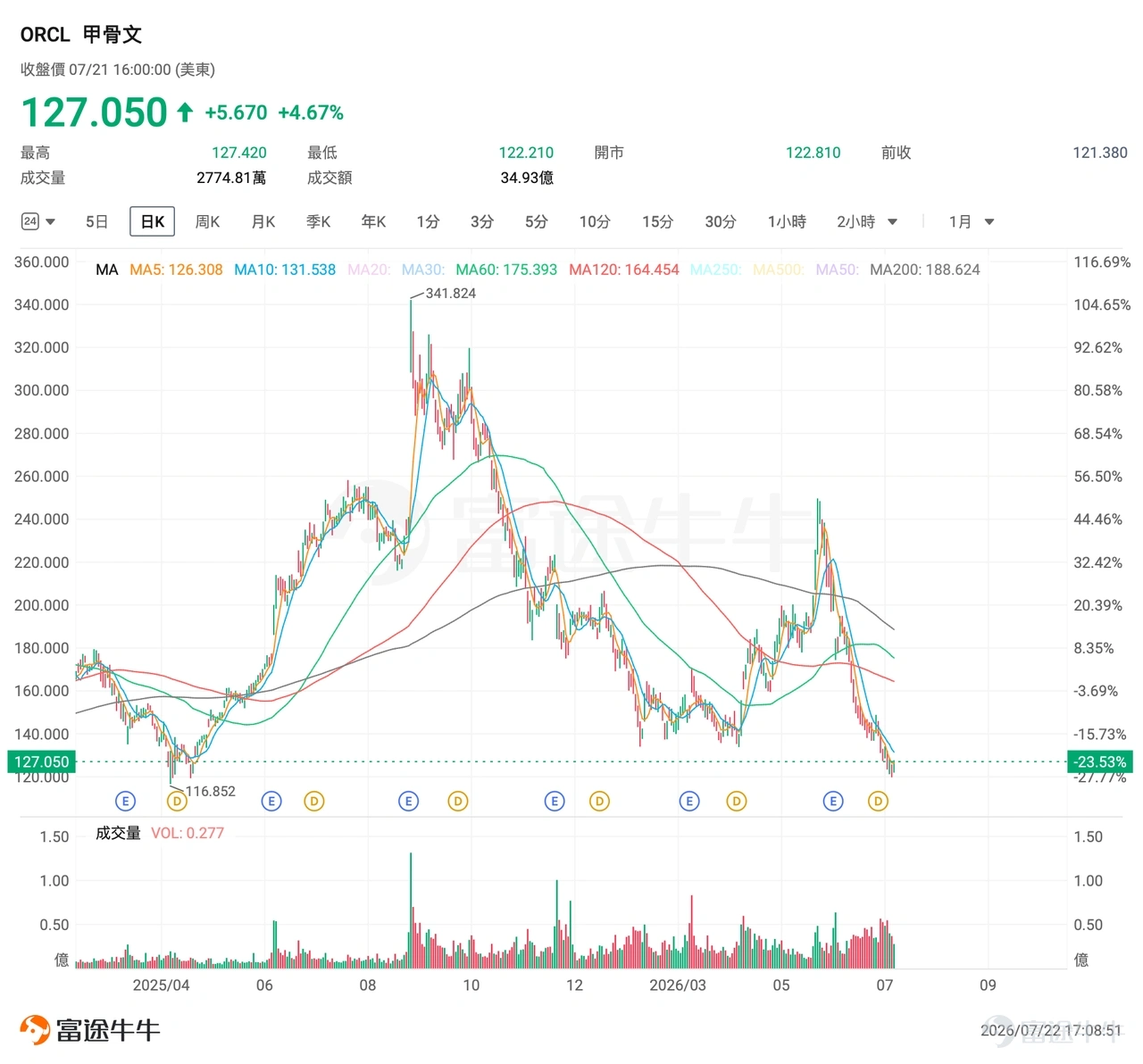
The current technical setup is in a recovery phase following a panic-driven sell-off.Since surging 36% in September 2025 on news of its partnership with OpenAI, Oracle has declined roughly 60%. The stock hit a 52-week low of $120.03 on Monday and rebounded to around $127 on Tuesday, but remains well below key moving averages and sits in a technically weak zone. The RSI has recovered from deeply oversold levels, but a trend reversal has yet to be confirmed.
The core reason behind Oracle’s continued stock decline is market concern that its aggressive spending on AI is triggering a credit crisis.In its push to capture market share in AI infrastructure, Oracle allocated a staggering $55.7 billion in capital expenditures in fiscal year 2026 alone—a burn rate that immediately alarmed rating agencies. Earlier this month, S&P Global downgraded Oracle’s credit rating to BBB-, just one notch above 'junk' status, citing concerns that massive AI infrastructure spending could impair its debt-servicing capacity.
Markets are also worried that nearly half of Oracle’s $638 billion in remaining performance obligations (essentially backlog orders) comes from OpenAI.If OpenAI fails to fulfill its commitments, Oracle will face significant risk.
Oracle’s stock hit another 52-week low after local authorities in New Mexico once again denied a critical natural gas pipeline permit for its massive data center project, codenamed 'Project Jupiter,' potentially causing delays and adding billions of dollars in costs.
Market panic is also reflected in the cost of insurance against debt default.The cost of credit derivatives providing default protection on Oracle’s debt has recently surged to a historic high, indicating bond investors had already recognized the risk.
After consecutive declines, Oracle’s stock rebounded on Tuesday primarily due to:
On one hand, $NVIDIA (NVDA.US)$ on the same day, Oracle announced progress on its Vera Rubin platform, confirming advancement of its next-generation platform targeting 'terawatt-scale AI factories,' directly boosting confidence in the AI infrastructure supply chain;
on the other hand, a view emerged on Wall Street that 'the software sector deserves renewed attention.' This sentiment was reinforced by Mizuho Securities reaffirming its 'outperform' rating on Oracle with a $320 price target, arguing that after the sharp sell-off, Oracle now offers 'the most attractive risk-reward profile among covered stocks.'
Mizuho pointed out several near- and medium-term catalysts that could add further value to Oracle, including monetization of capacity extending into fiscal years 2027 and 2028, gradually easing financing pressures, and a potential credit rating reassessment.
3. Options Premium Collection Strategy
1. Cash Secured Put
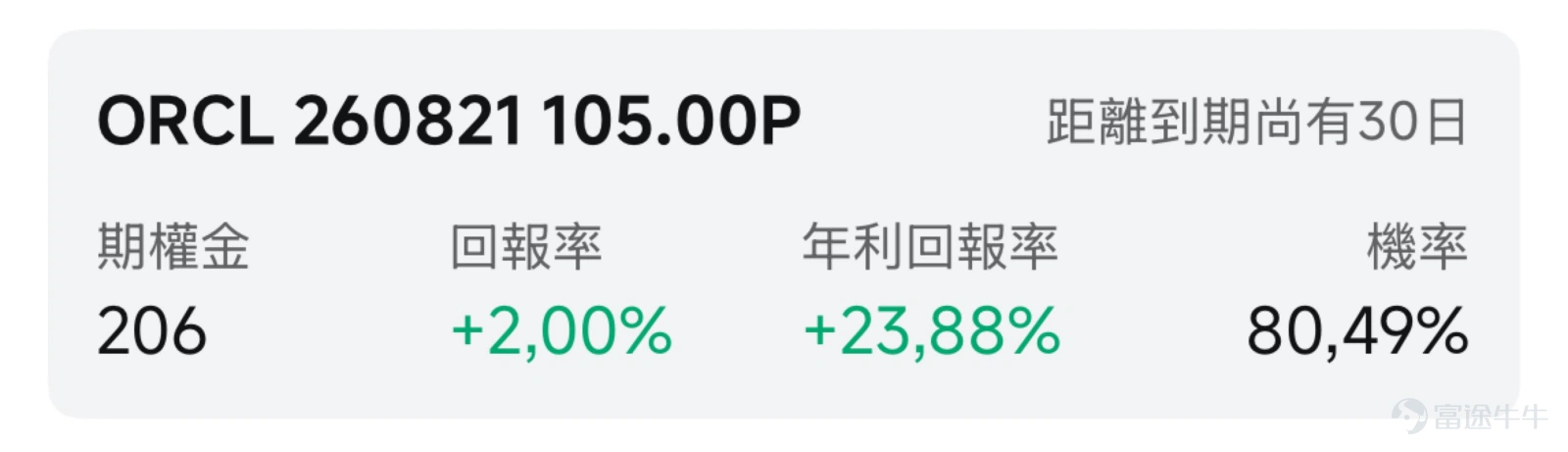
Sell 1 contract of $Oracle (ORCL.US)$ ORCL 260821 105P; estimated margin requirement (for reference only): $10,500 ($105 × 100)
Opportunity Rationale:
For investors who acknowledge the long-term value of AI cloud infrastructure but have not yet established positions, Oracle is currently trading near its 52-week low amid multiple headwinds, as market panic over AI capital expenditure has driven the stock significantly lower from its peak.
By selling put options, investors can collect premium income in this high-volatility environment if the stock stabilizes or rebounds from current lows; if the share price declines further due to financing concerns, they may also have the opportunity to establish a position at an even more attractive cost basis.
2. Covered Call
Opportunity Rationale:
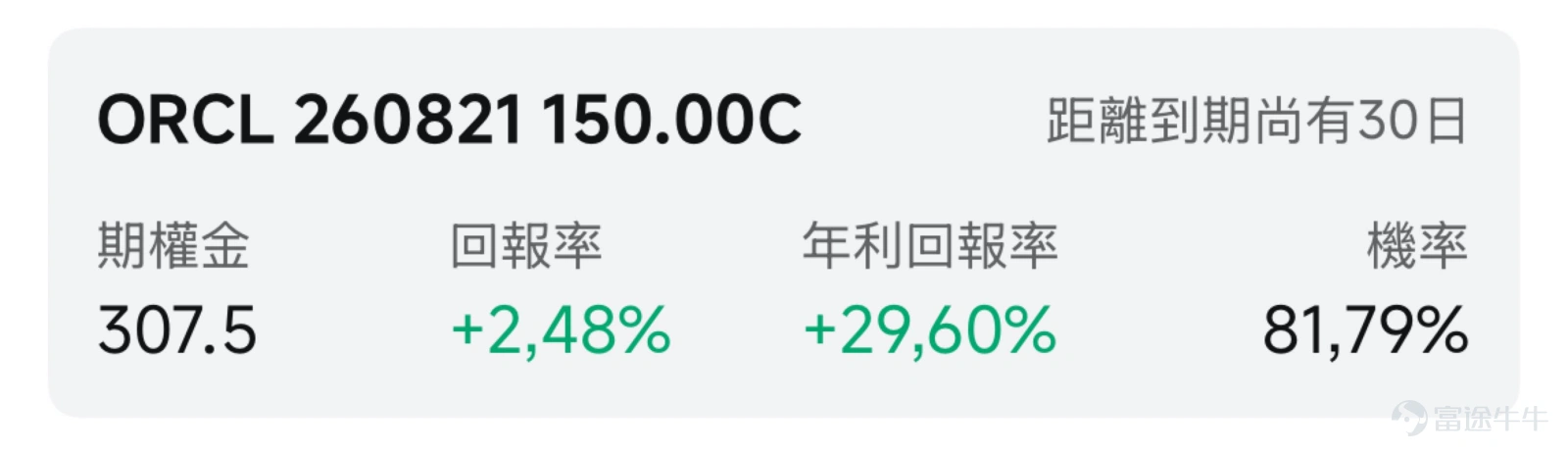
For investors already holding Oracle, the stock is currently trading near historic lows in the short term. If investors are bullish on the company's medium- to long-term AI computing business prospects but concerned about near-term uncertainties around project progress and financing pressures, they could consider selling call options. If the stock consolidates at these low levels, the premium income can gradually lower their cost basis; if the share price subsequently rebounds to around $150 and the option is exercised, it effectively realizes a staged profit-taking at a key resistance level.
IV. Risk Management Advisory
Although seller strategies have a high win rate, investors must still implement proper risk management:
– Position sizing is key:The biggest risk of option selling strategies lies in black swan events. It is recommended that the margin allocated to any single underlying asset should not exceed 20% of total capital. Never sell options beyond your risk tolerance just for the sake of collecting premium.
– Timely rolling of covered calls:If a covered call becomes deeply in-the-money (i.e., the stock price significantly exceeds the strike price) and you remain bullish on the underlying stock, promptly 'roll' the position—close the current option by buying it back and simultaneously sell a new call with a later expiration and a higher strike price—to avoid having your shares called away at an unfavorable price.
– Beware of 'left-tail risk' with cash-secured puts:For cash-secured puts, if the stock price crashes due to fundamental deterioration (rather than normal pullbacks), do not hold on stubbornly. In such cases, exit with a stop-loss or 'roll down' the position to buy time and wait for volatility to normalize.
Make good use of the Option Seller Hub to understand potential income strategies for selling options,Earn option premiums!
Make good use of the Option Seller Hub to understand potential income strategies for selling options,Earn option premiums!

Options Risk Disclosure
An option is a contract that grants the holder the right—but not the obligation—to buy or sell an underlying asset at a fixed price on or before a specified date. The price of an option is influenced by various factors, including the current price of the underlying asset, the strike price, time to expiration, and implied volatility. Implied volatility reflects the market's expectation of future price fluctuations over the life of the option; it is derived by reverse-engineering the option’s price using the Black-Scholes pricing model and is commonly viewed as an indicator of market sentiment. When investors anticipate greater volatility, they may be willing to pay higher premiums for options to hedge their risk, leading to higher implied volatility. Traders and investors use implied volatility to assess the attractiveness of option prices, identify potential mispricings, and manage risk exposure.
Disclaimer
This content does not constitute an offer, solicitation, recommendation, advice, opinion, or any guarantee regarding any securities, financial products, or instruments. Trading options involves substantial risk of loss. In certain circumstances, your losses may exceed the initial margin deposit. Even if you place contingent orders, such as 'stop-loss' or 'limit' orders, you may not necessarily avoid losses, as market conditions may prevent these orders from being executed. You may be required to deposit additional margin on short notice. If you fail to provide the required amount within the stipulated time, your open positions may be liquidated. Nevertheless, you remain liable for any resulting deficit in your account. Therefore, you should thoroughly research and understand options and carefully consider whether trading them is suitable for you based on your financial condition and investment objectives. If you trade options, you should familiarize yourself with the procedures for exercising options and handling expiration, as well as your rights and obligations upon exercise or expiration. Options trading entails very high risk and is not appropriate for all investors. Investors should carefully read the document 'Characteristics and Risks of Standardized Options' before engaging in any options trading strategy.
Risk Disclaimer: The above content only represents the author's view. It does not represent any position or investment advice of Futu. Futu makes no representation or warranty.Read more


Comments (4)
to post a comment
14
36