
In Conversation with Luo Yin of Zhongke Wenge: Avoiding Head-on Competition with Tech Giants and Focusing on Deep Vertical Industry Implementation
In his 1947 book 'Administrative Behavior,' Herbert Simon stated that an organization is first and foremost a decision-making process, and that decision-making is the essence of management.
In the complex and ever-changing business world, human rationality is limited, and integrating AI into decision-making will further enhance that rationality.
While the industry focuses on AI applications that can 'get things done,' the constant and critical decision-making process has not received commensurate attention. From micro-level scheduling on production lines to macro-level corporate strategy, every choice not only involves real financial stakes but can also determine ultimate success or failure.
Overseas, Palantir has emerged as a leader in decision intelligence through its FDE (Forward Deployed Engineer) model, demonstrating the immense value of AI in decision-making. However, there remains a significant cost chasm between its expensive customization and scalable deployment.
The next frontier for AI goes beyond content generation and process efficiency—it will move into factories, workshops, and offices, embedding itself deeply into more aspects of enterprise operations and management. With contextual grounding, AI now has the potential to directly participate in micro, meso, and even macro-level corporate decision-making.
AI adoption is accelerating, yet few applications are truly embedded into operational workflows. Key pain points include insufficient handling of trustworthy data, a disconnect between domain expertise and large models, and misalignment between processes and engineering that prevents closed-loop business workflows—collectively hindering the development of robust decision simulation capabilities.
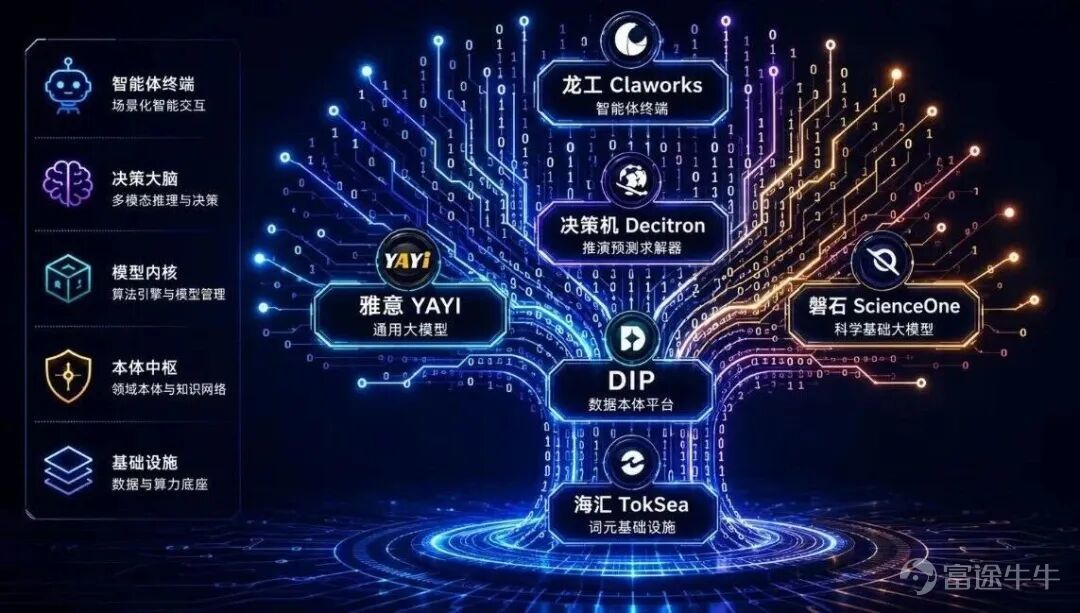
On July 18, at the World Artificial Intelligence Conference (WAIC), Zhongke Wenge, one of China's leading decision intelligence companies, unveiled the industry’s first comprehensive AI decision-making product suite. This framework features a five-layer architecture—'Foundation, Hub, Core, Brain, and Endpoint'—aiming to create an end-to-end chain linking data governance, business modeling, and intelligent agent execution, thereby building for enterprises a 'decision brain' capable of simulation, forecasting, and judgment support.
The Haihui TokSea Token platform is the foundation of the entire system,"Foundation". Serving as an enterprise’s intelligent infrastructure, it centrally manages and orchestrates computing power and model resources. Enterprises no longer need to worry about complex underlying resource allocation; through this platform, they can securely and efficiently leverage AI capabilities at scale—as easily as using water or electricity.
The DIP Ontology Data Platform is part of the system’s"Hub"In real-world scenarios, enterprises are scattered with all kinds of disorganized data. The DIP platform reorganizes this fragmented data into a logically coherent business network, enabling AI to truly understand how the enterprise actually operates.
The general-purpose large model "Yayi" and the scientific foundation model "ScienceOne" serve as the"Core"of the system, driving systemic thinking through algorithm engines and model management. Yayi handles general office and business processes, while ScienceOne specializes in advanced scientific computing and industrial R&D. Together, they combine commercial common sense with deep scientific expertise.
Decitron Decision Engine is the central"Brain"of the system. While general-purpose large models answer questions about the present, the Decision Engine’s role is to compute the future. Similar to war-gaming simulations, it models causal relationships and multi-party strategic interactions under various complex scenarios to help enterprises identify optimal solutions.
as"Endpoint"Clawork is the task-executing agent. Once the brain makes a decision, Clawork translates instructions into concrete actions, automatically invoking the appropriate tools to complete assigned tasks.
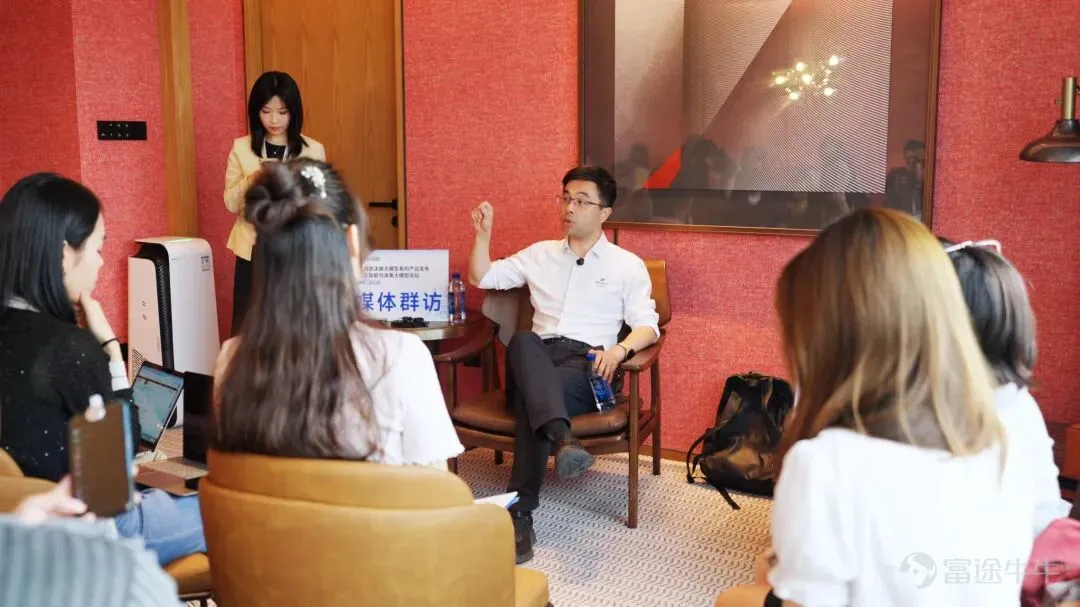
More than a month ago, Zhongke Wenge listed on the Hong Kong Stock Exchange. The market widely dubbed it as the 'first stock in decision intelligence' and attempted to analyze this venture—spun out of the Institute of Automation at the Chinese Academy of Sciences—through the lens of Palantir’s business model. Taking the opportunity of launching its full suite of AI-powered decision products, we spoke with Dr. Luo Yin, CEO of Zhongke Wenge. The following is an edited transcript of our conversation, condensed for brevity while preserving the original intent:
Q: In your view, what key shifts are currently taking place in AI product competition? What differentiated advantages does your company possess?
Luo Yin: This boils down to two kinds of 'brains.' One is the decision-making brain integrated into production and operational workflows; the other is the embodied brain that interacts with the physical world. These two brains determine how you make decisions within production processes and how you engage with the physical environment. We’ve chosen the decision intelligence path, while embodied intelligence focuses on the physical world—I believe both represent the biggest opportunities ahead.
Q: Large decision models primarily serve complex, high-value cognitive decision-making scenarios, which tend to be deeply industry-specific and relatively low in standardization. How does Zhongke Wenge ensure its decision large models maintain deep industry expertise while also achieving scalable, replicable product capabilities?
Luo Yin: We learn from leading international companies. While many have labeled us in certain ways, the path we’re on has proven successful. We must understand how each industry defines its own concepts and terminology. We can’t generalize decision logic in the same way we do with general-purpose foundation models.
Moreover, even highly capable general-purpose models often fail to deliver effective services when applied in specific industries—a fundamental contradiction. Therefore, we must stay grounded and rely on FDE (Functional Decision Engineering) and SOPs (Standard Operating Procedures), combined with large models, to truly enable industry-specific decision-making. In the past, without such models, the cost of development, deployment, and implementation for each client was extremely high. Today, we’ve reduced those costs by 90% and improved efficiency by 192 times.
Q: The AI industry is shifting from a focus on model parameters toward delivering tangible industrial value, with core capabilities evolving from understanding and generation to reasoning, prediction, and decision execution. Why do you believe decision intelligence will become the focal point of the next phase of development?
Luo Yin: I see this evolution as inevitable. Herbert Simon already addressed this issue: human decision-making is often incomplete and irrational. AI serves as a rational augmentation loop. Management, at its core, is a stack of decisions. Previously, we lacked the tools and systems to support this—but now, solutions are within reach.
Take industrial manufacturing: as production processes become increasingly automated, future operational decisions certainly won’t be made by CEOs alone. AI can instantly sense shifts in market demand and orchestrate supply chains accordingly, enabling systems to automatically reconfigure workflows. I believe that within five to ten years, numerous industries will move in this direction, freeing human effort to focus on strategic, top-level design.
Every enterprise calculates ROI. When chatbots fail to generate real production value, executives inevitably ask: 'After spending so much on tokens, what actual value did I get?' They’ll naturally turn to optimizing and upgrading their workflows. Countless granular processes within production remain untouched by AI and still operate under traditional information-system logic. We need to fundamentally reshape these into AI-driven workflows.
Q: Major tech firms are active in both the 'brain' (AI models) and 'end devices' (hardware). At WAIC, Zhongke Wenge unveiled a comprehensive system. In your view, what capabilities does Zhongke Wenge possess that big tech firms cannot easily replicate?
Luo Yin: Big tech firms adopt a general-purpose mindset—they aim to capture the entire market at once. However, in vertical domains, deep industry understanding requires extensive expertise accumulated over time. Moreover, data accumulated by industry experts is far less open than internet data, especially since much of it is protected due to confidentiality concerns.
In the field of general-purpose large models, leading enterprises have leveraged their traffic advantages to secure an early lead. Their accumulated data and rapid iteration cycles are creating significant generational barriers. Therefore, we’ve chosen to avoid direct competition and instead focus on deep implementation within vertical industries. By continuously accumulating domain-specific decision-making data and expert knowledge, we’re building professional moats across multiple sectors, thereby establishing irreplaceable partnership value.
Q: Will you expand into physical AI next?
Luo Yin: At the hardware execution layer, it’s indeed necessary to bridge the information layer with the physical world. This year, we’ve already achieved breakthroughs in manufacturing in East China, where our intelligent analytics system has been integrated with robotics to create a closed-loop automation—from anomaly detection to production process execution.
Q: In industrial applications of decision intelligence, which industries or operational stages are most likely to see explosive adoption?
Luo Yin: There are several potential breakout points, primarily concentrated in three areas. Materials science is poised to become the fastest-impact frontier. Unlike biopharma, which typically requires 5 to 10 years for R&D cycles, new materials can move from research to market in just 1–2 years, thanks to significant advantages in AI-for-Science (AI4S) methodologies, data accumulation, and industrial chain conversion efficiency. The second area is manufacturing—building an 'AI brain' for factories.
By replacing traditional plant managers’ experience with AI-driven optimization, we enhance production scheduling efficiency, reduce energy consumption, and automatically rectify production anomalies. Although current deployment faces challenges due to varying baseline conditions across factories—and will take time—the value proposition is immense. Finally, in social services and consumer sectors, AI can significantly accelerate the flow of goods and capital, further stimulating consumption and boosting overall operational efficiency.
Q: Decision simulation involves far greater computational load than single-turn Q&A, and token usage continues to rise this year. How does the company balance accuracy against cost in actual deployments? Where lies the future inflection point for value creation?
Luo Yin: On cost management, we segment decision simulation into three tiers: micro-level (high-frequency, production-linked), meso-level (daily scheduling), and macro-level (quarterly or annual strategic planning). For each tier—differing in frequency and context—we flexibly deploy models with appropriate parameter scales and compute requirements to ensure economic viability.
In terms of value assessment, the core of decision intelligence does not lie in the absolute cost per token consumed, but rather in the precision and professionalism of its outcomes. Although a single deep reasoning session may cost dozens of times more than that of a general-purpose large model, it delivers comprehensive, accurate, and expert-level strategic insights in one go, thereby avoiding the inefficiencies caused by users’ repeated trial-and-error. For enterprises, the business value generated by high-quality, trustworthy decision support fully justifies its cost.
Q: Beyond standard comparisons, through which core technical approaches has PanShi (ScienceOne) specifically achieved superior output quality compared to flagship general-purpose models like Gemini-3.1-Pro and GPT-5.5? In comparison with specialized models such as the AlphaFold series in protein structure prediction, how has PanShi managed to outperform them? Throughout the R&D and evaluation process, which particularly challenging scientific tasks did the team primarily overcome?
Luo Yin: PanShi’s (ScienceOne) advantages over other models stem from the principle that data determines intelligence. Leveraging the Chinese Academy of Sciences, we secured early access to high-quality, high-value scientific research data and established a secure, trustworthy training environment. Furthermore, through deep collaboration with researchers, we adopted a novel architecture that integrates scientific modalities—such as waveforms, spectra, and fields—with textual data for joint training.
This interdisciplinary integration enables the model to conduct cross-domain research like human experts—for instance, applying physics-based methods to solve chemistry problems—significantly elevating its intelligence. Regarding comparisons with specialized models like AlphaFold, the fundamental difference lies in data accumulation. PanShi is an L1-level foundational scientific large model designed to address general research tasks across multiple domains, whereas AlphaFold targets highly specific scenarios. In my view, what truly matters is the ultimate translational value of the technical approach.
Since the release of AlphaFold 3, no new drug development breakthroughs have directly emerged, indicating that merely elucidating protein folding structures does not automatically translate into commercial value. Therefore, during model training, clearly defining the end-use application and selecting the right research direction are far more critical than solely chasing superiority in isolated metrics.
Q: Zhongke Wenge’s Hong Kong IPO had an exceptionally strong debut, yet as decision intelligence is an emerging sector, the market inevitably focuses on its commercial validation timeline. In your opinion, what is the most critical trust barrier that decision intelligence currently needs to overcome?
Luo Yin: Everyone’s been watching stocks lately, right? (Laughs) I don’t pay much attention to stock prices. I believe that as long as the company operates excellently and our grasp of business and technology aligns with market trends, the stock price will naturally gain market recognition.
Among dozens of ventures spun out from the Institute of Automation at the Chinese Academy of Sciences, few initially believed in Wenge—but ultimately, Wenge became the first to go public. For us, the key lies in where we place our focus: whether to fixate on short-term capital market volatility or to concentrate on deeply integrating technology with real-world markets to create tangible value. My priority has always been the latter.
In fact, after the successful IPO, I feel even more energized than during the pre-listing sprint. With each new milestone achieved, we can now fully commit ourselves—diving deep into frontline industries to test and validate which business models are truly viable and which technologies deliver core value in real-world applications.
Q: There’s currently significant interest in FDEs (Forward-Deployed Engineers), who have helped companies like Palantir achieve notable results. In the Chinese context, do you think this will become the dominant deployment model going forward? Would embedding top-tier engineers directly on the front lines pose significant challenges for Zhongke Wenge?
Luo Yin: This is fundamentally a question of financial viability. Palantir can secure numerous global contracts worth over $100 million, giving it the confidence to hire large engineering teams—but this isn’t realistic in China’s current business environment. Domestic vendors must ensure their numbers add up, where product strength and standardization are most critical. Internally, our priority is standardization: by standardizing processes and thoroughly penetrating one vertical domain, replication into other areas becomes extremely fast. Although Palantir’s clients are all industry leaders, the sectors themselves are fragmented, inevitably requiring its Forward Deployed Engineers (FDEs) to possess exceptionally high cross-industry adaptability—at very high cost.
Our strategy is to go deep in one specific domain and cultivate specialized talent within that field. Once our product strength and degree of standardization are sufficiently high, the number of personnel we need to deploy on-site will drop significantly, making costs manageable.
Q: In a previous interview, you mentioned AI’s three evolutionary stages: computational AI, generative AI, and decision AI—with decision AI representing the highest form. How do these three relate to each other?
Luo Yin: We’ve discussed this internally—decision AI will likely dominate the next 5 to 10 years. Technically speaking, these stages aren’t mutually exclusive or replacement-based; rather, they’re layered and sequentially invoked. Just as humans use increasingly sophisticated tools, today’s generative AI can already call upon underlying computational AI tools. In the future, decision AI will invoke both generative and computational AI, creating a nested capability architecture.
Q: Decision-making differs from simple Q&A—it often lacks a single correct answer and involves highly complex scenarios. If decision AI intervenes and an error occurs, how should accountability be assigned?
Luo Yin: In micro-level operational scenarios like production execution, the goal of decision AI is to reduce error probability to an extremely low level. Analogous to autonomous driving, if AI can maintain an accident rate far below that of human drivers, users will readily accept a minimal margin of error.
At the operational level, AI rarely makes mistakes. Because it integrates with standardized operating procedures (SOPs) and robust data governance at the foundational layer, AI primarily performs calculations and planning based on clear rules and workflows—resulting in very high determinism.
At the strategic decision-making level, AI’s core value isn’t about 'making decisions for humans' but about 'exhaustively exploring all possibilities.'
Human decisions are often neither fully rational nor comprehensive. Decision AI, by contrast, can simulate high-probability events, medium-probability scenarios, and even 'black swan' events, presenting decision-makers with corresponding war-game outcomes. The ultimate responsibility for the final call still rests with humans.
Risk Disclaimer: The above content only represents the author's view. It does not represent any position or investment advice of Futu. Futu makes no representation or warranty.Read more

Comment (1)
to post a comment
1