
What's the Talk on US Stocks | A Quiet Week, but Are US Treasuries Poised for Turmoil?

At-a-glance Preview | Earnings season for US tech giants is here! Tesla and Google take the spotlight next week—can strong AI-driven profits continue to support their stock prices?
As mid-July approaches, the second-quarter U.S. earnings season has gradually begun.
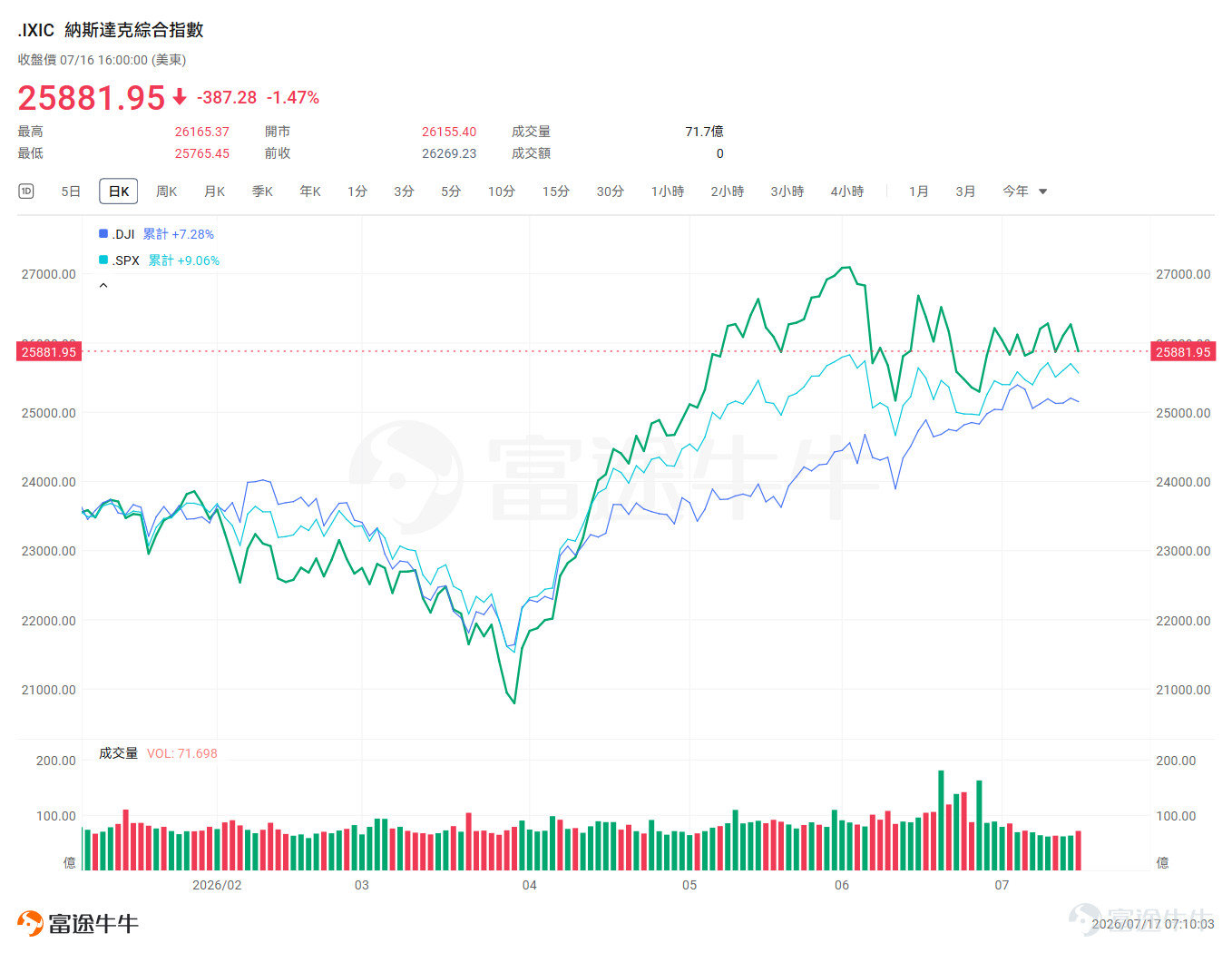
Buoyed by investor confidence in the AI-driven tech rally, the three major U.S. stock indexes surged collectively in the second quarter, repeatedly hitting record highs, $Nasdaq Composite Index (.IXIC.US)$ gaining over 21% for the quarter, $S&P 500 Index (.SPX.US)$ rising nearly 15%, $Dow Jones Industrial Average (.DJI.US)$ and climbing almost 12%. However, volatility intensified across the three major indexes in June; tech sectors such as memory chips continued to face downward pressure and corrections in July, fueling growing concerns about overall tech stock volatility.

Meanwhile, geopolitical tensions and unpredictable shifts in monetary policy are testing investors’ confidence and patience in the AI-driven tech theme, with the just-started Q2 earnings season serving as a key indicator to validate market direction.
According to Goldman Sachs, the U.S. equity market is poised for another strong earnings season.Goldman Sachs expects S&P 500 earnings to surge 22% year-over-year in Q2, with AI infrastructure-related stocks contributing nearly 60% of the growth, including $Micron Technology (MU.US)$and $NVIDIA (NVDA.US)$two companies together accounting for over 40%.If realized, this would mark the second consecutive quarter of earnings growth exceeding 20% for the S&P 500.

However, as U.S. equity valuations remain persistently elevated, earnings season could turn into a true 'two-way massacre'—beating expectations no longer guarantees a stock price increase, and even minor disappointments may trigger severe sell-offs, as market tolerance for earnings shortfalls has dropped to a low point. Notably,the theme this quarter is no longer simply 'beating expectations,' but whether strong earnings and guidance can effectively translate into upward momentum for stock prices.Investors will pay closer attention to companies’ views on forward orders and guidance for the next quarter.
The AI boom will continue, but can robust earnings keep supporting stock prices?
Goldman Sachs explicitly identified the AI investment boom as the top theme of this earnings season. Strategists wrote that Q2 earnings"will once again confirm strong earnings growth, underpinned by solid macro fundamentals and sustained enthusiasm around AI investments."Data shows that, in the United States,Second-quarter profits for information technology companies are expected to grow by nearly 60%, ranking second among S&P 500 sectors, just behind the energy sector’s 122%.

Major buyers of AI infrastructure— $Alphabet-A (GOOGL.US)$ / $Alphabet-C (GOOG.US)$ 、 $Amazon (AMZN.US)$ 、 $Meta Platforms (META.US)$ and $Microsoft (MSFT.US)$ —will report earnings in late July, with market attention focused on two key points:The sustainability and scalability of AI investment returns, and forward-looking guidance from companies on future capital expenditures.Google and Amazon have already begun showing early signs of returns on their capital expenditure investments last quarter.
Goldman Sachs’ report emphasizes that the market’s current focus is not so much on the performance of tech giants themselves—after all, hyperscale cloud providers’ AI spending is already evident—but rather onwhether a broader set of companies across the supply chain can translate AI-driven demand into actual profitability.Hyperscale cloud providers such as Microsoft, Amazon, Google, and Meta are betting on AI infrastructure at a pace exceeding their own operating cash flows. Whether this unprecedented wave of capital investment will generate sufficient returns has become the market’s most critical unresolved question.
Optimists argue this spending represents critical 'options' purchased for the future explosive growth of AI agents, enterprise tools, and new applications—and that returns will eventually materialize as costs decline and adoption scales. Pessimists, however, worry that recent delays in returns, potential oversupply, rising pricing pressures, and the emergence of cheaper alternatives globally could severely test whether enterprises can monetize AI in time—fueling concerns about valuation bubbles and concentrated position risks.
Against this backdrop,The Q2 earnings season serves as a crucial near-term test of whether tangible progress can be made on the path toward realizing returns on AI investments.
It is also worth noting thatthe market has become increasingly 'demanding.'U.S. tech stocks appear caught in a dilemma that leaves investors stuck between a rock and a hard place:Stellar earnings reports fail to lift share prices, while poor results trigger sharp sell-offs.The market is no longer satisfied with 'good'—it now demands 'sustained outperformance,' a test all AI-related tech stocks will soon face collectively.
Previously, $Taiwan Semiconductor (TSM.US)$ Yesterday, despite Q2 results that vastly exceeded expectations, the stock price fell more than 2%, as the market played out the classic 'buy the rumor, sell the news' pattern. $ASML Holding (ASML.US)$ On Wednesday, it reported quarterly results that beat expectations and raised guidance, yet the stock rose just over 2% on the day of the earnings release. Meanwhile, $IBM Corp (IBM.US)$ another company plunged more than 20% in a single day after issuing a profit warning.
Market analysts believe the core reasons are twofold: first, investors are concerned about lofty AI valuations and whether massive spending will yield adequate returns; sky-high earnings expectations have caused a severe disconnect between fundamentals and share prices. Second, the market is undergoing systemic deleveraging and a breakdown in momentum trading—positioning structures, not fundamentals, now drive price action. What’s currently steering price movements may no longer be fundamentals, but rather positioning dynamics and factor flows—which also implies that the bar for earnings expectations in the hardware sector has been set extremely high.
Investors now place greater emphasis on earnings quality, forward guidance, and whether valuations sufficiently justify current share prices.The market is closely watching whether tech giants’ ever-expanding capital expenditures will ultimately deliver sufficient returns. Companies must simultaneously demonstrate resilient profit margins, unchanged or improved full-year guidance, and evidence that earnings growth is broadening beyond a handful of AI and tech leaders to a wider swath of industries—only then will the market be willing to assign higher valuations.
 AI breaks down earnings highlights in seconds—set up in three stepsOptions Strategy! Open Futubull > Stock page > Tap [Company] >Earnings Flash
Risk Disclaimer: The above content only represents the author's view. It does not represent any position or investment advice of Futu. Futu makes no representation or warranty.Read more


Comments
to post a comment
7
1