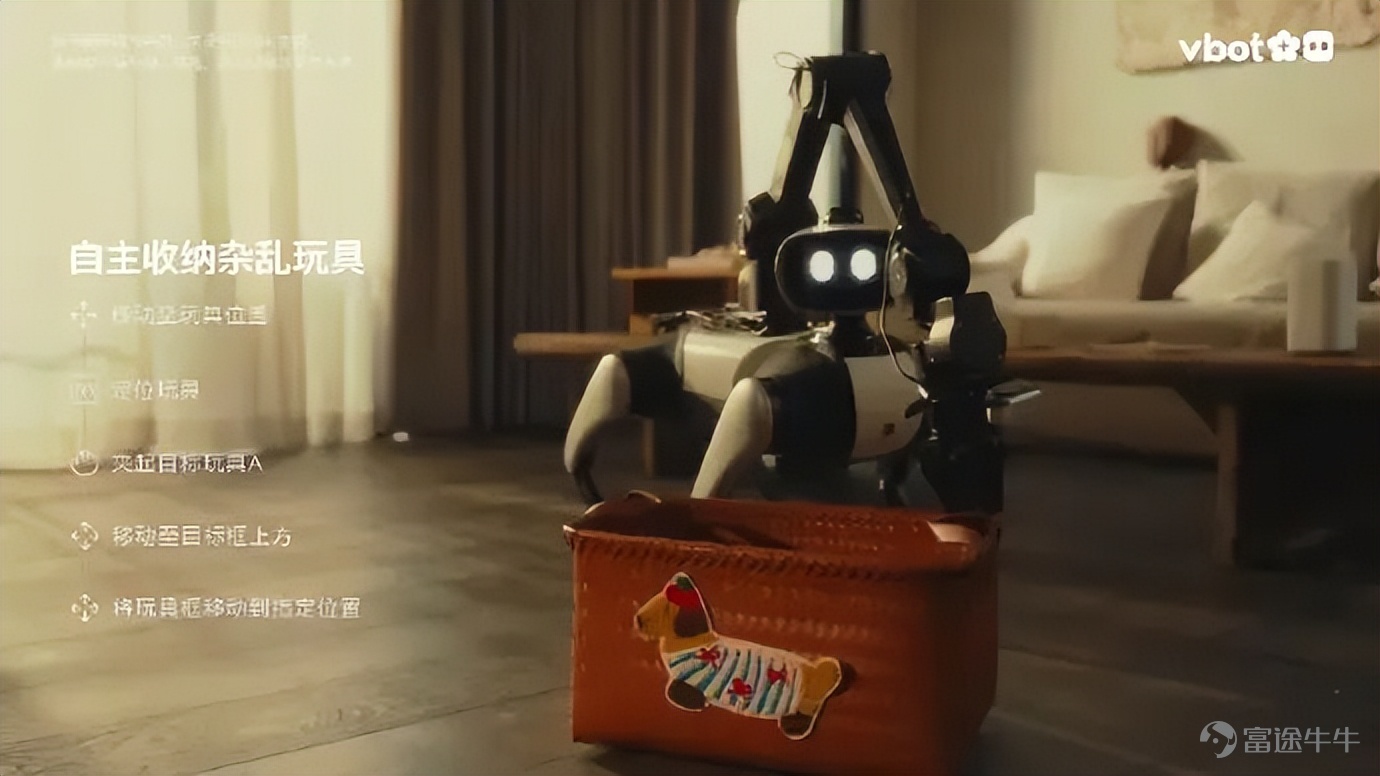

While others are racing to build humanoid robots, this company has given its robotic dog a hand.
Article author and source: 36Kr
Can it really get work done with just one arm?
Chinese robotics companies still have way too much imagination.
Today’s embodied intelligence companies either strive relentlessly to make robots look more human—complete with two legs, two arms, and ten fingers—or follow the quadrupedal path, making robotic dogs increasingly resemble smart, obedient real dogs.
Vitech Robotics, however, came up with a 'mythical chimera':
A robotic dog with an arm growing out of its back.
In July 2026, Vitech Robotics launched the 'Dadao EDU Edition.' This is a quadrupedal robotics platform designed for developers, labs, and enterprise R&D teams, featuring pre-reserved expansion interfaces on its back for components like robotic arms.
Simply attach a robotic arm to the expansion interface, and instantly you have a robotic dog with an arm on its back.
Aside from creating a 'mythical chimera,' Vitech Robotics has another interesting contrast.
Just two months ago, Vta Dynamics completed a Pre-A funding round of nearly RMB 500 million. Having been founded for just over a year, the company has now raised nearly RMB 800 million in total.
Yet to this day, Vta Dynamics has not launched a single humanoid robot.
Faced with the industry’s most mainstream—and capital-favored—direction, it didn’t rush to assemble a full human-like body for its robot. Instead, it mounted a robotic arm onto the back of a quadrupedal robot dog.
What exactly is the unconventional Vta Dynamics trying to achieve?
In videos released by Vta Dynamics, this hand mounted on the robot dog’s backhas already started doing real household chores.。
It can feed a cat with a spoon, pull open curtains, pick up scattered items from the floor, water plants, and even walk up to a washing machine, open the door, grab clothes, and press the start button.
Previous-generation robot dogs were mostly limited to following, companionship, and patrolling.Now that it has an extra hand on its back, it can finally do something meaningful once it reaches its target.
But getting a robotic arm to work alongside a robot dog is clearly not as simple as just bolting the two devices together.
A robotic arm fixed to a tabletop only needs to consider how its hand moves; in contrast, every time the arm mounted on the robot dog lifts, extends, or rotates, it shifts the entire robot’s center of gravity.
If the robotic arm wants to reach farther, the robot dog must adjust its stance; to pick up an object low to the ground, the dog has to actively lower its body; and when facing targets at varying heights and angles—like curtains or washing machines—its four legs must continuously coordinate with the arm to adjust position and orientation.


Throughout this process, the robot dog first needs to see the target and judge the distance, then move to an appropriate position, before finally letting the robotic arm perform the grasp, pull, or press.
To ensure this ‘hand’ performs well, Unitree Robotics has also invested considerable effort.
The Dajtou EDU is equipped with 128 TOPS of on-device computing power, along with a stereo depth camera and a 16-line LiDAR, enabling environmental perception, autonomous navigation, and object recognition.
Its back also features standardized expansion interfaces that integrate power, data, and control pathways, allowing the connection of robotic arms, grippers, and additional sensors. Developers can also use ROS 2 interfaces to combine the robot dog’s mobility with the arm’s manipulation capabilities.
In simple terms, the four legs get the robot to the worksite, and the ‘hand’ on its back gets the job done.
After solving these coordination challenges, Unitree Robotics has set high expectations for this ‘hand.’
Yu Yinan, founder of Unitree Robotics, believes that"Quadruped robot plus robotic arm" may represent the smallest viable unit for robots entering the home.
After all, to enable a robot to hand over an item, pick up clutter from the floor, press a switch, or draw the curtains, the most basic requirements are actually just two: it must be able to move freely around the house and manipulate objects in its environment.
The quadruped robot has already solved the first challenge, and the robotic arm mounted on its back addresses the second.
Compared with immediately tackling bipedal balance, dual-arm coordination, and fine manipulation with ten fingers, a four-legged platform with one arm is clearly a more practical starting point for handling certain household chores.
However, even if high hopes are placed on the 'quadruped robot plus robotic arm' combination, Vta Dynamics’ ambitions clearly extend beyond this.
The quadruped robot may be its first step into the home, but humanoid robots remain the company’s ultimate aspiration.
Humanoid robots have long been part of Vta Dynamics’ roadmap—it simply chose not to rush into launching its first product as a humanoid.
This approach is closely tied to Vta Dynamics’ team background.
Vta Dynamics was founded in late 2024. Its founder, Yu Yinan, previously served as President of Horizon Robotics’ autonomous driving division. The other two co-founders, Song Wei and Zhao Zhelun, also come from the autonomous driving teams at Horizon Robotics and Li Auto, respectively.
What this group of people used to excel at most was enabling a machine to understand its surroundings, plan a route, and safely navigate to its destination.
Applying this capability to robots,a robotic dog is clearly a more practical and immediately viable approach.
The locomotion capabilities of quadrupedal robots have already matured to a considerable degree—they can step over thresholds and climb stairs, avoiding the immediate need to solve the complex challenges of bipedal balance and full-body control. What Vitas Dynamics needs to add are primarily perception, navigation, interaction capabilities, and—most importantly—how to turn it into a product that ordinary consumers would actually want to buy and bring home.
Thus, Vitas Dynamics first developed a robotic dog that resembles more of an electronic pet.

With its rounded head and a screen on top dedicated to emotional interaction, 'Big Head BoBo' stands shorter than a child. Placed in a home, it clearly feels far less imposing than a 1.7-meter-tall humanoid robot.
However, Vitas Dynamics does not position it merely as a cute, acrobatic robotic toy.
Big Head BoBo emphasizes autonomous operation without remote control—it can follow users on its own, sense its environment, avoid obstacles, carry loads, record video while accompanying its owner, and even help monitor family members.
In December 2025, Big Head BoBo officially opened for pre-orders at a price of RMB 9,988.
During the pre-order period, it accumulated 6,540 orders. By May 2026, the first batch of 500 units rolled off the production line and began delivery to consumers.
In other words, while a wave of humanoid robots remains stuck in demo presentations and small-batch prototyping, Unitree has already shipped its robotic dogs to customers.
This allowed the company to run through the entire consumer robotics playbook ahead of its humanoid robot launch—figuring out cost control, supply chain setup, mass production, experience store rollouts, and how to convince ordinary consumers to spend nearly RMB 10,000 to bring a robot home.
Now, by adding an arm to the back of its robotic dog, Unitree is taking its product roadmap another step forward.
The earlier-generation BoBo solved the question of 'how to get the robot to the user'; with the addition of a robotic arm, Unitree is now exploring how the robot can 'get the job done' once it arrives.
From autonomous mobility to object interaction and manipulation, and eventually full-body coordination, Unitree is tackling the challenges inherent to humanoid robots one layer at a time.
All of this groundwork is ultimately aimed at Unitree’s long-cherished goal: humanoid robots.
In May 2026, Unitree completed a Pre-A funding round of nearly RMB 500 million. The proceeds will support large-scale production and sales network expansion for its robotic dogs, as well as R&D for its next-generation humanoid robot.
To accelerate this initiative, Unitree has also brought on Qin Hailong, former Chief Scientist at Qianli Autonomous Driving, who will lead R&D efforts in world models, spatial intelligence, Agent OS, and humanoid robots.
At this point, Unitree’s strategic path has become increasingly clear:
First, use robotic dogs to solve mobility and achieve product-market fit; then equip them with manipulators capable of interacting with objects. Once supply chains, mass production capabilities, and AI models mature sufficiently, tackle the ultimate challenge: bipedal locomotion, dual-arm dexterity, and full-body coordination in humanoid robots.
However, this approach also raises an unavoidable issue.
If Unitree Robotics ultimately aims to build a humanoid robot, is attaching a single arm to the back of a robotic dog really a good choice?
At least for now, it’s unclear whether mounting an arm on a robotic dog’s back is truly beneficial, but it certainly appears to be a more expedient path.
A fully functional humanoid robot must simultaneously solve challenges related to bipedal locomotion, whole-body balance, dual-arm coordination, and dexterous hand manipulation. If any of these components falls short, the robot will struggle to perform effectively in real-world scenarios.
Unitree Robotics has decoupled these challenges.
It first uses a quadrupedal base to address mobility and stability, while a robotic arm handles grasping and manipulation. This way, the company doesn’t have to wait for bipedal robots to mature fully or develop two arms and ten fingers all at once—it can already deploy robots capable of tasks like drawing curtains, passing objects, or pressing buttons, tackling a subset of real-world assignments.
For a venture that has existed for just over a year, this strategy is clearly more pragmatic.
More importantly, these efforts also enable Unitree Robotics to accumulate valuable data on mobility, object recognition, grasping, and human-robot interaction.
Even when the company eventually develops a humanoid robot—with a different form factor and mode of movement—the core capabilities related to environmental understanding, target identification, and translating verbal commands into physical actions will remain directly applicable.
But this shortcut could soon hit a ceiling.
After all, what one hand can do is ultimately limited.
Tasks like drawing curtains, picking up items, and flipping switches can be done with just one hand; folding laundry, making beds, cooking, and moving large objects often require both hands—or even the whole body.
The robot dog’s height, the length of its robotic arm, and its payload capacity also limit the range it can reach. The farther the arm extends and the heavier the object it lifts, the greater the strain on the robot’s center of gravity and battery life.

The washing machine, curtains, and cat food bowl shown in the demo video represent relatively ideal scenarios. In real homes, however, it may encounter clutter randomly scattered on the floor, constantly changing lighting conditions, furniture of varying sizes, and household routines that differ entirely from one family to another.
This means that beyond demonstrations, there remains serious doubt about how reliably the robot dog can perform tasks consistently.
The developer platform faces the same issue.
Dobot EDU has already opened access to its robotic arm, sensors, and ROS 2 interfaces, but the ultimate success of any platform still depends on whether enough developers are willing to build applications for it—and how many of those applications can move beyond the lab to serve real customers.
Otherwise, 'a robotic arm mounted on a robot dog' risks becoming little more than an eye-catching product showcase, rather than a capability that ordinary users would willingly pay for over the long term.
Moreover, the robot dog segment itself struggles to support the same level of market imagination as humanoid robots.
According to the China Industrial Research Institute, China's quadrupedal robot market is projected to reach approximately RMB 850 million in 2025, with sales of around 23,000 units. In contrast, the 'Humanoid Robot Industry Research Report' forecasts that the Chinese humanoid robot market will reach RMB 10.471 billion by 2026 and further expand to RMB 119.246 billion by 2030.
One remains a niche market measured in hundreds of millions, while the other already carries expectations of a trillion-yuan scale—the disparity clearly goes beyond just the number of legs on the robots.
Perhaps this hybrid creature—part quadruped, part manipulator—will ultimately prove no more than a passing fad.
Risk Disclaimer: The above content only represents the author's view. It does not represent any position or investment advice of Futu. Futu makes no representation or warranty.Read more
Comments
to post a comment