
Doubao has started charging—does ByteDance really face commercialization pressure?
Author: Yang Xiaoxian
Source: DeepDive Atom
On June 24, 2026, Doubao officially launched its Pro subscription service, offering three tiers priced at RMB 68, RMB 200, and RMB 500, respectively. Public opinion quickly split into two camps.
On one side were outraged users saying, 'The free era is over,' and 'This is even more expensive than ChatGPT.' On the other were industry observers with a knowing tone: 'ByteDance has finally started doing the math.'
Both perspectives point to the same core question:Does ByteDance truly face commercialization pressure? Is Doubao’s move to charge users a strategic monetization effort or a desperate measure to stem losses?
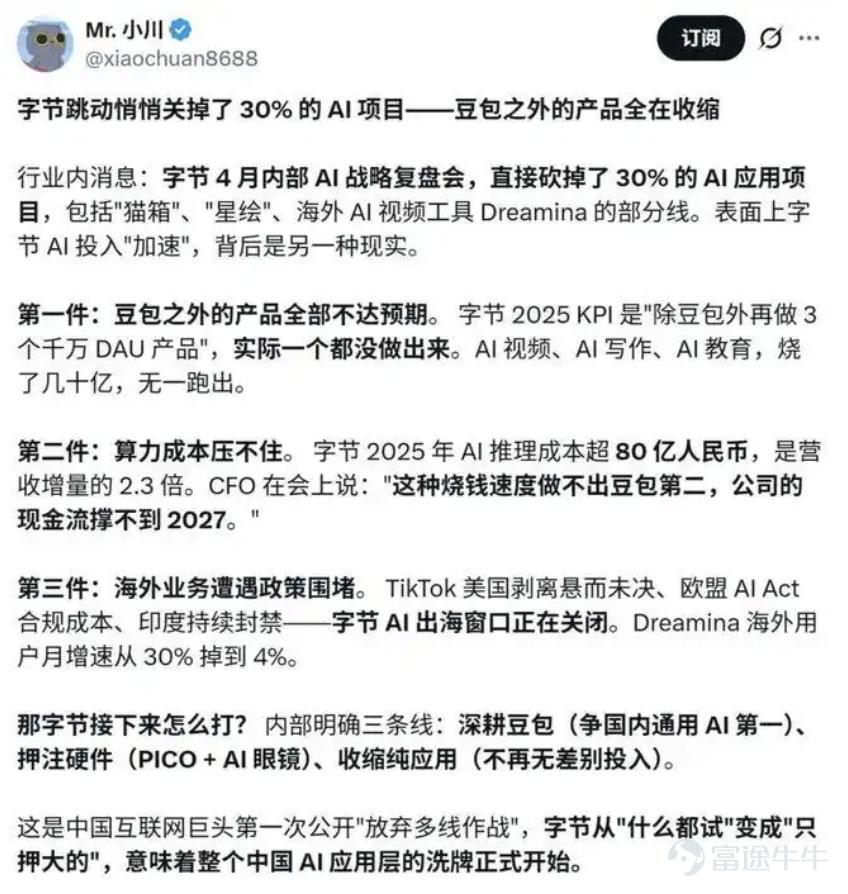
In May this year, a rumor went viral on social media: 'ByteDance quietly cut 30% of its AI projects. Its AI inference costs in 2025 will exceed RMB 8 billion—2.3 times its incremental revenue—and the company’s cash runway won’t last until 2027.'

ByteDance employees responded, calling it 'way too fake' and 'obviously false.' Zheshang Securities estimated ByteDance’s AI infrastructure budget for 2026 to exceed RMB 200 billion. An analogy circulating in the industry makes the absurdity crystal clear: A wealthy man planning to spend RMB 20 million on home renovations sees his utility bill from last month was RMB 80, then announces to his entire family, 'We’re done—we won’t make it to next year.' It’s so ridiculous it doesn’t even require a calculator.
The rebuttal holds water. ByteDance’s revenue scale, cash reserves, and core business fundamentals are all transparent and publicly visible—the claim of a 'cash flow crisis' simply doesn’t hold up. Moreover, the rumor’s assertion about 'cutting 30% of projects' has been confirmed factually incorrect: far from being canceled, products like 'Meng' and 'Dreamina' are currently among ByteDance’s key strategic priorities.
The fake news has been debunked. But if we stop there, we’ll miss the truly important issue.
Although the rumor itself is riddled with flaws, the resonance it triggered across the industry is very real.Yu Bo, founder of YouMind, offered an assessment during this controversy that deserves far more serious attention than the rumor itself: 'Applying internet-era thinking to AI products is a dead end—AI products don’t benefit from economies of scale.' His background gives this statement significant weight. He joined Alibaba in 2008 and spent 15 years within the company, leading the development of Ant Design and Yuque. In 2023, he joined ByteDance as VP of Product for Lark, left after one year, and founded his own AI startup. In a June 2026 exclusive interview with Huxiu, he summed up his past two years as 'de-romanticizing the internet mindset.' Coming from someone who reached P10 at Alibaba, served as Lark’s product VP at ByteDance, and is now building an AI company himself, this observation carries more insight than any analyst report: the challenges facing Doubao today—from 'the more free users it has, the more it loses,' to 'users’ willingness to pay being locked in by free habits,' and 'advertising models failing to work for AI'—all stem directly from the foundational error of 'applying internet-era thinking to AI.'
On June 26, China Entrepreneur magazine published an in-depth report titled 'ByteDance’s AI Dilemma: Sweet Yet Troublesome' (Huxiu also released related analysis on June 29). The title itself offers the answer—both 'sweetness' and 'trouble' abound.
The report revealed two critical data points: Doubao has surpassed 200 million daily active users, yet generates less than RMB 1 million in daily revenue; meanwhile, its large language model processes over 180 trillion tokens per day—an increase of more than 10x year-over-year. When interviewed by China Entrepreneur, a founder in the AI infrastructure space bluntly stated:If Doubao continues its current pace of user growth, its computing power consumption could exhaust ByteDance's resources.
In an interview, Tan Dai, President of Volcano Engine, attempted to downplay such concerns, stating, 'From Volcano Engine’s perspective, we haven’t evaluated our computing power budget; our primary focus is on B2B business.' However, in the same interview, he acknowledged a revealing detail: 'The revenue figures for Seedance circulating externally are all incorrect—and inflated. I’m under immense pressure; finance keeps asking me every day if I’m hiding numbers.'

Even the revenue from its most core and high-profile product line is being scrutinized by the finance team.This might not qualify as a 'cash flow crisis,' but it certainly reflects commercialization anxiety.
More concerning is the shift in ByteDance’s overall financial trajectory. ByteDance is projected to generate approximately $50 billion in profit in 2025, according to insiders familiar with the matter, while its capital expenditures for that year are estimated at around RMB 150 billion. The South China Morning Post reported that its AI infrastructure budget for 2026 exceeds RMB 200 billion—equivalent to roughly 60% of its 2025 profit. Douyin’s annual ad revenue is about RMB 400 billion, which sounds substantial, but AI alone could burn through nearly RMB 200 billion annually. After subtracting TikTok’s overseas investments and operational costs across various business lines, profit margins are being severely compressed.
Meanwhile,Multiple growth engines are simultaneously decelerating.Douyin has reached 1.009 billion monthly active users, up just 14.43% year-over-year, essentially hitting a ceiling; GMV growth for Douyin E-commerce has steadily declined from 320% in 2022 to around 30% in 2025, and is expected to drop further in 2026. Revenue growth is flattening, while cost curves remain steeply upward—what matters now is no longer whether trouble will arise, but how long the company can endure it.
All these figures point to one underlying issue:ByteDance’s spending is accelerating while its revenue growth is slowing down.But this is just the ledger of the entire group and does not directly answer why Doubao needs to charge fees. To truly understand this issue, we must refocus the lens squarely on Doubao itself.
First, consider the revenue side. As of the first half of 2026, the Doubao app generated less than RMB 1 million in daily revenue, primarily from e-commerce commissions—revenue sharing from user purchases made within Doubao. In other words, before the official launch of paid subscriptions on June 24, Doubao’s monetization from end consumers was virtually nonexistent. With 345 million monthly active users generating less than RMB 1 million per day, each user contributed less than RMB 0.003 per day on average.
Now consider the cost side. According to data disclosed at Volcano Engine’s FORCE conference, Doubao’s large language model already exceeds 180 trillion tokens in daily usage. Huxiu’s article 'ByteDance Starts Charging You' cited a CSDN cost breakdown estimating that the blended cost for standard conversational queries is approximately RMB 4 per million tokens, implying a daily cost of roughly RMB 720 million for 180 trillion tokens. Guolian Securities and Minsheng Securities offered more conservative figures; even assuming the cheapest available model, daily costs still range between RMB 130 million and RMB 240 million. Taking a midpoint estimate, annual costs amount to tens of billions of yuan.

This vast gap between revenue and costs constitutes the most immediate rationale for Doubao’s decision to introduce fees.But that’s not all.
An even bigger issue lies in its user composition.QuestMobile data shows that in Q1 2026, new users of AI applications exhibited a dual expansion trend toward both lower-tier cities and older demographics. In analyzing Doubao’s pricing strategy, Huxiu referenced Citi survey data indicating that among Doubao’s 345 million monthly active users, students and middle-aged-to-elderly users constitute the majority. Their usage is largely limited to casual chatting, information lookup, and everyday consultations, with average daily usage under one hour. Meanwhile, professionals—such as office workers, developers, and expert creators—who have high-frequency productivity needs generally find Doubao insufficiently capable and prefer alternatives like ChatGPT, Claude, or domestic options such as Kimi.
That same Citi survey, which covered 1,800 respondents, also revealed a more specific dilemma: 45% of respondents expressed willingness to pay for premium AI features, but their acceptable average monthly price was only RMB 48.30. Doubao’s standard subscription plan starts at RMB 68—about RMB 20 above this psychological price threshold.
This has created a lose-lose situation:Users most willing to pay find Doubao not powerful enough, while its most loyal users have no need for paid features.In plain terms, it’s a case of 'low-end users can’t use it effectively, and high-end users won’t take it seriously.'
This mismatch between user structure and business model is not unfamiliar in ByteDance’s history. In 2020, online education was one of ByteDance’s largest advertising clients. Seeing the scale of the education sector through its ad business data, ByteDance quickly launched Dali Education, hiring 10,000 people through social recruitment in just four months and running over twenty internal projects simultaneously. After China’s 'Double Reduction' policy was introduced in 2021, Dali Education hastily laid off staff, wrapping up with 'N+2 severance packages and yellow farewell boxes.' ByteDance saw the market size in its ad data but underestimated the barriers to actually entering that market.
The AI sector is now replaying a similar logic—but with the problem reversed. The barriers in the education sector were regulatory and operational; ByteDance had traffic and capital but simply didn’t have time to cross those hurdles. In contrast, the barriers in AI lie in technology and product. ByteDance’s large-model capabilities aren’t weak, but its ingrained commercial playbook—user acquisition through free access followed by monetization via ads—simply doesn’t work in AI. Professor Wang Xiaojie of Beijing University of Posts and Telecommunications put it bluntly in an interview with Huxiu: 'It’s extremely hard to find a suitable entry point for AI advertising; the slightest misstep could be perceived as data poisoning.' When users ask AI to draft reports or create PowerPoint slides, you can’t just pop up a 'Recommended for You' ad.

Across the industry, companies that have truly achieved commercial success in AI have taken entirely different paths. According to an in-depth review by TMTPost, Anthropic’s enterprise adoption rate reached 34.4% in April 2026, surpassing OpenAI for the first time. Its annual recurring revenue (ARR) soared to $45 billion, with over 80% coming from enterprise services. OpenAI has 900 million weekly active users, yet its paid conversion rate is under 6%, and it spends $1.60 to $2.25 for every dollar of revenue generated. Sam Altman has acknowledged that the $200-per-month Pro subscription remains unprofitable.
The divergence is even starker domestically. According to an analysis by The Paper, Alibaba’s Qwen is deeply embedded in Alibaba Cloud and its e-commerce ecosystem, while Tencent’s Yuanbao leverages WeChat’s social and payment infrastructure. Neither relies on direct consumer subscriptions for monetization. So far, Kimi is the only domestic player that has achieved meaningful results in C-end subscriptions—by 'doing less and filtering users,' it reached $200 million in ARR in April.
Baidu’s ERNIE Bot has taken a path worth examining separately. In November 2023, just eight months after ERNIE Bot’s launch, Baidu introduced a professional version priced at RMB 59.9 per month, becoming the first domestic large model to charge consumers directly. This timing was significant. At the time, China’s large-model sector was still in a frenzy of 'competing on free quotas, parameter counts, and user growth,' with burning cash for growth as the dominant narrative. Baidu went against the grain by erecting a paywall at the earliest possible stage. When reviewing this decision, Haibao News summarized it as capturing 'first-mover premium': from day one, Baidu differentiated between genuine AI users and mere curiosity-driven experimenters—if someone truly had ongoing needs for an AI product rather than just dabbling, they were likely willing to pay.
In hindsight, this logic proved prescient. In the early days of AI—when compute costs were extremely high and business models completely uncertain—offering free access meant each additional user added to losses. By introducing paid access early, Baidu filtered out casual traffic and retained users who genuinely needed the tool and were willing to pay for productivity. This acted both as a barrier to prevent wasteful compute consumption and as a mechanism to lock in the most valuable users early. In February 2025, facing pressure from DeepSeek’s free strategy, Baidu announced that ERNIE Bot would become fully free starting April 1, with refunds issued to existing paying users. However, this refund wasn’t a repudiation of the original pricing strategy but rather a deliberate pivot after completing its initial mission.
This contrast is key to understanding Doubao’s new pricing. Baidu’s decision to charge was a strategic, proactive choice made during the product’s early stage and the industry’s hype phase—it clearly drew a line: who is my user, and who isn’t.Doubao’s move to charge, however, is a reactive measure driven by plateauing user growth and exploding cost pressures.—only starting to calculate costs when it absolutely had to. On the surface, both involve charging end consumers, but their underlying logics are fundamentally different: one filters first and then serves; the other offers free access first and then monetizes. That’s why Baidu’s RMB 59.9 price tag seemed expensive at the time but now appears restrained in retrospect, whereas Doubao’s RMB 68 price isn’t objectively high today—but for users accustomed to three years of free access, every yuan represents a psychological hurdle.
DeepSeek’s API pricing adds the final note to this comparison. DeepSeek V4-Pro has announced permanent pricing at a 75% discount, with output costing just RMB 6 per million tokens and cached input as low as RMB 0.025. By contrast, Volcano Engine has disclosed that Doubao 2.1 Pro charges RMB 30 per million output tokens and RMB 1.2 for cached input. The cost difference for equivalent tasks ranges from 5x to as high as 60x. DeepSeek previously reported an inference cost profit margin of up to 545%—though that figure applied to V3/R1, its technical efficiency advantage has carried over to V4-Pro, indicating this pricing reflects genuine cost advantages rather than subsidized losses. For Doubao users, a stark choice now exists: pay RMB 68 per month for Doubao, or spend far less to integrate DeepSeek’s API into other applications? When user switching costs approach zero, such a price gap is hard to justify with 'ecosystem' or 'brand' alone.
Against this backdrop, Doubao's position becomes very clear. It lacks Anthropic’s strong enterprise-service DNA, doesn’t have the massive ecosystems that Qwen and Yuanbao can rely on, and hasn’t yet achieved the precise product-market fit that Kimi already enjoys. With 345 million monthly active users, average daily usage is under an hour, willingness to pay is concentrated below RMB 50, and power users still find it insufficiently powerful. Under these circumstances, Doubao’s decision to introduce paid features appears less like a validated business model and more like a necessary step toward testing one.
Back to the core question: does ByteDance really face commercialization pressure?
My assessment is:It hasn’t reached the point of a 'cash flow crisis,' but growth anxiety is real.
ByteDance remains one of China’s most profitable internet companies. Its cash reserves are sufficient to sustain AI investments for many years to come—there’s no risk of 'not making it to 2027.'
But 'having money' and 'having a working business model' are two different things. Doubao generates less than RMB 1 million in daily revenue, while its daily computing costs run into tens or even hundreds of millions. Volcano Engine’s B2B business is indeed growing—the MaaS Token market share has reached 49.5%, and there were earlier market rumors that Seedance alone exceeded RMB 1 billion in monthly revenue. However, Tan Dai himself has stated that figure was inflated, and B2B growth still lags far behind the surging inference costs on the consumer side.

The real issue is this:Every bit of growth comes at a cost—but the cost is rising faster than the growth itself.
ByteDance’s commercial DNA has long been built on a 'traffic tax'—aggregating massive user attention and charging advertisers who need that attention. This model was unbeatable in the mobile internet era. But in the AI era, the core cost has shifted to electricity and depreciation of GPU clusters, and marginal costs per product are rising rather than falling. The old internet mantra of 'more users → lower costs' has been replaced by 'more users → greater losses.' ByteDance’s entire business model needs to be rebuilt.
Doubao’s move to charge users is the first step in this reconstruction.
The article opens with a question: Is Doubao’s move to charge users a strategic monetization effort or a desperate attempt to stem losses?
The truth likely lies somewhere in between. On one hand, it is indeed a strategic push—ByteDance is actively exploring new avenues: the professional office-task mode has integrated Doubao 2.1 Pro, Seedance 2.5 is about to launch, and ByteDance’s Volcano Engine MaaS (Model-as-a-Service) business is gaining strong traction among enterprise clients. On the other hand, there’s undeniable pressure: Doubao reportedly generates less than RMB 1 million in daily revenue against daily costs running into tens or even hundreds of millions—a gap that won’t close on its own.
But the more critical judgment may lie on another level. According to multiple media outlets citing informed sources, Doubao will not prioritize paid-user penetration rate as a core performance metric in 2026. This detail speaks louder than the pricing scheme itself: ByteDance isn’t counting on subscriptions to instantly erase its deficits. Instead, it’s conducting a cautious commercial trial—to test whether Chinese users are willing to pay for an AI assistant, how much they’d pay, and whether they’ll renew after purchasing.
The outcome of this trial matters beyond just Doubao as a single product. It’s testing whether ByteDance can forge a new path beyond its traditional ‘traffic-for-ads’ model. User growth has plateaued, ad revenue growth is slowing, and the cost structure of AI is the exact opposite of mobile internet economics—Doubao’s decision to charge users is ByteDance’s first answer to this challenge. The grade? Watch the renewal rate.
Risk Disclaimer: The above content only represents the author's view. It does not represent any position or investment advice of Futu. Futu makes no representation or warranty.Read more
Comments
to post a comment