
Converging tides of innovation ignite the future; the Internet Conference reshapes a new paradigm for industrial development
As the pivotal first year of China’s 15th Five-Year Plan, the 25th China Internet Conference—themed 'Intelligent Beginnings, Integrated Innovation for the Future'—was held from July 8 to 10 at the China National Convention Center in Beijing. Centered on core missions of digital-intelligent technological innovation and integration of digital and physical economies, the conference established a high-level industry platform to advance the building of a cyberpower, a digital China, and the cultivation of new-quality productive forces.
Amid the confluence of a once-in-a-century transformation and the digital wave, internet, artificial intelligence, big data, and other digital-intelligent technologies are deeply empowering countless industries, serving as the core engine driving high-quality economic and social development. From interconnectivity in computing power networks to real-world AI application deployment, from innovations in e-commerce and short-video business models to the construction of comprehensive cybersecurity frameworks, China's internet industry is accelerating its shift from traffic-driven to technology-driven growth and from isolated development toward integrated coexistence.
Positioned at a new stage of industrial development, this year’s conference directly addresses challenges in technological innovation, business model upgrading, and security. Through in-depth discussions on key issues, sharing of cutting-edge achievements, and forging consensus on development pathways, it aims to unlock greater value from the internet industry in cultivating new-quality productive forces and enhancing the quality and efficiency of the digital economy.
Artificial Intelligence Strengthens Foundational Support through Interconnected Computing Power and Activates New-Quality Productive Forces via Real-World Application Scenarios
As the core engine of new-quality productivity, artificial intelligence is a central focus of this year’s conference, showcasing clear characteristics: a continuously solidified computing infrastructure, accelerated technological iteration and breakthroughs, and widespread deployment across application scenarios. AI is transitioning from a laboratory technology to deep integration with the real economy, becoming a key driver of industrial upgrading.
This year’s conference prominently unveiled a comprehensive standards system for interconnected computing power and introduced an operational framework for millisecond-level metropolitan computing resource scheduling. These initiatives directly address long-standing industry pain points—fragmented computing resources and inefficient allocation—and lay a solid foundation for the industrial-scale adoption of AI.
The establishment of an interconnected computing power system marks China’s entry into a new phase of standardized and coordinated AI infrastructure development. With these unified standards now implemented, servers, AI chips, and data center equipment from different vendors can be interoperably scheduled—enabling nationwide computing resources to be allocated as seamlessly as electricity. This directly drives new demand across the entire supply chain, including computing power switches, high-speed optical transmission hardware, and computing orchestration software. Concurrently, the rollout of the '1+M+N' three-tier computing node system is advancing, with over 60 computing infrastructure tender projects valued at hundreds of millions of yuan already launched this year, clearly signaling tangible industry growth.
The large-scale deployment of AI application scenarios demonstrates the technology’s robust capacity to empower countless industries. This year’s interactive tech exhibition spotlighted cutting-edge domains such as AI agents, multimodal interaction, and industrial AI implementation, presenting innovative AI applications across diverse sectors including education and innovation, local services, digital marketing, and enterprise solutions.
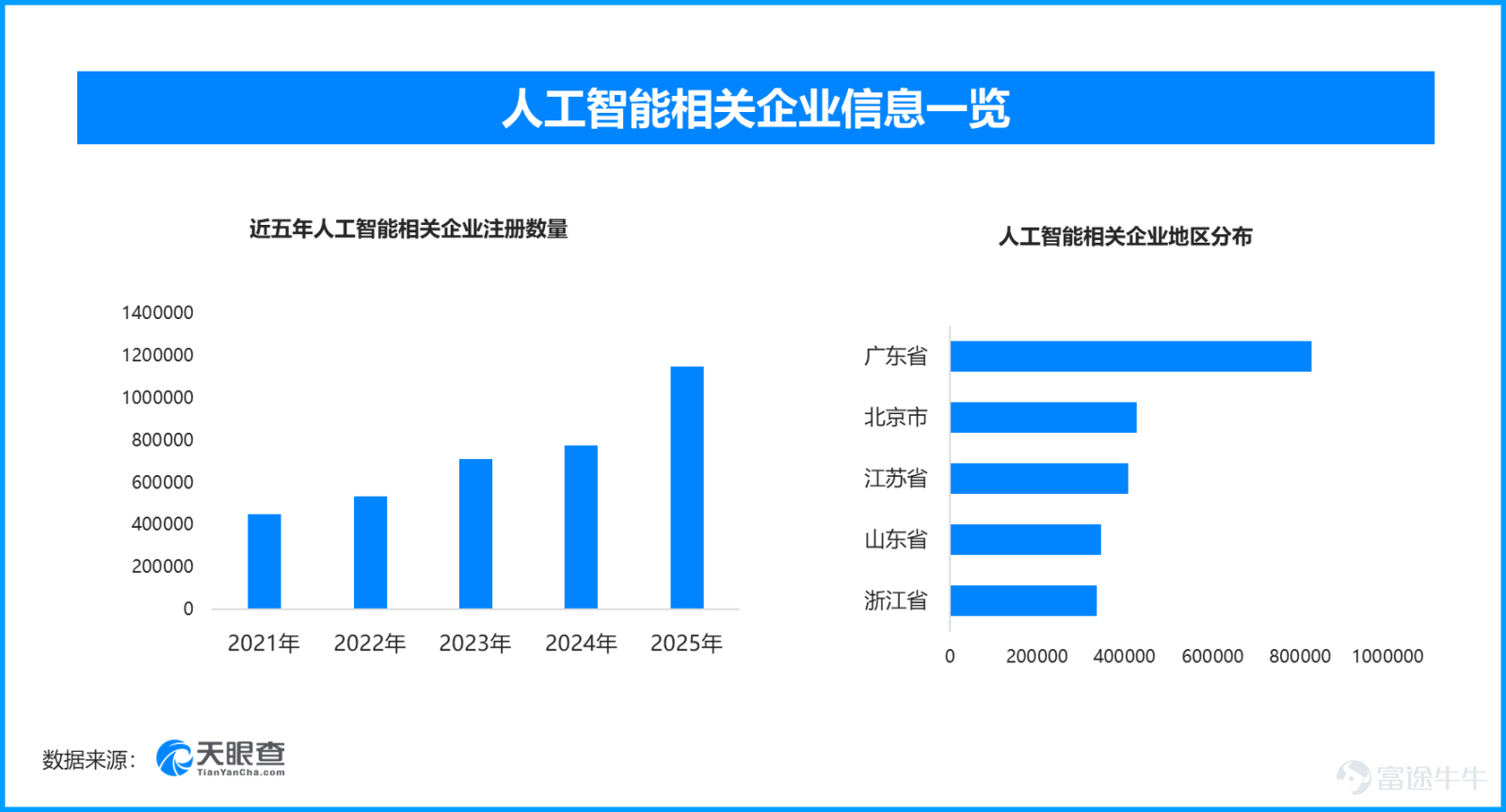
According to Tianyancha Professional Edition data, as of now, there are more than 5.323 million active and operational AI-related enterprises in China. Of these, approximately 472,000 new AI-related enterprises have been registered so far in 2026. Looking at registration trends over the past five years, the number of newly registered AI-related enterprises has grown annually, peaking in 2025.
In terms of regional distribution, Guangdong Province, Beijing Municipality, and Jiangsu Province lead the nation in the number of artificial intelligence-related enterprises, with more than 825,000, 427,000, and 408,000 enterprises respectively. Following closely behind are Shandong Province and Zhejiang Province.
In manufacturing, AI optimizes production lines to boost efficiency; in healthcare, it aids precise diagnosis and treatment; in finance, it enhances risk control and security; and in education, it enables personalized, adaptive learning. AI is evolving from a flashy concept into a practical tool, delivering tailored solutions that meet the specific needs of different sectors and driving deeper digital and intelligent transformation across the real economy.
E-commerce and short-form video platforms are reshaping consumer pathways through content innovation and unlocking new growth opportunities by integrating digital and physical economies.
As core vehicles of digital consumption, e-commerce and short-form video showcased strong momentum at this year’s conference, marked by deep integration of content and commerce and synergistic innovation between technology and business models. They are rapidly evolving from traditional traffic-driven e-commerce toward content-based, interest-driven, and omnichannel e-commerce, continuously unlocking digital consumption potential and reshaping competitive dynamics across the industry.
This year’s conference featured in-depth discussions on AI-powered digital consumption, content ecosystem innovation, and compliant e-commerce development, with a focus on critical areas such as monetizing short-video traffic, enhancing live-streaming e-commerce efficiency, and achieving breakthroughs in cross-border e-commerce—offering fresh perspectives for the sector’s high-quality development.
The refinement and intelligent enhancement of short-form video content have become key drivers of e-commerce conversion. As AI becomes deeply embedded in content creation, short-video production is shifting away from crude, homogenized approaches toward a new era of precision, personalization, and efficiency. AI-generated content enables rapid production of diverse video styles, intelligent editing tools significantly lower creative barriers, and big data analytics accurately capture user preferences—ensuring precise alignment between content creation and audience demand.
High-quality short video content combines entertainment, knowledge, and practicality—it captures user attention, enhances user engagement, and seamlessly integrates product information to stimulate purchasing desire, forming a complete pathway from 'content-driven discovery' to 'interest ignition' and finally to 'consumption conversion,' positioning short videos as a core entry point for e-commerce traffic.
The diversified evolution of e-commerce models and the integration of digital and physical economies continue to expand industrial growth boundaries. Livestream e-commerce is continuously upgrading, evolving from early influencer-led streams toward diverse formats such as brand-owned livestreams, origin-based livestreams, and virtual livestreams. AI-powered virtual hosts enable 24/7 broadcasting, while big data-driven product selection precisely matches market demand, driving livestream e-commerce’s transition from traffic-driven gains to quality and efficiency dividends.
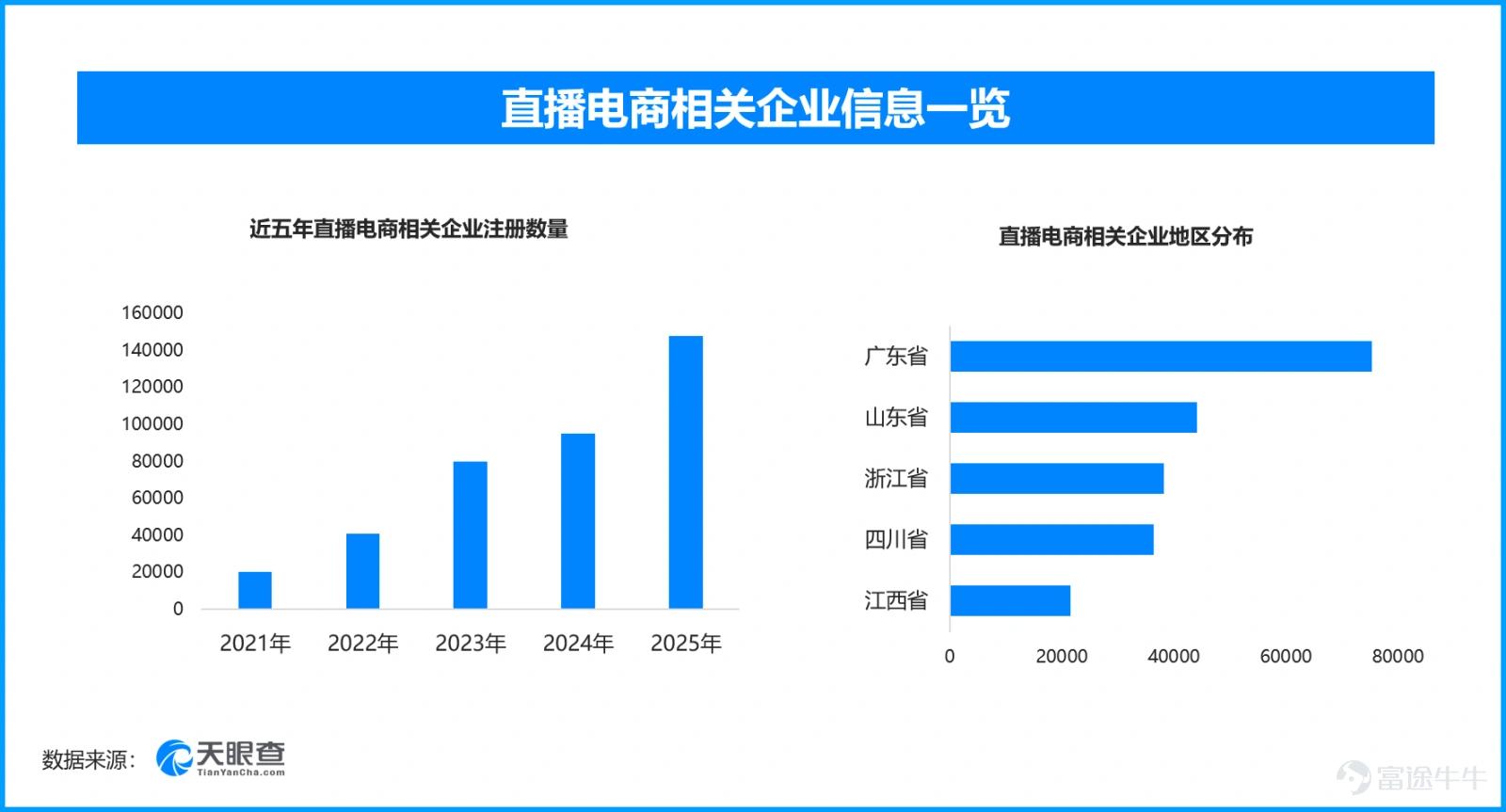
According to Tianyancha Professional Edition data, as of now, there are over 521,000 live-streaming e-commerce-related enterprises in active or ongoing operational status across China. Of these, approximately 83,000 new enterprises were registered in 2026 to date. Looking at registration trends over the past five years, the number of newly registered live-streaming e-commerce-related enterprises has grown steadily year-over-year, peaking in 2025.
In terms of regional distribution, Guangdong Province, Shandong Province, and Zhejiang Province lead the country in the number of live-streaming e-commerce-related enterprises, with more than 75,000, 44,000, and 38,000 such enterprises, respectively.
Interest-based e-commerce leverages precise short video content distribution centered on user preferences, shifting the paradigm from 'people searching for products' to 'products finding people,' thereby unlocking the consumption potential of niche goods. Meanwhile, cross-border e-commerce breaks geographical barriers through digital technologies, with short video content supporting Chinese brands’ global expansion. The integration of digital and physical elements enables seamless connectivity between online consumption and offline experiences, building a new ecosystem for omnichannel retail.
Cybersecurity safeguards digital development through systematic architecture and fortifies a new industrial security barrier via technological innovation.
Against the backdrop of rapid iteration in digital technologies and continuous realization of data value, cybersecurity has become the foundational guarantee for the healthy development of the internet industry. This year’s conference elevates cybersecurity to a strategic priority, focusing on critical issues such as agent security, data security, personal information protection, and cyber legal frameworks—demonstrating a clear commitment to advancing comprehensive security through technological defense, institutional safeguards, and ecosystem collaboration. As AI, big data, cloud computing, and other technologies are widely adopted, cybersecurity risks are becoming increasingly intelligent, stealthy, and complex, making it urgent to establish an all-encompassing, multi-layered, and integrated cybersecurity system.
Agent security and data security have become the core focal points of current cybersecurity defenses. This year’s conference features a dedicated forum on agent security, delving into the security risks and governance pathways associated with the application of agent technologies. As intelligent agents move from virtual environments into real-world settings, their autonomous decision-making and collaborative capabilities, while enhancing efficiency, also introduce security concerns such as data leakage, malicious manipulation, and challenges in liability attribution.
On data security, the focus lies on key issues including compliant data circulation, data privacy protection, and data governance. Leveraging updated compliance guidelines for data flow released at the conference, regions across the country are accelerating the implementation of industry-specific data lakes and data security protection systems—ensuring lawful data movement and unlocking data value while rigorously preventing data security risks.
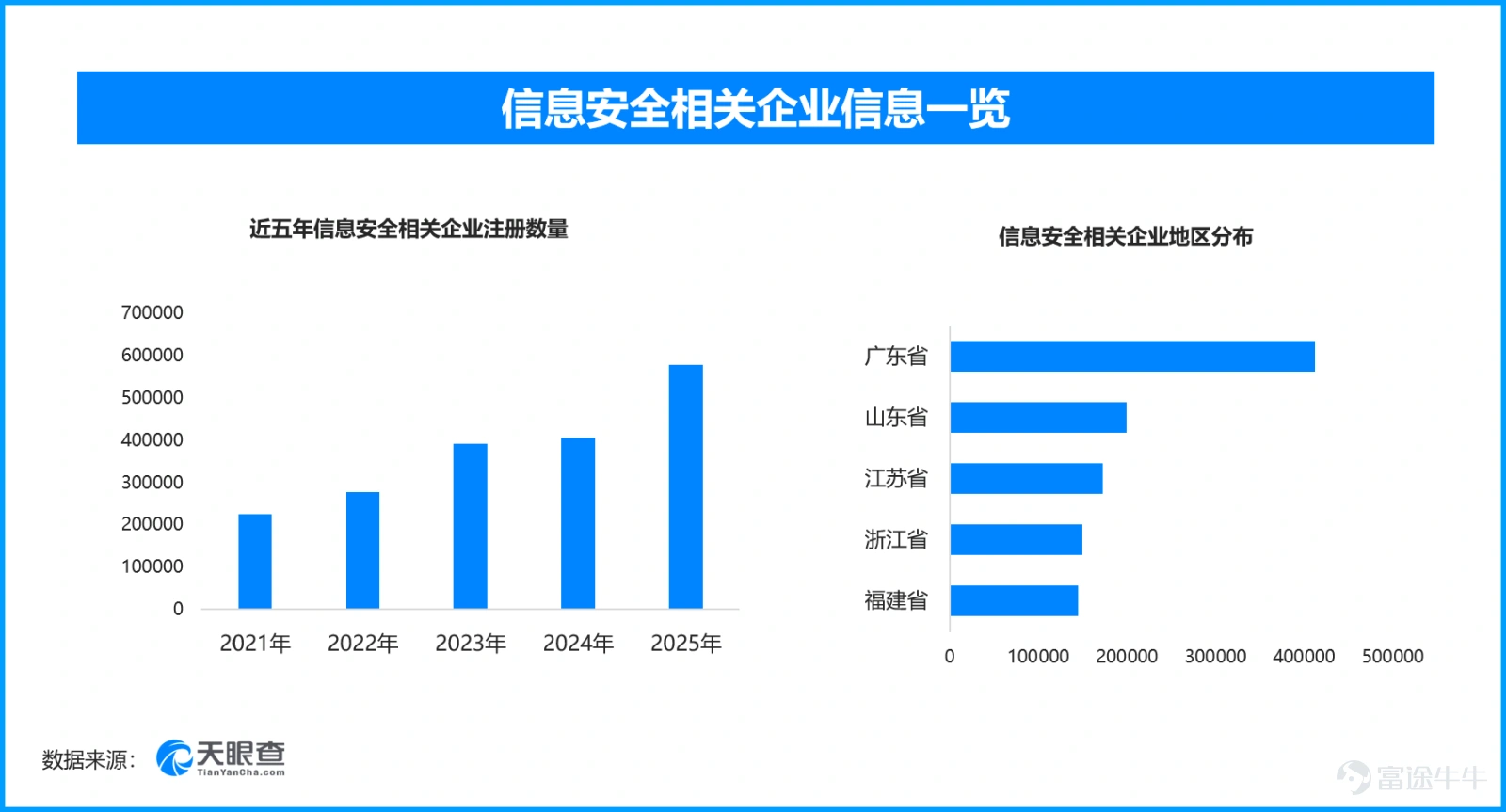
According to Tianyancha Professional Edition data, as of now, there are over 2.658 million active enterprises in China engaged in information security-related businesses. Among them, approximately 303,000 new enterprises in this sector have been registered so far in 2026. Looking at enterprise registration trends over the past five years, the number of newly registered information security-related enterprises has shown steady annual growth, peaking in 2025.
In terms of regional distribution, Guangdong Province leads the nation with over 412,000 information security-related enterprises, accounting for 15.5% of the national total. It is followed by Shandong, Jiangsu, Zhejiang, and Fujian provinces.
Continuous innovation in cybersecurity technology and ecosystem collaboration consistently enhance security protection capabilities. In response to emerging cyber threats such as AI-powered bot armies, 'keyboard-triggered corporate damage,' and cyberattacks, the industry is intensifying R&D investment and deepening the integration of security technologies with cutting-edge fields like AI and big data.
AI-powered security detection systems can identify malicious content, anomalous traffic, and attack behaviors in real time, enabling proactive defense and precise response; blockchain technology provides reliable assurance for data notarization and traceability; and zero-trust architecture establishes a security model based on 'never trust, always verify.' Meanwhile, governments, enterprises, and industry associations are working in concert to improve the legal and regulatory framework for cybersecurity, strengthen industry self-discipline and compliance, and promote public cybersecurity awareness and education—thereby building a comprehensive cybersecurity ecosystem integrating technical safeguards, institutional constraints, and Q&M Dental participation, which safeguards the high-quality development of the internet industry.
Overall, the 25th China Internet Conference, held at the outset of the 15th Five-Year Plan period, demonstrates the internet industry’s coordinated progress in technological innovation, business model upgrading, and security reinforcement. Key strategic sectors are mutually reinforcing and advancing in synergy, accelerating the industry’s shift from scale expansion to quality enhancement and from traffic-driven growth to value creation. This dynamic is injecting strong momentum into building a cyberpower and a Digital China, propelling the digital economy toward a new phase of higher-quality development.
Risk Disclaimer: The above content only represents the author's view. It does not represent any position or investment advice of Futu. Futu makes no representation or warranty.Read more
Comments
to post a comment